Graphical abstract template · Metal–organic frameworks · Reticular design · Bottom-up
Isoreticular MOFs: one net, designed pores
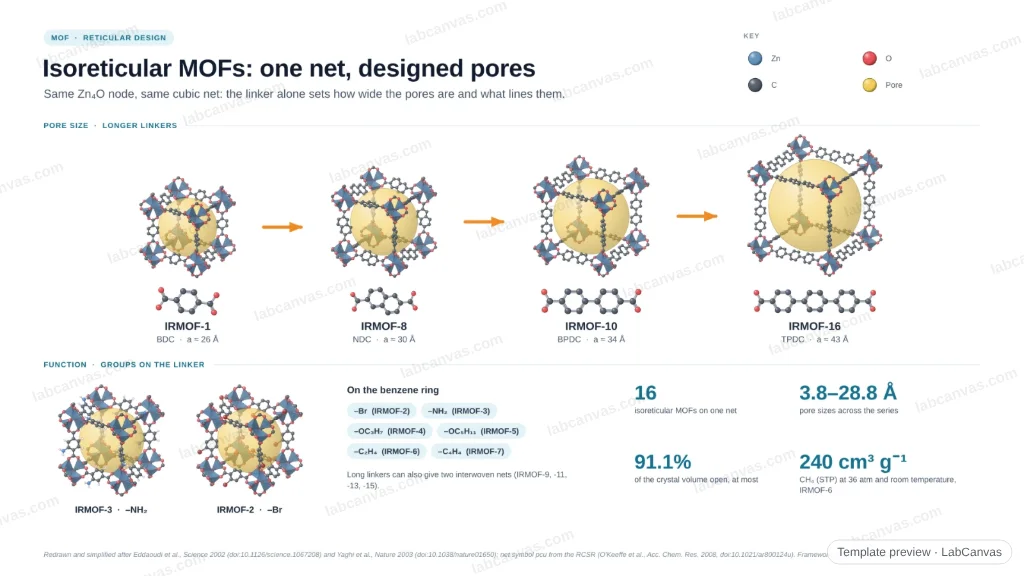
Keeping the Zn₄O node and the cubic net of MOF-5 while changing only the linker gave a series of 16 isoreticular frameworks (IRMOFs): longer struts (naphthalene, biphenyl, terphenyl…) widen the pores step by step, and groups on the benzene ring (–Br, –NH₂, alkoxy, fused rings) change what lines them. Open space reaches 91.1% of the crystal and the pores run from 3.8 to 28.8 Å.
Updated 3 cited papers63 editable layers
At a glance
- Category
- Metal–organic frameworks
- Method
- Reticular design
- Approach
- Bottom-up
- Starting materials
- Zinc nitrate and a dicarboxylic acid (BDC, a substituted BDC, NDC, BPDC, TPDC…) in N,N-diethylformamide
- Product
- Cubic Zn₄O(linker)₃ frameworks on the same (pcu) net, with designed pore sizes and pore linings
- Typical size
- Cell edges ≈ 26 Å (IRMOF-1), 30 Å (IRMOF-8), 34 Å (IRMOF-10) and 43 Å (IRMOF-16)
- Key result
- 16 crystalline IRMOFs; open space up to 91.1% of the crystal volume; pores from 3.8 to 28.8 Å (Eddaoudi et al. 2002)
- Figure
- 1920 × 1080 px (16:9), 63 editable layers, 10 generated objects
Step by step
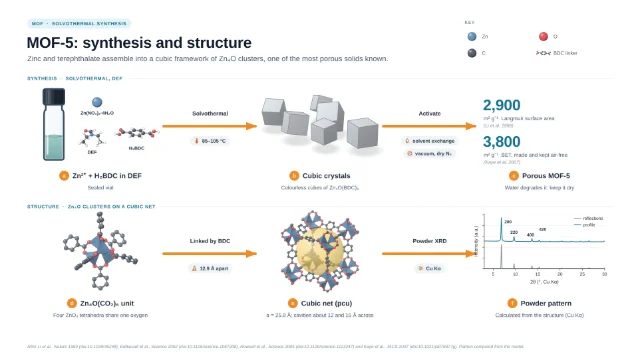
- Same nodeZn₄O(CO₂)₆ clusters form with each linker under the MOF-5 conditions (DEF, 85–105 °C)
- ExpandLonger struts (naphthalene, biphenyl, tetrahydropyrene, pyrene, terphenyl) widen the pores
- Functionalize–Br, –NH₂, –OC₃H₇, –OC₅H₁₁, –C₂H₄ or –C₄H₄ on the benzene ring line the pores (IRMOF-2 to -7)
- InterpenetrationLong linkers can also give two interwoven nets (IRMOF-9, -11, -13, -15)
Strengths
- Pore size and pore chemistry set by design
- One synthesis for the whole series
- A clear test of reticular design
Limitations
- Zinc carboxylate nodes are sensitive to moisture
- Long linkers favour interpenetrated nets
Uses
- Methane and hydrogen storage
- Designed pores for separations
- Teaching reticular chemistry
Papers this template follows
- Eddaoudi et al., “Systematic Design of Pore Size and Functionality in Isoreticular MOFs and Their Application in Methane Storage”, Science 2002. doi:10.1126/science.1067208primary
- Yaghi et al., “Reticular synthesis and the design of new materials”, Nature 2003. doi:10.1038/nature01650review
- O'Keeffe et al., “The Reticular Chemistry Structure Resource (RCSR) Database of, and Symbols for, Crystal Nets”, Acc. Chem. Res. 2008. doi:10.1021/ar800124ufurther reading
Redrawn and simplified after Eddaoudi et al., Science 2002 (doi:10.1126/science.1067208) and Yaghi et al., Nature 2003 (doi:10.1038/nature01650); net symbol pcu from the RCSR (O'Keeffe et al., Acc. Chem. Res. 2008, doi:10.1021/ar800124u). Frameworks drawn to one scale.
How templates are written and checked: editorial guidelines.
Questions
What does the “Isoreticular MOFs: one net, designed pores” template show?
Keeping the Zn₄O node and the cubic net of MOF-5 while changing only the linker gave a series of 16 isoreticular frameworks (IRMOFs): longer struts (naphthalene, biphenyl, terphenyl…) widen the pores step by step, and groups on the benzene ring (–Br, –NH₂, alkoxy, fused rings) change what lines them. Open space reaches 91.1% of the crystal and the pores run from 3.8 to 28.8 Å.
What are the steps shown in “Isoreticular MOFs: one net, designed pores”?
1. Same node: Zn₄O(CO₂)₆ clusters form with each linker under the MOF-5 conditions (DEF, 85–105 °C). 2. Expand: Longer struts (naphthalene, biphenyl, tetrahydropyrene, pyrene, terphenyl) widen the pores. 3. Functionalize: –Br, –NH₂, –OC₃H₇, –OC₅H₁₁, –C₂H₄ or –C₄H₄ on the benzene ring line the pores (IRMOF-2 to -7). 4. Interpenetration: Long linkers can also give two interwoven nets (IRMOF-9, -11, -13, -15).
What are the starting materials and the product?
Starting materials: Zinc nitrate and a dicarboxylic acid (BDC, a substituted BDC, NDC, BPDC, TPDC…) in N,N-diethylformamide. Product: Cubic Zn₄O(linker)₃ frameworks on the same (pcu) net, with designed pore sizes and pore linings.
Which papers is “Isoreticular MOFs: one net, designed pores” based on?
Eddaoudi et al., “Systematic Design of Pore Size and Functionality in Isoreticular MOFs and Their Application in Methane Storage”, Science 2002 (doi:10.1126/science.1067208); Yaghi et al., “Reticular synthesis and the design of new materials”, Nature 2003 (doi:10.1038/nature01650); O'Keeffe et al., “The Reticular Chemistry Structure Resource (RCSR) Database of, and Symbols for, Crystal Nets”, Acc. Chem. Res. 2008 (doi:10.1021/ar800124u).
Can I edit the “Isoreticular MOFs: one net, designed pores” template?
Yes. Open it in the LabCanvas editor: all 63 layers are editable, including 10 generated objects (structures, plots, equipment) with their own settings. Change the text, colours and layout, then export PNG, TIFF, SVG or PDF.
Do I need an account to use this template?
Not to view it here. To open and edit it, sign in to LabCanvas or create a free account (the free plan keeps one design of each kind). Downloading the figure is part of LabCanvas Pro (US$19 a month or US$199 a year).