Graphical abstract template · Metal–organic frameworks · Characterization · Bottom-up
Characterizing a new MOF
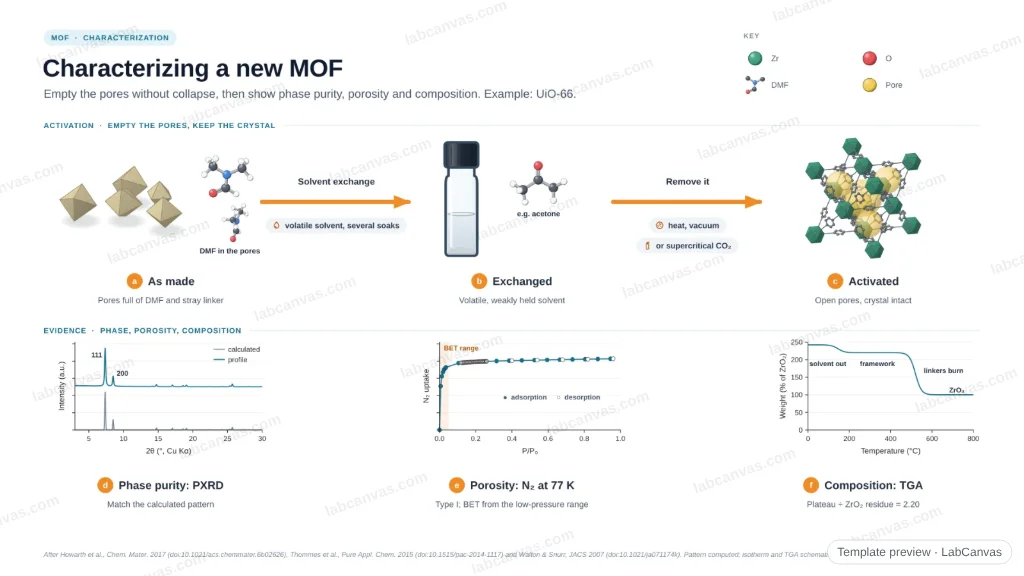
A new framework is only as good as its evidence. Solvent has to leave the pores without the crystal collapsing; then the powder pattern shows the bulk is the phase solved from the crystal structure, a nitrogen isotherm at 77 K shows the pores are open (a type I curve for a microporous MOF, with the BET area taken from the low-pressure range that meets the consistency criteria), and thermogravimetry shows the composition. Drawn here for UiO-66.
Updated 4 cited papers75 editable layers
At a glance
- Category
- Metal–organic frameworks
- Method
- Characterization
- Approach
- Bottom-up
- Starting materials
- An as-made MOF with solvent in its pores (here UiO-66, made in DMF)
- Product
- An activated, characterized framework: phase purity, porosity and composition
- Key result
- Report what supports permanent porosity: PXRD after activation, the isotherm with its BET range, and TGA
- Figure
- 1920 × 1080 px (16:9), 75 editable layers, 10 generated objects
Step by step
- Solvent exchangeHigh-boiling synthesis solvent (DMF) replaced by a volatile one over several soaks
- ActivationSolvent removed by heating under vacuum, or by supercritical CO₂ drying for fragile frameworks (Howarth et al. 2017)
- PXRDMeasured powder pattern compared with the one calculated from the crystal structure; UiO-66: 111 at 7.4°, 200 at 8.5° 2θ (Cu Kα)
- N₂ at 77 KType I isotherm for micropores; BET area from the low-pressure range that meets the consistency criteria (Walton & Snurr 2007; Thommes et al. 2015)
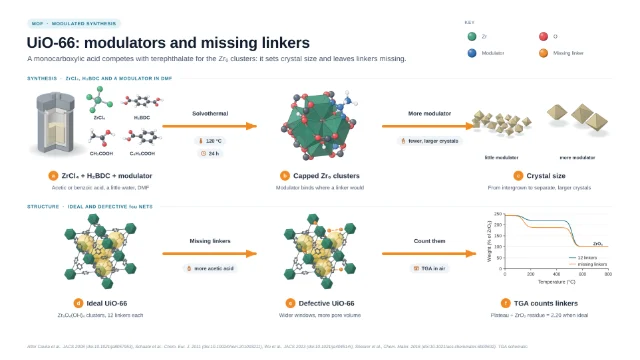
- TGAIn air: solvent loss, then the linkers burn to ZrO₂; for Zr₆O₆(BDC)₆ the plateau is 2.20 × the residue
Strengths
- Three quick measurements cover structure, porosity and composition
- Calculated patterns and formula masses make the checks quantitative
Limitations
- BET areas of microporous MOFs depend on the pressure range chosen
- Collapse on activation can hide behind a good as-made pattern
Uses
- Any new or newly made MOF
- Batch-to-batch quality control
Papers this template follows
- Howarth et al., “Best Practices for the Synthesis, Activation, and Characterization of Metal–Organic Frameworks”, Chem. Mater. 2017. doi:10.1021/acs.chemmater.6b02626review
- Thommes et al., “Physisorption of gases, with special reference to the evaluation of surface area and pore size distribution (IUPAC Technical Report)”, Pure Appl. Chem. 2015. doi:10.1515/pac-2014-1117method origin
- Walton & Snurr, “Applicability of the BET Method for Determining Surface Areas of Microporous Metal−Organic Frameworks”, J. Am. Chem. Soc. 2007. doi:10.1021/ja071174kfurther reading
- Valenzano et al., “Disclosing the Complex Structure of UiO-66 Metal Organic Framework: A Synergic Combination of Experiment and Theory”, Chem. Mater. 2011. doi:10.1021/cm1022882further reading
After Howarth et al., Chem. Mater. 2017 (doi:10.1021/acs.chemmater.6b02626), Thommes et al., Pure Appl. Chem. 2015 (doi:10.1515/pac-2014-1117) and Walton & Snurr, JACS 2007 (doi:10.1021/ja071174k). Pattern computed; isotherm and TGA schematic.
How templates are written and checked: editorial guidelines.
Questions
What does the “Characterizing a new MOF” template show?
A new framework is only as good as its evidence. Solvent has to leave the pores without the crystal collapsing; then the powder pattern shows the bulk is the phase solved from the crystal structure, a nitrogen isotherm at 77 K shows the pores are open (a type I curve for a microporous MOF, with the BET area taken from the low-pressure range that meets the consistency criteria), and thermogravimetry shows the composition. Drawn here for UiO-66.
What are the steps shown in “Characterizing a new MOF”?
1. Solvent exchange: High-boiling synthesis solvent (DMF) replaced by a volatile one over several soaks. 2. Activation: Solvent removed by heating under vacuum, or by supercritical CO₂ drying for fragile frameworks (Howarth et al. 2017). 3. PXRD: Measured powder pattern compared with the one calculated from the crystal structure; UiO-66: 111 at 7.4°, 200 at 8.5° 2θ (Cu Kα). 4. N₂ at 77 K: Type I isotherm for micropores; BET area from the low-pressure range that meets the consistency criteria (Walton & Snurr 2007; Thommes et al. 2015). 5. TGA: In air: solvent loss, then the linkers burn to ZrO₂; for Zr₆O₆(BDC)₆ the plateau is 2.20 × the residue.
What are the starting materials and the product?
Starting materials: An as-made MOF with solvent in its pores (here UiO-66, made in DMF). Product: An activated, characterized framework: phase purity, porosity and composition.
Which papers is “Characterizing a new MOF” based on?
Howarth et al., “Best Practices for the Synthesis, Activation, and Characterization of Metal–Organic Frameworks”, Chem. Mater. 2017 (doi:10.1021/acs.chemmater.6b02626); Thommes et al., “Physisorption of gases, with special reference to the evaluation of surface area and pore size distribution (IUPAC Technical Report)”, Pure Appl. Chem. 2015 (doi:10.1515/pac-2014-1117); Walton & Snurr, “Applicability of the BET Method for Determining Surface Areas of Microporous Metal−Organic Frameworks”, J. Am. Chem. Soc. 2007 (doi:10.1021/ja071174k); Valenzano et al., “Disclosing the Complex Structure of UiO-66 Metal Organic Framework: A Synergic Combination of Experiment and Theory”, Chem. Mater. 2011 (doi:10.1021/cm1022882).
Can I edit the “Characterizing a new MOF” template?
Yes. Open it in the LabCanvas editor: all 75 layers are editable, including 10 generated objects (structures, plots, equipment) with their own settings. Change the text, colours and layout, then export PNG, TIFF, SVG or PDF.
Do I need an account to use this template?
Not to view it here. To open and edit it, sign in to LabCanvas or create a free account (the free plan keeps one design of each kind). Downloading the figure is part of LabCanvas Pro (US$19 a month or US$199 a year).