Graphical abstract template · Metal–organic frameworks · CO₂ capture · Bottom-up
Mg-MOF-74: open metal sites for CO₂ capture
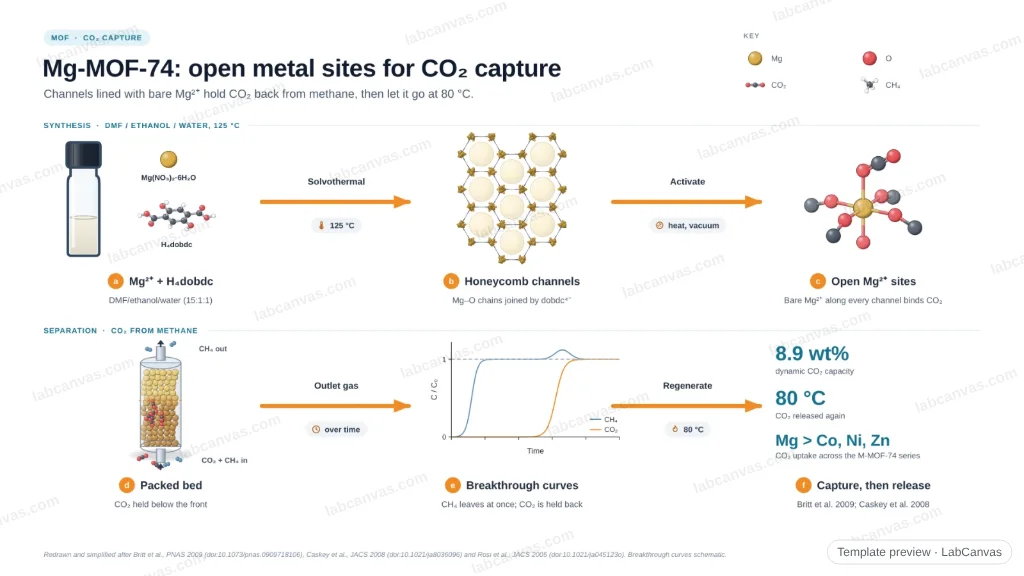
In Mg-MOF-74, chains of magnesium ions joined by 2,5-dioxidoterephthalate line one-dimensional hexagonal channels. Removing the solvent leaves a bare Mg²⁺ site every few ångströms along each channel, and these hold CO₂ strongly. In a packed bed fed with CO₂ and methane, methane passes straight through while CO₂ is held back; the bed reaches 8.9 wt% dynamic capacity and gives the CO₂ up again at 80 °C.
Updated 3 cited papers79 editable layers
At a glance
- Category
- Metal–organic frameworks
- Method
- CO₂ capture
- Approach
- Bottom-up
- Starting materials
- Magnesium nitrate hexahydrate and 2,5-dihydroxyterephthalic acid (H₄dobdc) in DMF/ethanol/water (15:1:1)
- Product
- Mg₂(dobdc): hexagonal one-dimensional channels lined with Mg²⁺ sites
- Key result
- 8.9 wt% dynamic CO₂ capacity; facile CO₂ release at 80 °C (Britt et al. 2009). Mg gives the highest CO₂ uptake of the Mg, Co, Ni and Zn versions (Caskey et al. 2008)
- Figure
- 1920 × 1080 px (16:9), 79 editable layers, 11 generated objects
Step by step
- SolvothermalMg(NO₃)₂·6H₂O and H₄dobdc in DMF/EtOH/H₂O (15:1:1) at 125 °C (Caskey et al. 2008)
- FrameworkHelical Mg–O chains (rod-shaped building units) joined by dobdc⁴⁻ into a honeycomb of channels (Rosi et al. 2005)
- ActivationSolvent removed from the magnesium sites by heating under vacuum: open Mg²⁺ along every channel
- SeparationCO₂/CH₄ fed through a packed bed: CH₄ breaks through at once, CO₂ is held (Britt et al. 2009)
- RegenerationCO₂ released at 80 °C
Strengths
- Dense, strong CO₂ binding sites
- Regenerated at low temperature
- Light, abundant metal
Limitations
- Water competes for the open sites
- Powders must be shaped into pellets for beds
Uses
- Natural gas and biogas upgrading
- CO₂ capture from flue gas
Papers this template follows
- Britt et al., “Highly efficient separation of carbon dioxide by a metal-organic framework replete with open metal sites”, PNAS 2009. doi:10.1073/pnas.0909718106primary
- Caskey et al., “Dramatic Tuning of Carbon Dioxide Uptake via Metal Substitution in a Coordination Polymer with Cylindrical Pores”, J. Am. Chem. Soc. 2008. doi:10.1021/ja8036096method origin
- Rosi et al., “Rod Packings and Metal−Organic Frameworks Constructed from Rod-Shaped Secondary Building Units”, J. Am. Chem. Soc. 2005. doi:10.1021/ja045123ofurther reading
Redrawn and simplified after Britt et al., PNAS 2009 (doi:10.1073/pnas.0909718106), Caskey et al., JACS 2008 (doi:10.1021/ja8036096) and Rosi et al., JACS 2005 (doi:10.1021/ja045123o). Breakthrough curves schematic.
How templates are written and checked: editorial guidelines.
Questions
What does the “Mg-MOF-74: open metal sites for CO₂ capture” template show?
In Mg-MOF-74, chains of magnesium ions joined by 2,5-dioxidoterephthalate line one-dimensional hexagonal channels. Removing the solvent leaves a bare Mg²⁺ site every few ångströms along each channel, and these hold CO₂ strongly. In a packed bed fed with CO₂ and methane, methane passes straight through while CO₂ is held back; the bed reaches 8.9 wt% dynamic capacity and gives the CO₂ up again at 80 °C.
What are the steps shown in “Mg-MOF-74: open metal sites for CO₂ capture”?
1. Solvothermal: Mg(NO₃)₂·6H₂O and H₄dobdc in DMF/EtOH/H₂O (15:1:1) at 125 °C (Caskey et al. 2008). 2. Framework: Helical Mg–O chains (rod-shaped building units) joined by dobdc⁴⁻ into a honeycomb of channels (Rosi et al. 2005). 3. Activation: Solvent removed from the magnesium sites by heating under vacuum: open Mg²⁺ along every channel. 4. Separation: CO₂/CH₄ fed through a packed bed: CH₄ breaks through at once, CO₂ is held (Britt et al. 2009). 5. Regeneration: CO₂ released at 80 °C.
What are the starting materials and the product?
Starting materials: Magnesium nitrate hexahydrate and 2,5-dihydroxyterephthalic acid (H₄dobdc) in DMF/ethanol/water (15:1:1). Product: Mg₂(dobdc): hexagonal one-dimensional channels lined with Mg²⁺ sites.
Which papers is “Mg-MOF-74: open metal sites for CO₂ capture” based on?
Britt et al., “Highly efficient separation of carbon dioxide by a metal-organic framework replete with open metal sites”, PNAS 2009 (doi:10.1073/pnas.0909718106); Caskey et al., “Dramatic Tuning of Carbon Dioxide Uptake via Metal Substitution in a Coordination Polymer with Cylindrical Pores”, J. Am. Chem. Soc. 2008 (doi:10.1021/ja8036096); Rosi et al., “Rod Packings and Metal−Organic Frameworks Constructed from Rod-Shaped Secondary Building Units”, J. Am. Chem. Soc. 2005 (doi:10.1021/ja045123o).
Can I edit the “Mg-MOF-74: open metal sites for CO₂ capture” template?
Yes. Open it in the LabCanvas editor: all 79 layers are editable, including 11 generated objects (structures, plots, equipment) with their own settings. Change the text, colours and layout, then export PNG, TIFF, SVG or PDF.
Do I need an account to use this template?
Not to view it here. To open and edit it, sign in to LabCanvas or create a free account (the free plan keeps one design of each kind). Downloading the figure is part of LabCanvas Pro (US$19 a month or US$199 a year).