Graphical abstract template · Metal–organic frameworks · Drug delivery · Bottom-up
Iron MOF nanoparticles for drug delivery
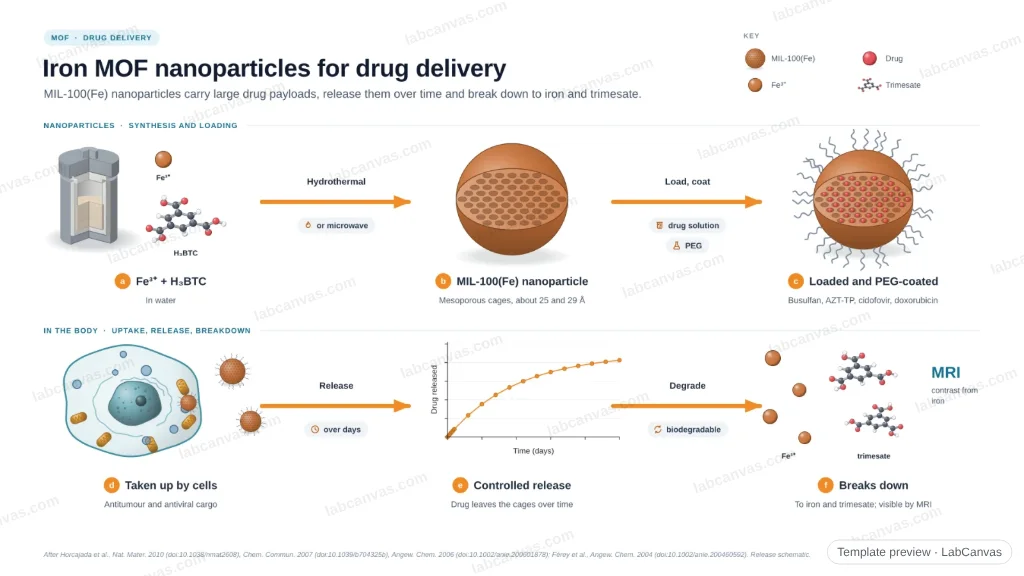
Nanoparticles of MIL-100(Fe), an iron(III) trimesate with mesoporous cages, soak up large amounts of drugs that are hard to formulate, such as busulfan, the antiviral AZT triphosphate, cidofovir and doxorubicin. A PEG coat can be added for longer circulation. The particles release their cargo over time, break down to iron and trimesic acid, and the iron makes them visible by MRI.
Updated 4 cited papers87 editable layers
At a glance
- Category
- Metal–organic frameworks
- Method
- Drug delivery
- Approach
- Bottom-up
- Starting materials
- An iron(III) source and trimesic acid (H₃BTC) in water
- Product
- MIL-100(Fe) nanoparticles: iron(III) trimesate with mesoporous cages, loaded with drug and optionally PEG-coated
- Key result
- High payloads of challenging drugs, controlled release, low toxicity and MRI contrast (Horcajada et al. 2010)
- Figure
- 1920 × 1080 px (16:9), 87 editable layers, 17 generated objects
Step by step
- SynthesisIron(III) and trimesic acid in water, hydrothermal (Horcajada et al. 2007), or with microwave heating for nanoparticles
- FrameworkFe₃O trimers and trimesate in the MTN net of MIL-100: cages about 25 and 29 Å across (Férey et al. 2004)
- LoadingParticles soaked in drug solution: busulfan, AZT-TP, cidofovir, doxorubicin (Horcajada et al. 2010)
- CoatingPEG on the surface for longer circulation
- In the bodyControlled release; the framework degrades to iron and trimesate; iron gives MRI contrast (Horcajada et al. 2010)
Strengths
- Very high payloads in mesoporous cages
- Biodegradable, iron-based
- Imaging and therapy in one particle
Limitations
- Stability in phosphate-rich biological media limits circulation
- Particle size and surface must be controlled for each use
Uses
- Anticancer and antiviral drug delivery
- MRI-traceable carriers (theranostics)
Papers this template follows
- Horcajada et al., “Porous metal–organic-framework nanoscale carriers as a potential platform for drug delivery and imaging”, Nat. Mater. 2010. doi:10.1038/nmat2608primary
- Horcajada et al., “Synthesis and catalytic properties of MIL-100(Fe), an iron(III) carboxylate with large pores”, Chem. Commun. 2007. doi:10.1039/b704325bmethod origin
- Férey et al., “A Hybrid Solid with Giant Pores Prepared by a Combination of Targeted Chemistry, Simulation, and Powder Diffraction”, Angew. Chem. Int. Ed. 2004. doi:10.1002/anie.200460592further reading
- Horcajada et al., “Metal–Organic Frameworks as Efficient Materials for Drug Delivery”, Angew. Chem. Int. Ed. 2006. doi:10.1002/anie.200601878further reading
After Horcajada et al., Nat. Mater. 2010 (doi:10.1038/nmat2608), Chem. Commun. 2007 (doi:10.1039/b704325b), Angew. Chem. 2006 (doi:10.1002/anie.200601878); Férey et al., Angew. Chem. 2004 (doi:10.1002/anie.200460592). Release schematic.
How templates are written and checked: editorial guidelines.
Questions
What does the “Iron MOF nanoparticles for drug delivery” template show?
Nanoparticles of MIL-100(Fe), an iron(III) trimesate with mesoporous cages, soak up large amounts of drugs that are hard to formulate, such as busulfan, the antiviral AZT triphosphate, cidofovir and doxorubicin. A PEG coat can be added for longer circulation. The particles release their cargo over time, break down to iron and trimesic acid, and the iron makes them visible by MRI.
What are the steps shown in “Iron MOF nanoparticles for drug delivery”?
1. Synthesis: Iron(III) and trimesic acid in water, hydrothermal (Horcajada et al. 2007), or with microwave heating for nanoparticles. 2. Framework: Fe₃O trimers and trimesate in the MTN net of MIL-100: cages about 25 and 29 Å across (Férey et al. 2004). 3. Loading: Particles soaked in drug solution: busulfan, AZT-TP, cidofovir, doxorubicin (Horcajada et al. 2010). 4. Coating: PEG on the surface for longer circulation. 5. In the body: Controlled release; the framework degrades to iron and trimesate; iron gives MRI contrast (Horcajada et al. 2010).
What are the starting materials and the product?
Starting materials: An iron(III) source and trimesic acid (H₃BTC) in water. Product: MIL-100(Fe) nanoparticles: iron(III) trimesate with mesoporous cages, loaded with drug and optionally PEG-coated.
Which papers is “Iron MOF nanoparticles for drug delivery” based on?
Horcajada et al., “Porous metal–organic-framework nanoscale carriers as a potential platform for drug delivery and imaging”, Nat. Mater. 2010 (doi:10.1038/nmat2608); Horcajada et al., “Synthesis and catalytic properties of MIL-100(Fe), an iron(III) carboxylate with large pores”, Chem. Commun. 2007 (doi:10.1039/b704325b); Férey et al., “A Hybrid Solid with Giant Pores Prepared by a Combination of Targeted Chemistry, Simulation, and Powder Diffraction”, Angew. Chem. Int. Ed. 2004 (doi:10.1002/anie.200460592); Horcajada et al., “Metal–Organic Frameworks as Efficient Materials for Drug Delivery”, Angew. Chem. Int. Ed. 2006 (doi:10.1002/anie.200601878).
Can I edit the “Iron MOF nanoparticles for drug delivery” template?
Yes. Open it in the LabCanvas editor: all 87 layers are editable, including 17 generated objects (structures, plots, equipment) with their own settings. Change the text, colours and layout, then export PNG, TIFF, SVG or PDF.
Do I need an account to use this template?
Not to view it here. To open and edit it, sign in to LabCanvas or create a free account (the free plan keeps one design of each kind). Downloading the figure is part of LabCanvas Pro (US$19 a month or US$199 a year).