Graphical abstract template · Metal–organic frameworks · Water harvesting · Bottom-up
MOF-801: water from desert air
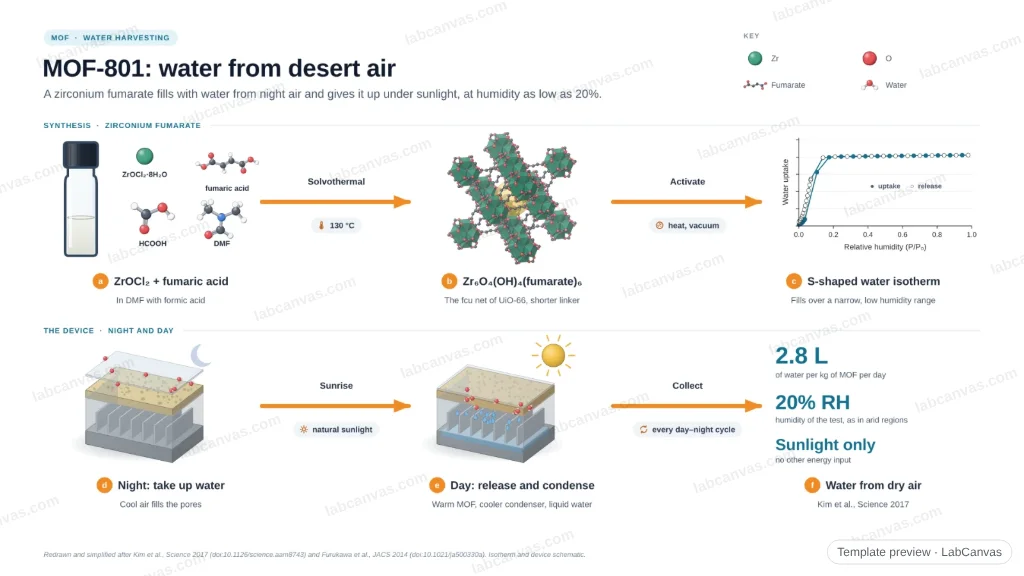
MOF-801 is a zirconium fumarate with the same net as UiO-66 and small pores that fill with water over a narrow range of low humidity. A layer of it in a simple box takes up water from the air at night; by day, sunlight warms it, the vapour condenses on a cooler surface and drips out as liquid. With ambient sunlight only, this gave 2.8 litres of water per kilogram of MOF per day at 20% relative humidity.
Updated 2 cited papers82 editable layers
At a glance
- Category
- Metal–organic frameworks
- Method
- Water harvesting
- Approach
- Bottom-up
- Starting materials
- Zirconium oxychloride octahydrate and fumaric acid in DMF/formic acid
- Product
- MOF-801, Zr₆O₄(OH)₄(fumarate)₆: microporous, water-stable powder
- Key result
- 2.8 L of water per kg of MOF per day at 20% relative humidity, powered by ambient sunlight (Kim et al. 2017)
- Figure
- 1920 × 1080 px (16:9), 82 editable layers, 13 generated objects
Step by step
- SolvothermalZrOCl₂·8H₂O and fumaric acid in DMF with formic acid, 130 °C (Furukawa et al. 2014)
- FrameworkZr₆O₄(OH)₄ clusters joined by fumarate: the 12-connected fcu net of UiO-66 with a shorter linker
- Water isothermS-shaped: most of the uptake over a narrow range at low relative humidity (Furukawa et al. 2014)
- NightCool night air: water fills the pores of the MOF layer
- DaySunlight heats the MOF; the vapour condenses on the cooler condenser and liquid water collects (Kim et al. 2017)
Strengths
- Works at low humidity, where dew harvesting fails
- No energy input other than sunlight
- Water-stable zirconium framework
Limitations
- Litres per kilogram of MOF per day: large MOF masses for drinking-water volumes
- Output depends on the day–night humidity and temperature swing
Uses
- Drinking water in arid regions
- Adsorption-driven heat pumps and dehumidification
Papers this template follows
- Kim et al., “Water harvesting from air with metal-organic frameworks powered by natural sunlight”, Science 2017. doi:10.1126/science.aam8743primary
- Furukawa et al., “Water Adsorption in Porous Metal–Organic Frameworks and Related Materials”, J. Am. Chem. Soc. 2014. doi:10.1021/ja500330amethod origin
Redrawn and simplified after Kim et al., Science 2017 (doi:10.1126/science.aam8743) and Furukawa et al., JACS 2014 (doi:10.1021/ja500330a). Isotherm and device schematic.
How templates are written and checked: editorial guidelines.
Questions
What does the “MOF-801: water from desert air” template show?
MOF-801 is a zirconium fumarate with the same net as UiO-66 and small pores that fill with water over a narrow range of low humidity. A layer of it in a simple box takes up water from the air at night; by day, sunlight warms it, the vapour condenses on a cooler surface and drips out as liquid. With ambient sunlight only, this gave 2.8 litres of water per kilogram of MOF per day at 20% relative humidity.
What are the steps shown in “MOF-801: water from desert air”?
1. Solvothermal: ZrOCl₂·8H₂O and fumaric acid in DMF with formic acid, 130 °C (Furukawa et al. 2014). 2. Framework: Zr₆O₄(OH)₄ clusters joined by fumarate: the 12-connected fcu net of UiO-66 with a shorter linker. 3. Water isotherm: S-shaped: most of the uptake over a narrow range at low relative humidity (Furukawa et al. 2014). 4. Night: Cool night air: water fills the pores of the MOF layer. 5. Day: Sunlight heats the MOF; the vapour condenses on the cooler condenser and liquid water collects (Kim et al. 2017).
What are the starting materials and the product?
Starting materials: Zirconium oxychloride octahydrate and fumaric acid in DMF/formic acid. Product: MOF-801, Zr₆O₄(OH)₄(fumarate)₆: microporous, water-stable powder.
Which papers is “MOF-801: water from desert air” based on?
Kim et al., “Water harvesting from air with metal-organic frameworks powered by natural sunlight”, Science 2017 (doi:10.1126/science.aam8743); Furukawa et al., “Water Adsorption in Porous Metal–Organic Frameworks and Related Materials”, J. Am. Chem. Soc. 2014 (doi:10.1021/ja500330a).
Can I edit the “MOF-801: water from desert air” template?
Yes. Open it in the LabCanvas editor: all 82 layers are editable, including 13 generated objects (structures, plots, equipment) with their own settings. Change the text, colours and layout, then export PNG, TIFF, SVG or PDF.
Do I need an account to use this template?
Not to view it here. To open and edit it, sign in to LabCanvas or create a free account (the free plan keeps one design of each kind). Downloading the figure is part of LabCanvas Pro (US$19 a month or US$199 a year).