Graphical abstract template · Nanomaterial synthesis · Hydrothermal · Bottom-up
Hydrothermal synthesis of carbon dots
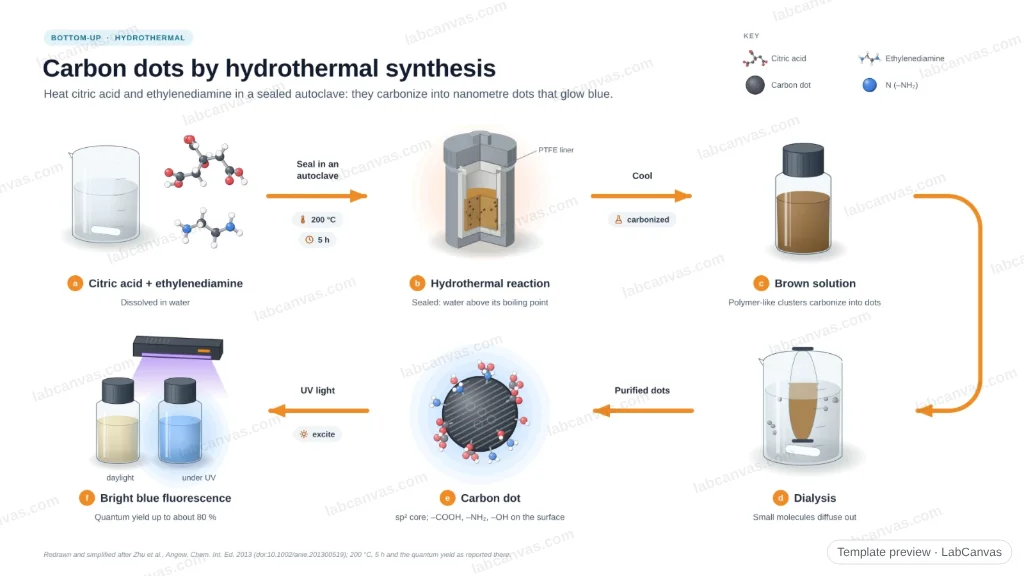
Citric acid and ethylenediamine are dissolved in water and heated in a sealed Teflon-lined autoclave. They condense into polymer-like clusters that carbonize into carbon dots: nanometre-sized particles with a partly graphitic core and amino, carboxyl and hydroxyl groups on the surface. After dialysis the dots give bright blue fluorescence under UV light, with quantum yields of up to about 80 % in the original report.
Updated 1 cited paper72 editable layers
At a glance
- Category
- Nanomaterial synthesis
- Method
- Hydrothermal
- Approach
- Bottom-up
- Starting materials
- Citric acid and ethylenediamine in water
- Product
- Nitrogen-doped carbon dots with –NH₂, –COOH and –OH surface groups
- Typical size
- A few nanometres
- Key result
- Highly fluorescent, water-soluble dots; core order and surface chemistry vary with the conditions
- Scalability
- High: one-pot, cheap precursors, water
- Figure
- 1920 × 1080 px (16:9), 72 editable layers, 16 generated objects
Step by step
- Precursor solutionCitric acid and ethylenediamine dissolved in water
- Hydrothermal reactionSealed in a Teflon-lined autoclave, 200 °C for 5 h (Zhu et al.)
- CarbonizationThe precursors condense into polymer-like dots that carbonize; the solution turns brown
- DialysisSmall molecules and salts diffuse out through the dialysis membrane
- FluorescenceBright blue emission under UV light; quantum yield up to about 80 % (Zhu et al.)
Strengths
- Cheap, non-toxic precursors and water as solvent
- Very bright, photostable fluorescence
- Water-soluble and easy to functionalize
Limitations
- Molecular fluorophores can form alongside the dots and must be separated
- Structure is heterogeneous and hard to define
- Needs a pressure vessel
Uses
- Bioimaging
- Fluorescent sensors and inks
- Multicolour patterning
- Light-emitting devices and photocatalysis
Papers this template follows
- Zhu et al., “Highly photoluminescent carbon dots for multicolor patterning, sensors, and bioimaging”, Angew. Chem. Int. Ed. 2013. doi:10.1002/anie.201300519primary
Redrawn and simplified after Zhu et al., Angew. Chem. Int. Ed. 2013 (doi:10.1002/anie.201300519); 200 °C, 5 h and the quantum yield as reported there.
How templates are written and checked: editorial guidelines.
Questions
What does the “Hydrothermal synthesis of carbon dots” template show?
Citric acid and ethylenediamine are dissolved in water and heated in a sealed Teflon-lined autoclave. They condense into polymer-like clusters that carbonize into carbon dots: nanometre-sized particles with a partly graphitic core and amino, carboxyl and hydroxyl groups on the surface. After dialysis the dots give bright blue fluorescence under UV light, with quantum yields of up to about 80 % in the original report.
What are the steps shown in “Hydrothermal synthesis of carbon dots”?
1. Precursor solution: Citric acid and ethylenediamine dissolved in water. 2. Hydrothermal reaction: Sealed in a Teflon-lined autoclave, 200 °C for 5 h (Zhu et al.). 3. Carbonization: The precursors condense into polymer-like dots that carbonize; the solution turns brown. 4. Dialysis: Small molecules and salts diffuse out through the dialysis membrane. 5. Fluorescence: Bright blue emission under UV light; quantum yield up to about 80 % (Zhu et al.).
What are the starting materials and the product?
Starting materials: Citric acid and ethylenediamine in water. Product: Nitrogen-doped carbon dots with –NH₂, –COOH and –OH surface groups.
Which papers is “Hydrothermal synthesis of carbon dots” based on?
Zhu et al., “Highly photoluminescent carbon dots for multicolor patterning, sensors, and bioimaging”, Angew. Chem. Int. Ed. 2013 (doi:10.1002/anie.201300519).
Can I edit the “Hydrothermal synthesis of carbon dots” template?
Yes. Open it in the LabCanvas editor: all 72 layers are editable, including 16 generated objects (structures, plots, equipment) with their own settings. Change the text, colours and layout, then export PNG, TIFF, SVG or PDF.
Do I need an account to use this template?
Not to view it here. To open and edit it, sign in to LabCanvas or create a free account (the free plan keeps one design of each kind). Downloading the figure is part of LabCanvas Pro (US$19 a month or US$199 a year).