Graphical abstract template · Nanomaterial synthesis · Hydrothermal · Bottom-up
Hydrothermal growth of ZnO nanorod arrays
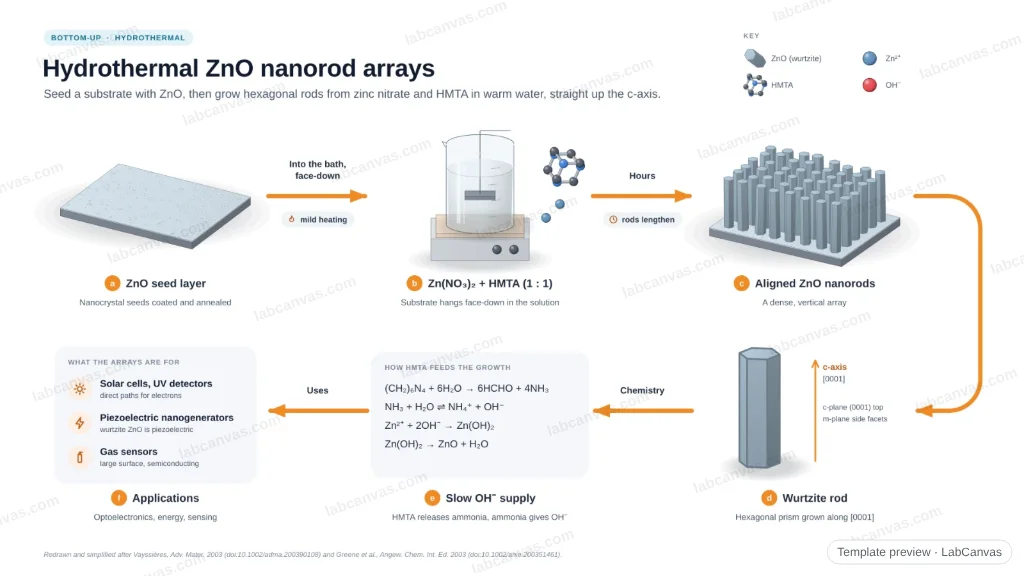
A substrate is coated with ZnO nanocrystals that act as seeds and annealed. It is then hung face-down in an aqueous solution of zinc nitrate and hexamethylenetetramine (HMTA) in equal amounts and heated gently. HMTA slowly releases hydroxide, zinc hydroxide forms and converts to ZnO on the seeds, and hexagonal wurtzite rods grow along their c-axis into a dense, vertically aligned array.
Updated 2 cited papers82 editable layers
At a glance
- Category
- Nanomaterial synthesis
- Method
- Hydrothermal
- Approach
- Bottom-up
- Starting materials
- ZnO nanocrystal seeds; Zn(NO₃)₂ and HMTA in water (equimolar)
- Product
- Vertically aligned single-crystalline ZnO nanorods on the substrate
- Typical size
- Rod diameters set by the seeds and conditions; lengths grow with time
- Key result
- Single-crystalline wurtzite rods, well aligned on textured seed layers
- Scalability
- High: low temperature, water, wafer-scale and on plastics (Greene et al.)
- Figure
- 1920 × 1080 px (16:9), 82 editable layers, 12 generated objects
Step by step
- Seed layerCoat the substrate with ZnO nanocrystals and anneal so they stick and orient
- Growth solutionZn(NO₃)₂ and HMTA in equal amounts in water
- GrowthHang the substrate face-down in the solution and heat it gently (well below the boiling point) for hours
- ChemistryHMTA hydrolyses to formaldehyde and ammonia, which supplies OH⁻; Zn²⁺ + 2OH⁻ → Zn(OH)₂ → ZnO + H₂O
- Rinse and dryRods grow along [0001]; their length follows the growth time
Strengths
- Low temperature and water-based
- Works on almost any substrate, including plastics
- Large areas and simple equipment
Limitations
- Slow growth; the bath depletes and needs refreshing for long rods
- Some homogeneous precipitation in the solution
- Defect-related emission compared with vapour-grown rods
Uses
- Dye-sensitized and hybrid solar cells
- UV photodetectors and LEDs
- Piezoelectric nanogenerators
- Gas sensors
Papers this template follows
- Vayssières, “Growth of arrayed nanorods and nanowires of ZnO from aqueous solutions”, Adv. Mater. 2003. doi:10.1002/adma.200390108method origin
- Greene et al., “Low-temperature wafer-scale production of ZnO nanowire arrays”, Angew. Chem. Int. Ed. 2003. doi:10.1002/anie.200351461primary
Redrawn and simplified after Vayssières, Adv. Mater. 2003 (doi:10.1002/adma.200390108) and Greene et al., Angew. Chem. Int. Ed. 2003 (doi:10.1002/anie.200351461).
How templates are written and checked: editorial guidelines.
Questions
What does the “Hydrothermal growth of ZnO nanorod arrays” template show?
A substrate is coated with ZnO nanocrystals that act as seeds and annealed. It is then hung face-down in an aqueous solution of zinc nitrate and hexamethylenetetramine (HMTA) in equal amounts and heated gently. HMTA slowly releases hydroxide, zinc hydroxide forms and converts to ZnO on the seeds, and hexagonal wurtzite rods grow along their c-axis into a dense, vertically aligned array.
What are the steps shown in “Hydrothermal growth of ZnO nanorod arrays”?
1. Seed layer: Coat the substrate with ZnO nanocrystals and anneal so they stick and orient. 2. Growth solution: Zn(NO₃)₂ and HMTA in equal amounts in water. 3. Growth: Hang the substrate face-down in the solution and heat it gently (well below the boiling point) for hours. 4. Chemistry: HMTA hydrolyses to formaldehyde and ammonia, which supplies OH⁻; Zn²⁺ + 2OH⁻ → Zn(OH)₂ → ZnO + H₂O. 5. Rinse and dry: Rods grow along [0001]; their length follows the growth time.
What are the starting materials and the product?
Starting materials: ZnO nanocrystal seeds; Zn(NO₃)₂ and HMTA in water (equimolar). Product: Vertically aligned single-crystalline ZnO nanorods on the substrate.
Which papers is “Hydrothermal growth of ZnO nanorod arrays” based on?
Vayssières, “Growth of arrayed nanorods and nanowires of ZnO from aqueous solutions”, Adv. Mater. 2003 (doi:10.1002/adma.200390108); Greene et al., “Low-temperature wafer-scale production of ZnO nanowire arrays”, Angew. Chem. Int. Ed. 2003 (doi:10.1002/anie.200351461).
Can I edit the “Hydrothermal growth of ZnO nanorod arrays” template?
Yes. Open it in the LabCanvas editor: all 82 layers are editable, including 12 generated objects (structures, plots, equipment) with their own settings. Change the text, colours and layout, then export PNG, TIFF, SVG or PDF.
Do I need an account to use this template?
Not to view it here. To open and edit it, sign in to LabCanvas or create a free account (the free plan keeps one design of each kind). Downloading the figure is part of LabCanvas Pro (US$19 a month or US$199 a year).