Graphical abstract template · Nanomaterial synthesis · Seed-mediated growth · Bottom-up
Seed-mediated growth of gold nanorods
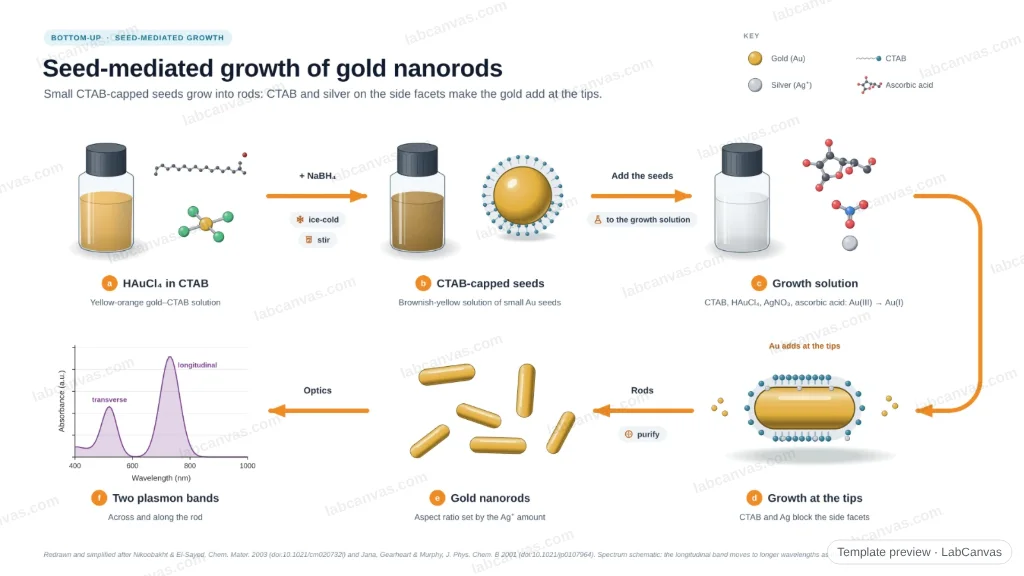
Small CTAB-capped gold seeds are made by reducing HAuCl₄ with ice-cold sodium borohydride in CTAB. They are added to a growth solution of CTAB, HAuCl₄, silver nitrate and ascorbic acid, where ascorbic acid has already reduced Au(III) to colourless Au(I). On the seeds, gold is deposited mainly at the tips, because the CTAB bilayer and silver block the side facets, so the particles grow into rods with two plasmon bands.
Updated 2 cited papers85 editable layers
At a glance
- Category
- Nanomaterial synthesis
- Method
- Seed-mediated growth
- Approach
- Bottom-up
- Starting materials
- HAuCl₄, CTAB, NaBH₄, AgNO₃ and ascorbic acid
- Product
- CTAB-capped gold nanorods
- Typical size
- Rods tens of nanometres long; the aspect ratio is set by the silver concentration (Nikoobakht & El-Sayed)
- Key result
- High yield of single-crystalline rods with the silver-assisted route
- Scalability
- Medium: batch wet chemistry; sensitive to reagent purity and temperature
- Figure
- 1920 × 1080 px (16:9), 85 editable layers, 16 generated objects
Step by step
- SeedsHAuCl₄ in CTAB is reduced with ice-cold NaBH₄: a brownish-yellow solution of small CTAB-capped Au seeds
- Growth solutionCTAB, HAuCl₄ and AgNO₃; ascorbic acid reduces Au(III) to Au(I) and the solution turns colourless
- Add the seedsA small volume of seed solution starts the reduction of Au(I) on the seeds
- Anisotropic growthThe CTAB bilayer and Ag on the side facets slow growth there; gold adds at the tips and the seeds become rods
- PurifyCentrifuge to remove excess CTAB and spherical by-products
Strengths
- Tunable aspect ratio and longitudinal plasmon band
- Water-based, room-temperature growth
- High rod yield with silver ions
Limitations
- CTAB is cytotoxic and hard to remove completely
- Sensitive to CTAB batch, silver and ascorbic acid amounts
- Spherical by-products need to be separated
Uses
- Photothermal therapy and imaging (near-infrared absorption)
- SERS and plasmonic sensing
- Optical materials
Papers this template follows
- Nikoobakht & El-Sayed, “Preparation and growth mechanism of gold nanorods (NRs) using seed-mediated growth method”, Chem. Mater. 2003. doi:10.1021/cm020732lprimary
- Jana, Gearheart & Murphy, “Wet chemical synthesis of high aspect ratio cylindrical gold nanorods”, J. Phys. Chem. B 2001. doi:10.1021/jp0107964method origin
Redrawn and simplified after Nikoobakht & El-Sayed, Chem. Mater. 2003 (doi:10.1021/cm020732l) and Jana, Gearheart & Murphy, J. Phys. Chem. B 2001 (doi:10.1021/jp0107964). Spectrum schematic: the longitudinal band moves to longer wavelengths as the rods get longer.
How templates are written and checked: editorial guidelines.
Questions
What does the “Seed-mediated growth of gold nanorods” template show?
Small CTAB-capped gold seeds are made by reducing HAuCl₄ with ice-cold sodium borohydride in CTAB. They are added to a growth solution of CTAB, HAuCl₄, silver nitrate and ascorbic acid, where ascorbic acid has already reduced Au(III) to colourless Au(I). On the seeds, gold is deposited mainly at the tips, because the CTAB bilayer and silver block the side facets, so the particles grow into rods with two plasmon bands.
What are the steps shown in “Seed-mediated growth of gold nanorods”?
1. Seeds: HAuCl₄ in CTAB is reduced with ice-cold NaBH₄: a brownish-yellow solution of small CTAB-capped Au seeds. 2. Growth solution: CTAB, HAuCl₄ and AgNO₃; ascorbic acid reduces Au(III) to Au(I) and the solution turns colourless. 3. Add the seeds: A small volume of seed solution starts the reduction of Au(I) on the seeds. 4. Anisotropic growth: The CTAB bilayer and Ag on the side facets slow growth there; gold adds at the tips and the seeds become rods. 5. Purify: Centrifuge to remove excess CTAB and spherical by-products.
What are the starting materials and the product?
Starting materials: HAuCl₄, CTAB, NaBH₄, AgNO₃ and ascorbic acid. Product: CTAB-capped gold nanorods.
Which papers is “Seed-mediated growth of gold nanorods” based on?
Nikoobakht & El-Sayed, “Preparation and growth mechanism of gold nanorods (NRs) using seed-mediated growth method”, Chem. Mater. 2003 (doi:10.1021/cm020732l); Jana, Gearheart & Murphy, “Wet chemical synthesis of high aspect ratio cylindrical gold nanorods”, J. Phys. Chem. B 2001 (doi:10.1021/jp0107964).
Can I edit the “Seed-mediated growth of gold nanorods” template?
Yes. Open it in the LabCanvas editor: all 85 layers are editable, including 16 generated objects (structures, plots, equipment) with their own settings. Change the text, colours and layout, then export PNG, TIFF, SVG or PDF.
Do I need an account to use this template?
Not to view it here. To open and edit it, sign in to LabCanvas or create a free account (the free plan keeps one design of each kind). Downloading the figure is part of LabCanvas Pro (US$19 a month or US$199 a year).