Graphical abstract template · Nanomaterial synthesis · Thermal polymerization · Bottom-up
g-C₃N₄ by thermal polymerization
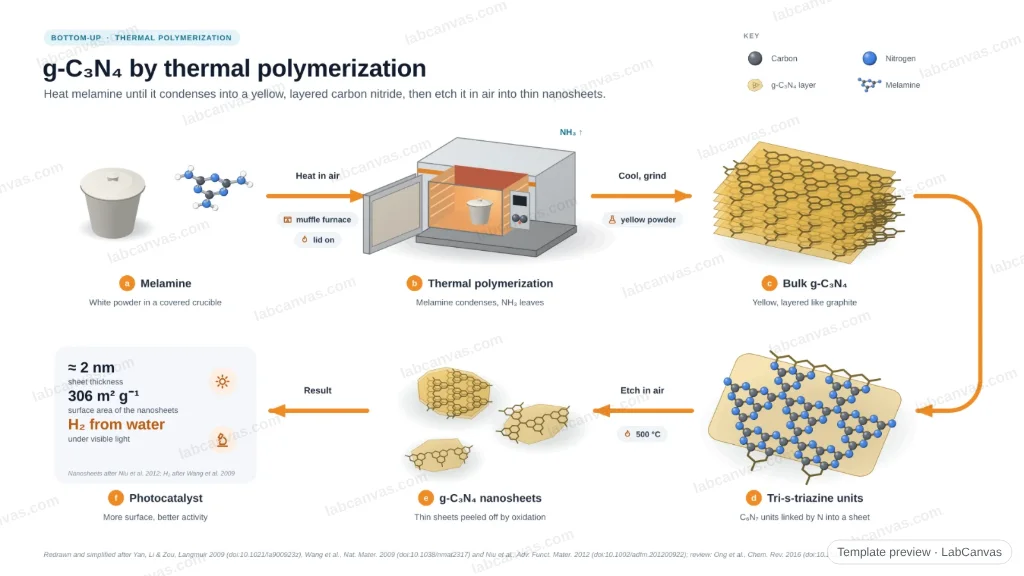
Melamine is heated in a covered crucible in a muffle furnace. It loses ammonia and condenses into graphitic carbon nitride, a yellow, layered polymer built from tri-s-triazine (heptazine) units linked by nitrogen. Heating the bulk powder again in air etches it into nanosheets about 2 nm thick with a much larger surface area, for visible-light photocatalysis.
Updated 4 cited papers78 editable layers
At a glance
- Category
- Nanomaterial synthesis
- Method
- Thermal polymerization
- Approach
- Bottom-up
- Starting materials
- Melamine (urea, cyanamide or dicyandiamide work too)
- Product
- Bulk g-C₃N₄ powder, then g-C₃N₄ nanosheets
- Typical size
- Bulk: micrometre particles of stacked layers; nanosheets about 2 nm thick (Niu et al.)
- Key result
- Polymeric, partly condensed (some NH/NH₂ groups remain); crystallinity depends on precursor and temperature
- Scalability
- Very high: cheap nitrogen-rich precursors, one heating step
- Figure
- 1920 × 1080 px (16:9), 78 editable layers, 16 generated objects
Step by step
- PrecursorMelamine powder in a covered (alumina or porcelain) crucible
- Thermal polymerizationHeated in a muffle furnace in air: deamination and condensation into tri-s-triazine units linked by N
- Bulk g-C₃N₄A yellow, layered solid; ground to a powder
- Thermal etchingThe bulk powder heated again at 500 °C in air is oxidized layer by layer into thin sheets (Niu et al.)
- NanosheetsAbout 2 nm thick, 306 m² g⁻¹ surface area (Niu et al.)
Strengths
- Metal-free, cheap, made from abundant precursors
- Absorbs visible light
- Chemically and thermally stable
Limitations
- Bulk material has a small surface area
- Fast recombination of charge carriers
- Exfoliation lowers the yield
Uses
- Photocatalytic H₂ evolution from water
- Degradation of pollutants
- CO₂ reduction
- Sensing
Papers this template follows
- Yan, Li & Zou, “Photodegradation performance of g-C3N4 fabricated by directly heating melamine”, Langmuir 2009. doi:10.1021/la900923zprimary
- Wang et al., “A metal-free polymeric photocatalyst for hydrogen production from water under visible light”, Nat. Mater. 2009. doi:10.1038/nmat2317method origin
- Niu et al., “Graphene-like carbon nitride nanosheets for improved photocatalytic activities”, Adv. Funct. Mater. 2012. doi:10.1002/adfm.201200922primary
- Ong et al., “Graphitic carbon nitride (g-C3N4)-based photocatalysts for artificial photosynthesis and environmental remediation: are we a step closer to achieving sustainability?”, Chem. Rev. 2016. doi:10.1021/acs.chemrev.6b00075review
Redrawn and simplified after Yan, Li & Zou, Langmuir 2009 (doi:10.1021/la900923z), Wang et al., Nat. Mater. 2009 (doi:10.1038/nmat2317) and Niu et al., Adv. Funct. Mater. 2012 (doi:10.1002/adfm.201200922); review: Ong et al., Chem. Rev. 2016 (doi:10.1021/acs.chemrev.6b00075).
How templates are written and checked: editorial guidelines.
Questions
What does the “g-C₃N₄ by thermal polymerization” template show?
Melamine is heated in a covered crucible in a muffle furnace. It loses ammonia and condenses into graphitic carbon nitride, a yellow, layered polymer built from tri-s-triazine (heptazine) units linked by nitrogen. Heating the bulk powder again in air etches it into nanosheets about 2 nm thick with a much larger surface area, for visible-light photocatalysis.
What are the steps shown in “g-C₃N₄ by thermal polymerization”?
1. Precursor: Melamine powder in a covered (alumina or porcelain) crucible. 2. Thermal polymerization: Heated in a muffle furnace in air: deamination and condensation into tri-s-triazine units linked by N. 3. Bulk g-C₃N₄: A yellow, layered solid; ground to a powder. 4. Thermal etching: The bulk powder heated again at 500 °C in air is oxidized layer by layer into thin sheets (Niu et al.). 5. Nanosheets: About 2 nm thick, 306 m² g⁻¹ surface area (Niu et al.).
What are the starting materials and the product?
Starting materials: Melamine (urea, cyanamide or dicyandiamide work too). Product: Bulk g-C₃N₄ powder, then g-C₃N₄ nanosheets.
Which papers is “g-C₃N₄ by thermal polymerization” based on?
Yan, Li & Zou, “Photodegradation performance of g-C3N4 fabricated by directly heating melamine”, Langmuir 2009 (doi:10.1021/la900923z); Wang et al., “A metal-free polymeric photocatalyst for hydrogen production from water under visible light”, Nat. Mater. 2009 (doi:10.1038/nmat2317); Niu et al., “Graphene-like carbon nitride nanosheets for improved photocatalytic activities”, Adv. Funct. Mater. 2012 (doi:10.1002/adfm.201200922); Ong et al., “Graphitic carbon nitride (g-C3N4)-based photocatalysts for artificial photosynthesis and environmental remediation: are we a step closer to achieving sustainability?”, Chem. Rev. 2016 (doi:10.1021/acs.chemrev.6b00075).
Can I edit the “g-C₃N₄ by thermal polymerization” template?
Yes. Open it in the LabCanvas editor: all 78 layers are editable, including 16 generated objects (structures, plots, equipment) with their own settings. Change the text, colours and layout, then export PNG, TIFF, SVG or PDF.
Do I need an account to use this template?
Not to view it here. To open and edit it, sign in to LabCanvas or create a free account (the free plan keeps one design of each kind). Downloading the figure is part of LabCanvas Pro (US$19 a month or US$199 a year).