Graphical abstract template · Nanomaterial synthesis · Co-precipitation · Bottom-up
Co-precipitation of magnetite (Fe₃O₄) nanoparticles
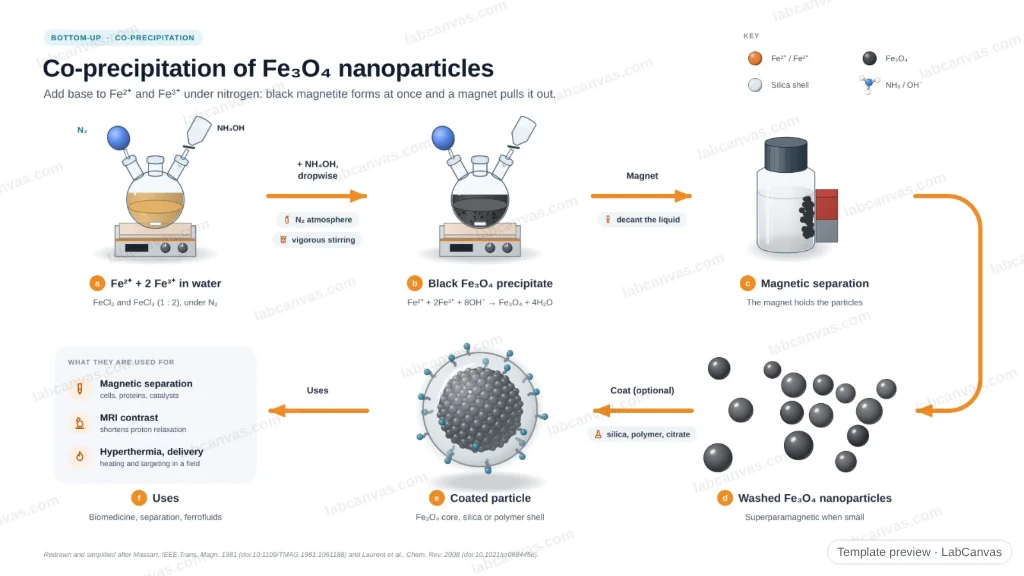
Ferrous and ferric salts in a 1 : 2 ratio are precipitated together by adding a base such as ammonia, under nitrogen so that Fe²⁺ is not oxidized. Black magnetite nanoparticles form at once; a magnet pulls them out of the liquid, and they are washed and can be coated with silica, polymers or small molecules. Small magnetite particles are superparamagnetic.
Updated 2 cited papers77 editable layers
At a glance
- Category
- Nanomaterial synthesis
- Method
- Co-precipitation
- Approach
- Bottom-up
- Starting materials
- Fe²⁺ and Fe³⁺ salts (e.g. FeCl₂ and FeCl₃) in water, and a base (NH₄OH or NaOH)
- Product
- Magnetite (Fe₃O₄) nanoparticles, bare or coated
- Typical size
- Nanoparticles small enough to be superparamagnetic; size set by pH, ionic strength, temperature and the Fe²⁺/Fe³⁺ ratio (Laurent et al.)
- Key result
- Crystalline magnetite with a fairly broad size distribution; oxidizes slowly to maghemite in air
- Scalability
- Very high: water, cheap salts, room-temperature or mild heating, minutes
- Figure
- 1920 × 1080 px (16:9), 77 editable layers, 13 generated objects
Step by step
- Iron saltsFe²⁺ and Fe³⁺ in water at a 1 : 2 molar ratio, deoxygenated and kept under N₂
- PrecipitationAdd the base with vigorous stirring: Fe²⁺ + 2Fe³⁺ + 8OH⁻ → Fe₃O₄ + 4H₂O; a black precipitate forms
- Magnetic separationA magnet holds the particles while the liquid is poured off
- WashWash with water (and ethanol) until neutral
- Coat (optional)Silica, polymers or small molecules stabilize the particles and add functional groups
Strengths
- Simple, fast, cheap and scalable
- Water-dispersible particles
- Easy magnetic separation
Limitations
- Broad size distribution compared with thermal decomposition
- Fe²⁺ oxidizes in air: needs N₂
- Bare particles aggregate; coating needed for stable colloids
Uses
- MRI contrast agents
- Magnetic separation of cells and biomolecules
- Drug delivery and magnetic hyperthermia
- Ferrofluids
Papers this template follows
- Massart, “Preparation of aqueous magnetic liquids in alkaline and acidic media”, IEEE Trans. Magn. 1981. doi:10.1109/TMAG.1981.1061188method origin
- Laurent et al., “Magnetic iron oxide nanoparticles: synthesis, stabilization, vectorization, physicochemical characterizations, and biological applications”, Chem. Rev. 2008. doi:10.1021/cr068445ereview
Redrawn and simplified after Massart, IEEE Trans. Magn. 1981 (doi:10.1109/TMAG.1981.1061188) and Laurent et al., Chem. Rev. 2008 (doi:10.1021/cr068445e).
How templates are written and checked: editorial guidelines.
Questions
What does the “Co-precipitation of magnetite (Fe₃O₄) nanoparticles” template show?
Ferrous and ferric salts in a 1 : 2 ratio are precipitated together by adding a base such as ammonia, under nitrogen so that Fe²⁺ is not oxidized. Black magnetite nanoparticles form at once; a magnet pulls them out of the liquid, and they are washed and can be coated with silica, polymers or small molecules. Small magnetite particles are superparamagnetic.
What are the steps shown in “Co-precipitation of magnetite (Fe₃O₄) nanoparticles”?
1. Iron salts: Fe²⁺ and Fe³⁺ in water at a 1 : 2 molar ratio, deoxygenated and kept under N₂. 2. Precipitation: Add the base with vigorous stirring: Fe²⁺ + 2Fe³⁺ + 8OH⁻ → Fe₃O₄ + 4H₂O; a black precipitate forms. 3. Magnetic separation: A magnet holds the particles while the liquid is poured off. 4. Wash: Wash with water (and ethanol) until neutral. 5. Coat (optional): Silica, polymers or small molecules stabilize the particles and add functional groups.
What are the starting materials and the product?
Starting materials: Fe²⁺ and Fe³⁺ salts (e.g. FeCl₂ and FeCl₃) in water, and a base (NH₄OH or NaOH). Product: Magnetite (Fe₃O₄) nanoparticles, bare or coated.
Which papers is “Co-precipitation of magnetite (Fe₃O₄) nanoparticles” based on?
Massart, “Preparation of aqueous magnetic liquids in alkaline and acidic media”, IEEE Trans. Magn. 1981 (doi:10.1109/TMAG.1981.1061188); Laurent et al., “Magnetic iron oxide nanoparticles: synthesis, stabilization, vectorization, physicochemical characterizations, and biological applications”, Chem. Rev. 2008 (doi:10.1021/cr068445e).
Can I edit the “Co-precipitation of magnetite (Fe₃O₄) nanoparticles” template?
Yes. Open it in the LabCanvas editor: all 77 layers are editable, including 13 generated objects (structures, plots, equipment) with their own settings. Change the text, colours and layout, then export PNG, TIFF, SVG or PDF.
Do I need an account to use this template?
Not to view it here. To open and edit it, sign in to LabCanvas or create a free account (the free plan keeps one design of each kind). Downloading the figure is part of LabCanvas Pro (US$19 a month or US$199 a year).