Graphical abstract template · Nanomaterial synthesis · Green synthesis · Bottom-up
Green synthesis of silver and gold nanoparticles
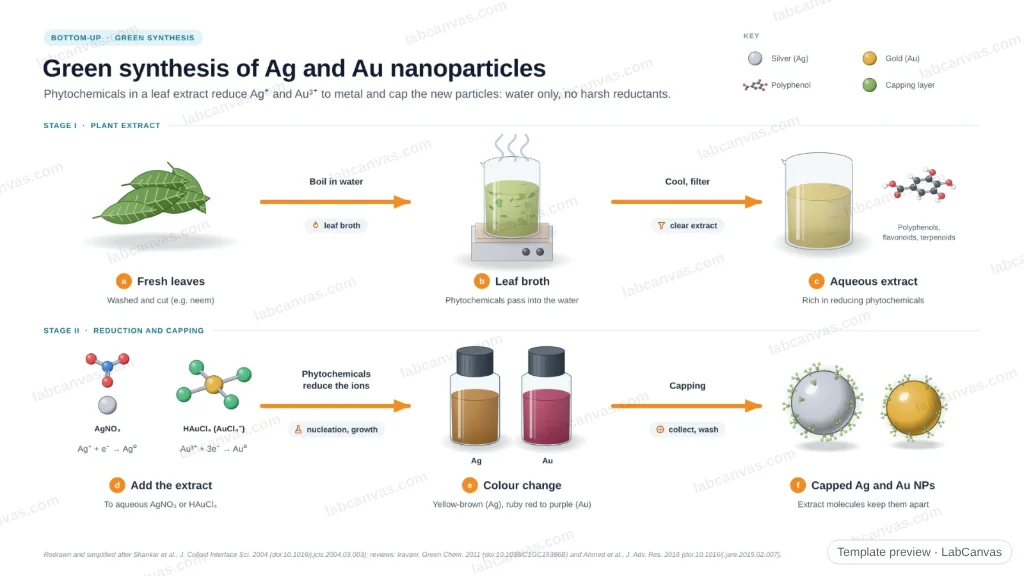
Leaves are boiled in water and the filtered extract is added to silver nitrate or chloroauric acid. Phytochemicals in the extract, such as polyphenols and flavonoids, reduce Ag⁺ and Au³⁺ to metal atoms that nucleate into nanoparticles, and the same molecules cap the particles. The colloid changes colour as the particles form: yellow-brown for silver, ruby red to purple for gold.
Updated 3 cited papers78 editable layers
At a glance
- Category
- Nanomaterial synthesis
- Method
- Green synthesis
- Approach
- Bottom-up
- Starting materials
- Plant leaves (e.g. neem) and aqueous AgNO₃ or HAuCl₄
- Product
- Silver or gold nanoparticles capped by phytochemicals, as a colloid in water
- Typical size
- Polydisperse nanoparticles; with neem broth many gold particles are flat plates (Shankar et al.)
- Key result
- Crystalline metal cores; size and shape vary with the plant, extract amount, pH and temperature
- Scalability
- High: water, cheap plant material, no toxic reducing agents
- Figure
- 1920 × 1080 px (16:9), 78 editable layers, 14 generated objects
Step by step
- Leaf extractWash and cut the leaves, boil them in water, cool and filter: the broth carries polyphenols, flavonoids and terpenoids
- ReductionAdd the extract to aqueous AgNO₃ or HAuCl₄: the phytochemicals reduce Ag⁺ / Au³⁺ to metal atoms, which nucleate and grow
- Colour changeThe solution turns yellow-brown (Ag) or ruby red to purple (Au) as the plasmon band appears
- CappingExtract molecules adsorb on the particles and keep them apart; centrifuge and wash to collect them
Strengths
- No hazardous reductants or organic solvents
- One step: the extract both reduces and caps
- Fast with plant broths (faster than with microorganisms)
- Biocompatible capping layer
Limitations
- Extract composition varies with plant, season and preparation
- Broader size and shape distributions than citrate or seed-mediated routes
- The capping layer is poorly defined
Uses
- Antimicrobial coatings and materials (Ag)
- Catalysis
- Sensing and SERS
- Biomedical research
Papers this template follows
- Shankar et al., “Rapid synthesis of Au, Ag, and bimetallic Au core–Ag shell nanoparticles using Neem (Azadirachta indica) leaf broth”, J. Colloid Interface Sci. 2004. doi:10.1016/j.jcis.2004.03.003primary
- Iravani, “Green synthesis of metal nanoparticles using plants”, Green Chem. 2011. doi:10.1039/C1GC15386Breview
- Ahmed et al., “A review on plants extract mediated synthesis of silver nanoparticles for antimicrobial applications: a green expertise”, J. Adv. Res. 2016. doi:10.1016/j.jare.2015.02.007review
Redrawn and simplified after Shankar et al., J. Colloid Interface Sci. 2004 (doi:10.1016/j.jcis.2004.03.003); reviews: Iravani, Green Chem. 2011 (doi:10.1039/C1GC15386B) and Ahmed et al., J. Adv. Res. 2016 (doi:10.1016/j.jare.2015.02.007).
How templates are written and checked: editorial guidelines.
Questions
What does the “Green synthesis of silver and gold nanoparticles” template show?
Leaves are boiled in water and the filtered extract is added to silver nitrate or chloroauric acid. Phytochemicals in the extract, such as polyphenols and flavonoids, reduce Ag⁺ and Au³⁺ to metal atoms that nucleate into nanoparticles, and the same molecules cap the particles. The colloid changes colour as the particles form: yellow-brown for silver, ruby red to purple for gold.
What are the steps shown in “Green synthesis of silver and gold nanoparticles”?
1. Leaf extract: Wash and cut the leaves, boil them in water, cool and filter: the broth carries polyphenols, flavonoids and terpenoids. 2. Reduction: Add the extract to aqueous AgNO₃ or HAuCl₄: the phytochemicals reduce Ag⁺ / Au³⁺ to metal atoms, which nucleate and grow. 3. Colour change: The solution turns yellow-brown (Ag) or ruby red to purple (Au) as the plasmon band appears. 4. Capping: Extract molecules adsorb on the particles and keep them apart; centrifuge and wash to collect them.
What are the starting materials and the product?
Starting materials: Plant leaves (e.g. neem) and aqueous AgNO₃ or HAuCl₄. Product: Silver or gold nanoparticles capped by phytochemicals, as a colloid in water.
Which papers is “Green synthesis of silver and gold nanoparticles” based on?
Shankar et al., “Rapid synthesis of Au, Ag, and bimetallic Au core–Ag shell nanoparticles using Neem (Azadirachta indica) leaf broth”, J. Colloid Interface Sci. 2004 (doi:10.1016/j.jcis.2004.03.003); Iravani, “Green synthesis of metal nanoparticles using plants”, Green Chem. 2011 (doi:10.1039/C1GC15386B); Ahmed et al., “A review on plants extract mediated synthesis of silver nanoparticles for antimicrobial applications: a green expertise”, J. Adv. Res. 2016 (doi:10.1016/j.jare.2015.02.007).
Can I edit the “Green synthesis of silver and gold nanoparticles” template?
Yes. Open it in the LabCanvas editor: all 78 layers are editable, including 14 generated objects (structures, plots, equipment) with their own settings. Change the text, colours and layout, then export PNG, TIFF, SVG or PDF.
Do I need an account to use this template?
Not to view it here. To open and edit it, sign in to LabCanvas or create a free account (the free plan keeps one design of each kind). Downloading the figure is part of LabCanvas Pro (US$19 a month or US$199 a year).