Graphical abstract template · Nanomaterial synthesis · Citrate reduction · Bottom-up
Turkevich citrate reduction of gold nanoparticles
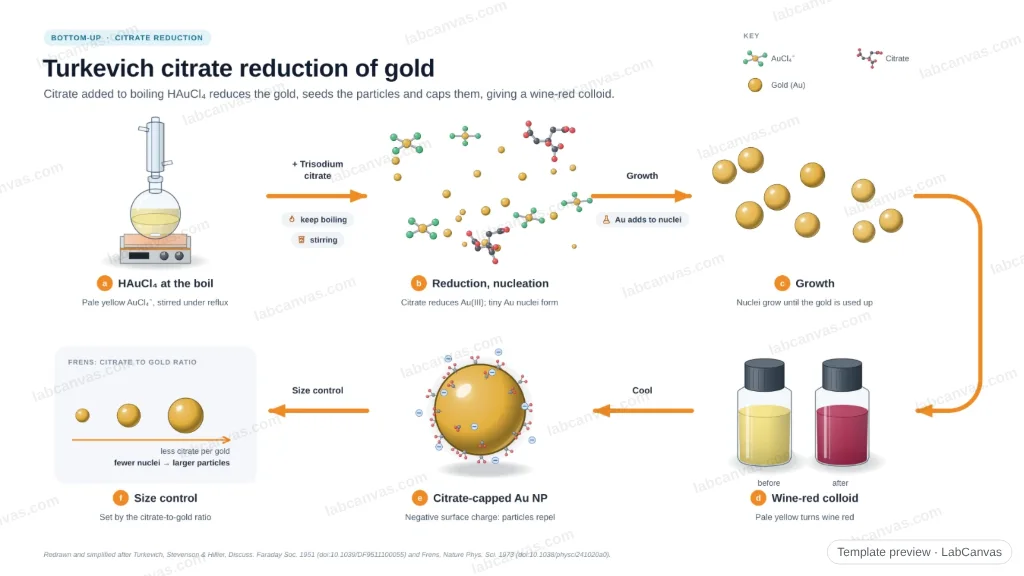
Trisodium citrate is added to a boiling solution of chloroauric acid. Citrate reduces Au(III) to gold atoms, which form nuclei that grow into spherical nanoparticles, and the adsorbed citrate gives them a negative charge that keeps the colloid stable. The pale yellow solution turns wine red. Frens showed that the citrate-to-gold ratio sets the particle size.
Updated 2 cited papers76 editable layers
At a glance
- Category
- Nanomaterial synthesis
- Method
- Citrate reduction
- Approach
- Bottom-up
- Starting materials
- HAuCl₄ in water and trisodium citrate
- Product
- Citrate-capped spherical gold nanoparticles (wine-red colloid)
- Typical size
- Tens of nanometres for the classic recipe; tunable by the citrate-to-gold ratio (Frens)
- Key result
- Near-spherical, fairly monodisperse particles at the usual ratios; broader distributions for large sizes
- Scalability
- High: one pot, water, simple reagents
- Figure
- 1920 × 1080 px (16:9), 76 editable layers, 20 generated objects
Step by step
- Boil the gold saltAqueous HAuCl₄ (pale yellow AuCl₄⁻) is brought to the boil with stirring
- Add citrateTrisodium citrate is added quickly; it reduces Au(III) to Au(0)
- Nucleation and growthGold atoms form nuclei, which grow as more gold is reduced on them
- ColloidThe solution turns wine red; adsorbed citrate makes the particles negatively charged so they repel
- Size control (Frens)Less citrate per gold gives fewer nuclei and larger particles; more citrate gives smaller ones
Strengths
- Simple, fast and reproducible
- Water-based; citrate is easy to replace with thiols or polymers
- Size tunable through one parameter
Limitations
- Large particles become polydisperse
- Weakly bound citrate: colloids aggregate in salt
- Needs boiling and quick mixing
Uses
- Colorimetric sensing and lateral-flow assays
- SERS substrates
- Seeds for larger or anisotropic particles
- Bioconjugation
Papers this template follows
- Turkevich, Stevenson & Hillier, “A study of the nucleation and growth processes in the synthesis of colloidal gold”, Discuss. Faraday Soc. 1951. doi:10.1039/DF9511100055method origin
- Frens, “Controlled nucleation for the regulation of the particle size in monodisperse gold suspensions”, Nature Phys. Sci. 1973. doi:10.1038/physci241020a0primary
Redrawn and simplified after Turkevich, Stevenson & Hillier, Discuss. Faraday Soc. 1951 (doi:10.1039/DF9511100055) and Frens, Nature Phys. Sci. 1973 (doi:10.1038/physci241020a0).
How templates are written and checked: editorial guidelines.
Questions
What does the “Turkevich citrate reduction of gold nanoparticles” template show?
Trisodium citrate is added to a boiling solution of chloroauric acid. Citrate reduces Au(III) to gold atoms, which form nuclei that grow into spherical nanoparticles, and the adsorbed citrate gives them a negative charge that keeps the colloid stable. The pale yellow solution turns wine red. Frens showed that the citrate-to-gold ratio sets the particle size.
What are the steps shown in “Turkevich citrate reduction of gold nanoparticles”?
1. Boil the gold salt: Aqueous HAuCl₄ (pale yellow AuCl₄⁻) is brought to the boil with stirring. 2. Add citrate: Trisodium citrate is added quickly; it reduces Au(III) to Au(0). 3. Nucleation and growth: Gold atoms form nuclei, which grow as more gold is reduced on them. 4. Colloid: The solution turns wine red; adsorbed citrate makes the particles negatively charged so they repel. 5. Size control (Frens): Less citrate per gold gives fewer nuclei and larger particles; more citrate gives smaller ones.
What are the starting materials and the product?
Starting materials: HAuCl₄ in water and trisodium citrate. Product: Citrate-capped spherical gold nanoparticles (wine-red colloid).
Which papers is “Turkevich citrate reduction of gold nanoparticles” based on?
Turkevich, Stevenson & Hillier, “A study of the nucleation and growth processes in the synthesis of colloidal gold”, Discuss. Faraday Soc. 1951 (doi:10.1039/DF9511100055); Frens, “Controlled nucleation for the regulation of the particle size in monodisperse gold suspensions”, Nature Phys. Sci. 1973 (doi:10.1038/physci241020a0).
Can I edit the “Turkevich citrate reduction of gold nanoparticles” template?
Yes. Open it in the LabCanvas editor: all 76 layers are editable, including 20 generated objects (structures, plots, equipment) with their own settings. Change the text, colours and layout, then export PNG, TIFF, SVG or PDF.
Do I need an account to use this template?
Not to view it here. To open and edit it, sign in to LabCanvas or create a free account (the free plan keeps one design of each kind). Downloading the figure is part of LabCanvas Pro (US$19 a month or US$199 a year).