Graphical abstract template · Nanomaterial synthesis · Silica synthesis · Bottom-up
MCM-41 mesoporous silica by surfactant templating
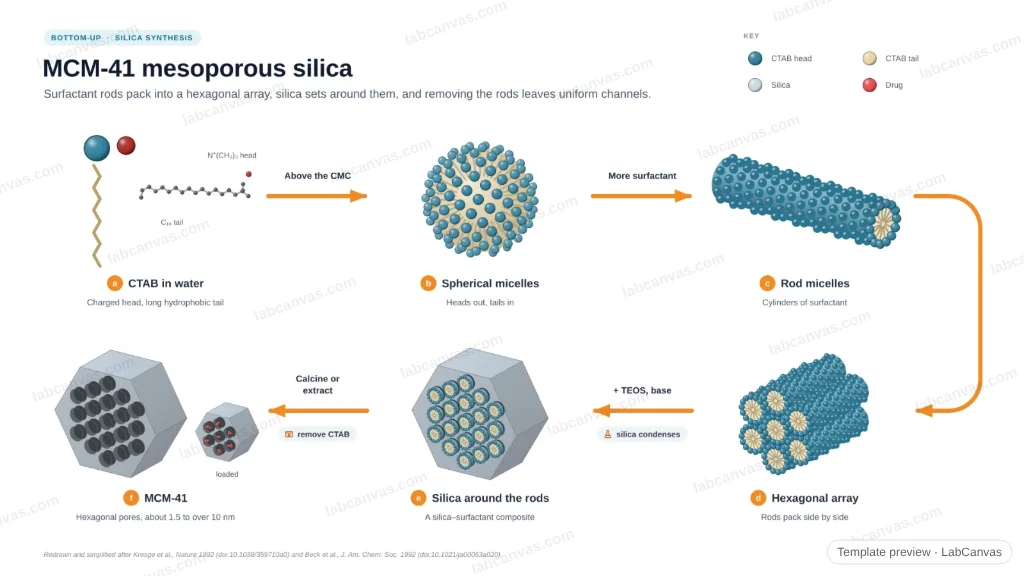
Cationic surfactant (CTAB) in water forms spherical micelles and, at higher concentration, rod-like micelles that pack into a hexagonal array. Silicate from TEOS under basic conditions condenses around the rods. Removing the surfactant by calcination or extraction leaves silica with a honeycomb of uniform channels, tunable from about 1.5 to over 10 nm, which can be loaded with drugs or catalysts.
Updated 2 cited papers64 editable layers
At a glance
- Category
- Nanomaterial synthesis
- Method
- Silica synthesis
- Approach
- Bottom-up
- Starting materials
- CTAB (surfactant template) and a silica source such as TEOS, in basic water
- Product
- MCM-41: amorphous silica with a hexagonal array of uniform mesopores
- Typical size
- Pores about 1.5 to over 10 nm (15 Å to more than 100 Å, Beck et al.)
- Key result
- Long-range hexagonal order of pores; amorphous walls
- Scalability
- High: aqueous, mild conditions; also as nanoparticles (MSNs)
- Figure
- 1920 × 1080 px (16:9), 64 editable layers, 10 generated objects
Step by step
- MicellesAbove the critical micelle concentration, CTAB forms spherical micelles
- Rod micellesAt higher concentration the micelles become rods that pack into a hexagonal array
- Silica around the rodsSilicate (from TEOS, base-catalysed) condenses around the surfactant rods
- Remove the templateCalcination or solvent extraction removes the CTAB
- MCM-41Hexagonal channels; pore size set by the surfactant chain length (and additives), about 1.5 to over 10 nm (Beck et al.)
Strengths
- Uniform, tunable pores and very high surface area
- Easy to functionalize the silanol walls
- Biocompatible silica
Limitations
- Thin amorphous walls: limited hydrothermal stability
- Template removal costs energy or solvent
- Pores collapse if the walls are too thin
Uses
- Drug delivery (loaded pores)
- Catalyst supports
- Adsorption and separation
- Templates for nanowires
Papers this template follows
- Kresge et al., “Ordered mesoporous molecular sieves synthesized by a liquid-crystal template mechanism”, Nature 1992. doi:10.1038/359710a0method origin
- Beck et al., “A new family of mesoporous molecular sieves prepared with liquid crystal templates”, J. Am. Chem. Soc. 1992. doi:10.1021/ja00053a020primary
Redrawn and simplified after Kresge et al., Nature 1992 (doi:10.1038/359710a0) and Beck et al., J. Am. Chem. Soc. 1992 (doi:10.1021/ja00053a020).
How templates are written and checked: editorial guidelines.
Questions
What does the “MCM-41 mesoporous silica by surfactant templating” template show?
Cationic surfactant (CTAB) in water forms spherical micelles and, at higher concentration, rod-like micelles that pack into a hexagonal array. Silicate from TEOS under basic conditions condenses around the rods. Removing the surfactant by calcination or extraction leaves silica with a honeycomb of uniform channels, tunable from about 1.5 to over 10 nm, which can be loaded with drugs or catalysts.
What are the steps shown in “MCM-41 mesoporous silica by surfactant templating”?
1. Micelles: Above the critical micelle concentration, CTAB forms spherical micelles. 2. Rod micelles: At higher concentration the micelles become rods that pack into a hexagonal array. 3. Silica around the rods: Silicate (from TEOS, base-catalysed) condenses around the surfactant rods. 4. Remove the template: Calcination or solvent extraction removes the CTAB. 5. MCM-41: Hexagonal channels; pore size set by the surfactant chain length (and additives), about 1.5 to over 10 nm (Beck et al.).
What are the starting materials and the product?
Starting materials: CTAB (surfactant template) and a silica source such as TEOS, in basic water. Product: MCM-41: amorphous silica with a hexagonal array of uniform mesopores.
Which papers is “MCM-41 mesoporous silica by surfactant templating” based on?
Kresge et al., “Ordered mesoporous molecular sieves synthesized by a liquid-crystal template mechanism”, Nature 1992 (doi:10.1038/359710a0); Beck et al., “A new family of mesoporous molecular sieves prepared with liquid crystal templates”, J. Am. Chem. Soc. 1992 (doi:10.1021/ja00053a020).
Can I edit the “MCM-41 mesoporous silica by surfactant templating” template?
Yes. Open it in the LabCanvas editor: all 64 layers are editable, including 10 generated objects (structures, plots, equipment) with their own settings. Change the text, colours and layout, then export PNG, TIFF, SVG or PDF.
Do I need an account to use this template?
Not to view it here. To open and edit it, sign in to LabCanvas or create a free account (the free plan keeps one design of each kind). Downloading the figure is part of LabCanvas Pro (US$19 a month or US$199 a year).