Graphical abstract template · Nanomaterial synthesis · Selective etching · Top-down
MXene (Ti₃C₂Tₓ) by selective etching of Ti₃AlC₂
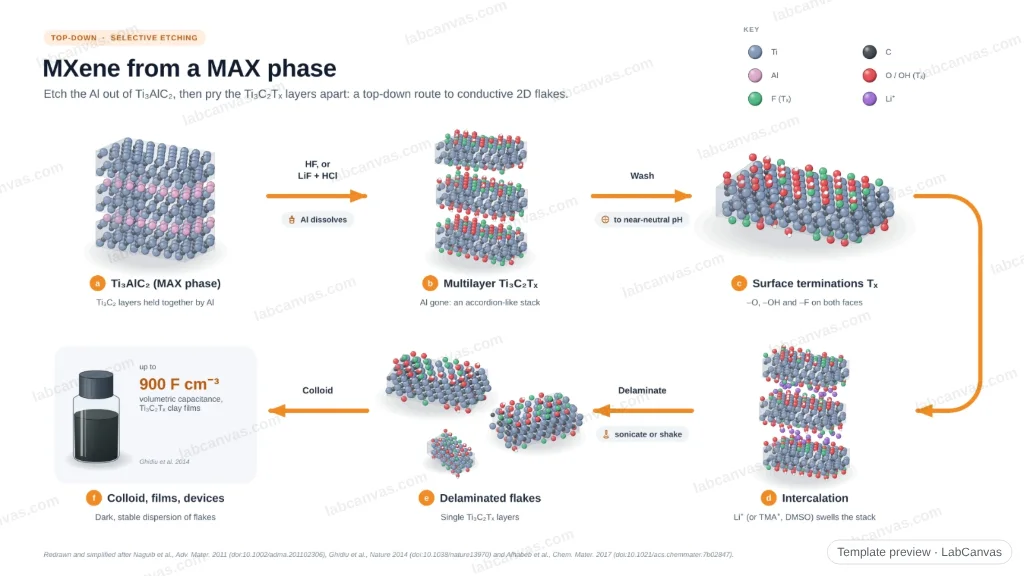
The MAX phase Ti₃AlC₂ is a layered carbide in which Ti₃C₂ layers are held together by aluminium. Hydrofluoric acid, or a mixture of LiF and HCl that forms HF in situ, dissolves the Al layers selectively and leaves an accordion-like stack of Ti₃C₂Tₓ layers whose surfaces carry –O, –OH and –F terminations. Cations such as Li⁺ or organic molecules intercalate between the layers, and sonication or simple hand shaking separates them into single flakes that form a stable colloid.
Updated 3 cited papers73 editable layers
At a glance
- Category
- Nanomaterial synthesis
- Method
- Selective etching
- Approach
- Top-down
- Starting materials
- Ti₃AlC₂ MAX phase powder
- Product
- Multilayer Ti₃C₂Tₓ, then delaminated single-layer flakes in water
- Typical size
- Single Ti₃C₂Tₓ layers; their lateral size depends on the etchant and the delamination method
- Key result
- Highly conductive flakes; terminations and defects depend on the etchant
- Scalability
- Medium to high: batch wet chemistry; HF handling is the main constraint
- Figure
- 1920 × 1080 px (16:9), 73 editable layers, 11 generated objects
Step by step
- MAX phaseTi₃AlC₂: Ti₃C₂ layers interleaved with Al
- Selective etchingHF (Naguib et al.: room temperature, 2 h) or LiF + HCl, which forms HF in situ (Ghidiu et al.), removes the Al
- Multilayer Ti₃C₂TₓAccordion-like stacks; the surfaces end in –O, –OH and –F (Tₓ)
- WashRepeated washing and centrifugation until the pH is close to neutral
- Intercalation and delaminationLi⁺ from LiF, or TMA⁺ / DMSO, swells the stack; sonication or hand shaking separates single flakes
- Colloid and filmsA dark colloid of single flakes; it can be rolled or filtered into conductive films
Strengths
- Metallic conductivity with a hydrophilic surface
- Water-processable into films, inks and clays
- LiF + HCl avoids concentrated HF and gives larger flakes
Limitations
- HF is extremely hazardous
- Flakes oxidize slowly in water and air
- Mixed, hard-to-control surface terminations
Uses
- Supercapacitors: up to 900 F cm⁻³ for Ti₃C₂Tₓ clay films (Ghidiu et al.)
- Batteries
- EMI shielding
- Conductive inks and sensors
Papers this template follows
- Naguib et al., “Two-dimensional nanocrystals produced by exfoliation of Ti3AlC2”, Adv. Mater. 2011. doi:10.1002/adma.201102306method origin
- Ghidiu et al., “Conductive two-dimensional titanium carbide 'clay' with high volumetric capacitance”, Nature 2014. doi:10.1038/nature13970primary
- Alhabeb et al., “Guidelines for synthesis and processing of two-dimensional titanium carbide (Ti3C2Tx MXene)”, Chem. Mater. 2017. doi:10.1021/acs.chemmater.7b02847review
Redrawn and simplified after Naguib et al., Adv. Mater. 2011 (doi:10.1002/adma.201102306), Ghidiu et al., Nature 2014 (doi:10.1038/nature13970) and Alhabeb et al., Chem. Mater. 2017 (doi:10.1021/acs.chemmater.7b02847).
How templates are written and checked: editorial guidelines.
Questions
What does the “MXene (Ti₃C₂Tₓ) by selective etching of Ti₃AlC₂” template show?
The MAX phase Ti₃AlC₂ is a layered carbide in which Ti₃C₂ layers are held together by aluminium. Hydrofluoric acid, or a mixture of LiF and HCl that forms HF in situ, dissolves the Al layers selectively and leaves an accordion-like stack of Ti₃C₂Tₓ layers whose surfaces carry –O, –OH and –F terminations. Cations such as Li⁺ or organic molecules intercalate between the layers, and sonication or simple hand shaking separates them into single flakes that form a stable colloid.
What are the steps shown in “MXene (Ti₃C₂Tₓ) by selective etching of Ti₃AlC₂”?
1. MAX phase: Ti₃AlC₂: Ti₃C₂ layers interleaved with Al. 2. Selective etching: HF (Naguib et al.: room temperature, 2 h) or LiF + HCl, which forms HF in situ (Ghidiu et al.), removes the Al. 3. Multilayer Ti₃C₂Tₓ: Accordion-like stacks; the surfaces end in –O, –OH and –F (Tₓ). 4. Wash: Repeated washing and centrifugation until the pH is close to neutral. 5. Intercalation and delamination: Li⁺ from LiF, or TMA⁺ / DMSO, swells the stack; sonication or hand shaking separates single flakes. 6. Colloid and films: A dark colloid of single flakes; it can be rolled or filtered into conductive films.
What are the starting materials and the product?
Starting materials: Ti₃AlC₂ MAX phase powder. Product: Multilayer Ti₃C₂Tₓ, then delaminated single-layer flakes in water.
Which papers is “MXene (Ti₃C₂Tₓ) by selective etching of Ti₃AlC₂” based on?
Naguib et al., “Two-dimensional nanocrystals produced by exfoliation of Ti3AlC2”, Adv. Mater. 2011 (doi:10.1002/adma.201102306); Ghidiu et al., “Conductive two-dimensional titanium carbide 'clay' with high volumetric capacitance”, Nature 2014 (doi:10.1038/nature13970); Alhabeb et al., “Guidelines for synthesis and processing of two-dimensional titanium carbide (Ti3C2Tx MXene)”, Chem. Mater. 2017 (doi:10.1021/acs.chemmater.7b02847).
Can I edit the “MXene (Ti₃C₂Tₓ) by selective etching of Ti₃AlC₂” template?
Yes. Open it in the LabCanvas editor: all 73 layers are editable, including 11 generated objects (structures, plots, equipment) with their own settings. Change the text, colours and layout, then export PNG, TIFF, SVG or PDF.
Do I need an account to use this template?
Not to view it here. To open and edit it, sign in to LabCanvas or create a free account (the free plan keeps one design of each kind). Downloading the figure is part of LabCanvas Pro (US$19 a month or US$199 a year).