Graphical abstract template · Nanomaterial synthesis · Sol-gel · Bottom-up
Sol–gel synthesis of TiO₂ and SiO₂
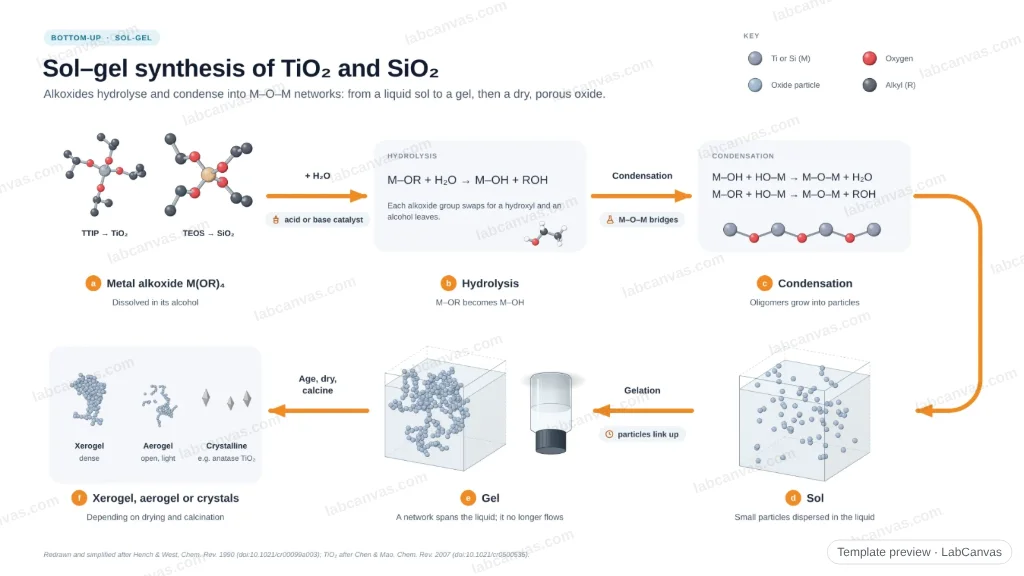
A metal alkoxide such as titanium isopropoxide (for TiO₂) or tetraethyl orthosilicate (for SiO₂) is mixed with water in alcohol, with an acid or base as catalyst. The alkoxide groups hydrolyse to M–OH, which condense into M–O–M bridges: first a sol of small particles, then a gel whose network spans the whole liquid. Drying gives a dense xerogel or, with supercritical drying, a light aerogel; calcination removes organics and crystallizes the oxide.
Updated 3 cited papers95 editable layers
At a glance
- Category
- Nanomaterial synthesis
- Method
- Sol-gel
- Approach
- Bottom-up
- Starting materials
- Metal alkoxides M(OR)₄: Ti(OCH(CH₃)₂)₄ (TTIP) or Si(OC₂H₅)₄ (TEOS), in alcohol
- Product
- TiO₂ or SiO₂ as gels, xerogels, aerogels, films or powders
- Typical size
- Primary particles of a few nanometres; pores from micro- to macropores depending on drying
- Key result
- Very pure, homogeneous oxides; texture tuned by pH, water ratio, catalyst and drying
- Scalability
- High for coatings and powders; slow drying limits monoliths
- Figure
- 1920 × 1080 px (16:9), 95 editable layers, 12 generated objects
Step by step
- PrecursorAlkoxide dissolved in its alcohol
- HydrolysisM–OR + H₂O → M–OH + ROH, catalysed by acid or base
- CondensationM–OH + HO–M → M–O–M + H₂O (or + ROH): oligomers, then particles
- Sol → gelParticles link into a network that spans the liquid; the gel no longer flows
- Aging, dryingEvaporative drying shrinks it into a xerogel; supercritical drying keeps the open network (aerogel)
- CalcinationBurns off organics and crystallizes the oxide, e.g. amorphous TiO₂ to anatase
Strengths
- Low-temperature chemistry, high purity and homogeneity
- Shapes: films, fibres, monoliths, powders, aerogels
- Easy doping and mixed oxides
Limitations
- Alkoxides are moisture-sensitive (TTIP hydrolyses very fast)
- Large shrinkage and cracking on drying
- Organic residues need calcination
Uses
- Photocatalytic and self-cleaning TiO₂ coatings
- Optical and protective silica coatings
- Aerogel insulation
- Catalyst supports
Papers this template follows
- Hench & West, “The sol-gel process”, Chem. Rev. 1990. doi:10.1021/cr00099a003review
- Chen & Mao, “Titanium dioxide nanomaterials: synthesis, properties, modifications, and applications”, Chem. Rev. 2007. doi:10.1021/cr0500535review
- Brinker & Scherer, “Sol-Gel Science: The Physics and Chemistry of Sol-Gel Processing”, Academic Press 1990.further reading
Redrawn and simplified after Hench & West, Chem. Rev. 1990 (doi:10.1021/cr00099a003); TiO₂ after Chen & Mao, Chem. Rev. 2007 (doi:10.1021/cr0500535).
How templates are written and checked: editorial guidelines.
Questions
What does the “Sol–gel synthesis of TiO₂ and SiO₂” template show?
A metal alkoxide such as titanium isopropoxide (for TiO₂) or tetraethyl orthosilicate (for SiO₂) is mixed with water in alcohol, with an acid or base as catalyst. The alkoxide groups hydrolyse to M–OH, which condense into M–O–M bridges: first a sol of small particles, then a gel whose network spans the whole liquid. Drying gives a dense xerogel or, with supercritical drying, a light aerogel; calcination removes organics and crystallizes the oxide.
What are the steps shown in “Sol–gel synthesis of TiO₂ and SiO₂”?
1. Precursor: Alkoxide dissolved in its alcohol. 2. Hydrolysis: M–OR + H₂O → M–OH + ROH, catalysed by acid or base. 3. Condensation: M–OH + HO–M → M–O–M + H₂O (or + ROH): oligomers, then particles. 4. Sol → gel: Particles link into a network that spans the liquid; the gel no longer flows. 5. Aging, drying: Evaporative drying shrinks it into a xerogel; supercritical drying keeps the open network (aerogel). 6. Calcination: Burns off organics and crystallizes the oxide, e.g. amorphous TiO₂ to anatase.
What are the starting materials and the product?
Starting materials: Metal alkoxides M(OR)₄: Ti(OCH(CH₃)₂)₄ (TTIP) or Si(OC₂H₅)₄ (TEOS), in alcohol. Product: TiO₂ or SiO₂ as gels, xerogels, aerogels, films or powders.
Which papers is “Sol–gel synthesis of TiO₂ and SiO₂” based on?
Hench & West, “The sol-gel process”, Chem. Rev. 1990 (doi:10.1021/cr00099a003); Chen & Mao, “Titanium dioxide nanomaterials: synthesis, properties, modifications, and applications”, Chem. Rev. 2007 (doi:10.1021/cr0500535); Brinker & Scherer, “Sol-Gel Science: The Physics and Chemistry of Sol-Gel Processing”, Academic Press 1990.
Can I edit the “Sol–gel synthesis of TiO₂ and SiO₂” template?
Yes. Open it in the LabCanvas editor: all 95 layers are editable, including 12 generated objects (structures, plots, equipment) with their own settings. Change the text, colours and layout, then export PNG, TIFF, SVG or PDF.
Do I need an account to use this template?
Not to view it here. To open and edit it, sign in to LabCanvas or create a free account (the free plan keeps one design of each kind). Downloading the figure is part of LabCanvas Pro (US$19 a month or US$199 a year).