Graphical abstract template · Nanomaterial synthesis · Silica synthesis · Bottom-up
Stöber synthesis of monodisperse silica spheres
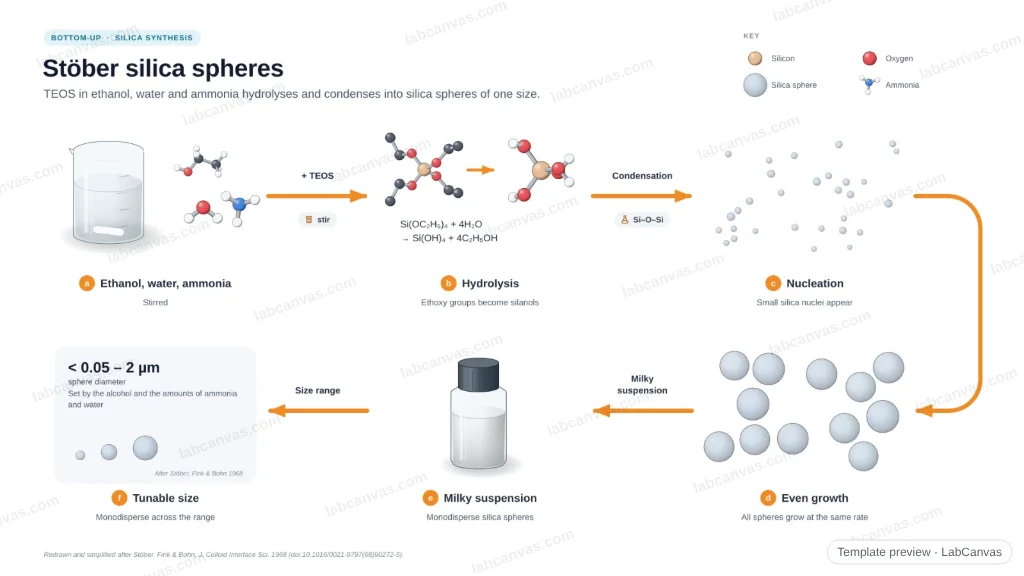
Tetraethyl orthosilicate (TEOS) is added to a stirred mixture of ethanol, water and ammonia. Ammonia catalyses the hydrolysis of TEOS to silicic acid and its condensation into Si–O–Si; nuclei form and then grow evenly, giving a milky suspension of uniform silica spheres. Stöber, Fink and Bohn obtained diameters from below 0.05 µm to 2 µm by choosing the alcohol, ammonia and water amounts.
Updated 2 cited papers73 editable layers
At a glance
- Category
- Nanomaterial synthesis
- Method
- Silica synthesis
- Approach
- Bottom-up
- Starting materials
- TEOS (Si(OC₂H₅)₄) in ethanol with water and ammonia
- Product
- Monodisperse amorphous silica spheres in suspension
- Typical size
- From below 0.05 µm to 2 µm in diameter (Stöber, Fink & Bohn)
- Key result
- Very uniform, smooth, amorphous spheres
- Scalability
- High: simple reagents, one pot
- Figure
- 1920 × 1080 px (16:9), 73 editable layers, 16 generated objects
Step by step
- MediumEthanol, water and ammonia, stirred
- Add TEOSHydrolysis: Si(OC₂H₅)₄ + 4H₂O → Si(OH)₄ + 4C₂H₅OH
- Condensation and nucleationSi–OH groups condense into Si–O–Si; small nuclei form
- GrowthThe nuclei grow evenly into uniform spheres; the suspension turns milky
- CollectCentrifuge and wash, or use the suspension directly
Strengths
- Excellent size uniformity
- Size tunable by ammonia, water and alcohol
- Easy surface chemistry (silanols)
Limitations
- Large spheres are harder to keep monodisperse
- Dilute suspensions; ethanol-heavy
- Particles are microporous rather than ordered-porous
Uses
- Colloidal and photonic crystals
- Cores for core–shell particles
- Coatings and fillers
- Model colloids
Papers this template follows
- Stöber, Fink & Bohn, “Controlled growth of monodisperse silica spheres in the micron size range”, J. Colloid Interface Sci. 1968. doi:10.1016/0021-9797(68)90272-5method origin
- Hench & West, “The sol-gel process”, Chem. Rev. 1990. doi:10.1021/cr00099a003further reading
Redrawn and simplified after Stöber, Fink & Bohn, J. Colloid Interface Sci. 1968 (doi:10.1016/0021-9797(68)90272-5).
How templates are written and checked: editorial guidelines.
Questions
What does the “Stöber synthesis of monodisperse silica spheres” template show?
Tetraethyl orthosilicate (TEOS) is added to a stirred mixture of ethanol, water and ammonia. Ammonia catalyses the hydrolysis of TEOS to silicic acid and its condensation into Si–O–Si; nuclei form and then grow evenly, giving a milky suspension of uniform silica spheres. Stöber, Fink and Bohn obtained diameters from below 0.05 µm to 2 µm by choosing the alcohol, ammonia and water amounts.
What are the steps shown in “Stöber synthesis of monodisperse silica spheres”?
1. Medium: Ethanol, water and ammonia, stirred. 2. Add TEOS: Hydrolysis: Si(OC₂H₅)₄ + 4H₂O → Si(OH)₄ + 4C₂H₅OH. 3. Condensation and nucleation: Si–OH groups condense into Si–O–Si; small nuclei form. 4. Growth: The nuclei grow evenly into uniform spheres; the suspension turns milky. 5. Collect: Centrifuge and wash, or use the suspension directly.
What are the starting materials and the product?
Starting materials: TEOS (Si(OC₂H₅)₄) in ethanol with water and ammonia. Product: Monodisperse amorphous silica spheres in suspension.
Which papers is “Stöber synthesis of monodisperse silica spheres” based on?
Stöber, Fink & Bohn, “Controlled growth of monodisperse silica spheres in the micron size range”, J. Colloid Interface Sci. 1968 (doi:10.1016/0021-9797(68)90272-5); Hench & West, “The sol-gel process”, Chem. Rev. 1990 (doi:10.1021/cr00099a003).
Can I edit the “Stöber synthesis of monodisperse silica spheres” template?
Yes. Open it in the LabCanvas editor: all 73 layers are editable, including 16 generated objects (structures, plots, equipment) with their own settings. Change the text, colours and layout, then export PNG, TIFF, SVG or PDF.
Do I need an account to use this template?
Not to view it here. To open and edit it, sign in to LabCanvas or create a free account (the free plan keeps one design of each kind). Downloading the figure is part of LabCanvas Pro (US$19 a month or US$199 a year).