Graphical abstract template · Nanomaterial synthesis · MOF synthesis · Bottom-up
MOF synthesis: ZIF-8 and UiO-66
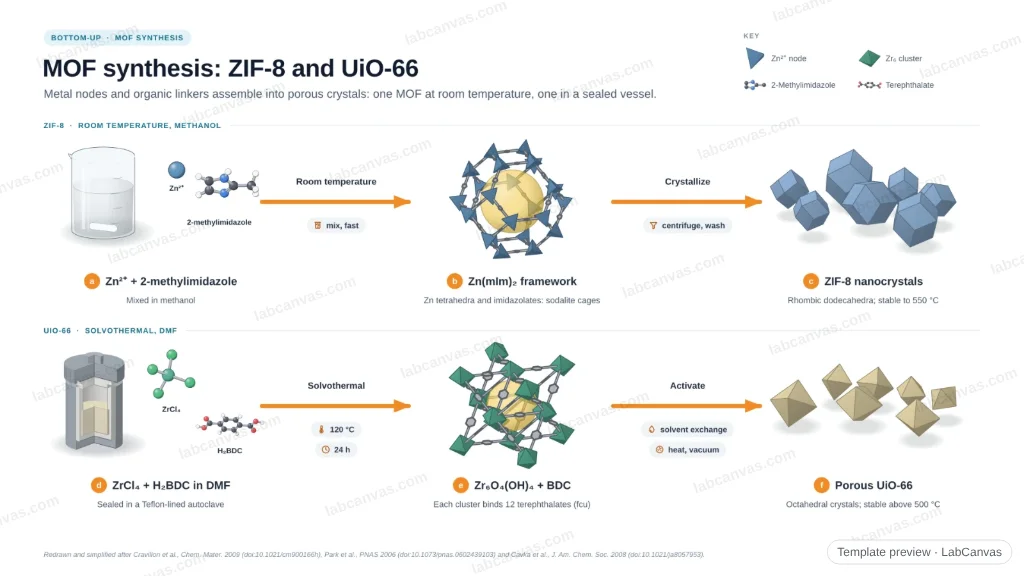
Metal–organic frameworks form when metal ions or clusters link through organic ligands into porous crystals. ZIF-8 forms rapidly when methanol solutions of a zinc salt and 2-methylimidazole are mixed at room temperature: Zn²⁺ tetrahedra joined by imidazolates make sodalite cages and rhombic-dodecahedral crystals. UiO-66 is made solvothermally from ZrCl₄ and terephthalic acid in DMF; Zr₆O₄(OH)₄ clusters each bind twelve terephthalates, and after solvent exchange and activation the octahedral crystals are porous and very stable.
Updated 3 cited papers82 editable layers
At a glance
- Category
- Nanomaterial synthesis
- Method
- MOF synthesis
- Approach
- Bottom-up
- Starting materials
- ZIF-8: zinc nitrate and 2-methylimidazole in methanol. UiO-66: ZrCl₄ and terephthalic acid (H₂BDC) in DMF
- Product
- ZIF-8 nanocrystals (rhombic dodecahedra); UiO-66 crystals (octahedra)
- Typical size
- ZIF-8: nanocrystals from the rapid room-temperature route; UiO-66: small octahedral crystals
- Key result
- Crystalline, permanently porous frameworks
- Scalability
- ZIF-8: high (room temperature, fast). UiO-66: medium (solvothermal, DMF)
- Figure
- 1920 × 1080 px (16:9), 82 editable layers, 19 generated objects
Step by step
- ZIF-8: mixMethanol solutions of a zinc salt and 2-methylimidazole, combined at room temperature (Cravillon et al.)
- ZIF-8: frameworkZn²⁺ tetrahedrally bound to four imidazolates; sodalite (SOD) cages
- ZIF-8: crystalsRhombic-dodecahedral nanocrystals; thermally stable to 550 °C (Park et al.)
- UiO-66: solvothermalZrCl₄ and H₂BDC in DMF, sealed, 120 °C for 24 h (after Cavka et al.)
- UiO-66: frameworkZr₆O₄(OH)₄ clusters, each linked to 12 terephthalates (fcu net)
- UiO-66: activationSolvent exchange, then heating under vacuum empties the pores; stable above 500 °C (Cavka et al.)
Strengths
- Very high surface areas and designed pores
- ZIF-8: fast, mild synthesis; UiO-66: exceptional chemical and thermal stability
- Tunable through linkers and modulators
Limitations
- DMF and solvothermal conditions for UiO-66
- Activation needed to empty the pores
- Defects and crystal size depend sensitively on conditions
Uses
- Gas storage and separation
- Catalysis
- Drug delivery
- Sensing and membranes
Papers this template follows
- Cravillon et al., “Rapid room-temperature synthesis and characterization of nanocrystals of a prototypical zeolitic imidazolate framework”, Chem. Mater. 2009. doi:10.1021/cm900166hprimary
- Park et al., “Exceptional chemical and thermal stability of zeolitic imidazolate frameworks”, PNAS 2006. doi:10.1073/pnas.0602439103method origin
- Cavka et al., “A new zirconium inorganic building brick forming metal organic frameworks with exceptional stability”, J. Am. Chem. Soc. 2008. doi:10.1021/ja8057953method origin
Redrawn and simplified after Cravillon et al., Chem. Mater. 2009 (doi:10.1021/cm900166h), Park et al., PNAS 2006 (doi:10.1073/pnas.0602439103) and Cavka et al., J. Am. Chem. Soc. 2008 (doi:10.1021/ja8057953).
How templates are written and checked: editorial guidelines.
Questions
What does the “MOF synthesis: ZIF-8 and UiO-66” template show?
Metal–organic frameworks form when metal ions or clusters link through organic ligands into porous crystals. ZIF-8 forms rapidly when methanol solutions of a zinc salt and 2-methylimidazole are mixed at room temperature: Zn²⁺ tetrahedra joined by imidazolates make sodalite cages and rhombic-dodecahedral crystals. UiO-66 is made solvothermally from ZrCl₄ and terephthalic acid in DMF; Zr₆O₄(OH)₄ clusters each bind twelve terephthalates, and after solvent exchange and activation the octahedral crystals are porous and very stable.
What are the steps shown in “MOF synthesis: ZIF-8 and UiO-66”?
1. ZIF-8: mix: Methanol solutions of a zinc salt and 2-methylimidazole, combined at room temperature (Cravillon et al.). 2. ZIF-8: framework: Zn²⁺ tetrahedrally bound to four imidazolates; sodalite (SOD) cages. 3. ZIF-8: crystals: Rhombic-dodecahedral nanocrystals; thermally stable to 550 °C (Park et al.). 4. UiO-66: solvothermal: ZrCl₄ and H₂BDC in DMF, sealed, 120 °C for 24 h (after Cavka et al.). 5. UiO-66: framework: Zr₆O₄(OH)₄ clusters, each linked to 12 terephthalates (fcu net). 6. UiO-66: activation: Solvent exchange, then heating under vacuum empties the pores; stable above 500 °C (Cavka et al.).
What are the starting materials and the product?
Starting materials: ZIF-8: zinc nitrate and 2-methylimidazole in methanol. UiO-66: ZrCl₄ and terephthalic acid (H₂BDC) in DMF. Product: ZIF-8 nanocrystals (rhombic dodecahedra); UiO-66 crystals (octahedra).
Which papers is “MOF synthesis: ZIF-8 and UiO-66” based on?
Cravillon et al., “Rapid room-temperature synthesis and characterization of nanocrystals of a prototypical zeolitic imidazolate framework”, Chem. Mater. 2009 (doi:10.1021/cm900166h); Park et al., “Exceptional chemical and thermal stability of zeolitic imidazolate frameworks”, PNAS 2006 (doi:10.1073/pnas.0602439103); Cavka et al., “A new zirconium inorganic building brick forming metal organic frameworks with exceptional stability”, J. Am. Chem. Soc. 2008 (doi:10.1021/ja8057953).
Can I edit the “MOF synthesis: ZIF-8 and UiO-66” template?
Yes. Open it in the LabCanvas editor: all 82 layers are editable, including 19 generated objects (structures, plots, equipment) with their own settings. Change the text, colours and layout, then export PNG, TIFF, SVG or PDF.
Do I need an account to use this template?
Not to view it here. To open and edit it, sign in to LabCanvas or create a free account (the free plan keeps one design of each kind). Downloading the figure is part of LabCanvas Pro (US$19 a month or US$199 a year).