COF-300: the first imine-linked 3D covalent organic framework
COF-300 is a three-dimensional covalent organic framework made from tetrahedral tetra-(4-anilyl)methane and linear terephthaldehyde joined by imine (C=N) bonds, repeat unit C₄₁H₂₈N₄. Reported by Uribe-Romo, Hunt, Furukawa, Klöck, O’Keeffe and Yaghi in J. Am. Chem. Soc. in 2009, it consists of five interwoven diamond nets, yet keeps pores 7.2 Å across, a surface area of 1,360 m² g⁻¹ and thermal stability up to 490 °C.
Last updated
COF-300 at a glance
| Formula | (C₄₁H₂₈N₄)ₙ: one tetra-(4-anilyl)methane and two terephthaldehyde less four water molecules (calculated) |
|---|---|
| Formula mass | 576.7 g mol⁻¹ per C₄₁H₂₈N₄ unit (calculated from the formula) |
| Building blocks | Tetra-(4-anilyl)methane (tetrahedral, C(C₆H₄NH₂)₄) and terephthaldehyde (linear) (Uribe-Romo et al. 2009) |
| Linkage | Imine (C=N), from amine–aldehyde condensation releasing water (Uribe-Romo et al. 2009) |
| Topology | dia (diamond): every tetrahedral carbon joined to four others (Uribe-Romo et al. 2009) |
| Interpenetration | Five independent diamond nets grown through one another (Uribe-Romo et al. 2009) |
| Unit cell (CURATED file) | Tetragonal, a = 28.13 Å, c = 8.88 Å (CURATED COFs entry 09000N3) |
| Pore size | 7.2 Å (Uribe-Romo et al. 2009) |
| Surface area | 1,360 m² g⁻¹ (Uribe-Romo et al. 2009) |
| Thermal stability | Up to 490 °C (Uribe-Romo et al. 2009) |
| Single crystals | Large single crystals of COF-300 and its hydrated form solved by X-ray diffraction (Ma et al. 2018) |
| First reported | Uribe-Romo, Hunt, Furukawa, Klöck, O’Keeffe and Yaghi, J. Am. Chem. Soc. 131, 4570 (2009) |
COF-300 structure diagram
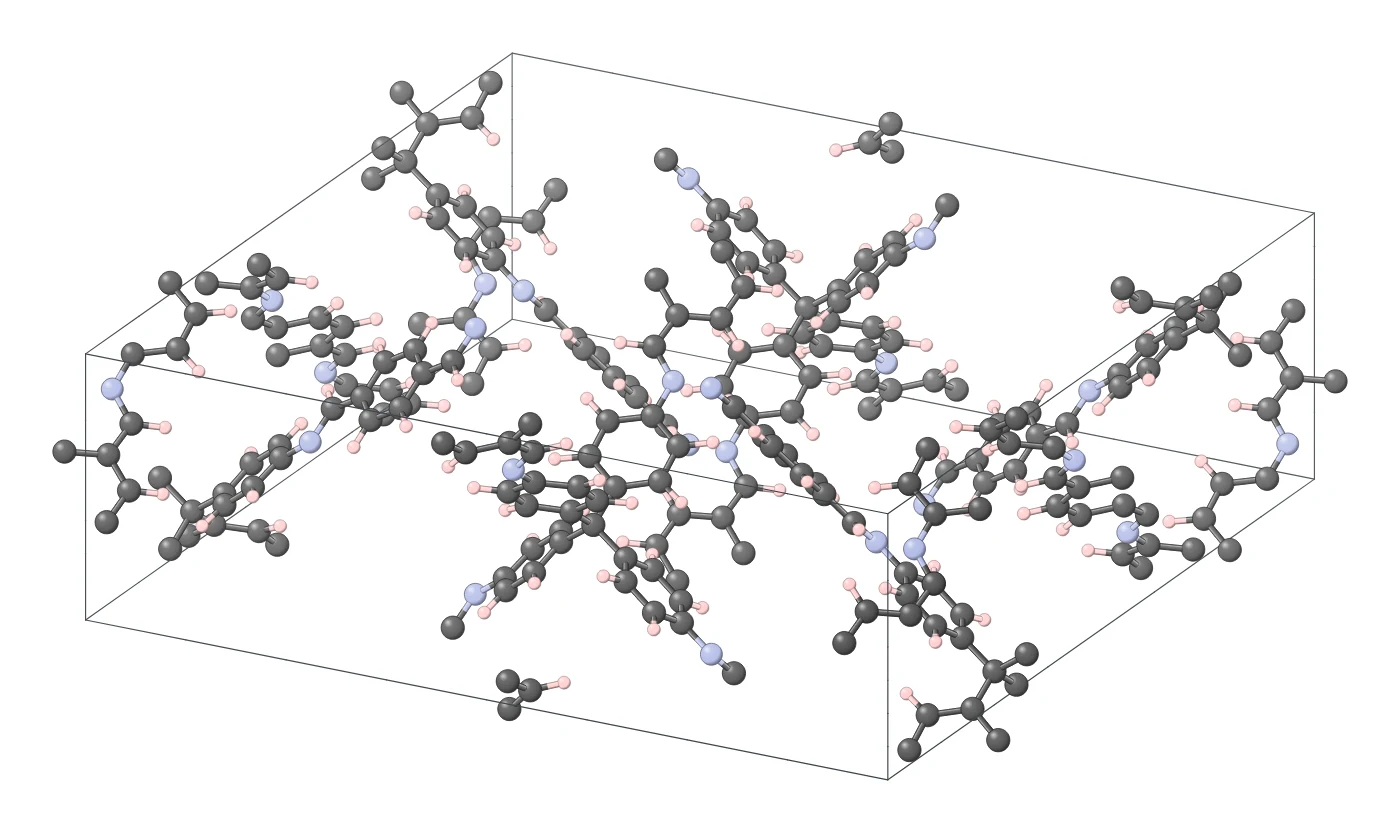
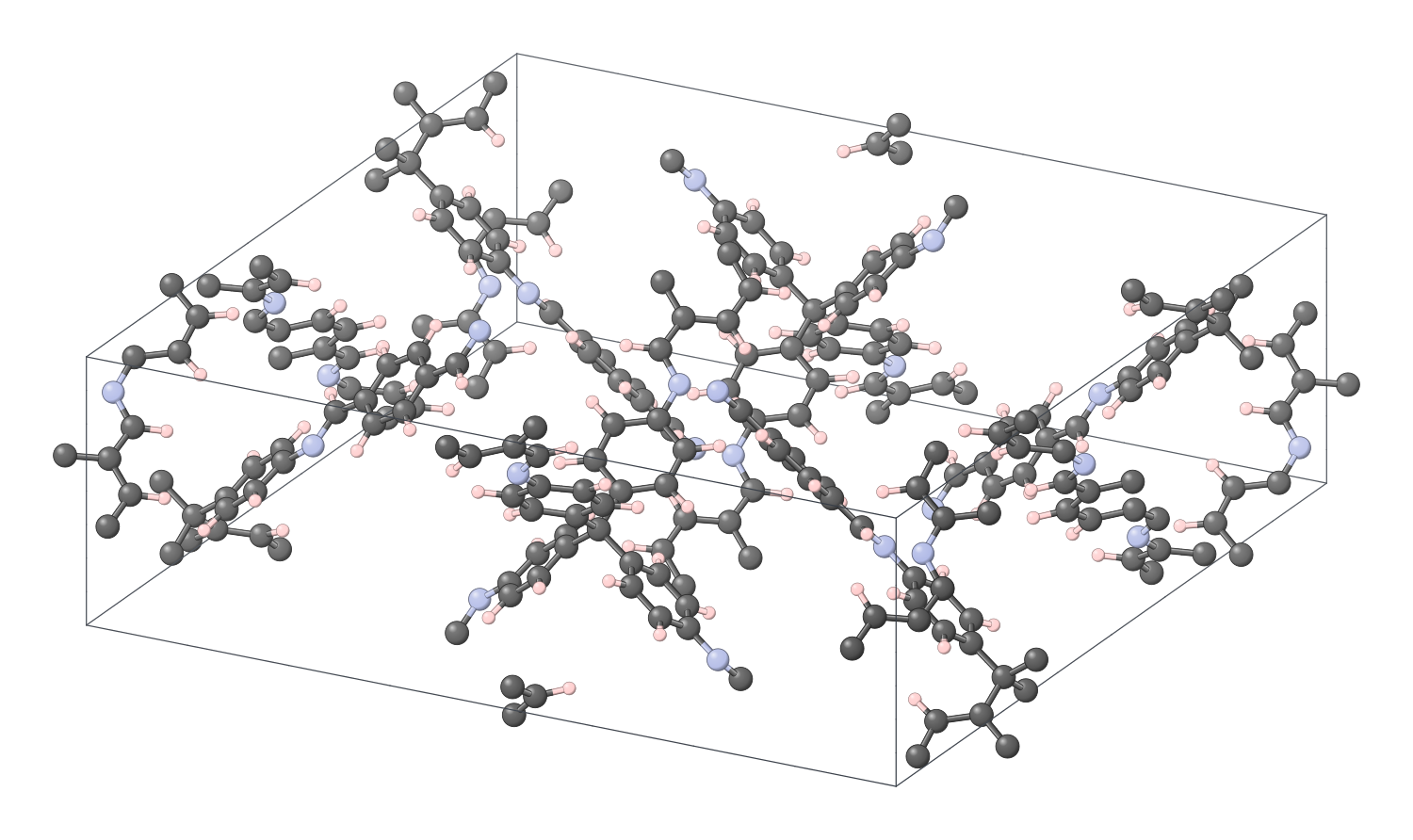
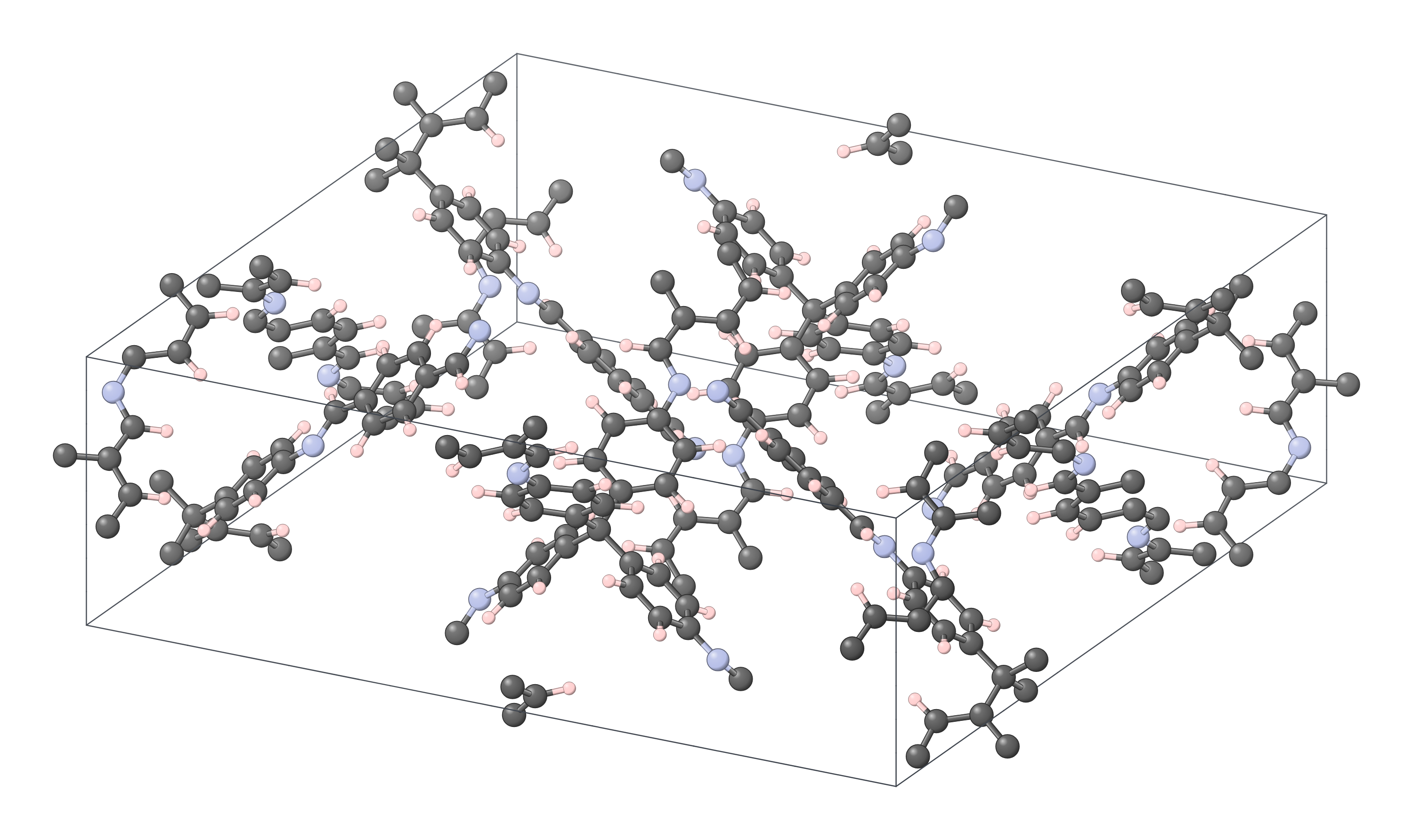
COF-300 crystal structure (high-resolution SVG)
COF-300 in 3D (interactive)
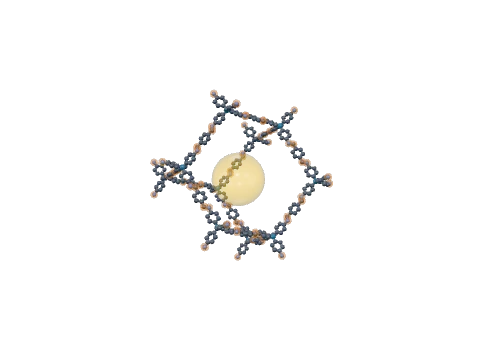
Loading the 3D model…
COF-300 structure explained
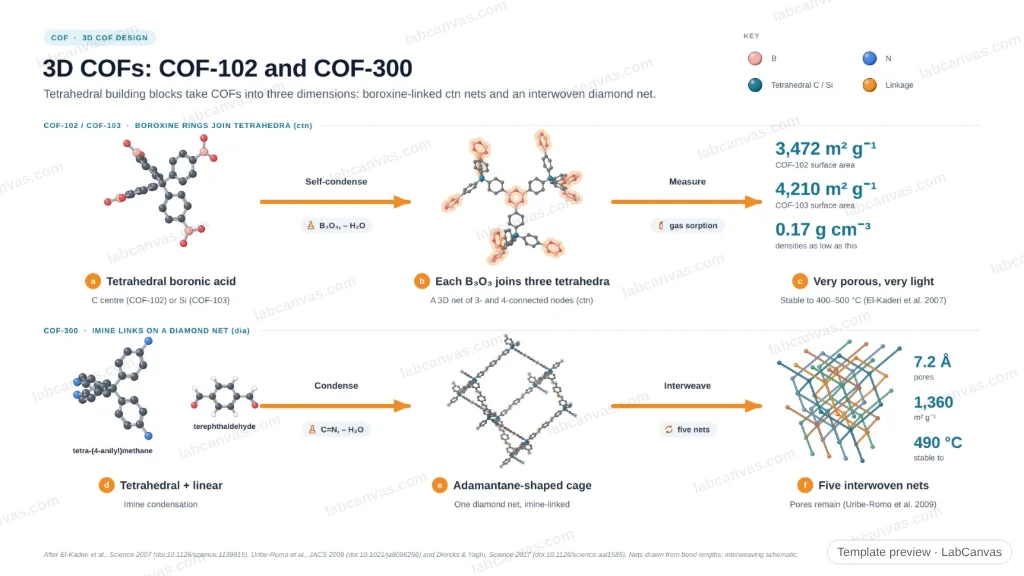
COF-300 takes covalent organic frameworks into three dimensions with a tetrahedral building block. Tetra-(4-anilyl)methane is a central carbon atom carrying four aminophenyl arms that point to the corners of a tetrahedron. Terephthaldehyde is a straight rod with an aldehyde at each end. Each amine condenses with an aldehyde, losing water, to form an imine (C=N) bond.
Every tetrahedral node joins four linkers and every linker joins two nodes, so the framework follows the diamond (dia) net, the same arrangement as the carbon atoms in diamond, with the tetrahedral carbons in place of the atoms and the long linkers in place of the C–C bonds. Its smallest cage has the shape of adamantane.
The cages are so open that further nets grow through them: the X-ray structure shows five independent diamond nets interwoven (interpenetrated) with one another. Even so, pores 7.2 Å across remain (Uribe-Romo et al. 2009).
How COF-300 is made
- Imine condensation. Tetra-(4-anilyl)methane and terephthaldehyde are heated together under solvothermal conditions (Uribe-Romo et al. 2009).
- Self-correction. Imine formation is reversible, so bonds can break and re-form while the solid grows, which lets a crystalline framework form.
- Activation. The solvent is removed from the pores, after which COF-300 shows permanent porosity, 1,360 m² g⁻¹, and stability up to 490 °C (Uribe-Romo et al. 2009).
Later, a general procedure for growing large single crystals of 3D imine COFs gave COF-300 and its hydrated form as crystals solved by single-crystal X-ray diffraction, revealing the degree of interpenetration and the arrangement of the water guests (Ma et al. 2018).
Why COF-300 matters
The first 3D COFs, COF-102 and COF-103, were boroxine-linked (El-Kaderi et al. 2007). COF-300 was the first 3D COF linked by imines, made by condensing amines with aldehydes rather than boronic acids. It showed that the geometry of the building blocks, a tetrahedron plus a rod, sets the net, the same design logic that reticular chemistry uses for MOFs.
It also made interpenetration a central topic in 3D COFs: a large, open net tends to fill itself with copies, shrinking the pores. In 2018 COF-300 was among the first COFs solved by single-crystal X-ray diffraction, which let the degree of interpenetration be determined with atomic precision (Ma et al. 2018).
Uses and research areas
- Model 3D COF. COF-300 is the classic example of how a tetrahedral and a linear building block assemble into a 3D COF.
- Crystallography. COF-300 and its hydrated form were among the first COFs solved from single crystals, at up to 0.83 Å resolution across the series studied (Ma et al. 2018).
- Adsorption screening. It is included in the CURATED COFs database, whose optimized structures were used to compute CO₂ and N₂ isotherms (Ongari et al. 2019).
- Limitation. The five-fold interweaving leaves pores of only 7.2 Å, much smaller than a single diamond net of the same linkers would have.
How to draw the COF-300 structure
For a paper, slide or poster, show the two building blocks, one adamantane-shaped cage of the diamond net with imine links, and a sketch of the five interwoven nets in different colours. The figure above has all three and opens as an editable LabCanvas figure. The crystal structure drawing is a high-resolution SVG from the CURATED COFs file and opens in the LabCanvas figure editor, where you can change the style, the number of cells and the view. The 3D model opens in the LabCanvas 3D Studio, where you can show the cage atom by atom, change the atom and bond sizes and export a high-resolution image.
COF-300 compared with other well-known COFs
| COF | Linkage | Building blocks | Structure | Surface area | First report |
|---|---|---|---|---|---|
| COF-300 | Imine | Tetra-(4-anilyl)methane + terephthaldehyde | 3D, five interwoven diamond nets, 7.2 Å pores | 1,360 m² g⁻¹ | Uribe-Romo et al., JACS 2009 |
| COF-102 | Boroxine (B₃O₃) | Tetra(4-dihydroxyborylphenyl)methane | 3D, ctn net | 3,472 m² g⁻¹ | El-Kaderi et al., Science 2007 |
| COF-103 | Boroxine (B₃O₃) | Tetra(4-dihydroxyborylphenyl)silane | 3D, ctn net | 4,210 m² g⁻¹ | El-Kaderi et al., Science 2007 |
| COF-5 | Boronate ester | BDBA + HHTP | 2D, eclipsed, 27 Å channels | 1,590 m² g⁻¹ | Côté et al., Science 2005 |
| COF-1 | Boroxine (B₃O₃) | BDBA alone | 2D, staggered layers | 711 m² g⁻¹ | Côté et al., Science 2005 |
| TpPa-1 | β-Ketoenamine | Tp + p-phenylenediamine | 2D, stable in acid and boiling water | — | Kandambeth et al., JACS 2012 |
Related materials
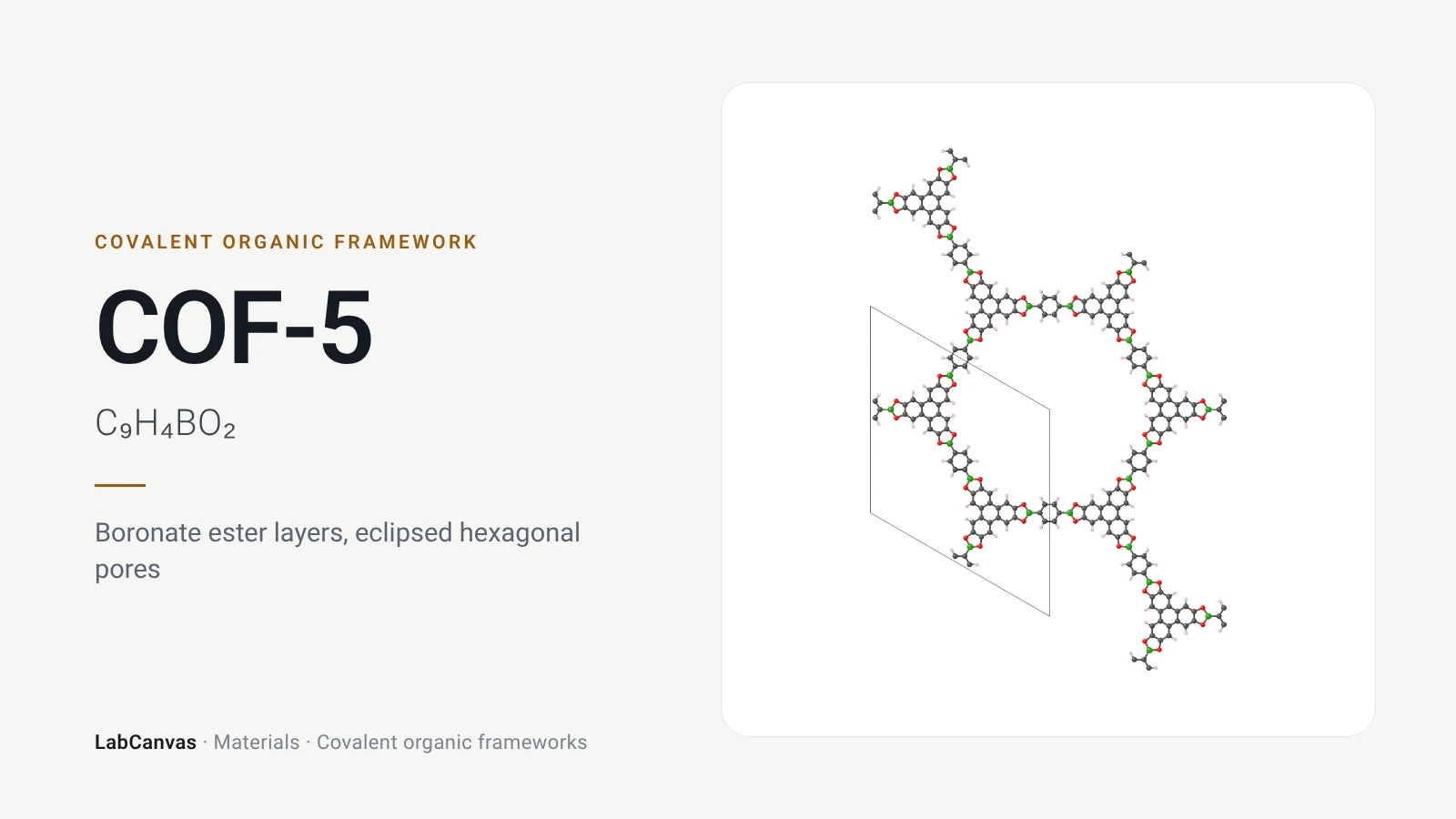
COF-5
COF-5, the boronate ester COF from HHTP and BDBA: eclipsed layers, 27 Å channels, 1,590 m² g⁻¹, synthesis and stability, with 2D and 3D figures to edit.
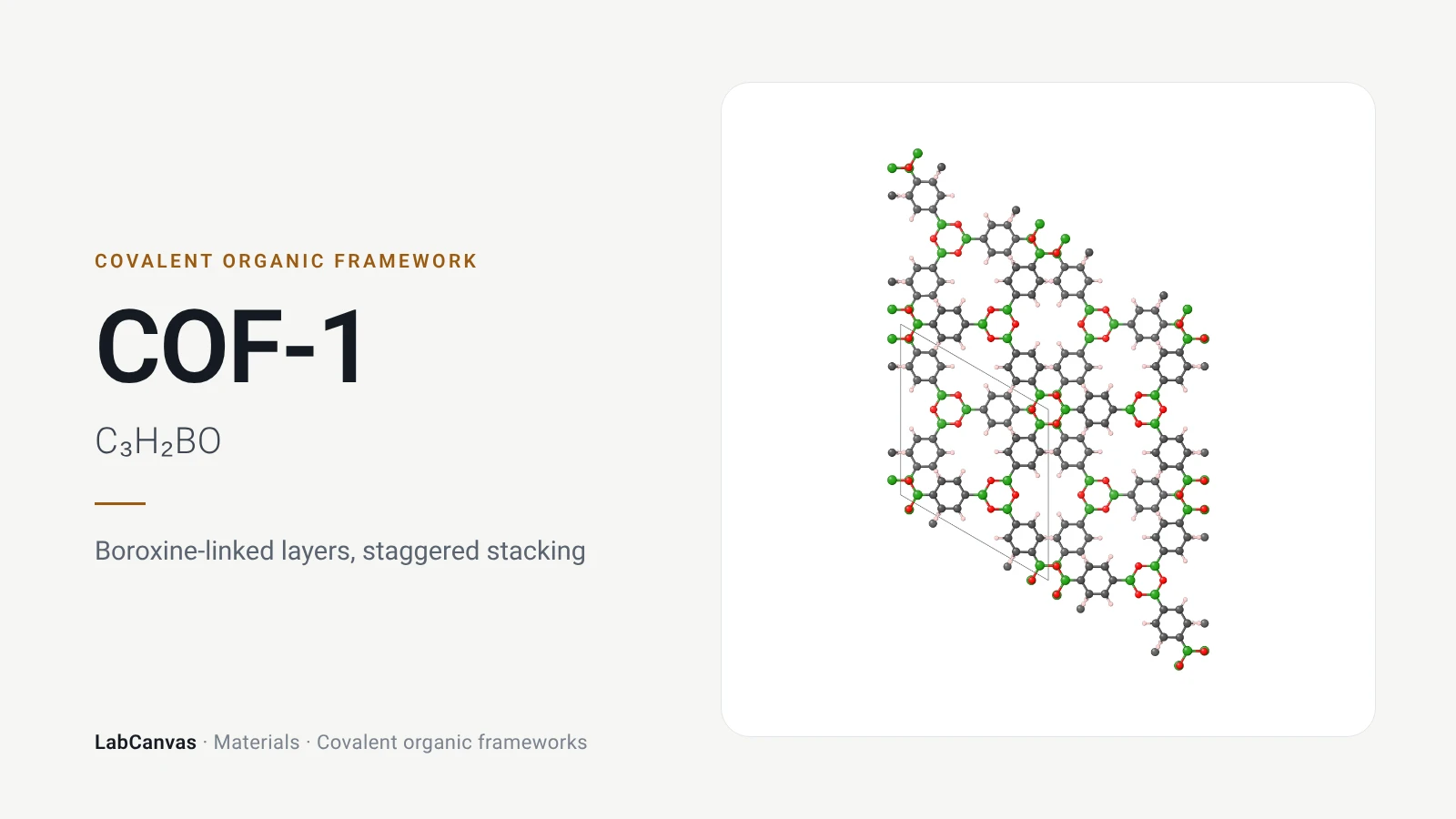
COF-1
COF-1, the first covalent organic framework: boroxine-linked layers from one boronic acid, staggered stacking, 711 m² g⁻¹, synthesis and stability, cited.
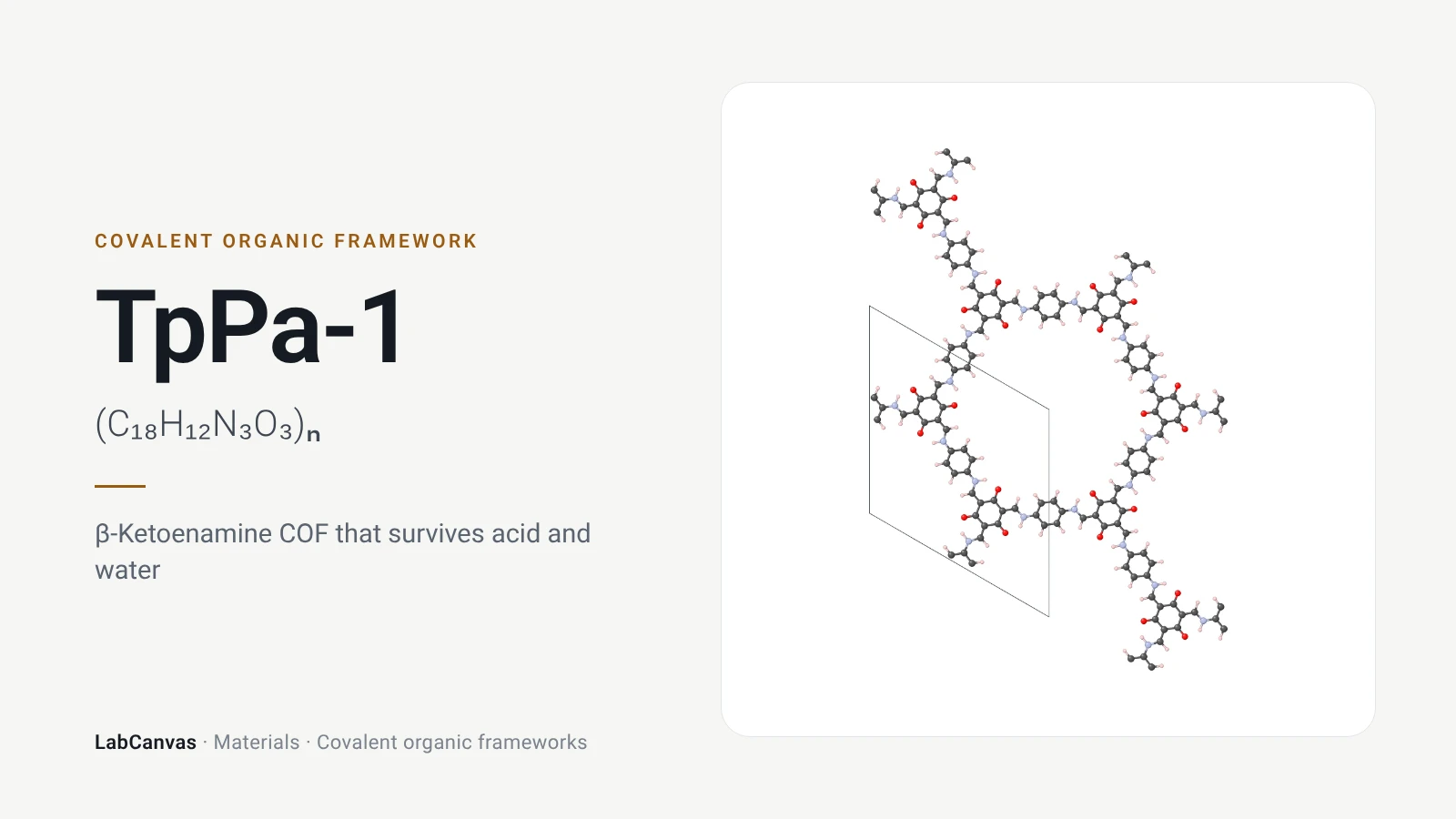
TpPa-1
TpPa-1, the β-ketoenamine COF from Tp and p-phenylenediamine: why it survives acid and boiling water, its structure, synthesis and surface area, cited.
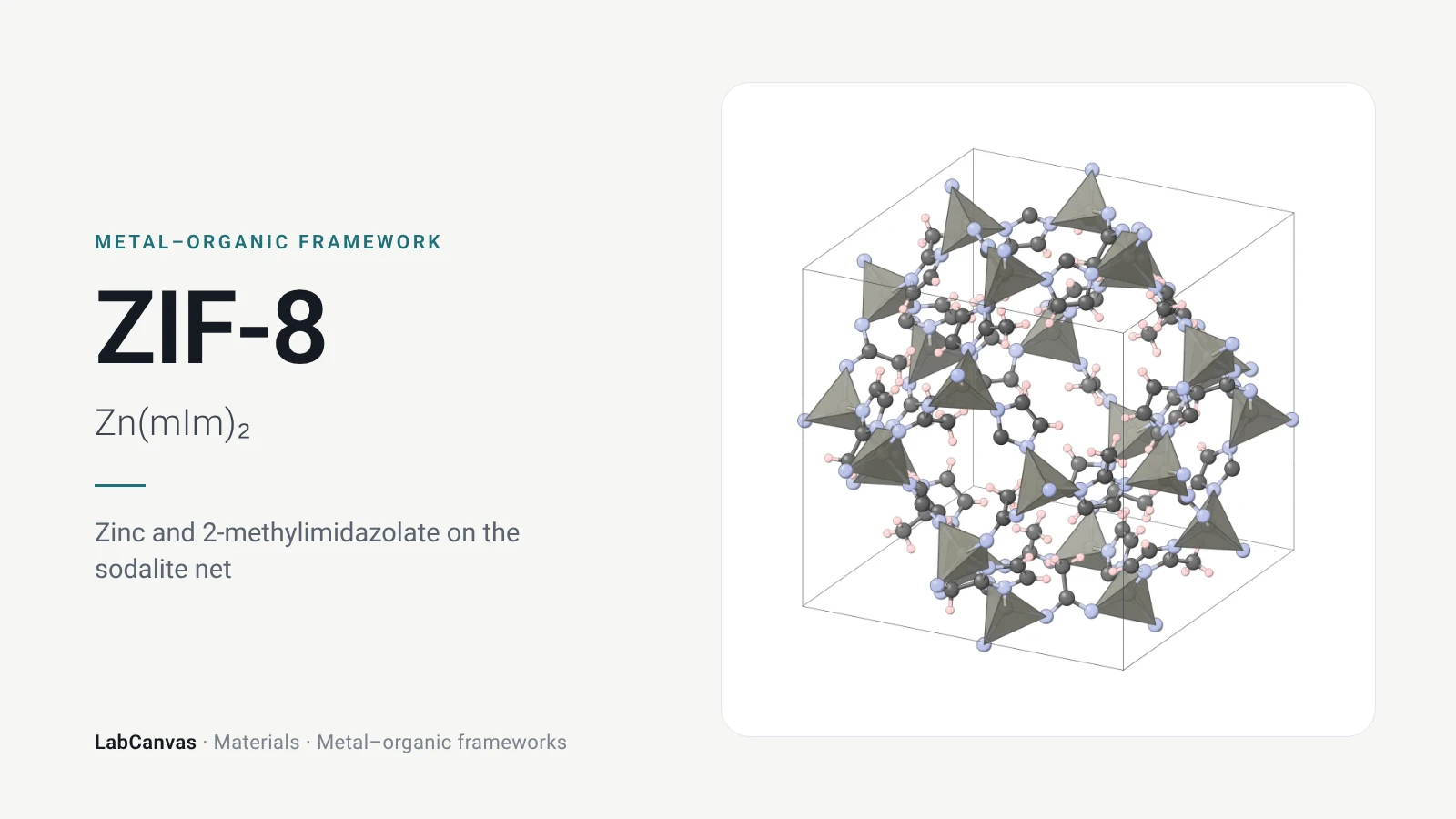
ZIF-8
ZIF-8, Zn(mIm)₂: its sodalite structure in 2D and 3D, how it is made, pore size, surface area and stability, with the original papers. Edit the figures free.
More on LabCanvas
- 3D COFs: COF-102 and COF-300: Editable figure template
- More COF figure templates: Ready-made, cited figures to edit
- Crystal structure figure software compared: VESTA, Mercury, CrystalMaker, Avogadro and LabCanvas
- XRD Scherrer crystallite size calculator: Free tool
- Molar mass calculator: Free tool
- Journal figure size guide: Column widths and resolutions for 38 journals
- 3D models gallery: Turn MOFs, COFs and more in 3D
Frequently asked questions
What is COF-300?
COF-300 is a three-dimensional covalent organic framework of tetra-(4-anilyl)methane and terephthaldehyde joined by imine bonds on a diamond net. Reported by the Yaghi group in 2009, it was the first imine-linked 3D COF.
What is the pore size of COF-300?
7.2 Å. Five diamond nets interweave, which shrinks the pores, but 7.2 Å channels remain (Uribe-Romo et al., JACS 2009).
What is the surface area of COF-300?
1,360 m²/g (Uribe-Romo et al., JACS 2009).
What is the topology of COF-300?
dia, the diamond net: each tetrahedral carbon is linked through terephthaldehyde to four others. The crystal contains five such nets interpenetrating one another.
How is COF-300 synthesised?
By imine condensation of tetra-(4-anilyl)methane and terephthaldehyde under solvothermal conditions (Uribe-Romo et al., JACS 2009). The reversible imine bond lets the framework crystallize.
Is COF-300 thermally stable?
Yes: it is stable up to 490 °C and permanently porous (Uribe-Romo et al., JACS 2009).
What does five-fold interpenetrated mean?
Five identical diamond nets occupy the same crystal, each passing through the open cages of the others without being bonded to them. In COF-300 the five nets still leave 7.2 Å pores.
Can COF-300 be grown as single crystals?
Yes. Large single crystals of COF-300 and of its hydrated form were grown and solved by single-crystal X-ray diffraction (Ma et al., Science 2018).
How can I draw COF-300 for a paper or presentation?
Open the 3D COF figure on this page in LabCanvas (free) to edit the building blocks, cage and interwoven nets, open the crystal structure drawing in the figure editor, or open the 3D model in the LabCanvas 3D Studio and export a render.
References
- F. J. Uribe-Romo, J. R. Hunt, H. Furukawa, C. Klöck, M. O’Keeffe, O. M. Yaghi. A crystalline imine-linked 3-D porous covalent organic framework. J. Am. Chem. Soc. 2009, 131, 4570–4571. doi:10.1021/ja8096256
- T. Ma et al.. Single-crystal x-ray diffraction structures of covalent organic frameworks. Science 2018, 361, 48–52. doi:10.1126/science.aat7679
- H. M. El-Kaderi et al.. Designed synthesis of 3D covalent organic frameworks. Science 2007, 316, 268–272. doi:10.1126/science.1139915
- C. S. Diercks, O. M. Yaghi. The atom, the molecule, and the covalent organic framework. Science 2017, 355, eaal1585. doi:10.1126/science.aal1585
- D. Ongari, A. V. Yakutovich, L. Talirz, B. Smit. Building a consistent and reproducible database for adsorption evaluation in covalent-organic frameworks. ACS Cent. Sci. 2019, 5, 1663–1675. doi:10.1021/acscentsci.9b00619
- A. P. Côté, A. I. Benin, N. W. Ockwig, M. O’Keeffe, A. J. Matzger, O. M. Yaghi. Porous, crystalline, covalent organic frameworks. Science 2005, 310, 1166–1170. doi:10.1126/science.1120411
- S. Kandambeth et al.. Construction of crystalline 2D covalent organic frameworks with remarkable chemical (acid/base) stability via a combined reversible and irreversible route. J. Am. Chem. Soc. 2012, 134, 19524–19527. doi:10.1021/ja308278w
Draw COF-300 for your paper or slides
LabCanvas is a browser workspace for scientific figures: framework clusters, linkers and nets, crystal structures in 2D and 3D, graphs and posters, all editable.
Edit the COF-300 figure