ZIF-8: structure, synthesis and properties
ZIF-8 is a zeolitic imidazolate framework, Zn(mIm)₂: single tetrahedral Zn²⁺ ions joined by 2-methylimidazolate (mIm⁻) linkers into a sodalite (sod) net, with cages 11.6 Å across connected by windows 3.4 Å wide. First reported by Park, Yaghi and co-workers in PNAS in 2006, it has a Langmuir surface area of 1,810 m² g⁻¹, is stable up to 550 °C, and resists boiling water, organic solvents and hot aqueous sodium hydroxide.
Last updated
ZIF-8 at a glance
| Formula | Zn(mIm)₂, mIm⁻ = 2-methylimidazolate (C₄H₅N₂⁻) |
|---|---|
| Other names | Zinc 2-methylimidazolate; zeolitic imidazolate framework-8 |
| Molar mass | 227.6 g mol⁻¹ (calculated from the formula) |
| Metal node | A single Zn²⁺ ion bound tetrahedrally to four imidazolate nitrogens, in place of the tetrahedral Si of a zeolite (Park et al. 2006) |
| Organic linker | 2-Methylimidazolate, bridging two zinc ions as oxygen bridges two silicons in a zeolite (Park et al. 2006) |
| Topology | sod (sodalite), the net of the zeolite sodalite (Park et al. 2006) |
| Crystal system | Cubic, space group I-43m, a ≈ 16.99 Å (the crystal file on this page), 12 zinc atoms per cell |
| Pores | Cages 11.6 Å across, joined by six-ring windows 3.4 Å wide (Park et al. 2006); the effective sieving aperture is 4.0–4.2 Å because the linkers can swing (Zhang et al. 2012) |
| Surface area | Langmuir 1,810 m² g⁻¹, BET 1,630 m² g⁻¹ (Park et al. 2006) |
| Density | About 0.92 g cm⁻³ (calculated from the cubic cell) |
| Thermal stability | Up to 550 °C (Park et al. 2006) |
| Chemical stability | Kept its crystallinity for 7 days in boiling benzene, methanol and water, and for 24 h in 0.1 M and 8 M aqueous NaOH at 100 °C (Park et al. 2006) |
| First reported | Park, Ni, Côté, Choi, Huang, Uribe-Romo, Chae, O’Keeffe and Yaghi, PNAS 103, 10186 (2006) |
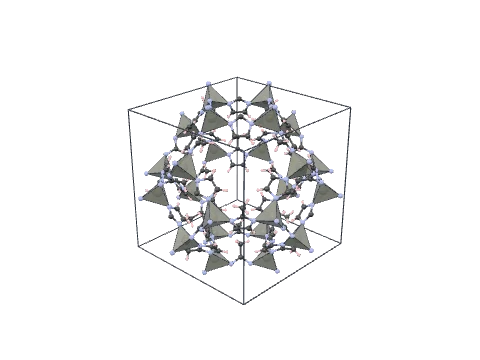
ZIF-8 structure diagram
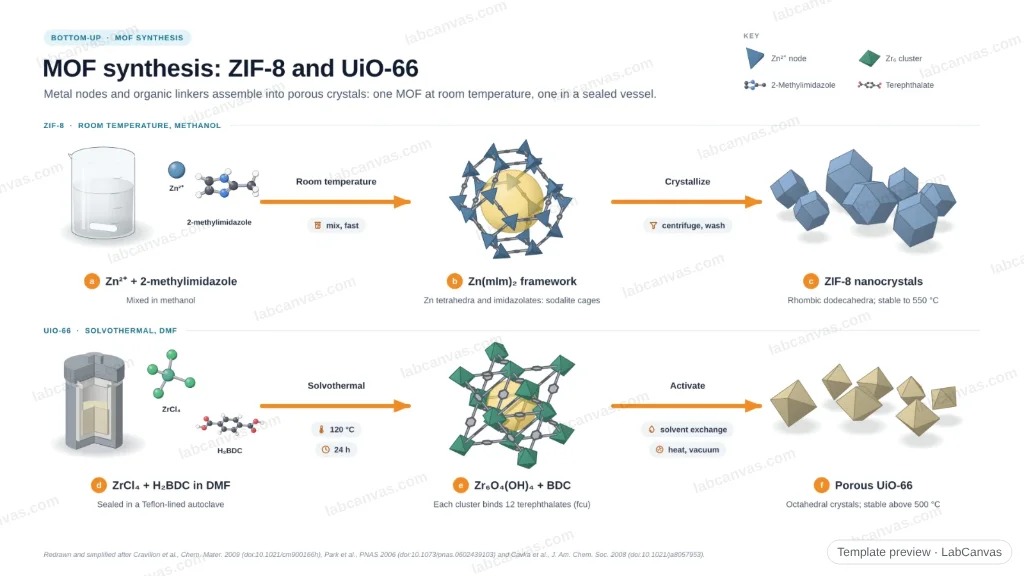
ZIF-8 crystal structure (high-resolution SVG)
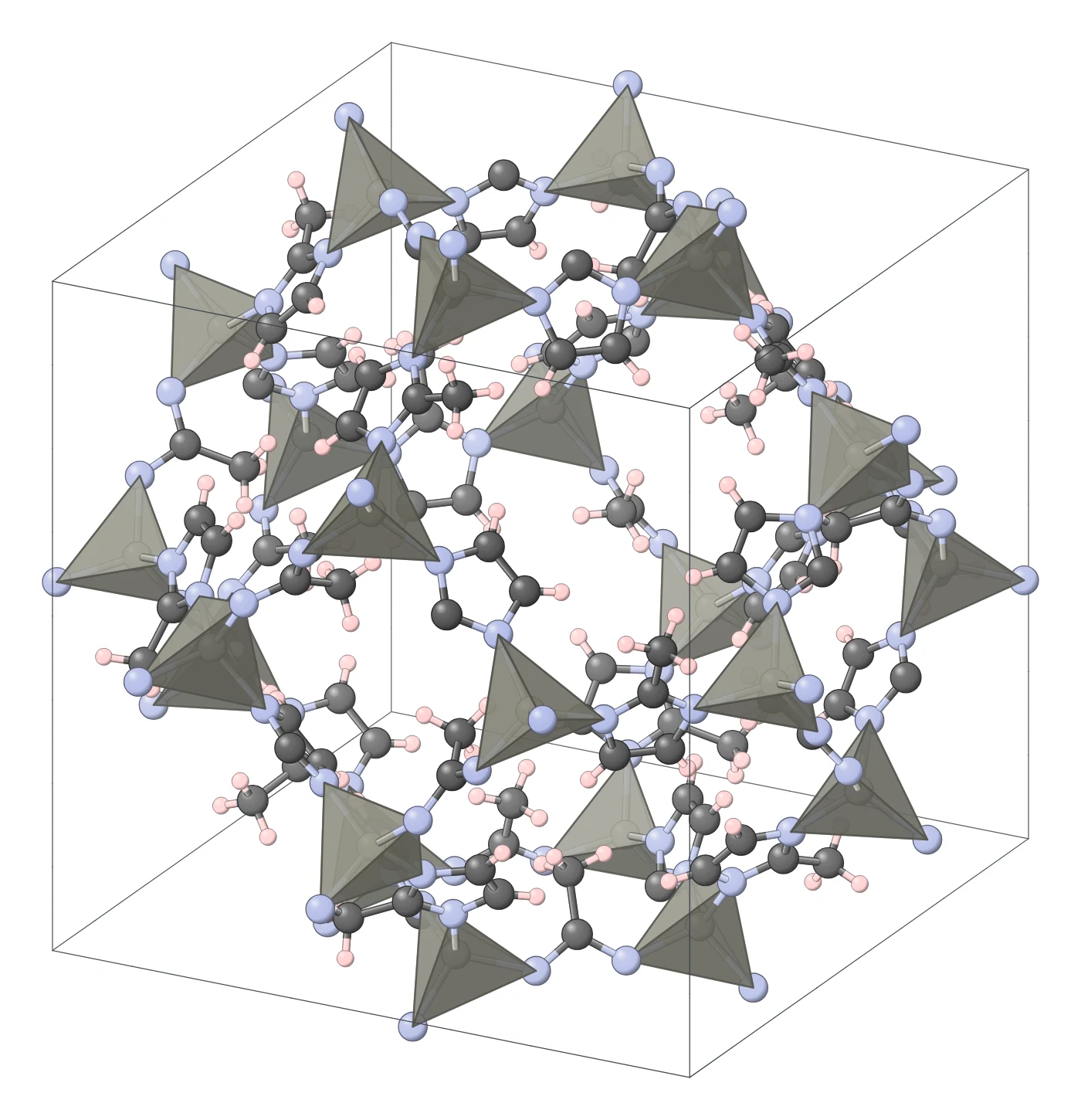
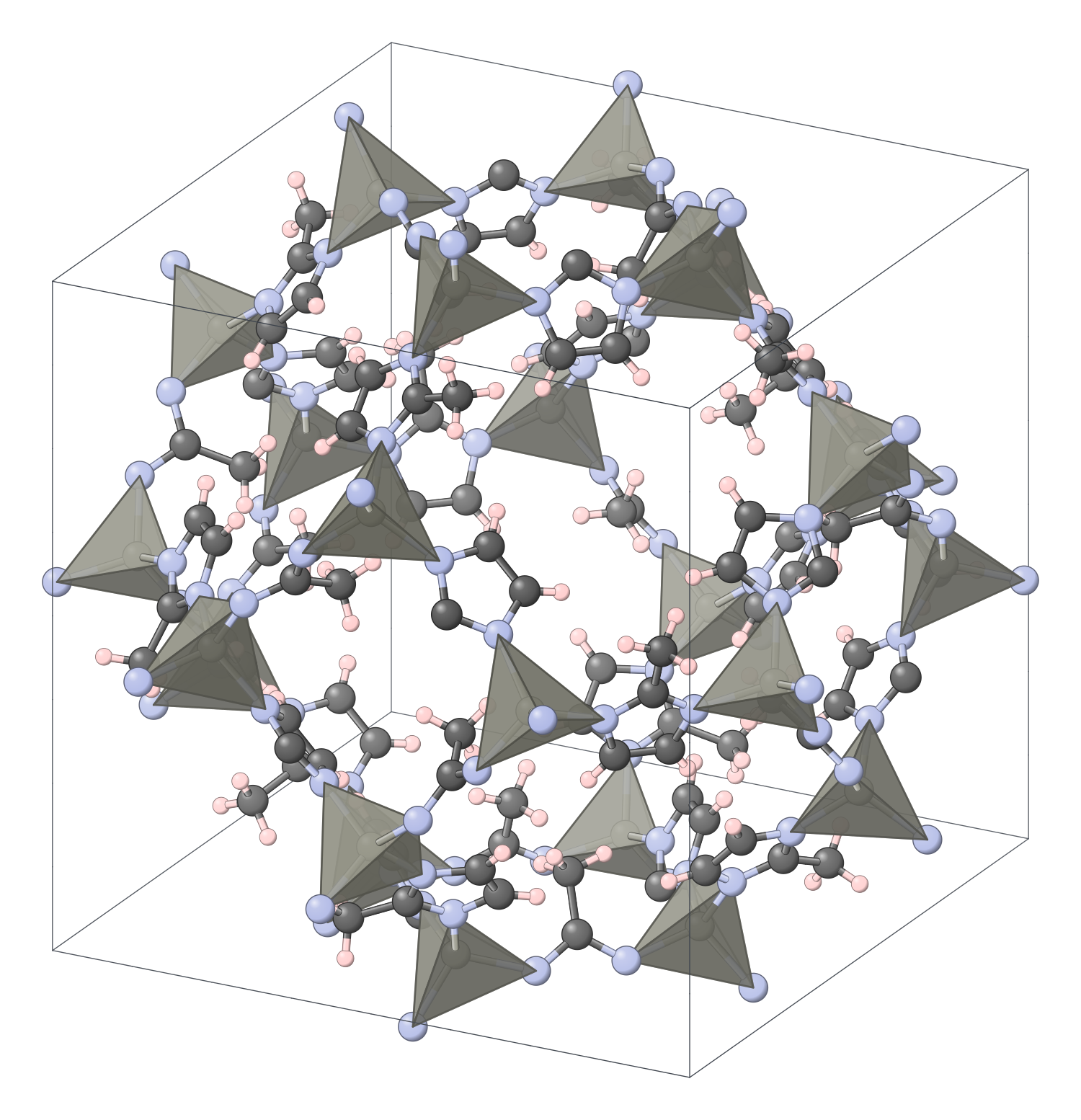
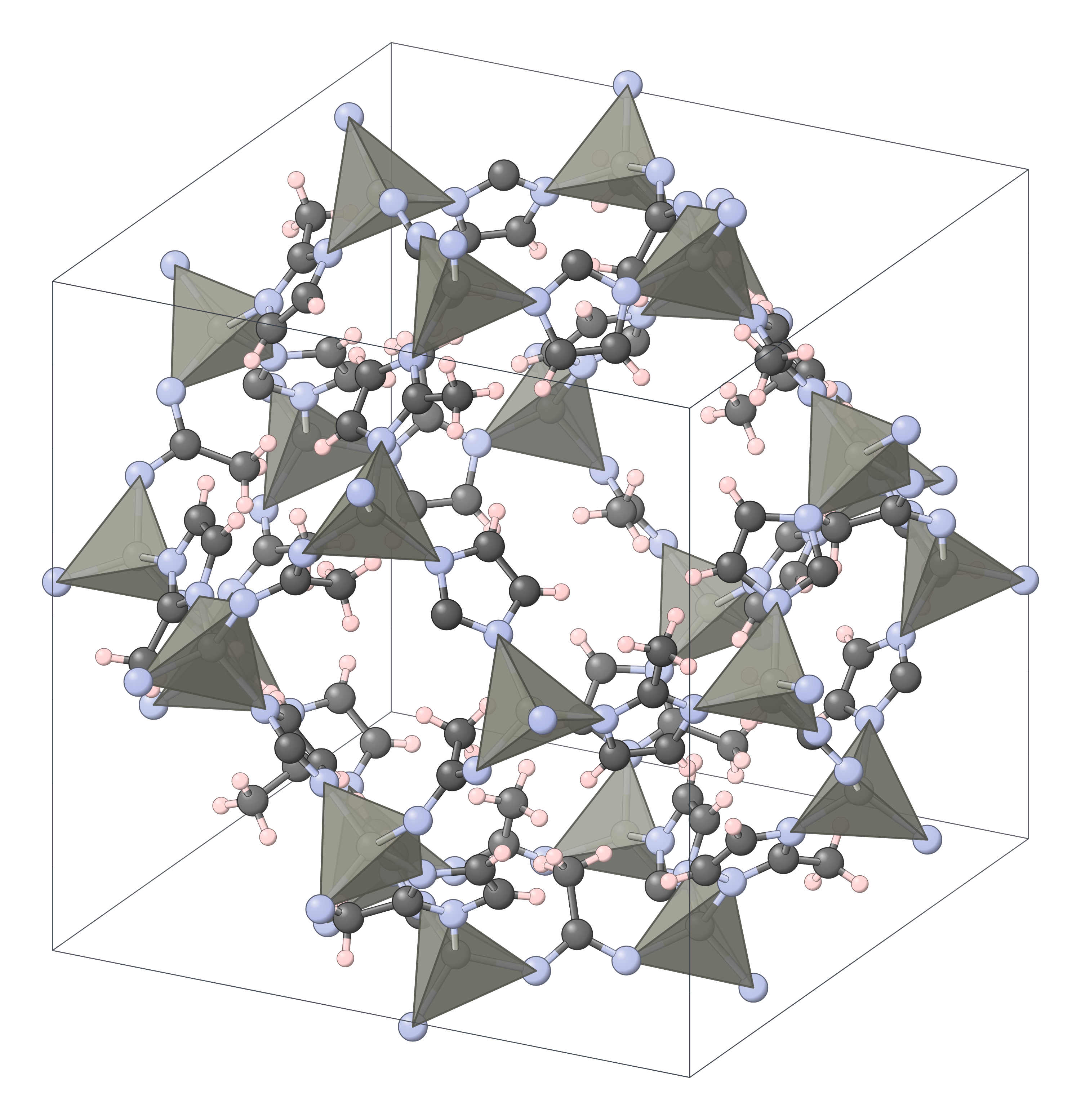
ZIF-8 in 3D (interactive)
Loading the 3D model…
ZIF-8 structure explained
ZIF-8 copies a zeolite with metal and organic parts. In an aluminosilicate zeolite, tetrahedral silicon (or aluminium) atoms are bridged by oxygen. In a zeolitic imidazolate framework (ZIF) the tetrahedral atom is a metal ion and the bridge is an imidazolate (Park et al. 2006). In ZIF-8 every Zn²⁺ is bound to four nitrogen atoms of four 2-methylimidazolate linkers, and each linker joins two zinc ions.
The zinc tetrahedra link up in the sodalite (sod) net, the net of the zeolite sodalite. Its building block is the sodalite (truncated-octahedral) cage, which has square four-ring and hexagonal six-ring faces. In ZIF-8 the cages are 11.6 Å across and are reached through six-ring windows only 3.4 Å wide (Park et al. 2006).
The framework is not rigid. The imidazolate rings can rotate, which widens the windows: diffusion measurements put the effective aperture at 4.0–4.2 Å, so molecules larger than the crystallographic 3.4 Å window still enter (Zhang et al. 2012), and under pressure the substituted rings swing open and the pore volume grows (Hobday et al. 2018). The crystallographic cell is cubic (I-43m, a ≈ 17.0 Å) and holds 12 zinc atoms.
How ZIF-8 is made
- Solvothermal synthesis. In the first report, crystals of ZIF-8 were grown from a zinc salt and 2-methylimidazole heated in N,N-dimethylformamide (DMF) (Park et al. 2006).
- Room temperature in methanol. ZIF-8 also forms quickly when methanol solutions of zinc nitrate and 2-methylimidazole are simply combined at room temperature, giving nanocrystals (Cravillon et al. 2009). Water can replace methanol, with nanocrystals forming at room temperature in minutes (Pan et al. 2011).
- Little or no solvent. ZIF-8 can be made by ball milling (Beldon et al. 2010) and by continuous extrusion (Crawford et al. 2015), and grown as thin films from the vapour phase (Stassen et al. 2016).
- Activation. The product is separated, washed, and the solvent in its pores is exchanged and removed by heating under vacuum to empty the cages.
Why ZIF-8 matters
ZIF-8 showed that a metal–organic framework could combine permanent porosity with the robustness of a zeolite. In the 2006 study that introduced it, ZIF-8 was stable up to 550 °C, and it kept its full crystallinity after 7 days in boiling benzene, methanol and water and after 24 h in 0.1 M and 8 M sodium hydroxide at 100 °C (Park et al. 2006). Most frameworks known at the time would not survive such treatment.
It also made the zeolite analogy concrete. Because the zinc–imidazolate–zinc unit mimics the Si–O–Si unit of a zeolite, ZIFs can be built on the nets of known zeolites; the 2006 paper reported twelve ZIFs on the nets of seven aluminosilicate zeolites (Park et al. 2006). ZIF-8, the sodalite member, became the most studied of them.
Uses and research areas
- Membranes and molecular sieving. Its narrow, flexible windows separate molecules by size: thin ZIF-8 membranes separate propylene from propane (Kwon and Jeong 2013), and ZIF-8 grown in polymer hollow fibres has been used the same way (Brown et al. 2014).
- Thin films for devices. ZIF-8 films can be deposited from the vapour phase (Stassen et al. 2016), and vapour-deposited ZIF-8 has been tested as an ultra-low-k dielectric that fills narrow trenches (Krishtab et al. 2019).
- Encapsulation. ZIF-8 grows around nanoparticles and other guests, enclosing them in a porous shell (Lu et al. 2012).
- Porous carbons. Carbonising ZIF-8 directly gives nanoporous carbon for supercapacitor electrodes (Chaikittisilp et al. 2012).
- Model of framework flexibility. The swing of its imidazolate linkers is a standard case for studying how a framework opens to guests (Fairen-Jimenez et al. 2011; Hobday et al. 2018).
How to draw the ZIF-8 structure
For a paper, slide or poster, show three levels: one Zn²⁺ with four 2-methylimidazolate linkers (a blue ZnN₄ tetrahedron), a single sodalite cage with its six-ring windows, and the cubic packing of cages. The synthesis figure above opens as an editable LabCanvas figure. The crystal structure SVG is drawn from the ZIF-8 crystal file by the LabCanvas figure editor, where you can switch between atoms and polyhedra and change the number of cells; the 3D model on this page opens in the LabCanvas 3D Studio, where you can turn it and export a high-resolution image.
ZIF-8 compared with other well-known MOFs
| MOF | Formula | Metal node | Linker | Net | Stable to | First report |
|---|---|---|---|---|---|---|
| ZIF-8 | Zn(mIm)₂ | Single Zn²⁺ (tetrahedral) | 2-Methylimidazolate | sod | 550 °C | Park et al., PNAS 2006 |
| MOF-5 (IRMOF-1) | Zn₄O(BDC)₃ | Zn₄O cluster | Terephthalate | pcu | 300 °C | Li et al., Nature 1999 |
| HKUST-1 | Cu₃(BTC)₂ | Cu₂ paddlewheel | Trimesate (BTC) | tbo | 240 °C | Chui et al., Science 1999 |
| UiO-66 | Zr₆O₄(OH)₄(BDC)₆ | Zr₆ cluster | Terephthalate | fcu | Above 500 °C | Cavka et al., JACS 2008 |
Related materials
UiO-66
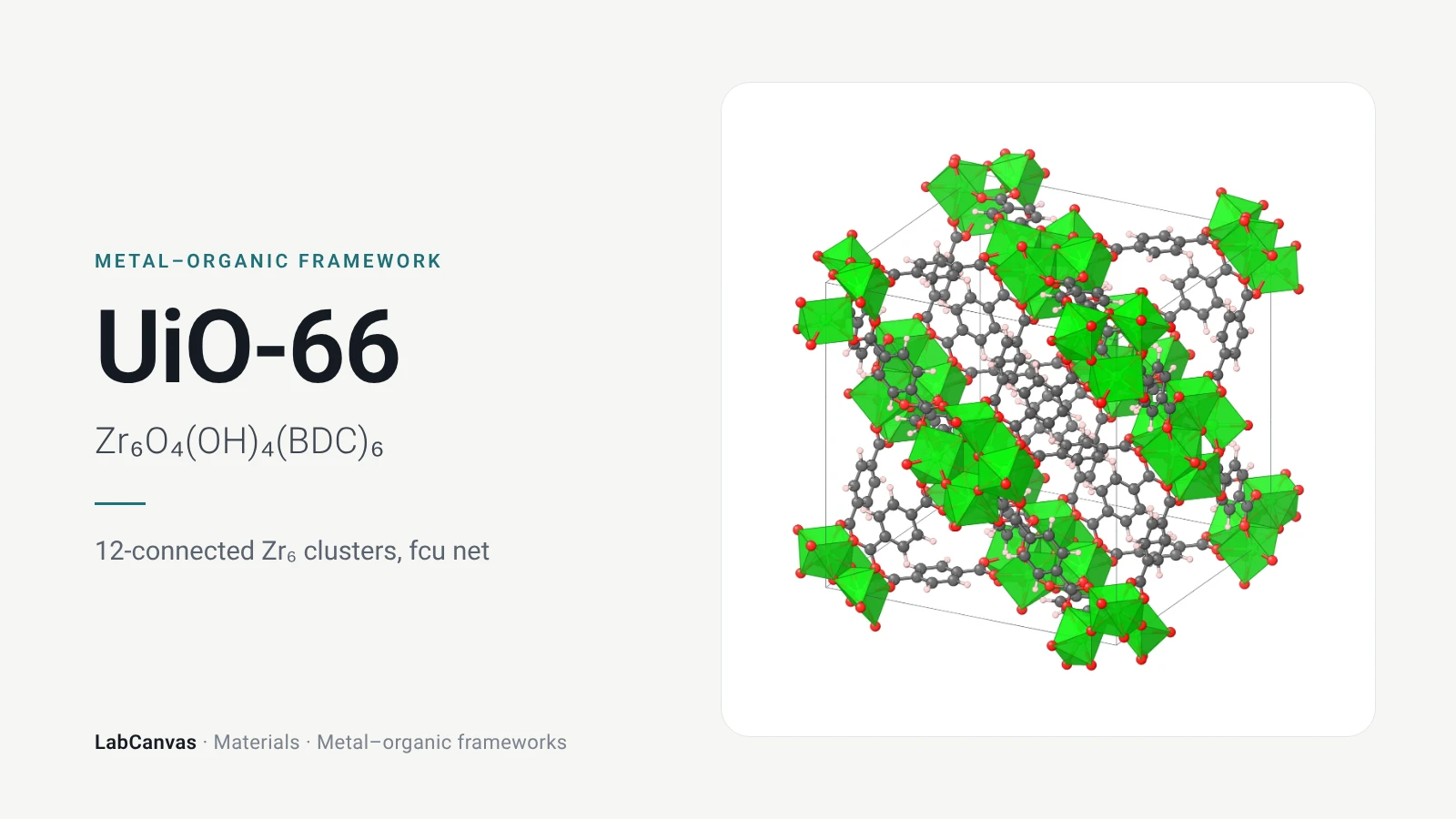
UiO-66, Zr₆O₄(OH)₄(BDC)₆: its fcu structure in 2D and 3D, how it is made, missing-linker defects, pore size, surface area and stability, with the papers.
HKUST-1
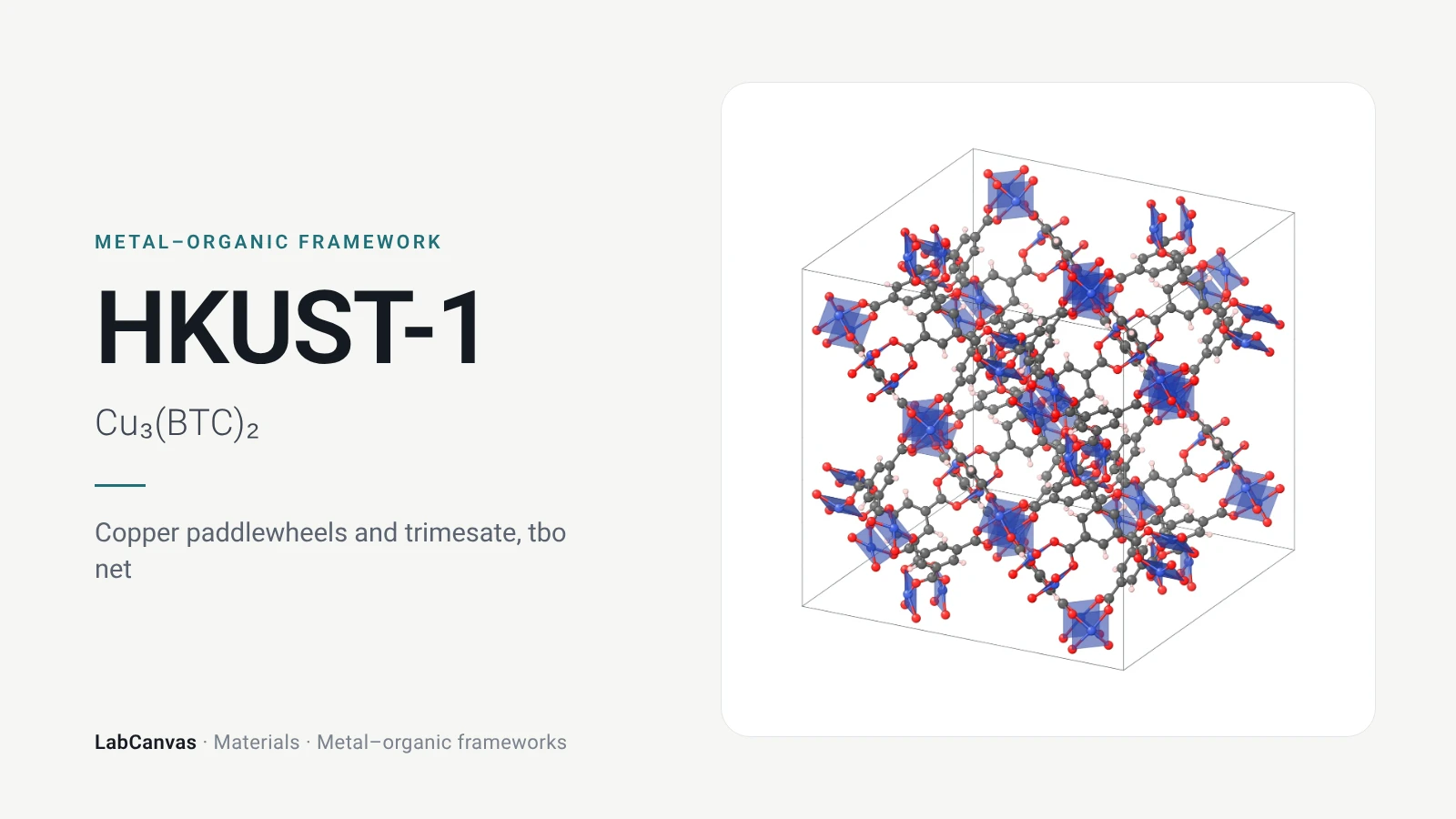
HKUST-1 (Cu-BTC), Cu₃(BTC)₂: its paddlewheel structure in 2D and 3D, how it is made, pore size, open copper sites and stability, with the original papers.
MOF-5
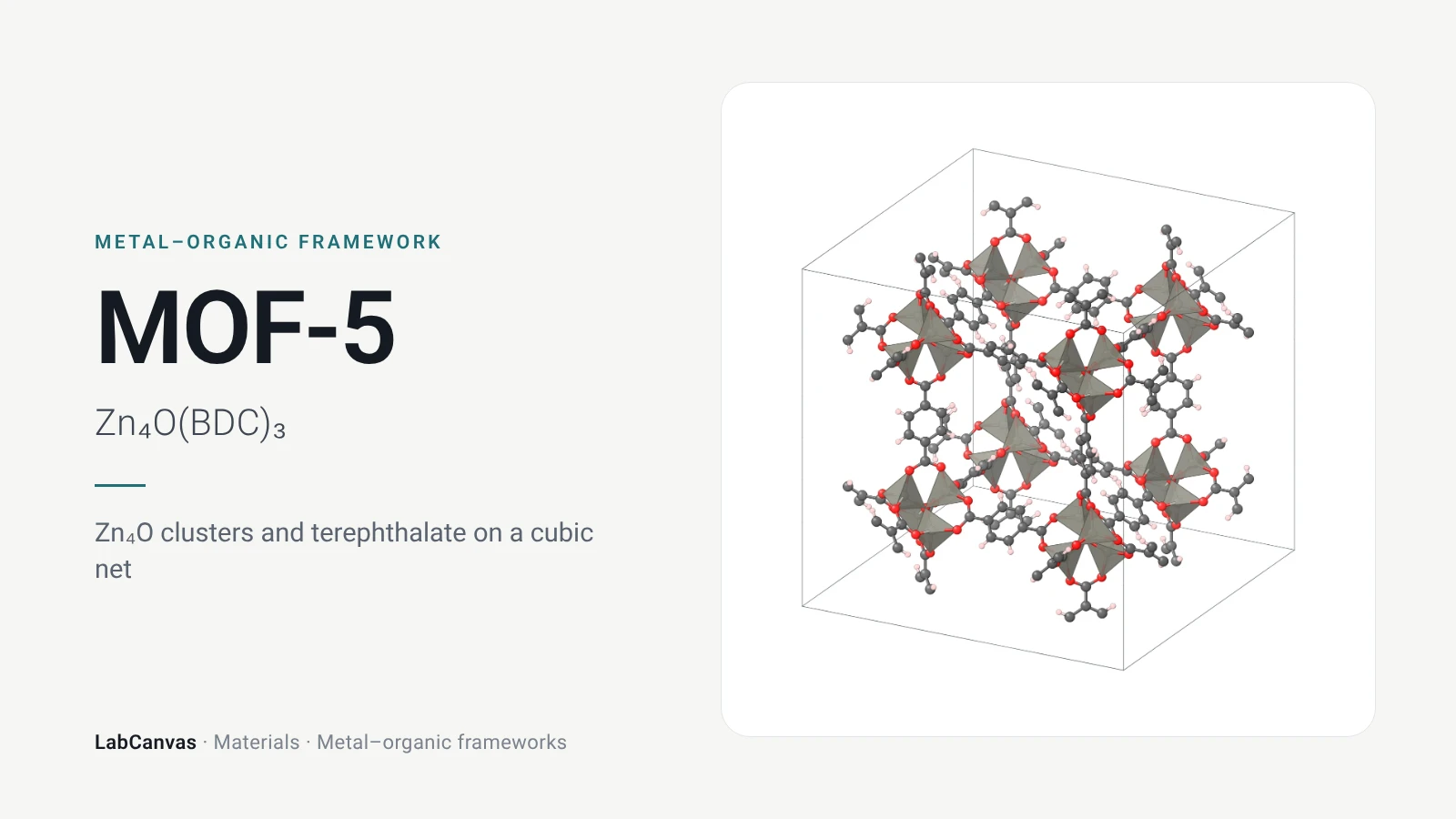
MOF-5, Zn₄O(BDC)₃: its cubic structure in 2D and interactive 3D, how it is made, surface area, stability and uses, with the original papers. Edit the figures free.
MOF-74
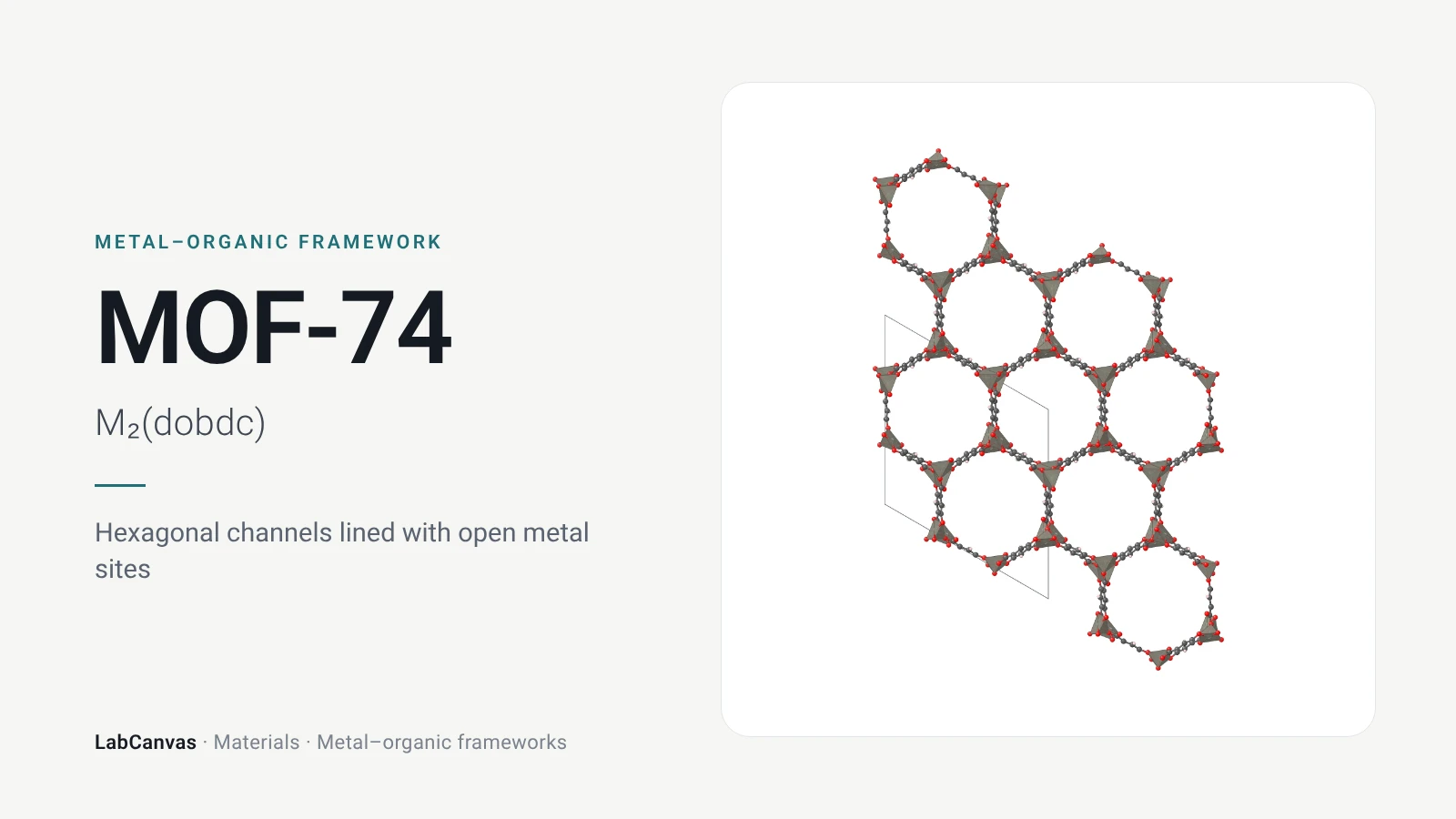
MOF-74 (CPO-27), M₂(dobdc): its honeycomb channels and open metal sites, Mg-MOF-74 for CO₂ capture, Zn-MOF-74, synthesis and pore size, with the papers.
COF-5
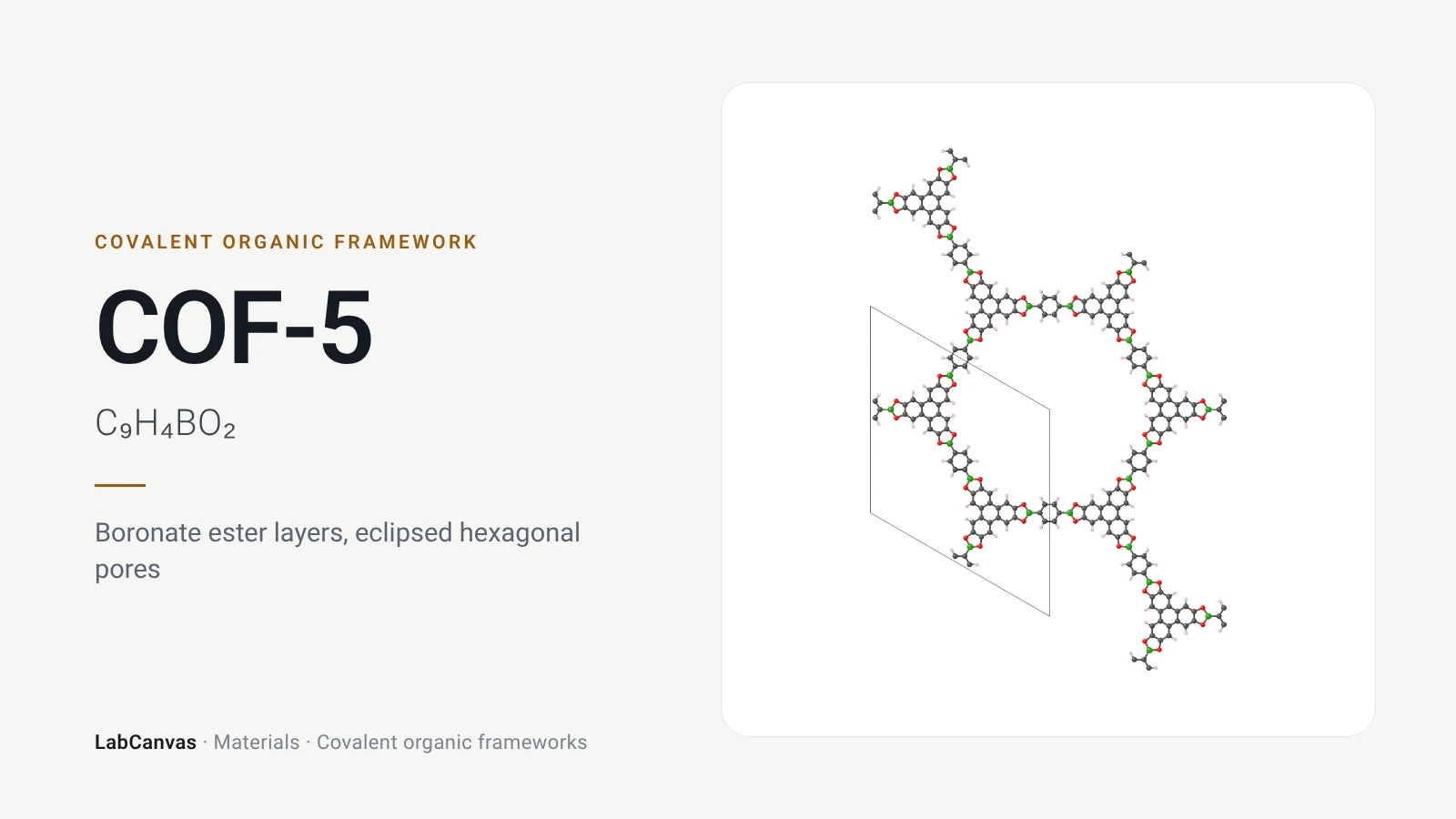
COF-5, the boronate ester COF from HHTP and BDBA: eclipsed layers, 27 Å channels, 1,590 m² g⁻¹, synthesis and stability, with 2D and 3D figures to edit.
More on LabCanvas
- MOF synthesis: ZIF-8 and UiO-66: Editable figure template
- More figure templates in this category: Ready-made, cited figures to edit
- Crystal structure figure software compared: VESTA, Mercury, CrystalMaker, Avogadro and LabCanvas
- XRD Scherrer crystallite size calculator: Free tool
- Molar mass calculator: Free tool
- Journal figure size guide: Column widths and resolutions for 38 journals
- 3D models gallery: Turn MOFs, COFs and more in 3D
Frequently asked questions
What is ZIF-8?
ZIF-8 is a zeolitic imidazolate framework: a porous crystal of zinc ions joined by 2-methylimidazolate linkers in the sodalite topology of a zeolite. It was reported in 2006 by the Yaghi group and is known for its thermal and chemical stability.
What is the chemical formula of ZIF-8?
Zn(mIm)₂, where mIm⁻ is 2-methylimidazolate (C₄H₅N₂⁻); written out, Zn(C₄H₅N₂)₂. Its molar mass is about 227.6 g/mol.
What is the pore size of ZIF-8?
Its cages are 11.6 Å across and are connected by windows 3.4 Å wide in the crystal structure (Park et al., PNAS 2006). Because the linkers can rotate, the effective aperture for diffusing molecules is larger, about 4.0–4.2 Å (Zhang et al., J. Phys. Chem. Lett. 2012).
What is the surface area of ZIF-8?
The first report gave a Langmuir surface area of 1,810 m²/g and a BET surface area of 1,630 m²/g (Park et al., PNAS 2006).
What is the structure of ZIF-8?
Each Zn²⁺ is tetrahedrally bound to four 2-methylimidazolate linkers, and the tetrahedra form the sodalite (sod) net, the same net as the zeolite sodalite. The cubic cell (I-43m) is about 17.0 Å on a side.
Is ZIF-8 stable in water?
In the original study ZIF-8 kept its crystallinity after 7 days in boiling water, benzene and methanol, and after 24 hours in 0.1 M and 8 M sodium hydroxide at 100 °C. It is also stable up to 550 °C (Park et al., PNAS 2006).
How is ZIF-8 synthesised?
The original route heats a zinc salt and 2-methylimidazole in DMF. ZIF-8 nanocrystals also form when methanol solutions of zinc nitrate and 2-methylimidazole are mixed at room temperature (Cravillon et al., Chem. Mater. 2009), and ZIF-8 can be made in water, by ball milling or by extrusion.
Why is ZIF-8 called a zeolitic framework?
Its zinc ions take the place of the tetrahedral silicon atoms of a zeolite and its imidazolate linkers the place of the bridging oxygens, so ZIF-8 adopts a zeolite net, sodalite (Park et al., PNAS 2006). ZIF stands for zeolitic imidazolate framework.
How can I draw ZIF-8 for a paper or presentation?
Open the figure on this page in LabCanvas (free) to edit it, use the crystal structure SVG drawn from the ZIF-8 crystal file, or open the 3D model in the LabCanvas 3D Studio and export a render.
References
- K. S. Park, Z. Ni, A. P. Côté, J. Y. Choi, R. Huang, F. J. Uribe-Romo, H. K. Chae, M. O’Keeffe, O. M. Yaghi. Exceptional chemical and thermal stability of zeolitic imidazolate frameworks. Proc. Natl. Acad. Sci. USA 2006, 103, 10186–10191. doi:10.1073/pnas.0602439103
- J. Cravillon, S. Münzer, S.-J. Lohmeier, A. Feldhoff, K. Huber, M. Wiebcke. Rapid room-temperature synthesis and characterization of nanocrystals of a prototypical zeolitic imidazolate framework. Chem. Mater. 2009, 21, 1410–1412. doi:10.1021/cm900166h
- C. Zhang et al.. Unexpected molecular sieving properties of zeolitic imidazolate framework-8. J. Phys. Chem. Lett. 2012, 3, 2130–2134. doi:10.1021/jz300855a
- C. L. Hobday et al.. Tuning the swing effect by chemical functionalization of zeolitic imidazolate frameworks. J. Am. Chem. Soc. 2018, 140, 382–387. doi:10.1021/jacs.7b10897
- D. Fairen-Jimenez et al.. Opening the gate: framework flexibility in ZIF-8 explored by experiments and simulations. J. Am. Chem. Soc. 2011, 133, 8900. doi:10.1021/ja202154j
- Y. Pan et al.. Rapid synthesis of zeolitic imidazolate framework-8 (ZIF-8) nanocrystals in an aqueous system. Chem. Commun. 2011, 47, 2071. doi:10.1039/c0cc05002d
- P. J. Beldon et al.. Rapid room-temperature synthesis of zeolitic imidazolate frameworks by using mechanochemistry. Angew. Chem. Int. Ed. 2010, 49, 9640. doi:10.1002/anie.201005547
- D. Crawford et al.. Synthesis by extrusion: continuous, large-scale preparation of MOFs using little or no solvent. Chem. Sci. 2015, 6, 1645. doi:10.1039/c4sc03217a
- I. Stassen et al.. Chemical vapour deposition of zeolitic imidazolate framework thin films. Nat. Mater. 2016, 15, 304. doi:10.1038/nmat4509
- H. T. Kwon, H.-K. Jeong. In situ synthesis of thin zeolitic-imidazolate framework ZIF-8 membranes exhibiting exceptionally high propylene/propane separation. J. Am. Chem. Soc. 2013, 135, 10763. doi:10.1021/ja403849c
- A. J. Brown et al.. Interfacial microfluidic processing of metal-organic framework hollow fiber membranes. Science 2014, 345, 72. doi:10.1126/science.1251181
- G. Lu et al.. Imparting functionality to a metal-organic framework material by controlled nanoparticle encapsulation. Nat. Chem. 2012, 4, 310. doi:10.1038/nchem.1272
- W. Chaikittisilp et al.. Nanoporous carbons through direct carbonization of a zeolitic imidazolate framework for supercapacitor electrodes. Chem. Commun. 2012, 48, 7259. doi:10.1039/c2cc33433j
- M. Krishtab et al.. Vapor-deposited zeolitic imidazolate frameworks as gap-filling ultra-low-k dielectrics. Nat. Commun. 2019, 10, 3729. doi:10.1038/s41467-019-11703-x
Draw ZIF-8 for your paper or slides
LabCanvas is a browser workspace for scientific figures: framework clusters, linkers and nets, crystal structures in 2D and 3D, graphs and posters, all editable.
Edit the ZIF-8 figure