COF-5: structure, synthesis and properties
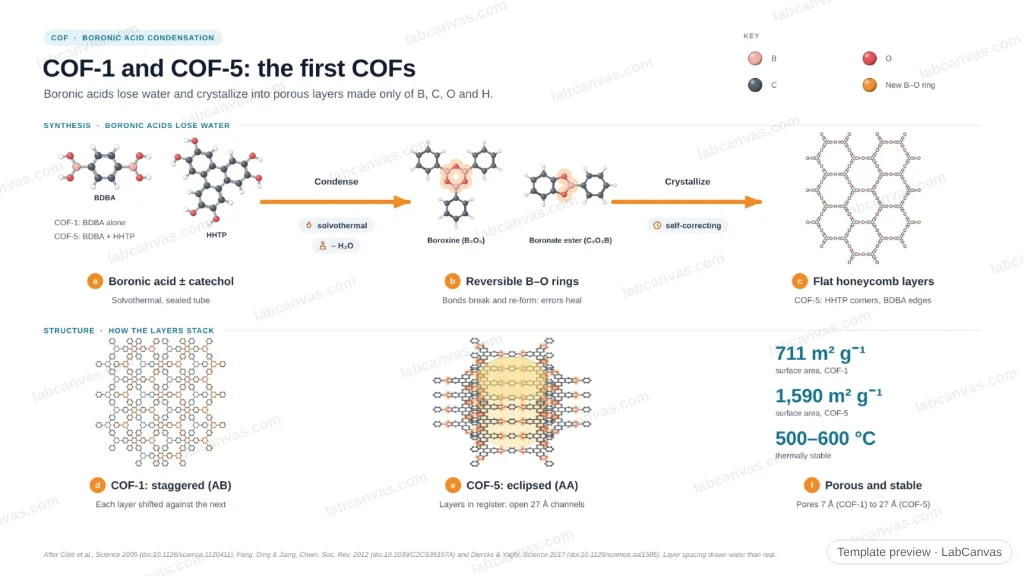
COF-5 is one of the two first covalent organic frameworks, C₉H₄BO₂: hexahydroxytriphenylene (HHTP) and benzene-1,4-diboronic acid (BDBA) joined by five-membered boronate ester rings into flat honeycomb layers. Reported by Côté, Benin, Ockwig, O’Keeffe, Matzger and Yaghi in Science in 2005, its layers stack eclipsed (P6/mmm), leaving hexagonal channels 27 Å across; it has a surface area of 1,590 m² g⁻¹ and is thermally stable to 500–600 °C.
Last updated
COF-5 at a glance
| Formula | C₉H₄BO₂ (Côté et al. 2005) |
|---|---|
| Formula mass | 154.9 g mol⁻¹ per C₉H₄BO₂ unit (calculated from the formula) |
| Building blocks | Hexahydroxytriphenylene (HHTP, C₁₈H₆(OH)₆) and benzene-1,4-diboronic acid (BDBA, C₆H₄[B(OH)₂]₂) (Côté et al. 2005) |
| Linkage | Boronate ester: a five-membered C₂O₂B ring formed from a catechol and a boronic acid, releasing water |
| Topology | hcb (honeycomb) layers: HHTP at the corners, BDBA along the edges |
| Stacking | Eclipsed (AA), space group P6/mmm (Côté et al. 2005) |
| Unit cell | Hexagonal, P6/mmm, a ≈ 30.0 Å, c ≈ 3.40 Å: one layer per cell, so the layers are about 3.40 Å apart (from its crystal file) |
| Pore size | 27 Å one-dimensional hexagonal channels (Côté et al. 2005; Furukawa & Yaghi 2009) |
| Surface area | 1,590 m² g⁻¹ (Côté et al. 2005) |
| Thermal stability | Stable up to 500–600 °C (Côté et al. 2005) |
| Gas uptake at 35 bar | Excess H₂ 36 mg g⁻¹ (77 K); CH₄ 89 mg g⁻¹ and CO₂ 779 mg g⁻¹ (298 K) (Furukawa & Yaghi 2009) |
| Water stability | Limited: boronate ester links are chemically sensitive, especially to water (DeBlase et al. 2013) |
| First reported | Côté, Benin, Ockwig, O’Keeffe, Matzger and Yaghi, Science 310, 1166 (2005) |
COF-5 structure diagram
COF-5 crystal structure (high-resolution SVG)
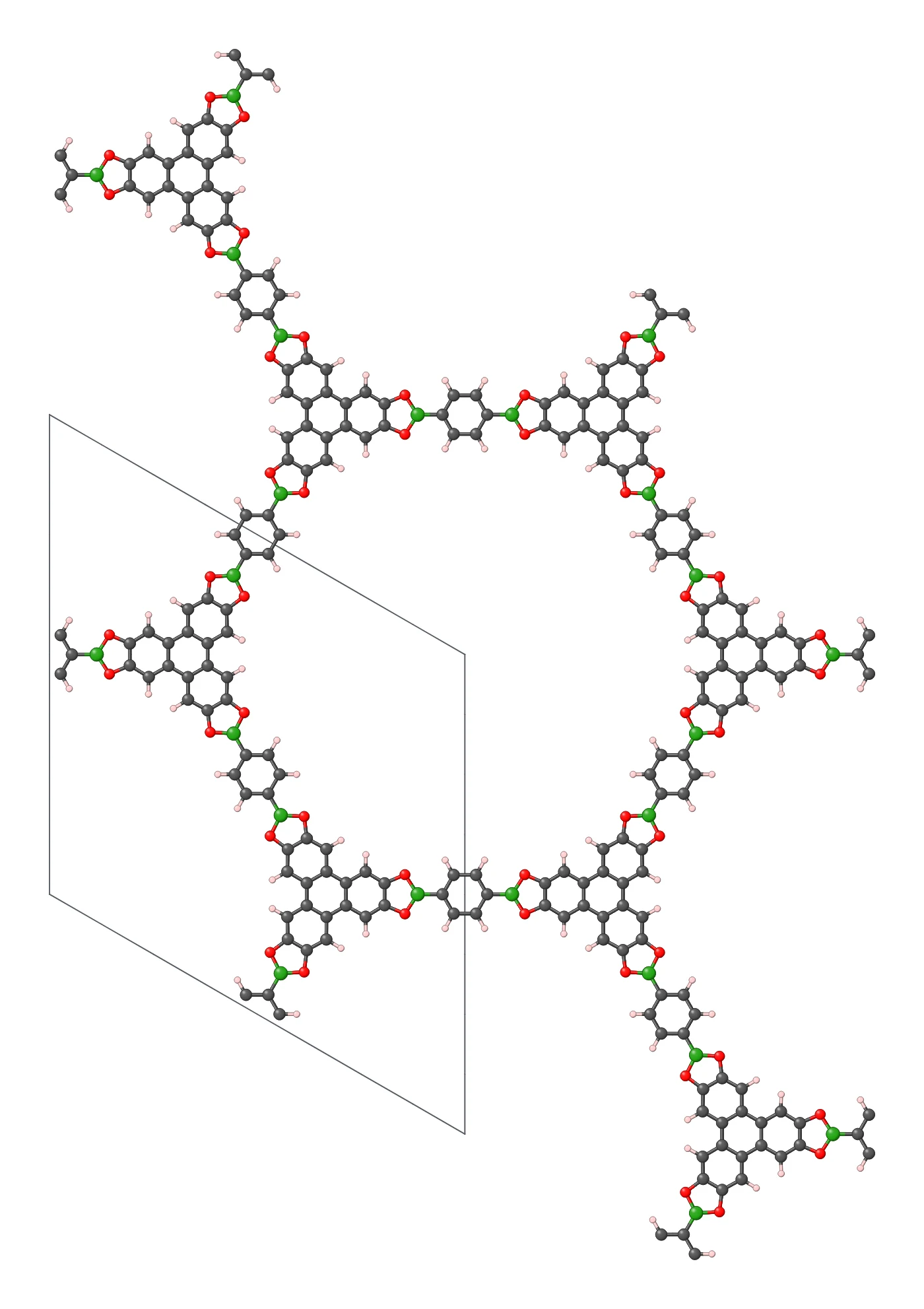
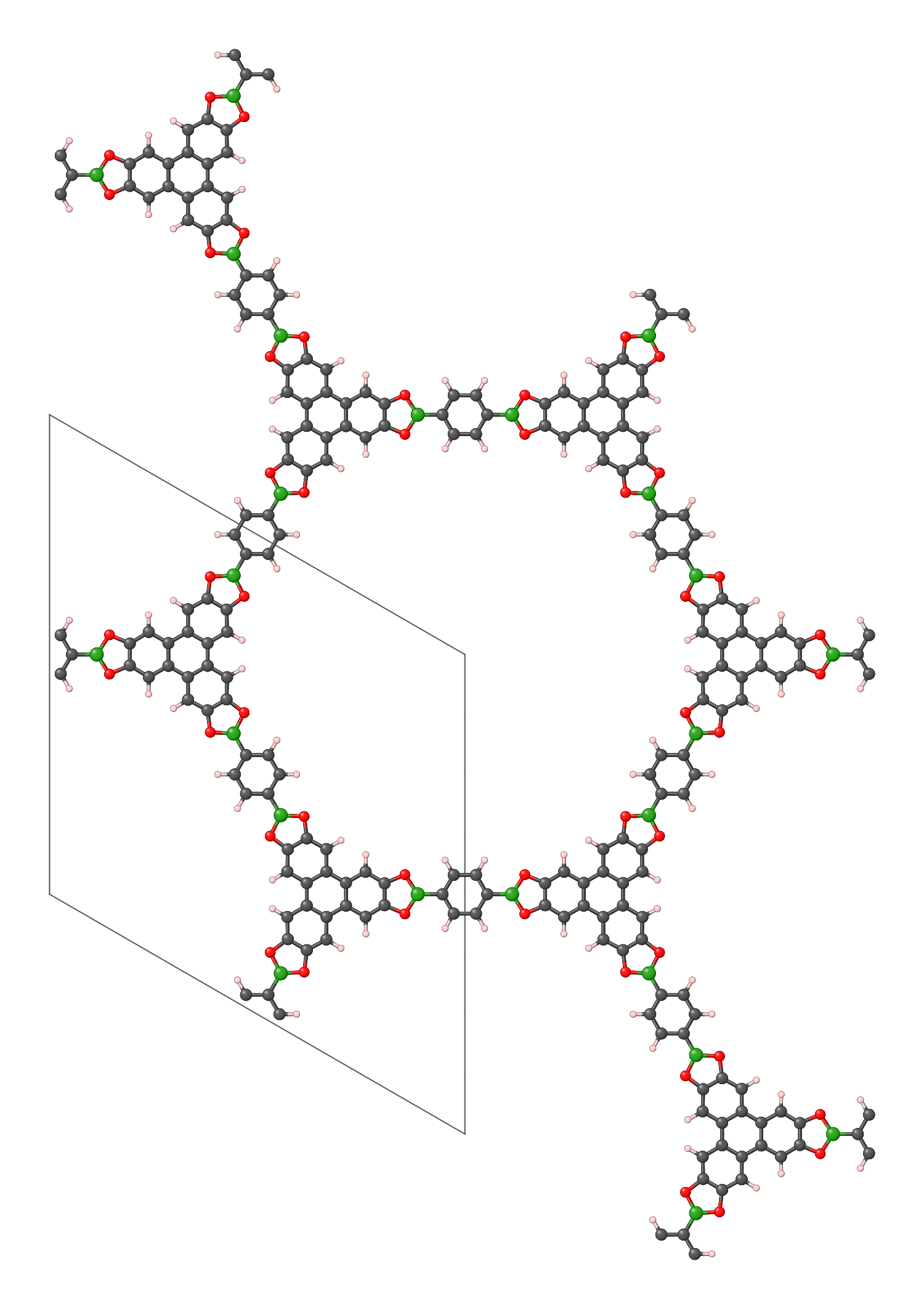
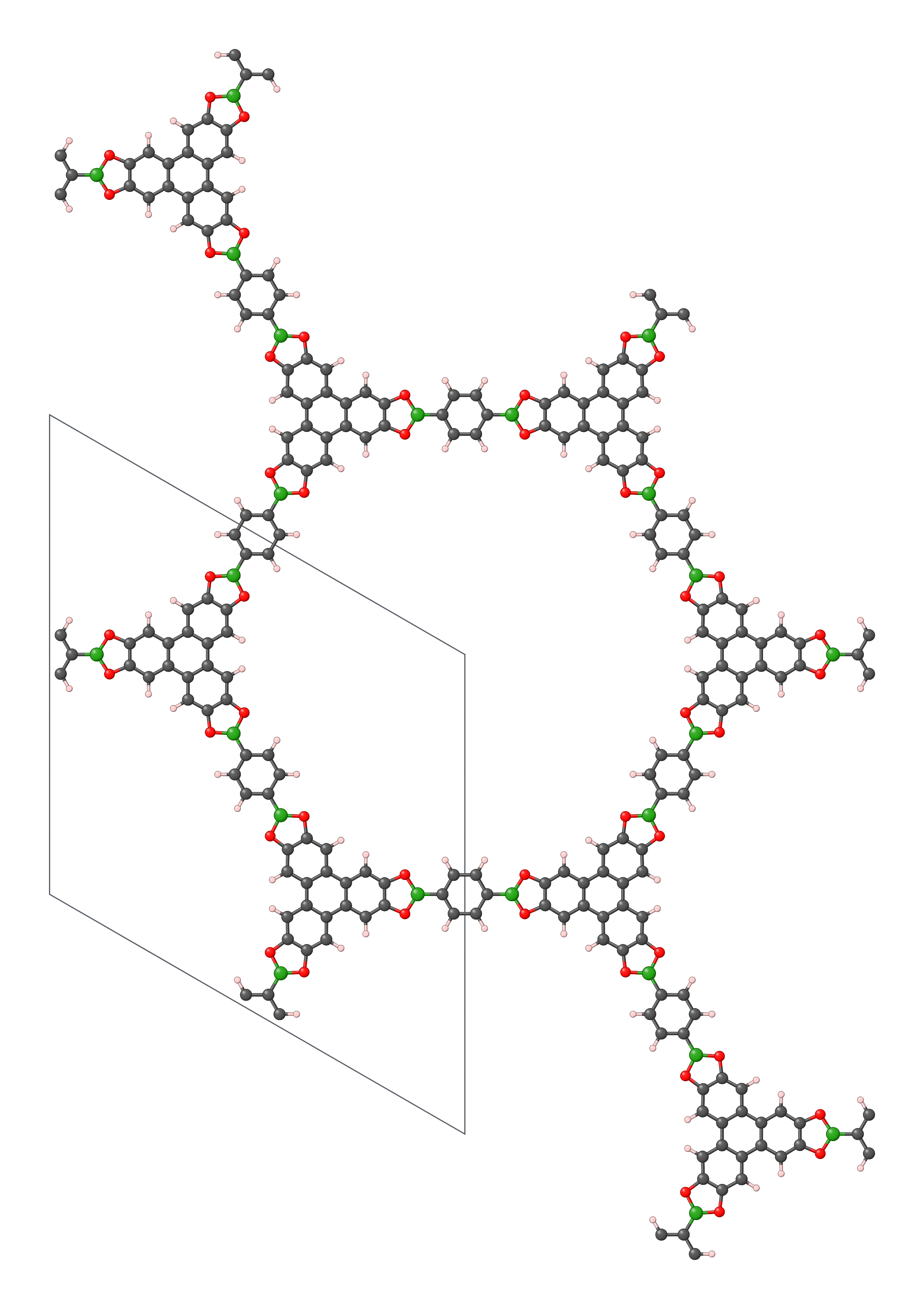
COF-5 in 3D (interactive)
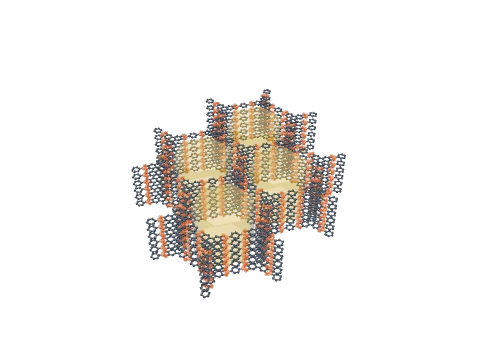
Loading the 3D model…
COF-5 structure explained
COF-5 is built from two organic molecules. HHTP (2,3,6,7,10,11-hexahydroxytriphenylene) is a flat, triangular molecule with three catechol (1,2-dihydroxy) pairs at its corners. BDBA (benzene-1,4-diboronic acid) is a straight rod with a boronic acid at each end. Each boronic acid reacts with one catechol, losing two water molecules, to close a five-membered boronate ester ring (C₂O₂B).
Every HHTP joins three BDBA and every BDBA joins two HHTP, so each sheet is a honeycomb (hcb): HHTP at the corners of large hexagons, BDBA along their edges. The sheets are flat and made only of boron, carbon, oxygen and hydrogen.
The sheets stack directly on top of one another, eclipsed (AA), in space group P6/mmm, with a hexagonal cell edge of about 30.0 Å and about 3.40 Å between layers (from its crystal file). Because the hexagons line up, they form open one-dimensional channels 27 Å across, which makes COF-5 a mesoporous material.
How COF-5 is made
- Condensation. BDBA and HHTP are heated together in an organic solvent mixture in a sealed tube (solvothermal synthesis; Côté et al. 2005).
- Self-correction. The B–O bonds form and break while the solid grows, so misplaced building blocks can come off again and the product is crystalline rather than amorphous.
- Activation. The powder is washed and the solvent removed from the pores before gas sorption. Boronate esters react with water (DeBlase et al. 2013), so the material is best kept dry.
Why COF-5 matters
Before 2005, organic polymers made of strong covalent bonds were amorphous: errors made during growth stayed in place. COF-1 and COF-5 showed that reversible condensation reactions can give crystalline, permanently porous frameworks “entirely held by strong bonds between B, C, and O atoms” (Côté et al. 2005), extending reticular chemistry from metal–organic frameworks to purely organic ones.
COF-5 in particular showed that the pore size follows from the building blocks: a larger node (HHTP) and an eclipsed stack give 27 Å channels, compared with about 7 Å in COF-1 (Côté et al. 2005). Its hexagonal boronate ester layer became a template for many later 2D COFs with longer linkers.
Uses and research areas
- Gas storage. COF-5 is one of the reference COFs for hydrogen, methane and carbon dioxide uptake; at 35 bar it takes up more of each than COF-1, but less than the 3D COF-102 (Furukawa & Yaghi 2009).
- Thin films and electronics. Boronate ester COFs from HHTP have been grown as oriented thin films on single-layer graphene, with improved crystallinity compared with powders (Colson et al. 2011).
- Teaching and design. Its simple eclipsed honeycomb is the standard picture of a 2D COF and of how the building blocks set the pore size.
- Limitation. Boronate esters hydrolyse; imine and β-ketoenamine COFs such as TpPa-1 were developed partly to overcome this (DeBlase et al. 2013; Kandambeth et al. 2012).
How to draw the COF-5 structure
For a paper, slide or poster, show three levels: the two building blocks (HHTP and BDBA), the boronate ester ring they form, and the layer or its eclipsed stack with a channel marked. The figure above shows all three and opens as an editable LabCanvas figure. The crystal structure drawing is a high-resolution SVG from the COF-5 crystal file and opens in the LabCanvas figure editor, where you can change the style, the number of cells and the view. The 3D model opens in the LabCanvas 3D Studio, where you can change the number of layers, show the channels and export a high-resolution image.
COF-5 compared with other well-known COFs
| COF | Linkage | Building blocks | Structure | Surface area | First report |
|---|---|---|---|---|---|
| COF-1 | Boroxine (B₃O₃) | BDBA alone | 2D, staggered layers | 711 m² g⁻¹ | Côté et al., Science 2005 |
| COF-5 | Boronate ester | BDBA + HHTP | 2D, eclipsed, 27 Å channels | 1,590 m² g⁻¹ | Côté et al., Science 2005 |
| COF-102 | Boroxine (B₃O₃) | Tetra(4-dihydroxyborylphenyl)methane | 3D, ctn net | 3,472 m² g⁻¹ | El-Kaderi et al., Science 2007 |
| COF-300 | Imine | Tetra-(4-anilyl)methane + terephthaldehyde | 3D, five interwoven diamond nets, 7.2 Å pores | 1,360 m² g⁻¹ | Uribe-Romo et al., JACS 2009 |
| TpPa-1 | β-Ketoenamine | Tp + p-phenylenediamine | 2D, stable in acid and boiling water | — | Kandambeth et al., JACS 2012 |
Related materials
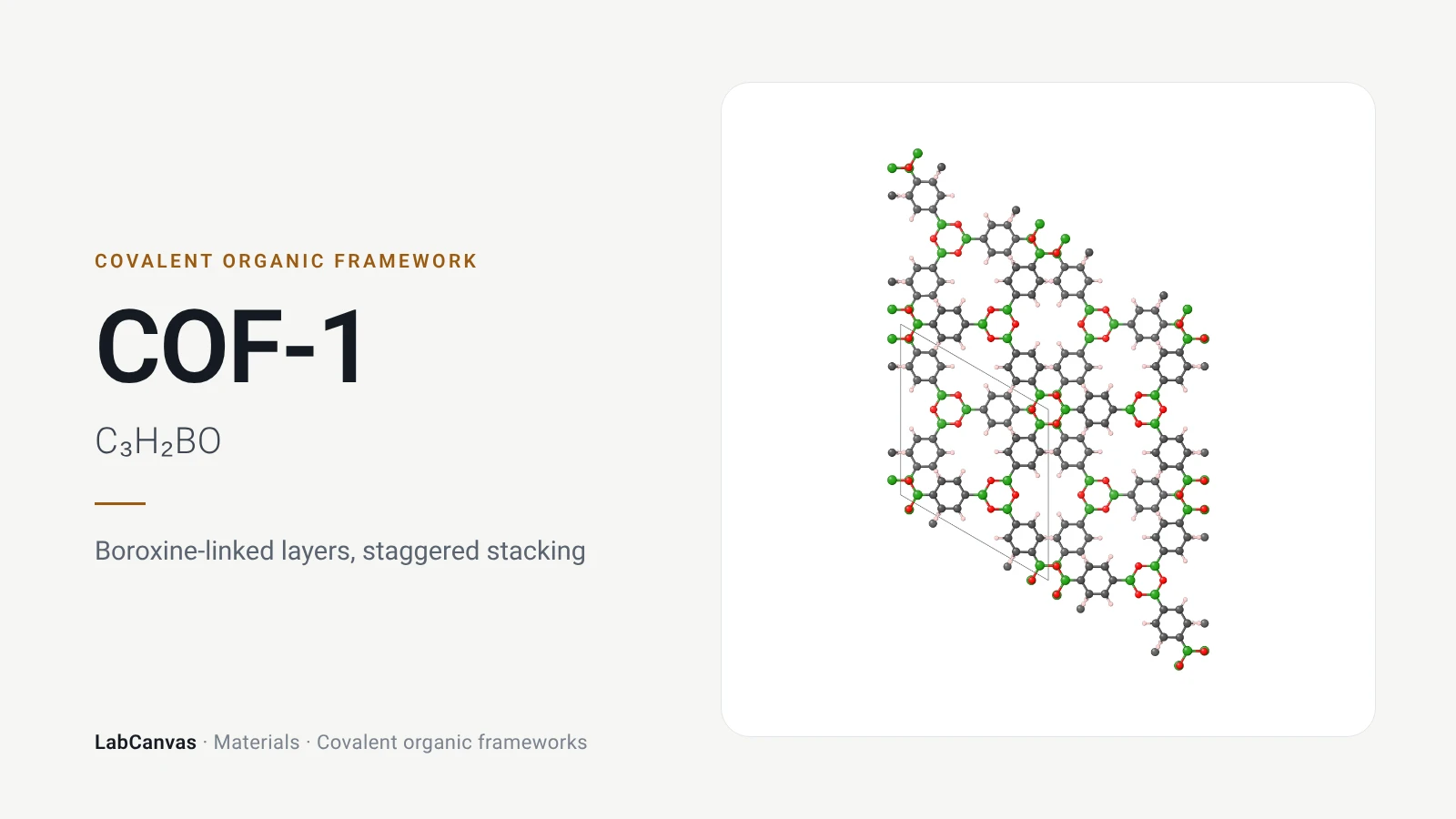
COF-1
COF-1, the first covalent organic framework: boroxine-linked layers from one boronic acid, staggered stacking, 711 m² g⁻¹, synthesis and stability, cited.
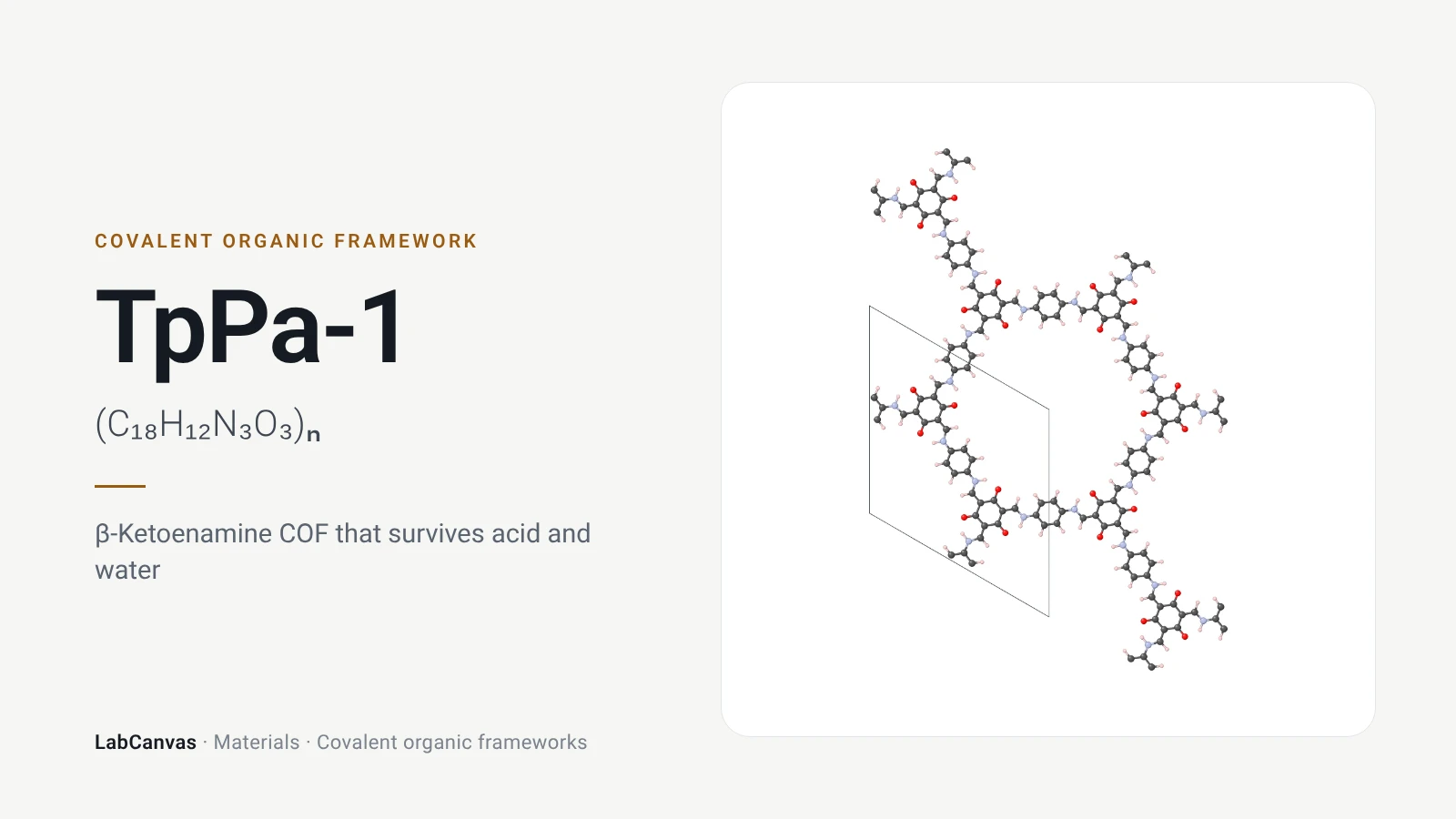
TpPa-1
TpPa-1, the β-ketoenamine COF from Tp and p-phenylenediamine: why it survives acid and boiling water, its structure, synthesis and surface area, cited.
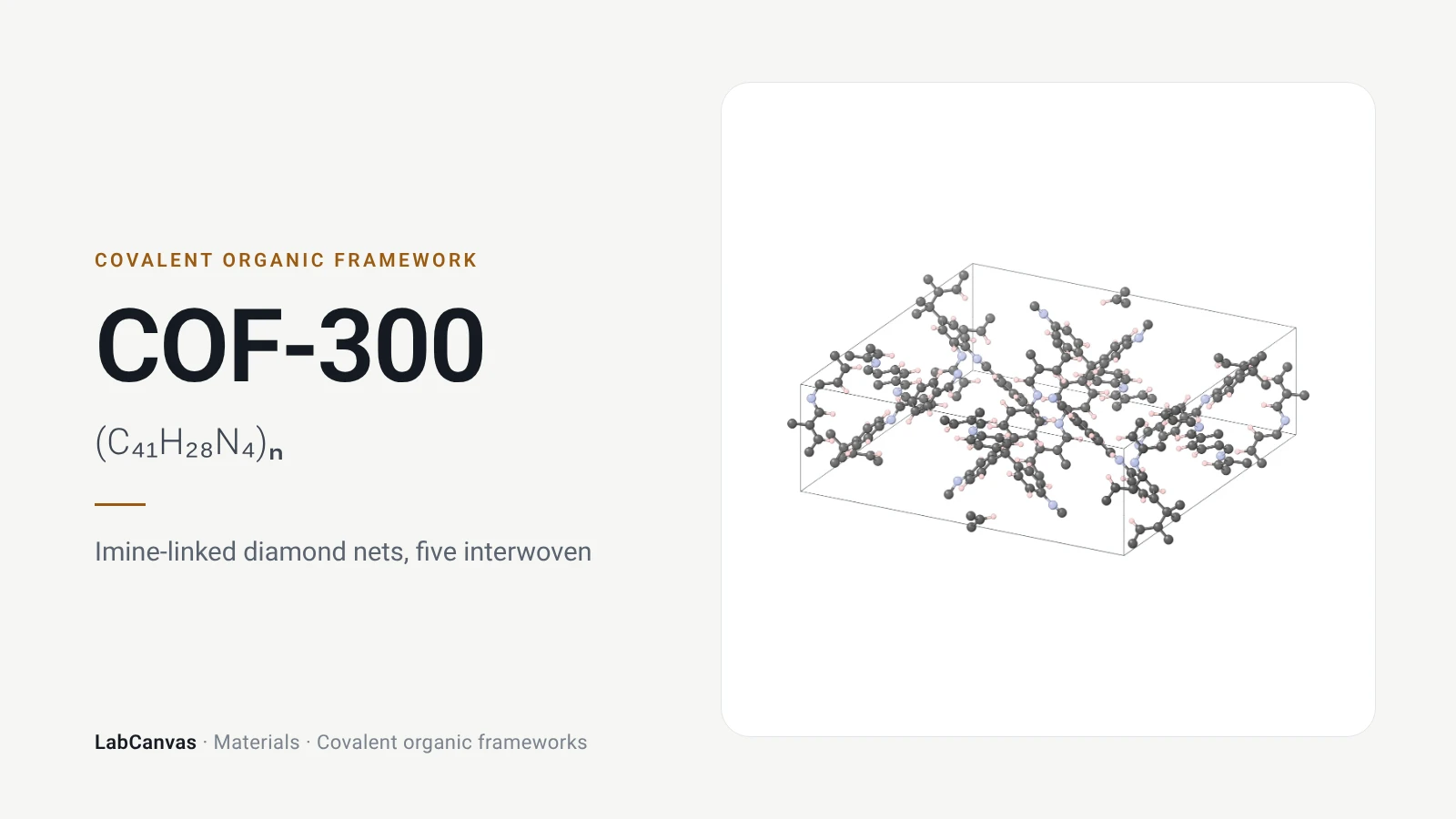
COF-300
COF-300, the first imine-linked 3D COF: five interwoven diamond nets, 7.2 Å pores, 1,360 m² g⁻¹, stable to 490 °C. Structure, synthesis and papers.
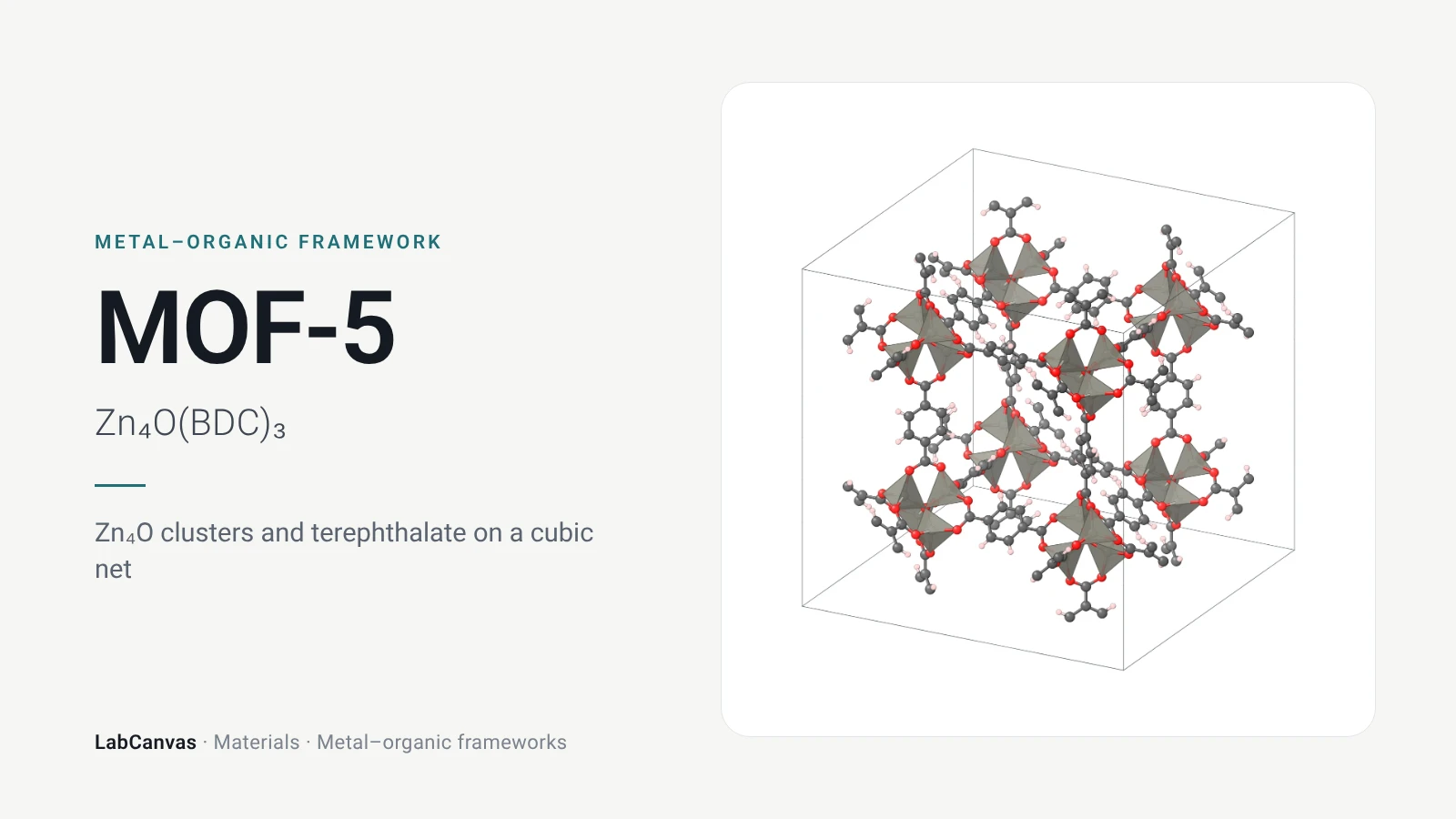
MOF-5
MOF-5, Zn₄O(BDC)₃: its cubic structure in 2D and interactive 3D, how it is made, surface area, stability and uses, with the original papers. Edit the figures free.
More on LabCanvas
- COF-1 and COF-5: the first COFs: Editable figure template
- More COF figure templates: Ready-made, cited figures to edit
- Crystal structure figure software compared: VESTA, Mercury, CrystalMaker, Avogadro and LabCanvas
- XRD Scherrer crystallite size calculator: Free tool
- Molar mass calculator: Free tool
- Journal figure size guide: Column widths and resolutions for 38 journals
- 3D models gallery: Turn MOFs, COFs and more in 3D
Frequently asked questions
What is COF-5?
COF-5 is a covalent organic framework made of hexahydroxytriphenylene (HHTP) and benzene-1,4-diboronic acid (BDBA) joined by boronate ester rings into honeycomb layers that stack eclipsed. Reported with COF-1 by the Yaghi group in 2005, it is one of the first two COFs.
What is the chemical formula of COF-5?
C₉H₄BO₂ per formula unit (Côté et al., Science 2005), about 154.9 g/mol.
What is the pore size of COF-5?
About 27 Å (2.7 nm): the hexagons of the eclipsed layers line up into one-dimensional channels of that width, so COF-5 is mesoporous.
What is the surface area of COF-5?
The first report gave 1,590 m²/g (Côté et al., Science 2005).
What is the structure of COF-5?
Flat hexagonal (hcb) layers, HHTP at the corners and BDBA on the edges, stacked eclipsed (AA) in space group P6/mmm, with a cell edge of about 30.0 Å and about 3.40 Å between layers.
How is COF-5 synthesised?
Solvothermally: BDBA and HHTP are heated in an organic solvent mixture in a sealed tube (Côté et al., Science 2005). Water is released as the boronate ester rings close, and the reversible B–O bonds let the solid crystallize.
Is COF-5 stable?
It is thermally stable up to 500–600 °C, but boronate ester links are sensitive to water, so it is kept dry. Imine and β-ketoenamine COFs such as TpPa-1 are used where water or acid is present.
What is the difference between COF-1 and COF-5?
COF-1 is made from BDBA alone and is linked by boroxine (B₃O₃) rings; its layers stack staggered, leaving pores of about 7 Å and 711 m²/g. COF-5 adds HHTP, is linked by boronate esters, stacks eclipsed and has 27 Å channels and 1,590 m²/g.
How can I draw COF-5 for a paper or presentation?
Open the COF-5 figure on this page in LabCanvas (free) to edit the building blocks, linkage and layers, open the crystal structure drawing in the figure editor, or open the 3D model in the LabCanvas 3D Studio and export a render.
References
- A. P. Côté, A. I. Benin, N. W. Ockwig, M. O’Keeffe, A. J. Matzger, O. M. Yaghi. Porous, crystalline, covalent organic frameworks. Science 2005, 310, 1166–1170. doi:10.1126/science.1120411
- H. Furukawa, O. M. Yaghi. Storage of hydrogen, methane, and carbon dioxide in highly porous covalent organic frameworks for clean energy applications. J. Am. Chem. Soc. 2009, 131, 8875–8883. doi:10.1021/ja9015765
- J. W. Colson et al.. Oriented 2D covalent organic framework thin films on single-layer graphene. Science 2011, 332, 228–231. doi:10.1126/science.1202747
- C. R. DeBlase, K. E. Silberstein, T.-T. Truong, H. D. Abruña, W. R. Dichtel. β-Ketoenamine-linked covalent organic frameworks capable of pseudocapacitive energy storage. J. Am. Chem. Soc. 2013, 135, 16821–16824. doi:10.1021/ja409421d
- H. M. El-Kaderi et al.. Designed synthesis of 3D covalent organic frameworks. Science 2007, 316, 268–272. doi:10.1126/science.1139915
- F. J. Uribe-Romo et al.. A crystalline imine-linked 3-D porous covalent organic framework. J. Am. Chem. Soc. 2009, 131, 4570–4571. doi:10.1021/ja8096256
- S. Kandambeth et al.. Construction of crystalline 2D covalent organic frameworks with remarkable chemical (acid/base) stability via a combined reversible and irreversible route. J. Am. Chem. Soc. 2012, 134, 19524–19527. doi:10.1021/ja308278w
- X. Feng, X. Ding, D. Jiang. Covalent organic frameworks. Chem. Soc. Rev. 2012, 41, 6010–6022. doi:10.1039/C2CS35157A
- C. S. Diercks, O. M. Yaghi. The atom, the molecule, and the covalent organic framework. Science 2017, 355, eaal1585. doi:10.1126/science.aal1585
Draw COF-5 for your paper or slides
LabCanvas is a browser workspace for scientific figures: framework clusters, linkers and nets, crystal structures in 2D and 3D, graphs and posters, all editable.
Edit the COF-5 figure