TpPa-1: the acid-stable β-ketoenamine COF
TpPa-1 is a two-dimensional covalent organic framework made from 1,3,5-triformylphloroglucinol (Tp) and p-phenylenediamine (Pa-1), repeat unit C₁₈H₁₂N₃O₃. The Schiff base condensation first gives an enol-imine, which tautomerizes irreversibly to a β-ketoenamine, so no hydrolysable imine bond remains. Reported by Kandambeth, Mallick, Lukose, Mane, Heine and Banerjee in J. Am. Chem. Soc. in 2012, it stays crystalline in 9 N hydrochloric acid and boiling water.
Last updated
TpPa-1 at a glance
| Formula | (C₁₈H₁₂N₃O₃)ₙ: one Tp and 1.5 Pa-1 less three water molecules (calculated) |
|---|---|
| Formula mass | 318.3 g mol⁻¹ per C₁₈H₁₂N₃O₃ unit (calculated from the formula) |
| Building blocks | 1,3,5-Triformylphloroglucinol (Tp) and p-phenylenediamine (Pa-1) (Kandambeth et al. 2012) |
| Linkage | β-Ketoenamine (C=O···H–N), formed by irreversible enol-imine to keto-enamine tautomerism (Kandambeth et al. 2012) |
| Topology | hcb (honeycomb) layers: Tp at the corners, Pa-1 along the edges |
| Unit cell (CURATED file) | Hexagonal, a = 22.56 Å, layers 3.4 Å apart (CURATED COFs entry 12000N2) |
| Chemical stability | Crystalline after 9 N HCl and boiling water (Kandambeth et al. 2012) |
| Base stability | TpPa-2, the 2,5-dimethyl analogue, also survives 9 N NaOH (Kandambeth et al. 2012) |
| Solvent | 1:1 mesitylene/dioxane (Kandambeth et al. 2012) |
| First reported | Kandambeth, Mallick, Lukose, Mane, Heine and Banerjee, J. Am. Chem. Soc. 134, 19524 (2012) |
TpPa-1 structure diagram
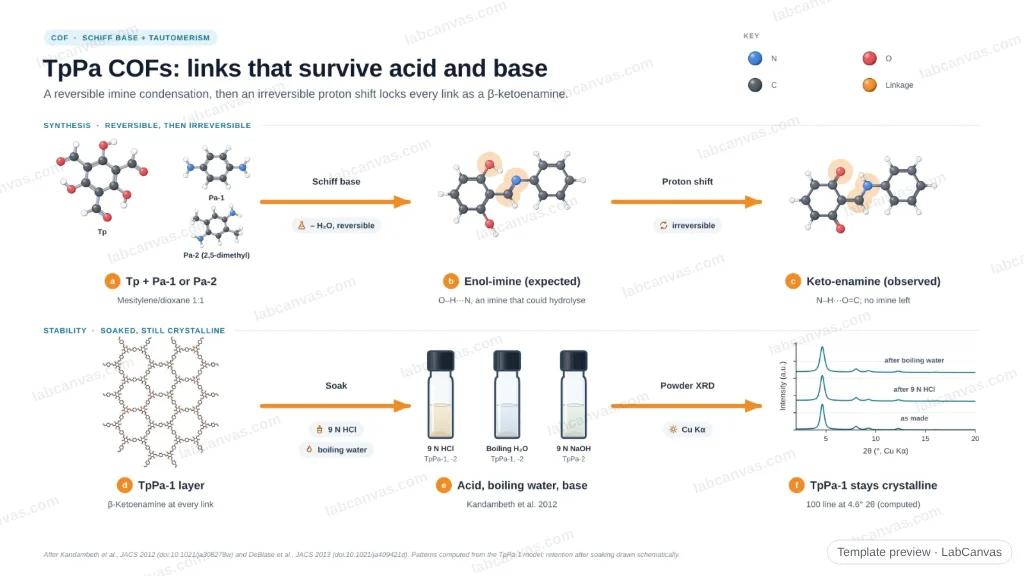
TpPa-1 crystal structure (high-resolution SVG)
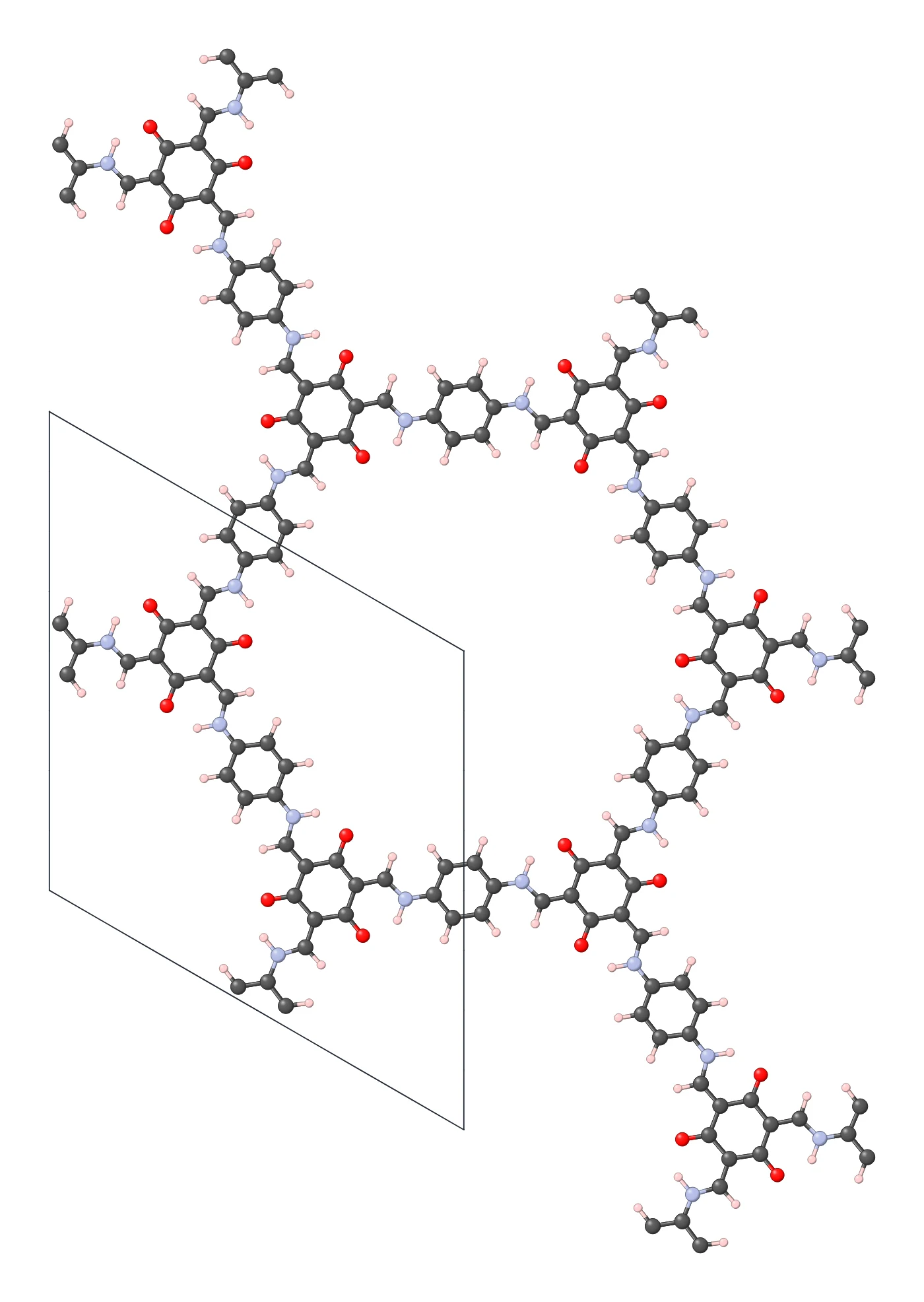
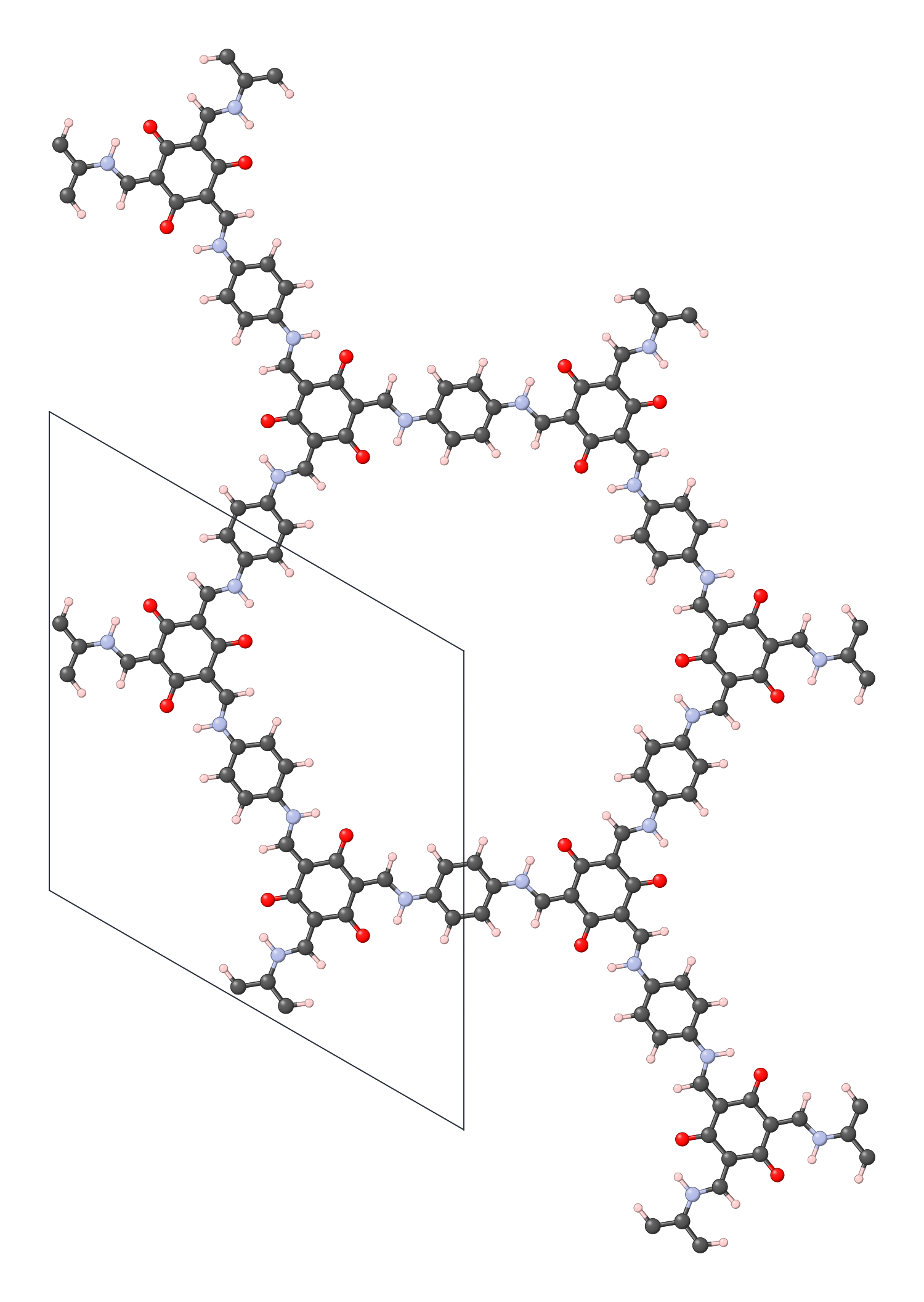
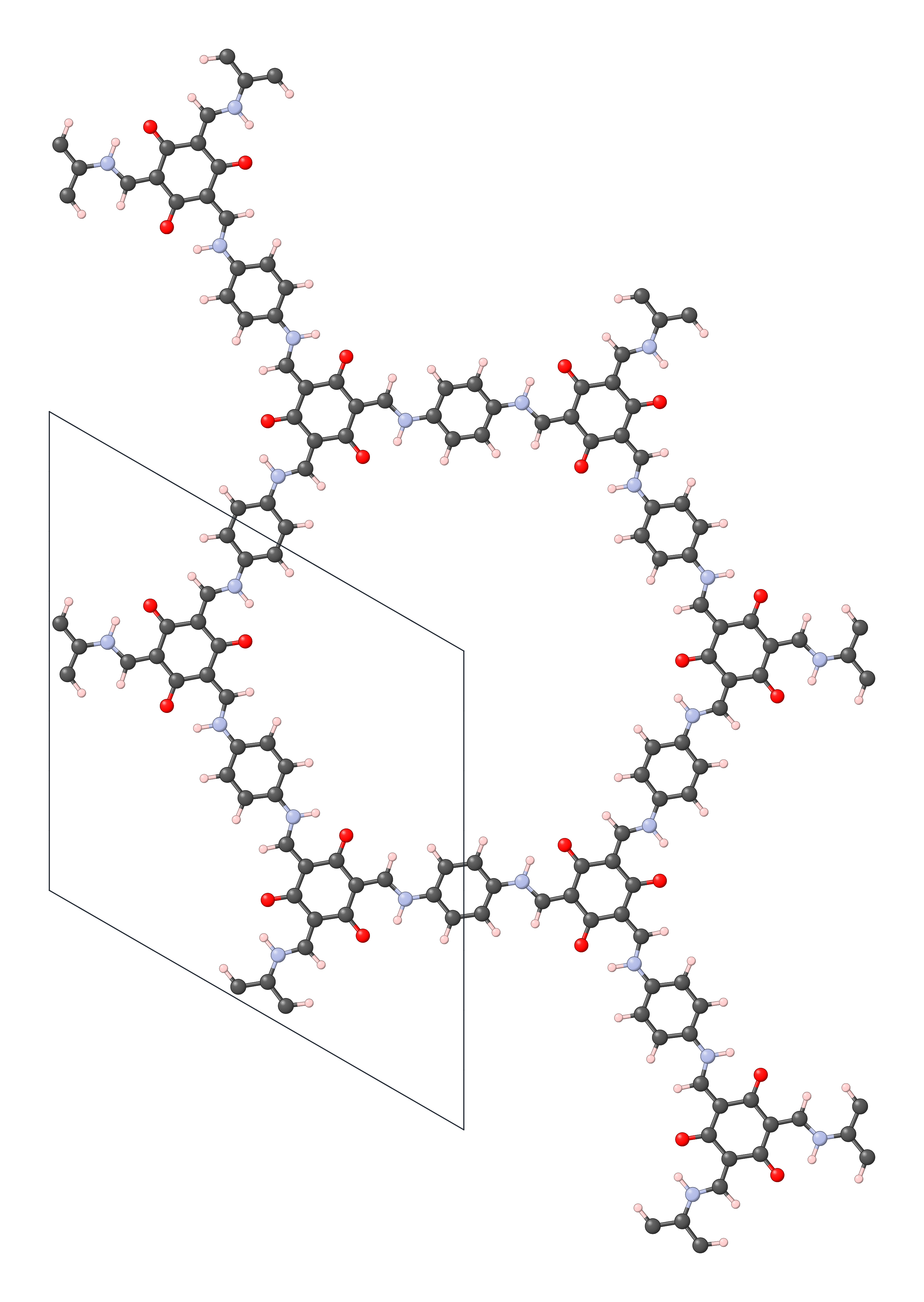
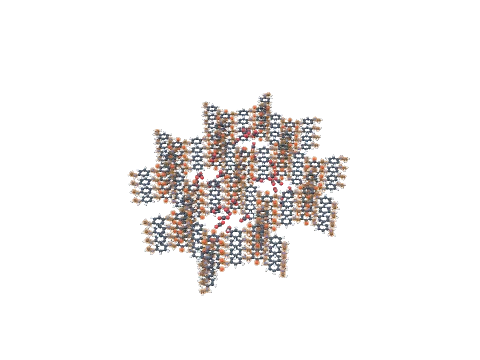
TpPa-1 in 3D (interactive)
Loading the 3D model…
TpPa-1 structure explained
TpPa-1 is built from two molecules. Tp (1,3,5-triformylphloroglucinol) is a benzene ring carrying three aldehyde groups, with a hydroxyl group between each pair. Pa-1 (p-phenylenediamine) is a benzene ring with an amine at each end. Each aldehyde condenses with an amine, losing water, in a Schiff base reaction.
Every Tp joins three Pa-1 and every Pa-1 joins two Tp, so each sheet is a honeycomb (hcb) of Tp corners and Pa-1 edges, like COF-5 but with nitrogen-containing links.
The key is the link itself. The expected product is an enol-imine: a C=N imine bond with the neighbouring O–H hydrogen-bonded to it. Instead, the proton moves from oxygen to nitrogen and only the keto-enamine form (C=O and N–H, hydrogen-bonded) is observed (Kandambeth et al. 2012). This tautomerism is irreversible, and with no imine left there is no bond for water or acid to hydrolyse.
How TpPa-1 is made
- Schiff base condensation. Tp and p-phenylenediamine react in a 1:1 mixture of mesitylene and dioxane under solvothermal conditions (Kandambeth et al. 2012). This step is reversible, which lets the layers order and crystallize.
- Tautomerism. Each enol-imine link converts irreversibly to the β-ketoenamine, locking the framework in place.
- Washing and activation. The powder is washed and its pores emptied before gas sorption.
Using 2,5-dimethyl-p-phenylenediamine (Pa-2) instead gives TpPa-2, whose methyl groups make it stable in strong base as well.
Why TpPa-1 matters
The first COFs, built on boroxine and boronate ester links, are sensitive to water, and imine COFs can be hydrolysed. TpPa-1 and TpPa-2 showed a way out: combine a reversible step, which gives crystallinity, with an irreversible one, which gives stability. Both COFs resist 9 N hydrochloric acid and boiling water, and TpPa-2 also 9 N sodium hydroxide (Kandambeth et al. 2012).
The same idea works with other aromatic amines in place of Pa-1, giving a family of Tp-based β-ketoenamine COFs (Geng et al. 2020). DeBlase et al. (2013) used this chemistry to make a redox-active β-ketoenamine COF that is stable in a strongly acidic electrolyte.
Uses and research areas
- Work in water and acid. Its chemical stability makes TpPa-1 a candidate for catalysis and separations in conditions that would destroy boronate ester COFs.
- Energy storage. A β-ketoenamine COF electrode kept a higher capacitance than a non-redox-active COF even after 5,000 charge–discharge cycles in acidic electrolyte (DeBlase et al. 2013).
- Gas adsorption screening. TpPa-1 is in the CURATED COFs database, whose structures were optimized and used to compute CO₂ and N₂ isotherms for carbon capture (Ongari et al. 2019).
- Stability testing. Its soaking experiments (acid, base and boiling water, then powder X-ray diffraction) show how the chemical stability of a COF can be checked.
How to draw the TpPa-1 structure
For a paper, slide or poster, show the two monomers, the enol-imine and keto-enamine forms side by side with an arrow for the proton shift, and a honeycomb layer with a β-ketoenamine at every link. The figure above has all of these, plus the soaking tests and powder patterns, and opens as an editable LabCanvas figure. The crystal structure drawing is a high-resolution SVG from the CURATED COFs file and opens in the LabCanvas figure editor, where you can change the style, the number of cells and the view. The 3D model opens in the LabCanvas 3D Studio, where you can change the layers and guests and export a high-resolution image.
TpPa-1 compared with other well-known COFs
| COF | Linkage | Building blocks | Structure | Surface area | First report |
|---|---|---|---|---|---|
| TpPa-1 | β-Ketoenamine | Tp + p-phenylenediamine | 2D, stable in acid and boiling water | — | Kandambeth et al., JACS 2012 |
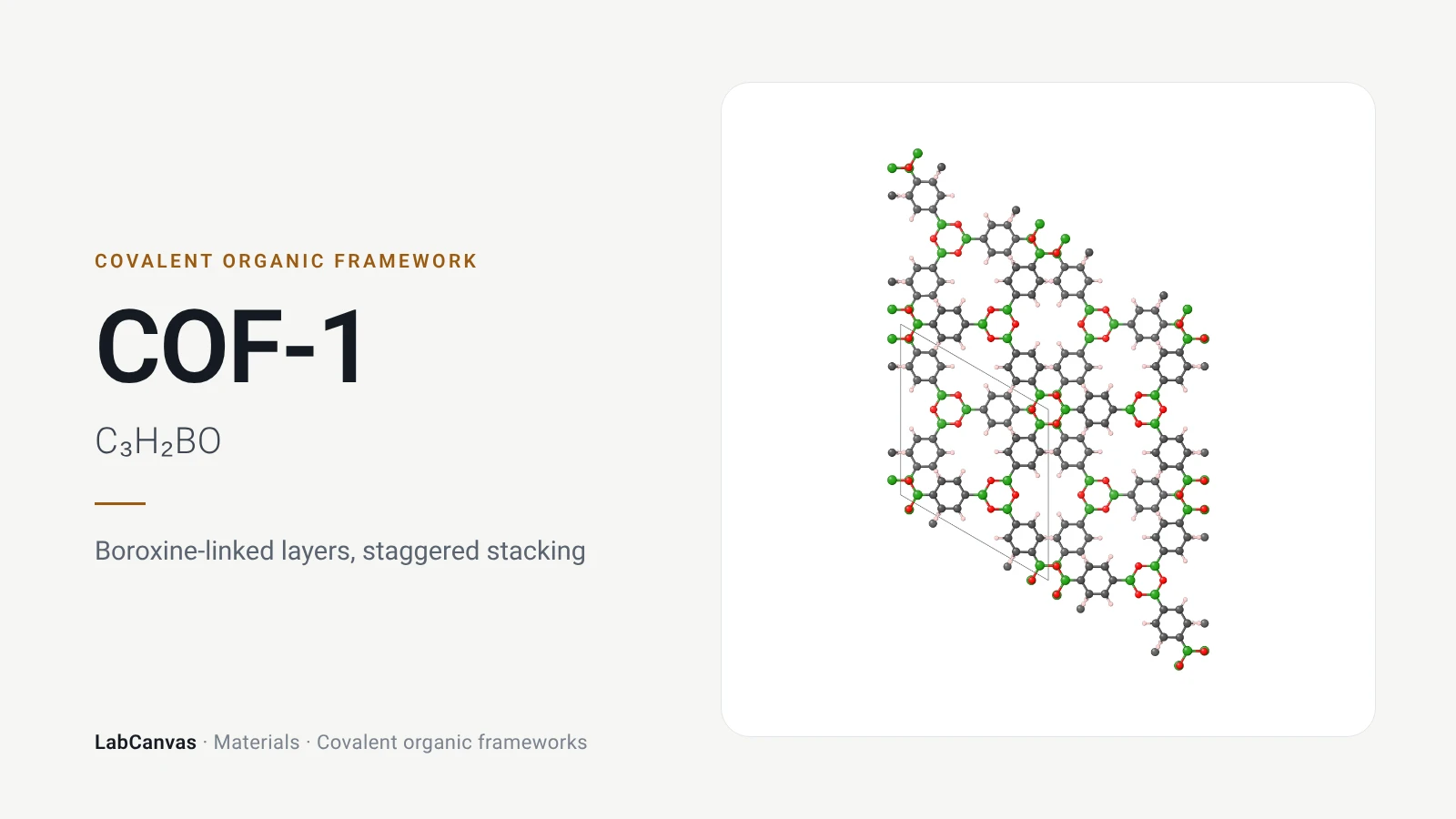
| COF-1 | Boroxine (B₃O₃) | BDBA alone | 2D, staggered layers | 711 m² g⁻¹ | Côté et al., Science 2005 |
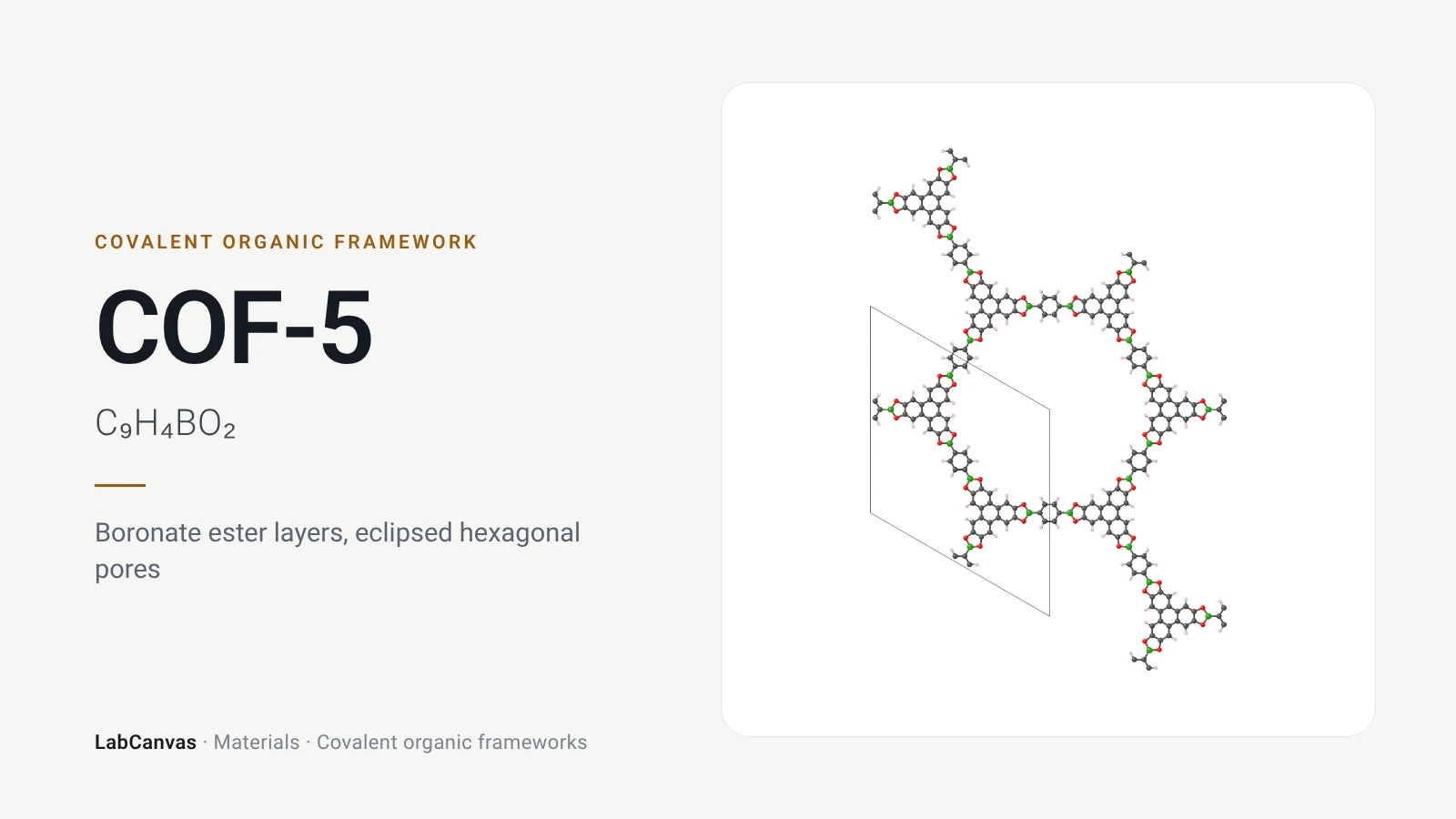
| COF-5 | Boronate ester | BDBA + HHTP | 2D, eclipsed, 27 Å channels | 1,590 m² g⁻¹ | Côté et al., Science 2005 |
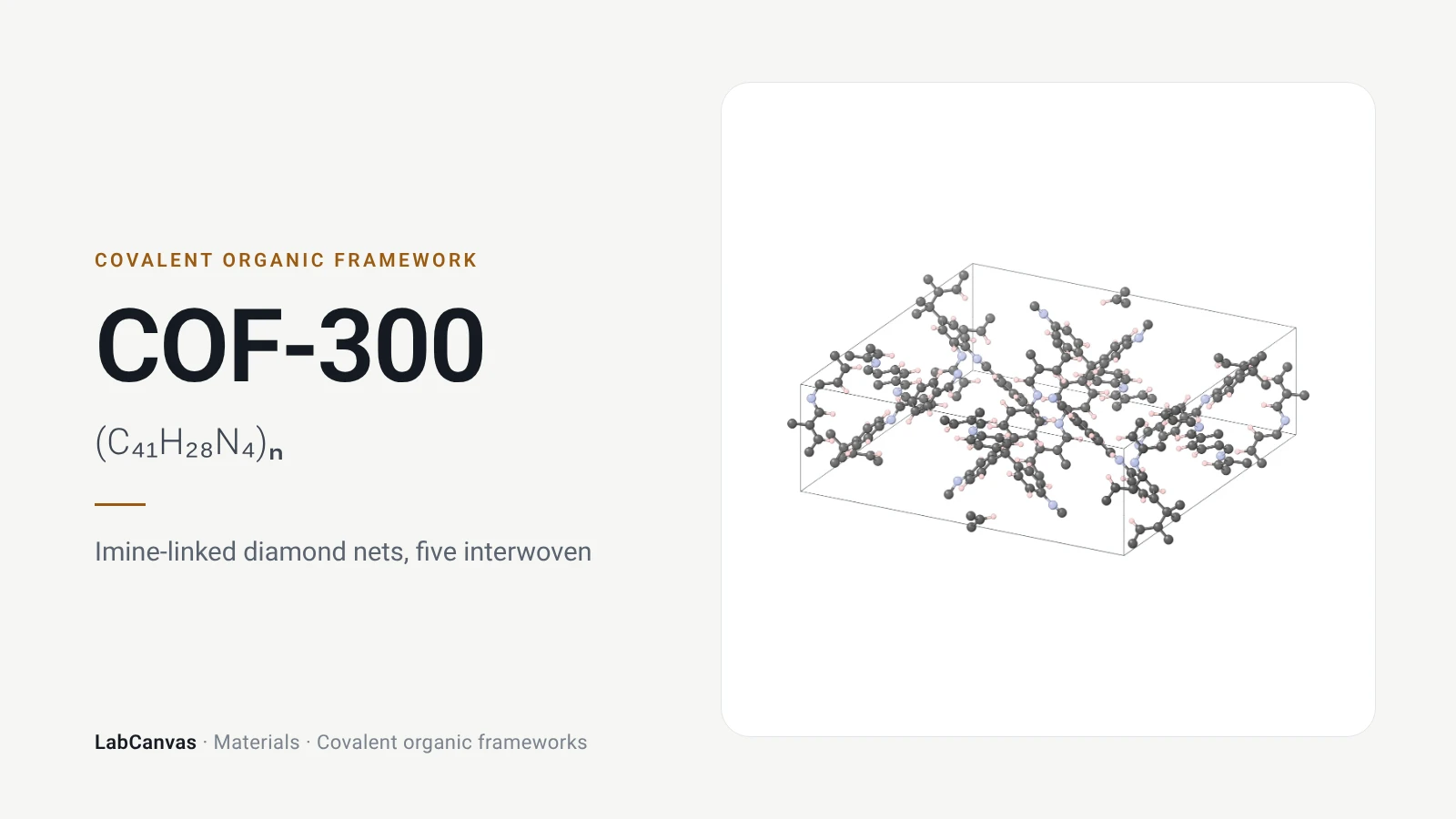
| COF-300 | Imine | Tetra-(4-anilyl)methane + terephthaldehyde | 3D, five interwoven diamond nets, 7.2 Å pores | 1,360 m² g⁻¹ | Uribe-Romo et al., JACS 2009 |
Related materials
COF-5
COF-5, the boronate ester COF from HHTP and BDBA: eclipsed layers, 27 Å channels, 1,590 m² g⁻¹, synthesis and stability, with 2D and 3D figures to edit.
COF-1
COF-1, the first covalent organic framework: boroxine-linked layers from one boronic acid, staggered stacking, 711 m² g⁻¹, synthesis and stability, cited.
COF-300
COF-300, the first imine-linked 3D COF: five interwoven diamond nets, 7.2 Å pores, 1,360 m² g⁻¹, stable to 490 °C. Structure, synthesis and papers.
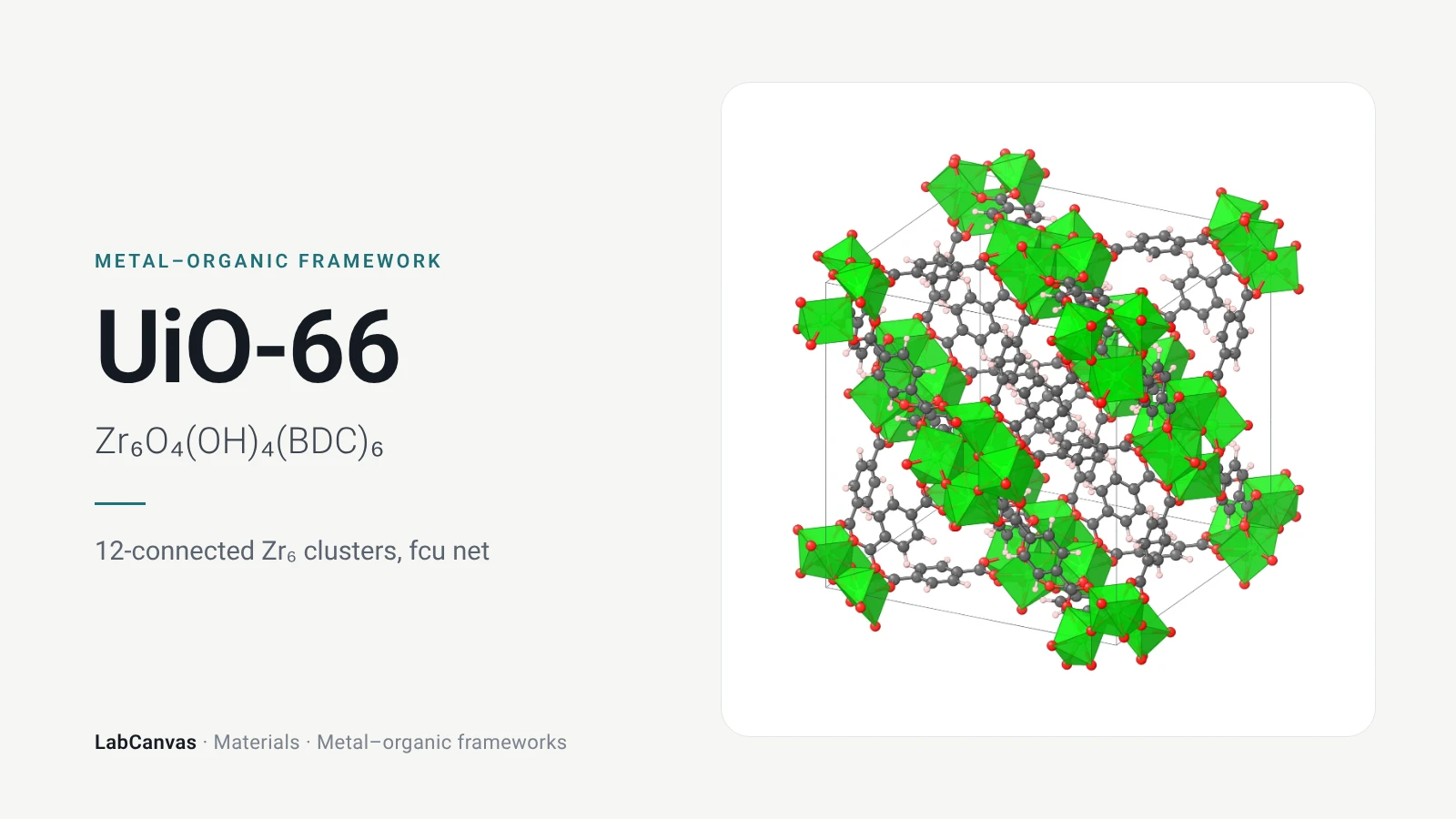
UiO-66
UiO-66, Zr₆O₄(OH)₄(BDC)₆: its fcu structure in 2D and 3D, how it is made, missing-linker defects, pore size, surface area and stability, with the papers.
More on LabCanvas
- TpPa COFs: β-ketoenamine links that survive acid and base: Editable figure template
- More COF figure templates: Ready-made, cited figures to edit
- Crystal structure figure software compared: VESTA, Mercury, CrystalMaker, Avogadro and LabCanvas
- XRD Scherrer crystallite size calculator: Free tool
- Molar mass calculator: Free tool
- Journal figure size guide: Column widths and resolutions for 38 journals
- 3D models gallery: Turn MOFs, COFs and more in 3D
Frequently asked questions
What is TpPa-1?
TpPa-1 is a two-dimensional covalent organic framework made from 1,3,5-triformylphloroglucinol (Tp) and p-phenylenediamine (Pa-1). Its links are β-ketoenamines, which makes it stable in strong acid and boiling water. It was reported by the Banerjee group in 2012.
Why is TpPa-1 stable in acid?
The imine formed first tautomerizes irreversibly to a β-ketoenamine (C=O and N–H). With no imine bond left to hydrolyse, TpPa-1 stays crystalline after 9 N HCl and boiling water (Kandambeth et al., JACS 2012).
How is TpPa-1 synthesised?
Tp and p-phenylenediamine are condensed solvothermally in 1:1 mesitylene/dioxane. The reversible Schiff base reaction lets the layers crystallize; the irreversible enol-to-keto tautomerism then locks the links.
What is the difference between TpPa-1 and TpPa-2?
TpPa-2 uses 2,5-dimethyl-p-phenylenediamine instead of p-phenylenediamine. Both resist 9 N HCl and boiling water, but only TpPa-2 was also stable in 9 N NaOH (Kandambeth et al., JACS 2012).
What is a β-ketoenamine linkage?
A C=O group and an N–H group on neighbouring atoms, hydrogen-bonded to each other: the keto tautomer of an enol-imine. It forms when an aldehyde next to a hydroxyl group condenses with an amine, as in Tp-based COFs.
How can I draw TpPa-1 for a paper or presentation?
Open the TpPa figure on this page in LabCanvas (free) to edit the monomers, tautomers and layer, open the crystal structure drawing in the figure editor, or open the 3D model in the LabCanvas 3D Studio and export a render.
References
- S. Kandambeth, A. Mallick, B. Lukose, M. V. Mane, T. Heine, R. Banerjee. Construction of crystalline 2D covalent organic frameworks with remarkable chemical (acid/base) stability via a combined reversible and irreversible route. J. Am. Chem. Soc. 2012, 134, 19524–19527. doi:10.1021/ja308278w
- C. R. DeBlase, K. E. Silberstein, T.-T. Truong, H. D. Abruña, W. R. Dichtel. β-Ketoenamine-linked covalent organic frameworks capable of pseudocapacitive energy storage. J. Am. Chem. Soc. 2013, 135, 16821–16824. doi:10.1021/ja409421d
- D. Ongari, A. V. Yakutovich, L. Talirz, B. Smit. Building a consistent and reproducible database for adsorption evaluation in covalent-organic frameworks. ACS Cent. Sci. 2019, 5, 1663–1675. doi:10.1021/acscentsci.9b00619
- K. Geng et al.. Covalent organic frameworks: design, synthesis, and functions. Chem. Rev. 2020, 120, 8814–8933. doi:10.1021/acs.chemrev.9b00550
- A. P. Côté, A. I. Benin, N. W. Ockwig, M. O’Keeffe, A. J. Matzger, O. M. Yaghi. Porous, crystalline, covalent organic frameworks. Science 2005, 310, 1166–1170. doi:10.1126/science.1120411
- F. J. Uribe-Romo et al.. A crystalline imine-linked 3-D porous covalent organic framework. J. Am. Chem. Soc. 2009, 131, 4570–4571. doi:10.1021/ja8096256
Draw TpPa-1 for your paper or slides
LabCanvas is a browser workspace for scientific figures: framework clusters, linkers and nets, crystal structures in 2D and 3D, graphs and posters, all editable.
Edit the TpPa-1 figure