Graphical abstract template · Battery materials · Cell assembly and testing
Making and testing a coin cell
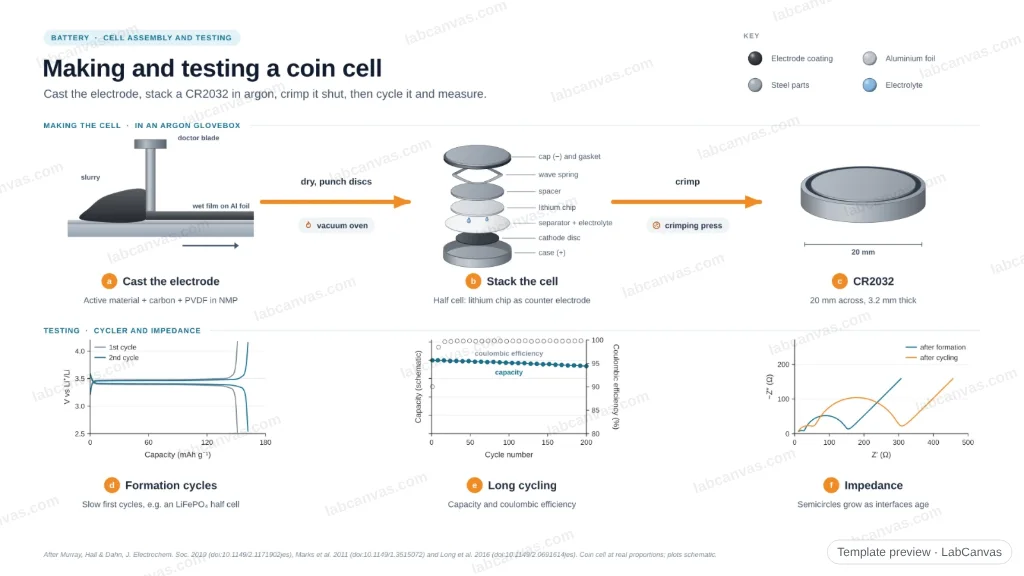
Most new battery materials are first tried in a CR2032 coin cell, a steel can 20 mm across and 3.2 mm thick. The electrode is cast from a slurry onto metal foil and punched into discs; the cell is stacked in an argon glovebox, filled with electrolyte and crimped shut. Formation cycles, long cycling with coulombic efficiency and impedance then show how the material behaves, as long as cells are made and tested the same way each time.
Updated 3 cited papers79 editable layers
At a glance
- Category
- Battery materials
- Method
- Cell assembly and testing
- Starting materials
- Active material, conductive carbon, PVDF binder and NMP; foil; lithium; separator; electrolyte; CR2032 parts
- Product
- A crimped CR2032 coin cell and its test data
- Typical size
- CR2032: 20 mm across, 3.2 mm thick
- Key result
- Repeatable cells need the same loading, electrolyte volume and pressure each time (Murray, Hall & Dahn 2019)
- Figure
- 1920 × 1080 px (16:9), 79 editable layers, 5 generated objects
Step by step
- ElectrodeSlurry cast on foil with a doctor blade, dried and punched into discs (Marks et al. 2011)
- StackIn an argon glovebox: case, cathode, electrolyte, separator, electrolyte, lithium (or a graphite anode), spacer, spring, cap
- CrimpThe press seals the cap and gasket into the case
- TestFormation cycles, cycling with coulombic efficiency, impedance; assembly and testing standardised (Long et al. 2016)
Strengths
- Small amounts of material
- Cheap, fast and comparable
Limitations
- A lithium counter electrode hides problems of real full cells
- Excess electrolyte flatters cycle life
Uses
- Screening new electrode materials and electrolytes
Papers this template follows
- Murray, Hall & Dahn, “A Guide to Full Coin Cell Making for Academic Researchers”, J. Electrochem. Soc. 2019. doi:10.1149/2.1171902jesmethod origin
- Marks, Trussler, Smith, Xiong & Dahn, “A Guide to Li-Ion Coin-Cell Electrode Making for Academic Researchers”, J. Electrochem. Soc. 2011. doi:10.1149/1.3515072method origin
- Long et al., “Enabling High-Energy, High-Voltage Lithium-Ion Cells: Standardization of Coin-Cell Assembly, Electrochemical Testing, and Evaluation of Full Cells”, J. Electrochem. Soc. 2016. doi:10.1149/2.0691614jesfurther reading
After Murray, Hall & Dahn, J. Electrochem. Soc. 2019 (doi:10.1149/2.1171902jes), Marks et al. 2011 (doi:10.1149/1.3515072) and Long et al. 2016 (doi:10.1149/2.0691614jes). Coin cell at real proportions; plots schematic.
How templates are written and checked: editorial guidelines.
Questions
What does the “Making and testing a coin cell” template show?
Most new battery materials are first tried in a CR2032 coin cell, a steel can 20 mm across and 3.2 mm thick. The electrode is cast from a slurry onto metal foil and punched into discs; the cell is stacked in an argon glovebox, filled with electrolyte and crimped shut. Formation cycles, long cycling with coulombic efficiency and impedance then show how the material behaves, as long as cells are made and tested the same way each time.
What are the steps shown in “Making and testing a coin cell”?
1. Electrode: Slurry cast on foil with a doctor blade, dried and punched into discs (Marks et al. 2011). 2. Stack: In an argon glovebox: case, cathode, electrolyte, separator, electrolyte, lithium (or a graphite anode), spacer, spring, cap. 3. Crimp: The press seals the cap and gasket into the case. 4. Test: Formation cycles, cycling with coulombic efficiency, impedance; assembly and testing standardised (Long et al. 2016).
What are the starting materials and the product?
Starting materials: Active material, conductive carbon, PVDF binder and NMP; foil; lithium; separator; electrolyte; CR2032 parts. Product: A crimped CR2032 coin cell and its test data.
Which papers is “Making and testing a coin cell” based on?
Murray, Hall & Dahn, “A Guide to Full Coin Cell Making for Academic Researchers”, J. Electrochem. Soc. 2019 (doi:10.1149/2.1171902jes); Marks, Trussler, Smith, Xiong & Dahn, “A Guide to Li-Ion Coin-Cell Electrode Making for Academic Researchers”, J. Electrochem. Soc. 2011 (doi:10.1149/1.3515072); Long et al., “Enabling High-Energy, High-Voltage Lithium-Ion Cells: Standardization of Coin-Cell Assembly, Electrochemical Testing, and Evaluation of Full Cells”, J. Electrochem. Soc. 2016 (doi:10.1149/2.0691614jes).
Can I edit the “Making and testing a coin cell” template?
Yes. Open it in the LabCanvas editor: all 79 layers are editable, including 5 generated objects (structures, plots, equipment) with their own settings. Change the text, colours and layout, then export PNG, TIFF, SVG or PDF.
Do I need an account to use this template?
Not to view it here. To open and edit it, sign in to LabCanvas or create a free account (the free plan keeps one design of each kind). Downloading the figure is part of LabCanvas Pro (US$19 a month or US$199 a year).