Graphical abstract template · Battery materials · Layered oxide cathode
Ni-rich NMC: more capacity, less stability
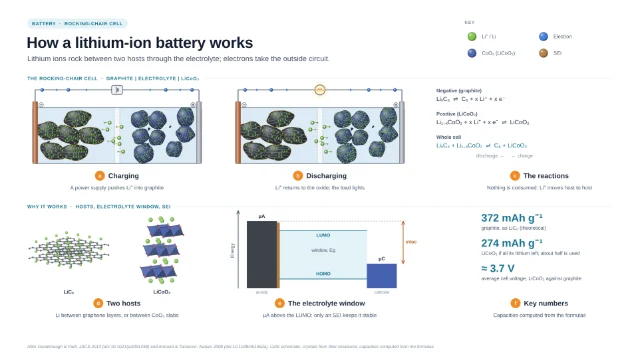
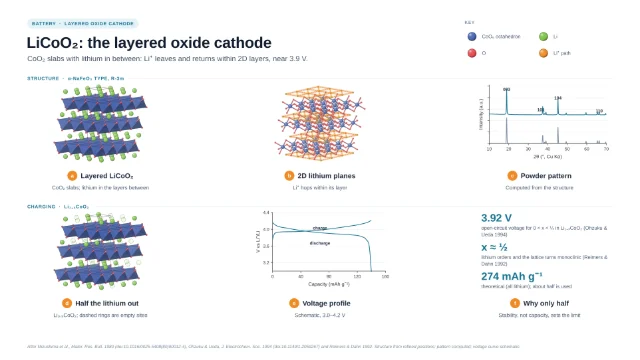
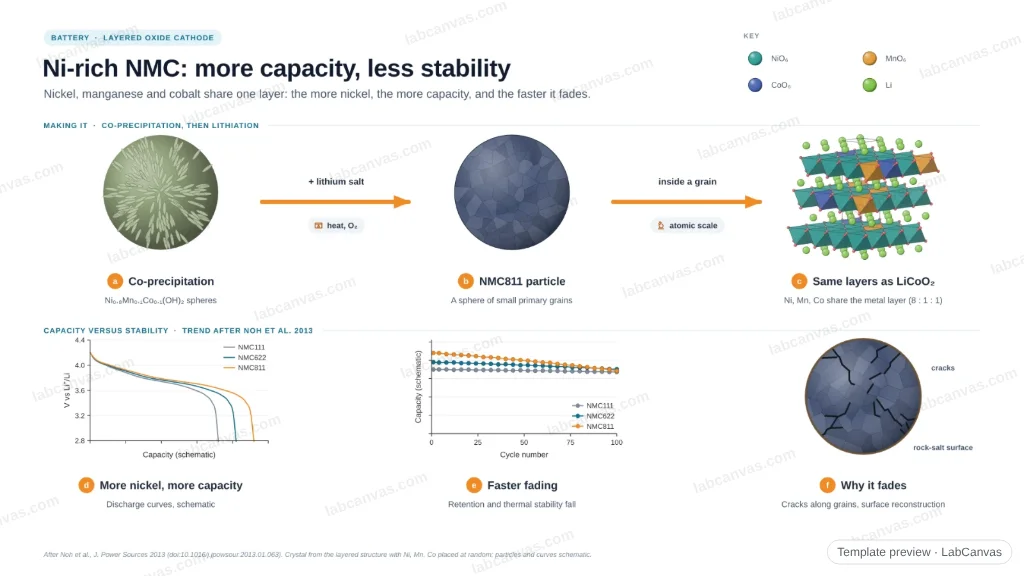
NMC cathodes replace most of LiCoO₂’s cobalt with nickel and some manganese, all sharing one layer of the same structure. They are made by co-precipitating a mixed hydroxide as dense spheres and then heating it with a lithium salt. The more nickel, the more capacity, as NMC811 shows; but retention and thermal stability fall with it, and particles crack along their grain boundaries as they cycle.
Updated 3 cited papers60 editable layers
At a glance
- Category
- Battery materials
- Method
- Layered oxide cathode
- Starting materials
- Ni, Mn and Co sulfates co-precipitated as a mixed hydroxide, e.g. Ni₀.₈Mn₀.₁Co₀.₁(OH)₂; then a lithium salt
- Product
- Layered LiNi₀.₈Mn₀.₁Co₀.₁O₂ (NMC811) as spherical secondary particles of small primary grains
- Key result
- Curves are schematic, showing the trend: more nickel, more capacity, faster fading
- Figure
- 1920 × 1080 px (16:9), 60 editable layers, 6 generated objects
Step by step
- Co-precipitationThe mixed hydroxide grows as dense spheres of plate-like primary particles
- LithiationHeated with a lithium salt (in oxygen for Ni-rich grades) into the layered oxide
- Same structureNi, Mn and Co share the transition-metal layer of the LiCoO₂ (R-3m) structure
- Trade-offFrom x = ⅓ to 0.85 in Li[NiₓCoᵧMn₁₋ₓ₋ᵧ]O₂, capacity rises while capacity retention and thermal stability fall (Noh et al. 2013)
Strengths
- High capacity and energy density
- Less cobalt
Limitations
- Capacity fades faster as nickel rises
- Lower thermal stability
- Particles crack along grain boundaries; surfaces turn rock-salt-like
Uses
- Electric vehicles
Papers this template follows
- Noh, Youn, Yoon & Sun, “Comparison of the structural and electrochemical properties of layered Li[NixCoyMnz]O2 (x = 1/3, 0.5, 0.6, 0.7, 0.8 and 0.85) cathode material for lithium-ion batteries”, J. Power Sources 2013. doi:10.1016/j.jpowsour.2013.01.063primary
- Whittingham, “Lithium Batteries and Cathode Materials”, Chem. Rev. 2004. doi:10.1021/cr020731creview
- Mizushima, Jones, Wiseman & Goodenough, “LixCoO2 (0<x≤1): A new cathode material for batteries of high energy density”, Mater. Res. Bull. 1980. doi:10.1016/0025-5408(80)90012-4further reading
After Noh et al., J. Power Sources 2013 (doi:10.1016/j.jpowsour.2013.01.063). Crystal from the layered structure with Ni, Mn, Co placed at random; particles and curves schematic.
How templates are written and checked: editorial guidelines.
Questions
What does the “Ni-rich NMC: more capacity, less stability” template show?
NMC cathodes replace most of LiCoO₂’s cobalt with nickel and some manganese, all sharing one layer of the same structure. They are made by co-precipitating a mixed hydroxide as dense spheres and then heating it with a lithium salt. The more nickel, the more capacity, as NMC811 shows; but retention and thermal stability fall with it, and particles crack along their grain boundaries as they cycle.
What are the steps shown in “Ni-rich NMC: more capacity, less stability”?
1. Co-precipitation: The mixed hydroxide grows as dense spheres of plate-like primary particles. 2. Lithiation: Heated with a lithium salt (in oxygen for Ni-rich grades) into the layered oxide. 3. Same structure: Ni, Mn and Co share the transition-metal layer of the LiCoO₂ (R-3m) structure. 4. Trade-off: From x = ⅓ to 0.85 in Li[NiₓCoᵧMn₁₋ₓ₋ᵧ]O₂, capacity rises while capacity retention and thermal stability fall (Noh et al. 2013).
What are the starting materials and the product?
Starting materials: Ni, Mn and Co sulfates co-precipitated as a mixed hydroxide, e.g. Ni₀.₈Mn₀.₁Co₀.₁(OH)₂; then a lithium salt. Product: Layered LiNi₀.₈Mn₀.₁Co₀.₁O₂ (NMC811) as spherical secondary particles of small primary grains.
Which papers is “Ni-rich NMC: more capacity, less stability” based on?
Noh, Youn, Yoon & Sun, “Comparison of the structural and electrochemical properties of layered Li[NixCoyMnz]O2 (x = 1/3, 0.5, 0.6, 0.7, 0.8 and 0.85) cathode material for lithium-ion batteries”, J. Power Sources 2013 (doi:10.1016/j.jpowsour.2013.01.063); Whittingham, “Lithium Batteries and Cathode Materials”, Chem. Rev. 2004 (doi:10.1021/cr020731c); Mizushima, Jones, Wiseman & Goodenough, “LixCoO2 (0<x≤1): A new cathode material for batteries of high energy density”, Mater. Res. Bull. 1980 (doi:10.1016/0025-5408(80)90012-4).
Can I edit the “Ni-rich NMC: more capacity, less stability” template?
Yes. Open it in the LabCanvas editor: all 60 layers are editable, including 6 generated objects (structures, plots, equipment) with their own settings. Change the text, colours and layout, then export PNG, TIFF, SVG or PDF.
Do I need an account to use this template?
Not to view it here. To open and edit it, sign in to LabCanvas or create a free account (the free plan keeps one design of each kind). Downloading the figure is part of LabCanvas Pro (US$19 a month or US$199 a year).