Graphical abstract template · Battery materials · Intercalation anode
The graphite anode: staging and the SEI
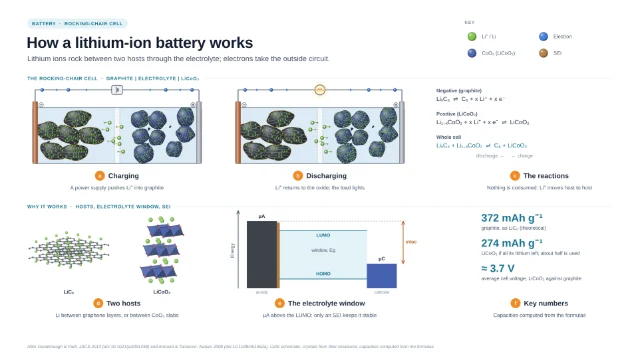
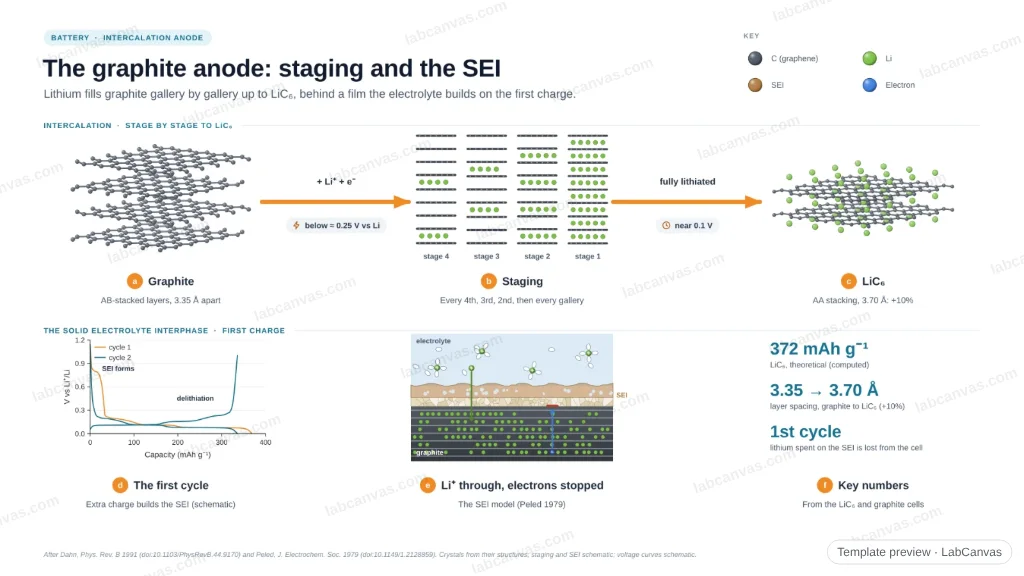
Graphite stores lithium between its graphene layers, filling them in stages, every fourth, third, second and finally every gallery as LiC₆, which opens the layers by about 10%. Graphite works in carbonate electrolytes only because the electrolyte decomposes on the first charge into a thin solid electrolyte interphase (SEI) that lets lithium ions through but stops electrons. The lithium locked in the SEI is lost from the cell.
Updated 4 cited papers72 editable layers
At a glance
- Category
- Battery materials
- Method
- Intercalation anode
- Starting materials
- Natural or synthetic graphite on copper foil, in a carbonate electrolyte with a lithium salt
- Product
- Lithiated graphite up to LiC₆, covered by an SEI
- Key result
- Interlayer spacing and capacity computed from the graphite and LiC₆ cells; voltage curves schematic
- Figure
- 1920 × 1080 px (16:9), 72 editable layers, 6 generated objects
Step by step
- GraphiteAB-stacked graphene layers 3.35 Å apart
- StagingDilute stage 1, then stages 4, 3, 2L, 2 and finally stage 1 as lithium increases (Dahn 1991)
- LiC₆Every gallery filled; the layers stack AA and open to 3.70 Å; 372 mAh g⁻¹ (computed)
- SEIOn the first charge the electrolyte is reduced into a film that conducts Li⁺ but not electrons (Peled 1979)
Strengths
- Low, flat potential near 0.1 V vs Li
- Small volume change (about 10%)
- Cheap and long-lived
Limitations
- Lithium lost to the SEI on the first cycle
- Lithium plating if charged too fast or too cold
Uses
- The negative electrode of almost every lithium-ion cell
Papers this template follows
- Dahn, “Phase diagram of LixC6”, Phys. Rev. B 1991. doi:10.1103/PhysRevB.44.9170primary
- Peled, “The Electrochemical Behavior of Alkali and Alkaline Earth Metals in Nonaqueous Battery Systems—The Solid Electrolyte Interphase Model”, J. Electrochem. Soc. 1979. doi:10.1149/1.2128859primary
- Ohzuku, Iwakoshi & Sawai, “Formation of Lithium-Graphite Intercalation Compounds in Nonaqueous Electrolytes and Their Application as a Negative Electrode for a Lithium Ion (Shuttlecock) Cell”, J. Electrochem. Soc. 1993. doi:10.1149/1.2220849primary
- Xu, “Nonaqueous Liquid Electrolytes for Lithium-Based Rechargeable Batteries”, Chem. Rev. 2004. doi:10.1021/cr030203greview
After Dahn, Phys. Rev. B 1991 (doi:10.1103/PhysRevB.44.9170) and Peled, J. Electrochem. Soc. 1979 (doi:10.1149/1.2128859). Crystals from their structures; staging and SEI schematic; voltage curves schematic.
How templates are written and checked: editorial guidelines.
Questions
What does the “The graphite anode: staging and the SEI” template show?
Graphite stores lithium between its graphene layers, filling them in stages, every fourth, third, second and finally every gallery as LiC₆, which opens the layers by about 10%. Graphite works in carbonate electrolytes only because the electrolyte decomposes on the first charge into a thin solid electrolyte interphase (SEI) that lets lithium ions through but stops electrons. The lithium locked in the SEI is lost from the cell.
What are the steps shown in “The graphite anode: staging and the SEI”?
1. Graphite: AB-stacked graphene layers 3.35 Å apart. 2. Staging: Dilute stage 1, then stages 4, 3, 2L, 2 and finally stage 1 as lithium increases (Dahn 1991). 3. LiC₆: Every gallery filled; the layers stack AA and open to 3.70 Å; 372 mAh g⁻¹ (computed). 4. SEI: On the first charge the electrolyte is reduced into a film that conducts Li⁺ but not electrons (Peled 1979).
What are the starting materials and the product?
Starting materials: Natural or synthetic graphite on copper foil, in a carbonate electrolyte with a lithium salt. Product: Lithiated graphite up to LiC₆, covered by an SEI.
Which papers is “The graphite anode: staging and the SEI” based on?
Dahn, “Phase diagram of LixC6”, Phys. Rev. B 1991 (doi:10.1103/PhysRevB.44.9170); Peled, “The Electrochemical Behavior of Alkali and Alkaline Earth Metals in Nonaqueous Battery Systems—The Solid Electrolyte Interphase Model”, J. Electrochem. Soc. 1979 (doi:10.1149/1.2128859); Ohzuku, Iwakoshi & Sawai, “Formation of Lithium-Graphite Intercalation Compounds in Nonaqueous Electrolytes and Their Application as a Negative Electrode for a Lithium Ion (Shuttlecock) Cell”, J. Electrochem. Soc. 1993 (doi:10.1149/1.2220849); Xu, “Nonaqueous Liquid Electrolytes for Lithium-Based Rechargeable Batteries”, Chem. Rev. 2004 (doi:10.1021/cr030203g).
Can I edit the “The graphite anode: staging and the SEI” template?
Yes. Open it in the LabCanvas editor: all 72 layers are editable, including 6 generated objects (structures, plots, equipment) with their own settings. Change the text, colours and layout, then export PNG, TIFF, SVG or PDF.
Do I need an account to use this template?
Not to view it here. To open and edit it, sign in to LabCanvas or create a free account (the free plan keeps one design of each kind). Downloading the figure is part of LabCanvas Pro (US$19 a month or US$199 a year).