Graphical abstract template · Battery materials · Olivine cathode
LiFePO₄: the olivine cathode
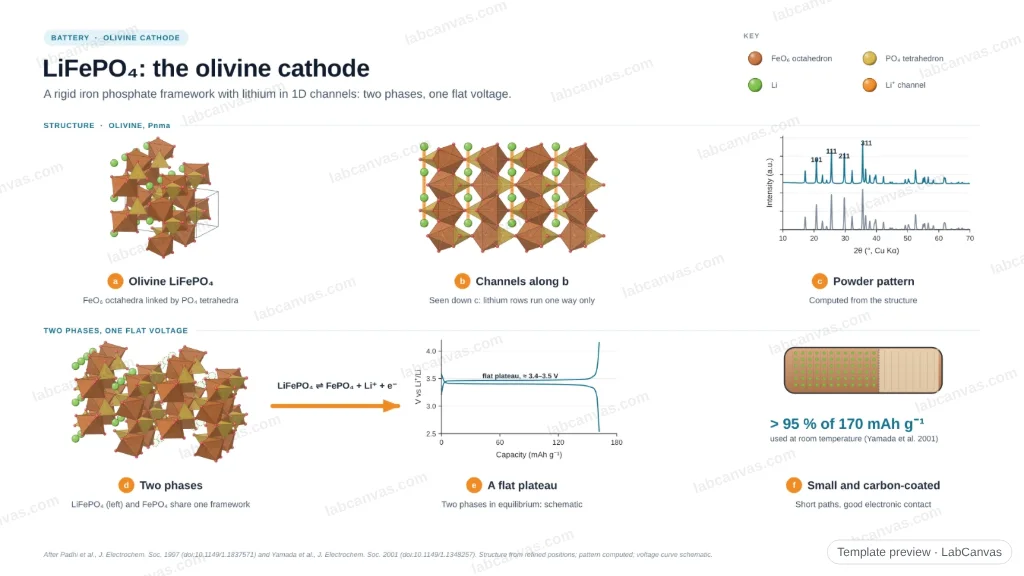
Lithium iron phosphate is cheap, non-toxic and very stable: iron and phosphate build a rigid olivine framework, and lithium sits in one-dimensional channels running through it. Lithium leaves at about 3.5 V by turning LiFePO₄ into FePO₄, two phases sharing one framework, which gives the famously flat voltage. Making the particles small and coating them with carbon was what unlocked nearly all of the 170 mAh g⁻¹.
Updated 4 cited papers57 editable layers
At a glance
- Category
- Battery materials
- Method
- Olivine cathode
- Starting materials
- Iron(II), lithium and phosphate sources, mixed homogeneously and sintered at a moderate temperature
- Product
- Olivine LiFePO₄ (Pnma): FeO₆ octahedra and PO₄ tetrahedra with Li in channels along b
- Key result
- Pattern computed from the refined structure: strongest line (311) near 35.6°, then (111) near 25.6° and (211)/(020) near 29.7° (Cu Kα)
- Figure
- 1920 × 1080 px (16:9), 57 editable layers, 4 generated objects
Step by step
- StructurePnma, a = 10.33, b = 6.01, c = 4.69 Å: corner-sharing FeO₆ octahedra linked by PO₄ tetrahedra
- 1D channelsLithium sites form chains along b, the only easy direction
- Two phasesLiFePO₄ → FePO₄ (heterosite) + Li⁺ + e⁻ at 3.5 V; the framework is kept (Padhi et al. 1997)
- Small and coatedModerate sintering and a homogeneous precursor gave > 95 % of 170 mAh g⁻¹ (Yamada et al. 2001); carbon composites approach it at high rates (Huang, Yin & Nazar 2001)
Strengths
- Iron and phosphate: cheap, non-toxic, abundant
- Very stable framework: safe and long-lived
- Flat voltage
Limitations
- Low electronic conductivity: needs small particles and carbon
- Lower voltage and density than layered oxides
Uses
- Electric buses and cars
- Stationary storage
- Power tools
Papers this template follows
- Padhi, Nanjundaswamy & Goodenough, “Phospho-olivines as Positive-Electrode Materials for Rechargeable Lithium Batteries”, J. Electrochem. Soc. 1997. doi:10.1149/1.1837571primary
- Yamada, Chung & Hinokuma, “Optimized LiFePO4 for Lithium Battery Cathodes”, J. Electrochem. Soc. 2001. doi:10.1149/1.1348257primary
- Huang, Yin & Nazar, “Approaching Theoretical Capacity of LiFePO4 at Room Temperature at High Rates”, Electrochem. Solid-State Lett. 2001. doi:10.1149/1.1396695primary
- Whittingham, “Lithium Batteries and Cathode Materials”, Chem. Rev. 2004. doi:10.1021/cr020731creview
After Padhi et al., J. Electrochem. Soc. 1997 (doi:10.1149/1.1837571) and Yamada et al., J. Electrochem. Soc. 2001 (doi:10.1149/1.1348257). Structure from refined positions; pattern computed; voltage curve schematic.
How templates are written and checked: editorial guidelines.
Questions
What does the “LiFePO₄: the olivine cathode” template show?
Lithium iron phosphate is cheap, non-toxic and very stable: iron and phosphate build a rigid olivine framework, and lithium sits in one-dimensional channels running through it. Lithium leaves at about 3.5 V by turning LiFePO₄ into FePO₄, two phases sharing one framework, which gives the famously flat voltage. Making the particles small and coating them with carbon was what unlocked nearly all of the 170 mAh g⁻¹.
What are the steps shown in “LiFePO₄: the olivine cathode”?
1. Structure: Pnma, a = 10.33, b = 6.01, c = 4.69 Å: corner-sharing FeO₆ octahedra linked by PO₄ tetrahedra. 2. 1D channels: Lithium sites form chains along b, the only easy direction. 3. Two phases: LiFePO₄ → FePO₄ (heterosite) + Li⁺ + e⁻ at 3.5 V; the framework is kept (Padhi et al. 1997). 4. Small and coated: Moderate sintering and a homogeneous precursor gave > 95 % of 170 mAh g⁻¹ (Yamada et al. 2001); carbon composites approach it at high rates (Huang, Yin & Nazar 2001).
What are the starting materials and the product?
Starting materials: Iron(II), lithium and phosphate sources, mixed homogeneously and sintered at a moderate temperature. Product: Olivine LiFePO₄ (Pnma): FeO₆ octahedra and PO₄ tetrahedra with Li in channels along b.
Which papers is “LiFePO₄: the olivine cathode” based on?
Padhi, Nanjundaswamy & Goodenough, “Phospho-olivines as Positive-Electrode Materials for Rechargeable Lithium Batteries”, J. Electrochem. Soc. 1997 (doi:10.1149/1.1837571); Yamada, Chung & Hinokuma, “Optimized LiFePO4 for Lithium Battery Cathodes”, J. Electrochem. Soc. 2001 (doi:10.1149/1.1348257); Huang, Yin & Nazar, “Approaching Theoretical Capacity of LiFePO4 at Room Temperature at High Rates”, Electrochem. Solid-State Lett. 2001 (doi:10.1149/1.1396695); Whittingham, “Lithium Batteries and Cathode Materials”, Chem. Rev. 2004 (doi:10.1021/cr020731c).
Can I edit the “LiFePO₄: the olivine cathode” template?
Yes. Open it in the LabCanvas editor: all 57 layers are editable, including 4 generated objects (structures, plots, equipment) with their own settings. Change the text, colours and layout, then export PNG, TIFF, SVG or PDF.
Do I need an account to use this template?
Not to view it here. To open and edit it, sign in to LabCanvas or create a free account (the free plan keeps one design of each kind). Downloading the figure is part of LabCanvas Pro (US$19 a month or US$199 a year).