Graphical abstract template · Battery materials · Spinel cathode
LiMn₂O₄: the spinel cathode
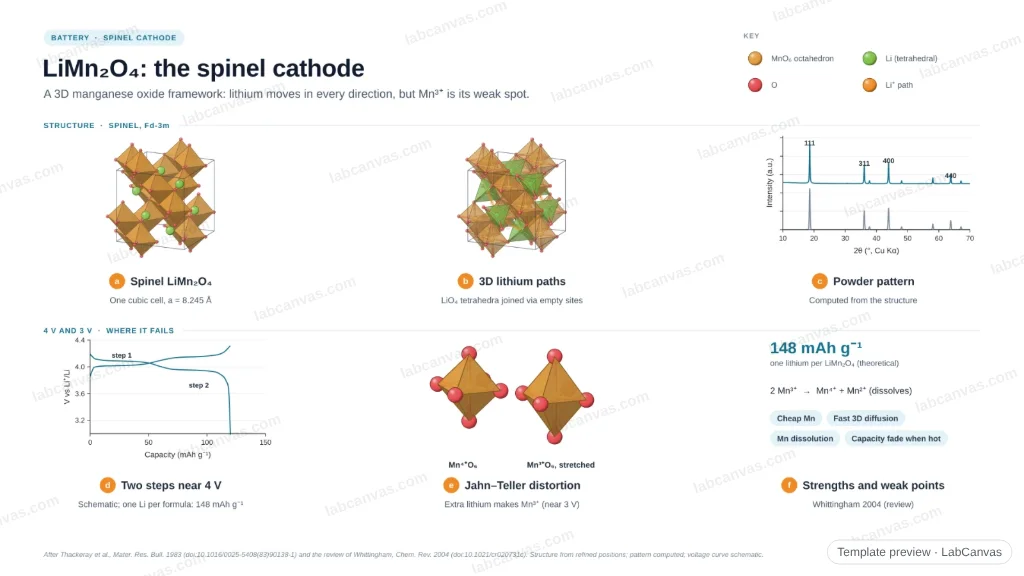
Manganese spinel is cheap and fast: MnO₆ octahedra form a three-dimensional framework, and lithium in tetrahedral sites can move in all three directions. Lithium comes out in two steps near 4 V. Push more lithium in, though, and Mn³⁺ appears; its Jahn–Teller distortion stretches the octahedra and the cubic crystal turns tetragonal, and Mn³⁺ can dissolve into the electrolyte, the spinel’s weak points.
Updated 3 cited papers66 editable layers
At a glance
- Category
- Battery materials
- Method
- Spinel cathode
- Starting materials
- Lithium and manganese oxides or salts, heated in air
- Product
- Cubic spinel LiMn₂O₄ (Fd-3m, a = 8.245 Å)
- Key result
- Pattern computed from the structure: (111) near 18.6°, (311) near 36.1°, (400) near 43.9° (Cu Kα)
- Figure
- 1920 × 1080 px (16:9), 66 editable layers, 3 generated objects
Step by step
- StructureMnO₆ octahedra (16d) share edges into a 3D framework; lithium sits in tetrahedral 8a sites
- 3D pathsLithium hops 8a → 16c → 8a in all directions
- Near 4 VOne lithium per formula comes out in two steps: 148 mAh g⁻¹ (computed from the formula)
- Near 3 VExtra lithium makes Mn³⁺; the Jahn–Teller effect stretches its octahedra and the cell turns tetragonal
Strengths
- Manganese: cheap, abundant, low toxicity
- 3D lithium paths: high rate
- No cobalt
Limitations
- Mn³⁺ disproportionates and dissolves, worse when hot
- Jahn–Teller distortion if over-lithiated
- Lower capacity than layered oxides
Uses
- Power tools
- Blended cathodes for electric vehicles
Papers this template follows
- Thackeray, David, Bruce & Goodenough, “Lithium insertion into manganese spinels”, Mater. Res. Bull. 1983. doi:10.1016/0025-5408(83)90138-1primary
- Whittingham, “Lithium Batteries and Cathode Materials”, Chem. Rev. 2004. doi:10.1021/cr020731creview
- Goodenough & Park, “The Li-Ion Rechargeable Battery: A Perspective”, J. Am. Chem. Soc. 2013. doi:10.1021/ja3091438review
After Thackeray et al., Mater. Res. Bull. 1983 (doi:10.1016/0025-5408(83)90138-1) and the review of Whittingham, Chem. Rev. 2004 (doi:10.1021/cr020731c). Structure from refined positions; pattern computed; voltage curve schematic.
How templates are written and checked: editorial guidelines.
Questions
What does the “LiMn₂O₄: the spinel cathode” template show?
Manganese spinel is cheap and fast: MnO₆ octahedra form a three-dimensional framework, and lithium in tetrahedral sites can move in all three directions. Lithium comes out in two steps near 4 V. Push more lithium in, though, and Mn³⁺ appears; its Jahn–Teller distortion stretches the octahedra and the cubic crystal turns tetragonal, and Mn³⁺ can dissolve into the electrolyte, the spinel’s weak points.
What are the steps shown in “LiMn₂O₄: the spinel cathode”?
1. Structure: MnO₆ octahedra (16d) share edges into a 3D framework; lithium sits in tetrahedral 8a sites. 2. 3D paths: Lithium hops 8a → 16c → 8a in all directions. 3. Near 4 V: One lithium per formula comes out in two steps: 148 mAh g⁻¹ (computed from the formula). 4. Near 3 V: Extra lithium makes Mn³⁺; the Jahn–Teller effect stretches its octahedra and the cell turns tetragonal.
What are the starting materials and the product?
Starting materials: Lithium and manganese oxides or salts, heated in air. Product: Cubic spinel LiMn₂O₄ (Fd-3m, a = 8.245 Å).
Which papers is “LiMn₂O₄: the spinel cathode” based on?
Thackeray, David, Bruce & Goodenough, “Lithium insertion into manganese spinels”, Mater. Res. Bull. 1983 (doi:10.1016/0025-5408(83)90138-1); Whittingham, “Lithium Batteries and Cathode Materials”, Chem. Rev. 2004 (doi:10.1021/cr020731c); Goodenough & Park, “The Li-Ion Rechargeable Battery: A Perspective”, J. Am. Chem. Soc. 2013 (doi:10.1021/ja3091438).
Can I edit the “LiMn₂O₄: the spinel cathode” template?
Yes. Open it in the LabCanvas editor: all 66 layers are editable, including 3 generated objects (structures, plots, equipment) with their own settings. Change the text, colours and layout, then export PNG, TIFF, SVG or PDF.
Do I need an account to use this template?
Not to view it here. To open and edit it, sign in to LabCanvas or create a free account (the free plan keeps one design of each kind). Downloading the figure is part of LabCanvas Pro (US$19 a month or US$199 a year).