Graphical abstract template · Battery materials · Layered oxide cathode
LiCoO₂: the layered oxide cathode
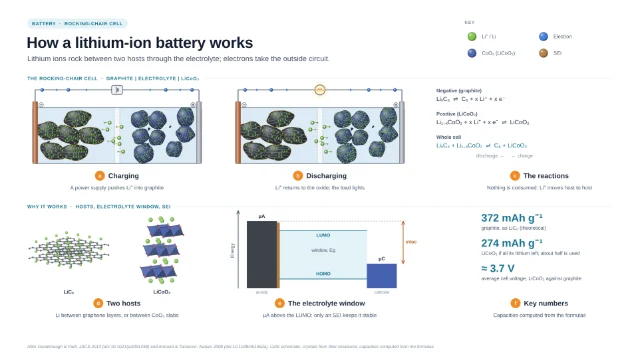
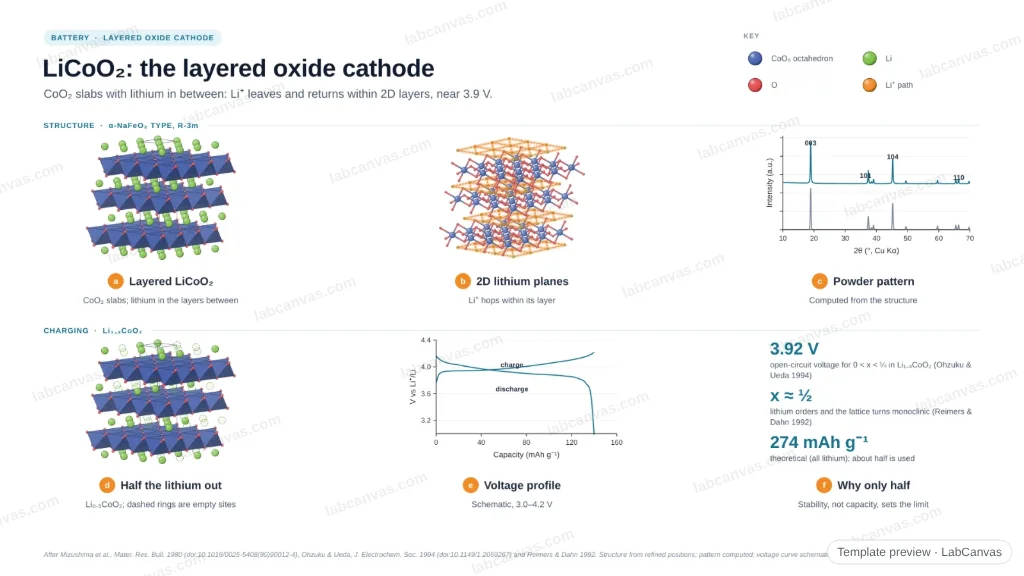
Lithium cobalt oxide, the cathode of the first lithium-ion cells, is built of CoO₂ slabs with lithium in the layers between them, where it can move freely in two dimensions. Charging pulls lithium out to Li₁₋ₓCoO₂ near 3.9 V; at about half the lithium the ions order and the lattice distorts, so in practice only about half of the 274 mAh g⁻¹ is used.
Updated 4 cited papers59 editable layers
At a glance
- Category
- Battery materials
- Method
- Layered oxide cathode
- Starting materials
- Lithium and cobalt salts or oxides, heated together in air
- Product
- Layered LiCoO₂: CoO₂ slabs with lithium between them (R-3m)
- Key result
- Pattern computed from the refined structure: (003) near 18.9° and (104) near 45.2° (Cu Kα)
- Figure
- 1920 × 1080 px (16:9), 59 editable layers, 3 generated objects
Step by step
- Structureα-NaFeO₂ type, R-3m, a = 2.82 Å, c = 14.1 Å: edge-sharing CoO₆ octahedra in slabs, Li in octahedral sites between them
- 2D diffusionLi⁺ hops from site to site within its layer
- ChargingLi₁₋ₓCoO₂: two-phase regions for 0 < x < ¼ and ¾ < x < 1, a single phase between; open-circuit voltage 3.92 V for 0 < x < ¼ (Ohzuku & Ueda 1994)
- Near x = ½Lithium ions order and the cell turns monoclinic (Reimers & Dahn 1992)
Strengths
- High voltage, about 3.9 V against lithium
- Dense, easy to make
- Fast 2D lithium diffusion
Limitations
- Only about half the lithium is used
- Cobalt is costly and scarce
- Unstable when charged too far
Uses
- Phones, laptops and other portable electronics
Papers this template follows
- Mizushima, Jones, Wiseman & Goodenough, “LixCoO2 (0<x≤1): A new cathode material for batteries of high energy density”, Mater. Res. Bull. 1980. doi:10.1016/0025-5408(80)90012-4primary
- Ohzuku & Ueda, “Solid-State Redox Reactions of LiCoO2 (R3m) for 4 Volt Secondary Lithium Cells”, J. Electrochem. Soc. 1994. doi:10.1149/1.2059267primary
- Reimers & Dahn, “Electrochemical and In Situ X-Ray Diffraction Studies of Lithium Intercalation in LixCoO2”, J. Electrochem. Soc. 1992. doi:10.1149/1.2221184primary
- Whittingham, “Lithium Batteries and Cathode Materials”, Chem. Rev. 2004. doi:10.1021/cr020731creview
After Mizushima et al., Mater. Res. Bull. 1980 (doi:10.1016/0025-5408(80)90012-4), Ohzuku & Ueda, J. Electrochem. Soc. 1994 (doi:10.1149/1.2059267) and Reimers & Dahn 1992. Structure from refined positions; pattern computed; voltage curve schematic.
How templates are written and checked: editorial guidelines.
Questions
What does the “LiCoO₂: the layered oxide cathode” template show?
Lithium cobalt oxide, the cathode of the first lithium-ion cells, is built of CoO₂ slabs with lithium in the layers between them, where it can move freely in two dimensions. Charging pulls lithium out to Li₁₋ₓCoO₂ near 3.9 V; at about half the lithium the ions order and the lattice distorts, so in practice only about half of the 274 mAh g⁻¹ is used.
What are the steps shown in “LiCoO₂: the layered oxide cathode”?
1. Structure: α-NaFeO₂ type, R-3m, a = 2.82 Å, c = 14.1 Å: edge-sharing CoO₆ octahedra in slabs, Li in octahedral sites between them. 2. 2D diffusion: Li⁺ hops from site to site within its layer. 3. Charging: Li₁₋ₓCoO₂: two-phase regions for 0 < x < ¼ and ¾ < x < 1, a single phase between; open-circuit voltage 3.92 V for 0 < x < ¼ (Ohzuku & Ueda 1994). 4. Near x = ½: Lithium ions order and the cell turns monoclinic (Reimers & Dahn 1992).
What are the starting materials and the product?
Starting materials: Lithium and cobalt salts or oxides, heated together in air. Product: Layered LiCoO₂: CoO₂ slabs with lithium between them (R-3m).
Which papers is “LiCoO₂: the layered oxide cathode” based on?
Mizushima, Jones, Wiseman & Goodenough, “LixCoO2 (0<x≤1): A new cathode material for batteries of high energy density”, Mater. Res. Bull. 1980 (doi:10.1016/0025-5408(80)90012-4); Ohzuku & Ueda, “Solid-State Redox Reactions of LiCoO2 (R3m) for 4 Volt Secondary Lithium Cells”, J. Electrochem. Soc. 1994 (doi:10.1149/1.2059267); Reimers & Dahn, “Electrochemical and In Situ X-Ray Diffraction Studies of Lithium Intercalation in LixCoO2”, J. Electrochem. Soc. 1992 (doi:10.1149/1.2221184); Whittingham, “Lithium Batteries and Cathode Materials”, Chem. Rev. 2004 (doi:10.1021/cr020731c).
Can I edit the “LiCoO₂: the layered oxide cathode” template?
Yes. Open it in the LabCanvas editor: all 59 layers are editable, including 3 generated objects (structures, plots, equipment) with their own settings. Change the text, colours and layout, then export PNG, TIFF, SVG or PDF.
Do I need an account to use this template?
Not to view it here. To open and edit it, sign in to LabCanvas or create a free account (the free plan keeps one design of each kind). Downloading the figure is part of LabCanvas Pro (US$19 a month or US$199 a year).