Graphical abstract template · Battery materials · Alloy anode
Silicon anodes: huge capacity, huge swelling
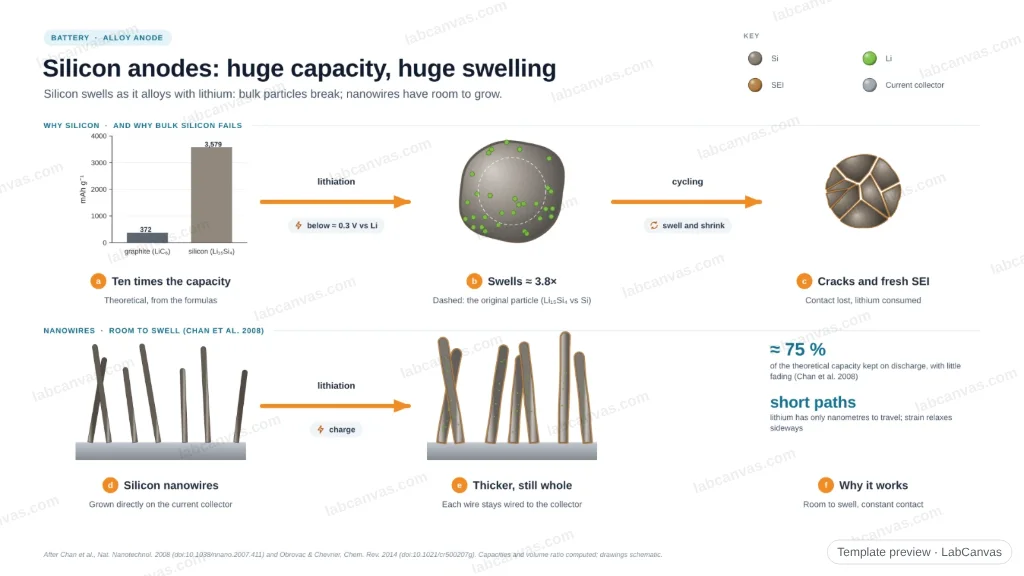
Silicon can take up almost ten times more lithium per gram than graphite, but it swells to nearly four times its volume as it does. Bulk particles crack, lose contact and grow fresh SEI on every new surface, so the capacity fades. Silicon nanowires grown straight on the current collector have room to swell: they stay whole and connected, and keep most of their capacity over cycling.
Updated 3 cited papers68 editable layers
At a glance
- Category
- Battery materials
- Method
- Alloy anode
- Starting materials
- Silicon particles, or silicon nanowires grown directly on a metal current collector
- Product
- A high-capacity negative electrode (Li₁₅Si₄ when fully lithiated at room temperature)
- Key result
- Capacities and the volume ratio computed; particles and wires schematic
- Figure
- 1920 × 1080 px (16:9), 68 editable layers, 7 generated objects
Step by step
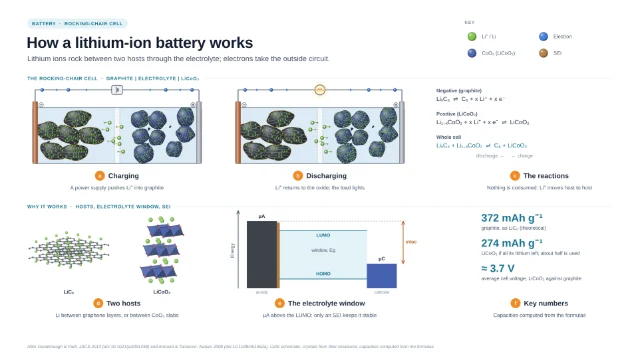
- Capacity3,579 mAh g⁻¹ for Li₁₅Si₄ against 372 for LiC₆ (computed from the formulas)
- SwellingLi₁₅Si₄ takes ≈3.8× the volume of the silicon it came from (from the two crystal structures)
- Failure of bulk SiParticles crack, lose electrical contact and keep forming SEI on new surfaces (Obrovac & Chevrier 2014)
- NanowiresWires grown on the current collector swell without breaking and stay connected; theoretical charge capacity, about 75% kept on discharge with little fading (Chan et al. 2008)
Strengths
- Very high capacity
- Abundant element
Limitations
- Huge volume change
- Continuous SEI growth consumes lithium
- Nanostructures are costly to make
Uses
- Silicon or silicon oxide blended into graphite anodes
Papers this template follows
- Chan et al., “High-performance lithium battery anodes using silicon nanowires”, Nat. Nanotechnol. 2008. doi:10.1038/nnano.2007.411primary
- Obrovac & Chevrier, “Alloy Negative Electrodes for Li-Ion Batteries”, Chem. Rev. 2014. doi:10.1021/cr500207greview
- Armand & Tarascon, “Building better batteries”, Nature 2008. doi:10.1038/451652areview
After Chan et al., Nat. Nanotechnol. 2008 (doi:10.1038/nnano.2007.411) and Obrovac & Chevrier, Chem. Rev. 2014 (doi:10.1021/cr500207g). Capacities and volume ratio computed; drawings schematic.
How templates are written and checked: editorial guidelines.
Questions
What does the “Silicon anodes: huge capacity, huge swelling” template show?
Silicon can take up almost ten times more lithium per gram than graphite, but it swells to nearly four times its volume as it does. Bulk particles crack, lose contact and grow fresh SEI on every new surface, so the capacity fades. Silicon nanowires grown straight on the current collector have room to swell: they stay whole and connected, and keep most of their capacity over cycling.
What are the steps shown in “Silicon anodes: huge capacity, huge swelling”?
1. Capacity: 3,579 mAh g⁻¹ for Li₁₅Si₄ against 372 for LiC₆ (computed from the formulas). 2. Swelling: Li₁₅Si₄ takes ≈3.8× the volume of the silicon it came from (from the two crystal structures). 3. Failure of bulk Si: Particles crack, lose electrical contact and keep forming SEI on new surfaces (Obrovac & Chevrier 2014). 4. Nanowires: Wires grown on the current collector swell without breaking and stay connected; theoretical charge capacity, about 75% kept on discharge with little fading (Chan et al. 2008).
What are the starting materials and the product?
Starting materials: Silicon particles, or silicon nanowires grown directly on a metal current collector. Product: A high-capacity negative electrode (Li₁₅Si₄ when fully lithiated at room temperature).
Which papers is “Silicon anodes: huge capacity, huge swelling” based on?
Chan et al., “High-performance lithium battery anodes using silicon nanowires”, Nat. Nanotechnol. 2008 (doi:10.1038/nnano.2007.411); Obrovac & Chevrier, “Alloy Negative Electrodes for Li-Ion Batteries”, Chem. Rev. 2014 (doi:10.1021/cr500207g); Armand & Tarascon, “Building better batteries”, Nature 2008 (doi:10.1038/451652a).
Can I edit the “Silicon anodes: huge capacity, huge swelling” template?
Yes. Open it in the LabCanvas editor: all 68 layers are editable, including 7 generated objects (structures, plots, equipment) with their own settings. Change the text, colours and layout, then export PNG, TIFF, SVG or PDF.
Do I need an account to use this template?
Not to view it here. To open and edit it, sign in to LabCanvas or create a free account (the free plan keeps one design of each kind). Downloading the figure is part of LabCanvas Pro (US$19 a month or US$199 a year).