Graphical abstract template · Battery materials · 3D renders
Inside a lithium-ion cell, from can to crystal (3D renders)
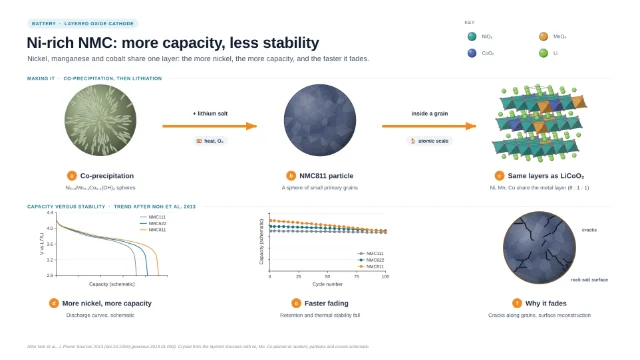
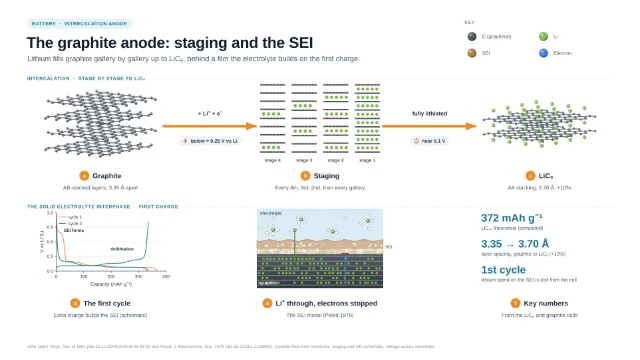
A graphical abstract made of path-traced 3D renders: a cylindrical lithium-ion cell cut away, its electrode stack in cross-section, and the two crystals that host the lithium, layered LiCoO₂ and graphite. Every render keeps its 3D scene: double-click one to open it in the 3D studio, turn it, restyle it and update it in the figure.
Updated 4 cited papers34 editable layers

At a glance
- Category
- Battery materials
- Method
- 3D renders
- Starting materials
- Graphite on copper foil (negative), LiCoO₂ on aluminium foil (positive), a porous separator and a liquid electrolyte
- Product
- A cell in which lithium ions shuttle between two host crystals
- Key result
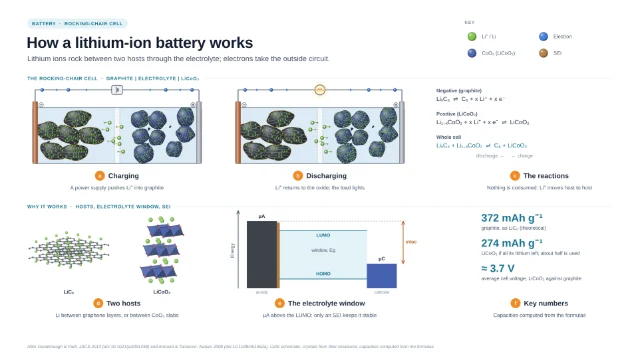
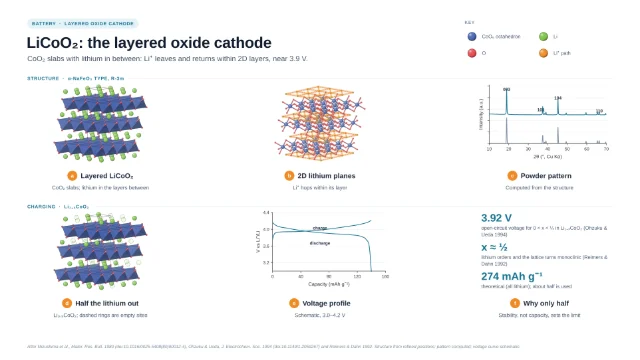
- Theoretical capacities from the formulas: LiC₆ 372 mAh g⁻¹; LiCoO₂ 274 mAh g⁻¹ if all its lithium left
- Figure
- 1920 × 1080 px (16:9), 34 editable layers
Step by step
- The cellElectrodes and separator wound into a cylinder (a jelly roll) in a metal can
- The electrodesGraphite and oxide particle layers on metal foils, with the separator and electrolyte between
- The hostsLithium sits between CoO₂ slabs in LiCoO₂ and between graphene layers in graphite (LiC₆)
Uses
- Graphical abstracts
- Talks and posters
- Teaching how a cell is built
Papers this template follows
- Goodenough & Park, “The Li-Ion Rechargeable Battery: A Perspective”, J. Am. Chem. Soc. 2013. doi:10.1021/ja3091438review
- Mizushima, Jones, Wiseman & Goodenough, “LixCoO2 (0<x≤1): A new cathode material for batteries of high energy density”, Mater. Res. Bull. 1980. doi:10.1016/0025-5408(80)90012-4primary
- Armand & Tarascon, “Building better batteries”, Nature 2008. doi:10.1038/451652areview
- Peled, “The electrochemical behavior of alkali and alkaline earth metals in nonaqueous battery systems — the solid electrolyte interphase model”, J. Electrochem. Soc. 1979. doi:10.1149/1.2128859further reading
After Goodenough & Park, JACS 2013 (doi:10.1021/ja3091438) and Mizushima et al., Mater. Res. Bull. 1980 (doi:10.1016/0025-5408(80)90012-4). Renders path traced in LabCanvas 3D studio; cell and stack schematic, crystals from their structures.
How templates are written and checked: editorial guidelines.
Questions
What does the “Inside a lithium-ion cell, from can to crystal (3D renders)” template show?
A graphical abstract made of path-traced 3D renders: a cylindrical lithium-ion cell cut away, its electrode stack in cross-section, and the two crystals that host the lithium, layered LiCoO₂ and graphite. Every render keeps its 3D scene: double-click one to open it in the 3D studio, turn it, restyle it and update it in the figure.
What are the steps shown in “Inside a lithium-ion cell, from can to crystal (3D renders)”?
1. The cell: Electrodes and separator wound into a cylinder (a jelly roll) in a metal can. 2. The electrodes: Graphite and oxide particle layers on metal foils, with the separator and electrolyte between. 3. The hosts: Lithium sits between CoO₂ slabs in LiCoO₂ and between graphene layers in graphite (LiC₆).
What are the starting materials and the product?
Starting materials: Graphite on copper foil (negative), LiCoO₂ on aluminium foil (positive), a porous separator and a liquid electrolyte. Product: A cell in which lithium ions shuttle between two host crystals.
Which papers is “Inside a lithium-ion cell, from can to crystal (3D renders)” based on?
Goodenough & Park, “The Li-Ion Rechargeable Battery: A Perspective”, J. Am. Chem. Soc. 2013 (doi:10.1021/ja3091438); Mizushima, Jones, Wiseman & Goodenough, “LixCoO2 (0<x≤1): A new cathode material for batteries of high energy density”, Mater. Res. Bull. 1980 (doi:10.1016/0025-5408(80)90012-4); Armand & Tarascon, “Building better batteries”, Nature 2008 (doi:10.1038/451652a); Peled, “The electrochemical behavior of alkali and alkaline earth metals in nonaqueous battery systems — the solid electrolyte interphase model”, J. Electrochem. Soc. 1979 (doi:10.1149/1.2128859).
Can I edit the “Inside a lithium-ion cell, from can to crystal (3D renders)” template?
Yes. Open it in the LabCanvas editor: all 34 layers are editable. Change the text, colours and layout, then export PNG, TIFF, SVG or PDF.
Do I need an account to use this template?
Not to view it here. To open and edit it, sign in to LabCanvas or create a free account (the free plan keeps one design of each kind). Downloading the figure is part of LabCanvas Pro (US$19 a month or US$199 a year).