Graphical abstract template · Battery materials · Conversion cathode
Lithium–sulfur: a carbon host and the polysulfide shuttle
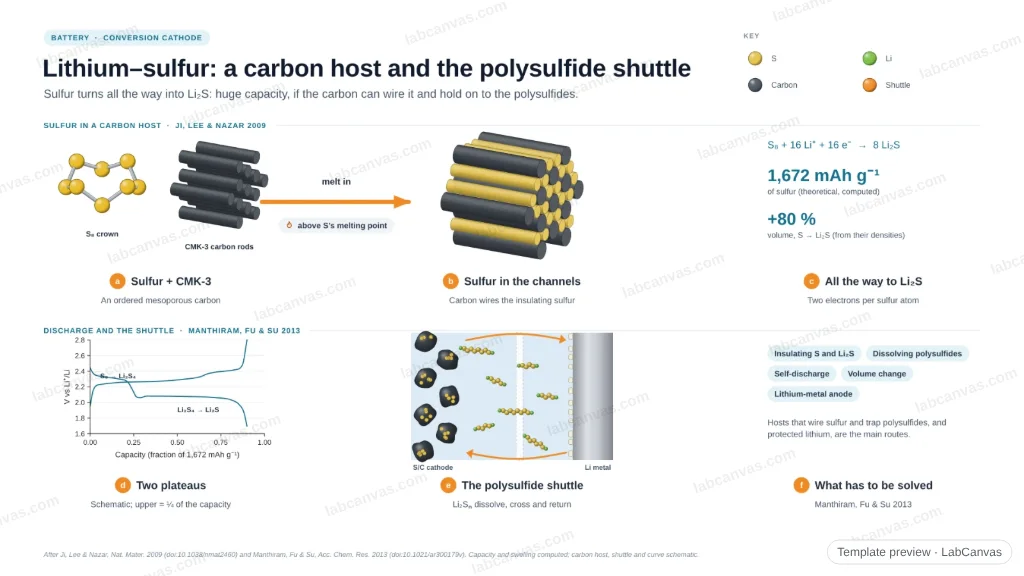
Sulfur can store far more lithium per gram than any oxide cathode, by turning all the way into Li₂S. But sulfur and Li₂S are insulators, the solid swells as it reacts, and the polysulfides formed on the way dissolve and shuttle to the lithium anode. Melting sulfur into the narrow channels of an ordered mesoporous carbon (CMK-3) wired it up and helped keep the polysulfides in place.
Updated 3 cited papers74 editable layers
At a glance
- Category
- Battery materials
- Method
- Conversion cathode
- Starting materials
- Sulfur and an ordered mesoporous carbon (CMK-3); lithium metal as the anode
- Product
- A sulfur–carbon composite cathode: sulfur confined in the carbon channels
- Key result
- 1,672 mAh g⁻¹ of sulfur and ≈80% swelling (S → Li₂S) computed from the formulas and densities; voltage curve schematic
- Figure
- 1920 × 1080 px (16:9), 74 editable layers, 5 generated objects
Step by step
- HostSulfur is melted into the channels of CMK-3, an ordered mesoporous carbon (Ji, Lee & Nazar 2009)
- Upper plateauS₈ opens into soluble long-chain polysulfides, down to Li₂S₄: a quarter of the capacity
- Lower plateauLi₂S₄ → Li₂S₂ / Li₂S, insoluble solids
- ShuttleDissolved polysulfides cross to the lithium, are reduced there and come back, wasting charge (Manthiram, Fu & Su 2013)
Strengths
- Very high capacity
- Sulfur is cheap and abundant
Limitations
- Insulating sulfur and Li₂S
- Polysulfide shuttle and self-discharge
- Volume change
- Lithium-metal anode
Uses
- Lightweight batteries (drones, aviation) under development
Papers this template follows
- Ji, Lee & Nazar, “A highly ordered nanostructured carbon–sulphur cathode for lithium–sulphur batteries”, Nat. Mater. 2009. doi:10.1038/nmat2460primary
- Manthiram, Fu & Su, “Challenges and Prospects of Lithium–Sulfur Batteries”, Acc. Chem. Res. 2013. doi:10.1021/ar300179vreview
- Xu et al., “Lithium metal anodes for rechargeable batteries”, Energy Environ. Sci. 2014. doi:10.1039/C3EE40795Kfurther reading
After Ji, Lee & Nazar, Nat. Mater. 2009 (doi:10.1038/nmat2460) and Manthiram, Fu & Su, Acc. Chem. Res. 2013 (doi:10.1021/ar300179v). Capacity and swelling computed; carbon host, shuttle and curve schematic.
How templates are written and checked: editorial guidelines.
Questions
What does the “Lithium–sulfur: a carbon host and the polysulfide shuttle” template show?
Sulfur can store far more lithium per gram than any oxide cathode, by turning all the way into Li₂S. But sulfur and Li₂S are insulators, the solid swells as it reacts, and the polysulfides formed on the way dissolve and shuttle to the lithium anode. Melting sulfur into the narrow channels of an ordered mesoporous carbon (CMK-3) wired it up and helped keep the polysulfides in place.
What are the steps shown in “Lithium–sulfur: a carbon host and the polysulfide shuttle”?
1. Host: Sulfur is melted into the channels of CMK-3, an ordered mesoporous carbon (Ji, Lee & Nazar 2009). 2. Upper plateau: S₈ opens into soluble long-chain polysulfides, down to Li₂S₄: a quarter of the capacity. 3. Lower plateau: Li₂S₄ → Li₂S₂ / Li₂S, insoluble solids. 4. Shuttle: Dissolved polysulfides cross to the lithium, are reduced there and come back, wasting charge (Manthiram, Fu & Su 2013).
What are the starting materials and the product?
Starting materials: Sulfur and an ordered mesoporous carbon (CMK-3); lithium metal as the anode. Product: A sulfur–carbon composite cathode: sulfur confined in the carbon channels.
Which papers is “Lithium–sulfur: a carbon host and the polysulfide shuttle” based on?
Ji, Lee & Nazar, “A highly ordered nanostructured carbon–sulphur cathode for lithium–sulphur batteries”, Nat. Mater. 2009 (doi:10.1038/nmat2460); Manthiram, Fu & Su, “Challenges and Prospects of Lithium–Sulfur Batteries”, Acc. Chem. Res. 2013 (doi:10.1021/ar300179v); Xu et al., “Lithium metal anodes for rechargeable batteries”, Energy Environ. Sci. 2014 (doi:10.1039/C3EE40795K).
Can I edit the “Lithium–sulfur: a carbon host and the polysulfide shuttle” template?
Yes. Open it in the LabCanvas editor: all 74 layers are editable, including 5 generated objects (structures, plots, equipment) with their own settings. Change the text, colours and layout, then export PNG, TIFF, SVG or PDF.
Do I need an account to use this template?
Not to view it here. To open and edit it, sign in to LabCanvas or create a free account (the free plan keeps one design of each kind). Downloading the figure is part of LabCanvas Pro (US$19 a month or US$199 a year).