Graphical abstract template · Battery materials · Solid electrolyte
Solid-state batteries: ceramic electrolytes
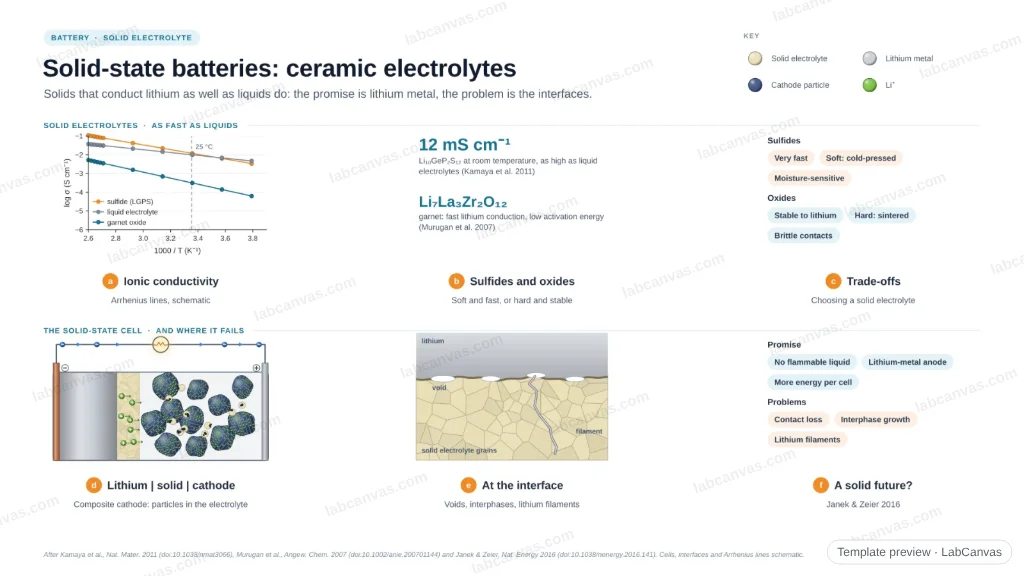
A solid-state battery replaces the flammable liquid electrolyte with a ceramic that conducts lithium ions, which could also make a lithium-metal anode practical. Some solids now conduct as well as liquids: the sulfide Li₁₀GeP₂S₁₂ reaches 12 mS cm⁻¹ at room temperature, and the garnet oxide Li₇La₃Zr₂O₁₂ is a fast, stable conductor. The hard part is the interfaces, where contact, chemistry and lithium filaments decide whether the cell lasts.
Updated 4 cited papers82 editable layers
At a glance
- Category
- Battery materials
- Method
- Solid electrolyte
- Starting materials
- Sulfide or oxide lithium conductors, pressed or sintered into dense layers; lithium metal; composite cathodes
- Product
- A cell with a solid electrolyte between a lithium-metal anode and a composite cathode
- Key result
- Arrhenius lines drawn through room-temperature values; schematic
- Figure
- 1920 × 1080 px (16:9), 82 editable layers, 2 generated objects
Step by step
- SulfidesLi₁₀GeP₂S₁₂: 12 mS cm⁻¹ at room temperature, like liquid electrolytes (Kamaya et al. 2011)
- OxidesGarnet Li₇La₃Zr₂O₁₂: fast lithium conduction, low activation energy (Murugan et al. 2007)
- CellLithium metal | solid electrolyte | cathode particles mixed with electrolyte particles
- InterfacesVoids where contact is lost, reaction interphases, lithium filaments along grain boundaries (Janek & Zeier 2016)
Strengths
- No flammable liquid
- Could enable lithium-metal anodes
- Single-ion conductors
Limitations
- Poor solid–solid contact
- Interphases and lithium filaments
- Sulfides are moisture-sensitive; oxides are brittle
Uses
- Next-generation electric-vehicle cells (in development)
Papers this template follows
- Kamaya et al., “A lithium superionic conductor”, Nat. Mater. 2011. doi:10.1038/nmat3066primary
- Murugan, Thangadurai & Weppner, “Fast Lithium Ion Conduction in Garnet-Type Li7La3Zr2O12”, Angew. Chem. Int. Ed. 2007. doi:10.1002/anie.200701144primary
- Janek & Zeier, “A solid future for battery development”, Nat. Energy 2016. doi:10.1038/nenergy.2016.141review
- Xu et al., “Lithium metal anodes for rechargeable batteries”, Energy Environ. Sci. 2014. doi:10.1039/C3EE40795Kfurther reading
After Kamaya et al., Nat. Mater. 2011 (doi:10.1038/nmat3066), Murugan et al., Angew. Chem. 2007 (doi:10.1002/anie.200701144) and Janek & Zeier, Nat. Energy 2016 (doi:10.1038/nenergy.2016.141). Cells, interfaces and Arrhenius lines schematic.
How templates are written and checked: editorial guidelines.
Questions
What does the “Solid-state batteries: ceramic electrolytes” template show?
A solid-state battery replaces the flammable liquid electrolyte with a ceramic that conducts lithium ions, which could also make a lithium-metal anode practical. Some solids now conduct as well as liquids: the sulfide Li₁₀GeP₂S₁₂ reaches 12 mS cm⁻¹ at room temperature, and the garnet oxide Li₇La₃Zr₂O₁₂ is a fast, stable conductor. The hard part is the interfaces, where contact, chemistry and lithium filaments decide whether the cell lasts.
What are the steps shown in “Solid-state batteries: ceramic electrolytes”?
1. Sulfides: Li₁₀GeP₂S₁₂: 12 mS cm⁻¹ at room temperature, like liquid electrolytes (Kamaya et al. 2011). 2. Oxides: Garnet Li₇La₃Zr₂O₁₂: fast lithium conduction, low activation energy (Murugan et al. 2007). 3. Cell: Lithium metal | solid electrolyte | cathode particles mixed with electrolyte particles. 4. Interfaces: Voids where contact is lost, reaction interphases, lithium filaments along grain boundaries (Janek & Zeier 2016).
What are the starting materials and the product?
Starting materials: Sulfide or oxide lithium conductors, pressed or sintered into dense layers; lithium metal; composite cathodes. Product: A cell with a solid electrolyte between a lithium-metal anode and a composite cathode.
Which papers is “Solid-state batteries: ceramic electrolytes” based on?
Kamaya et al., “A lithium superionic conductor”, Nat. Mater. 2011 (doi:10.1038/nmat3066); Murugan, Thangadurai & Weppner, “Fast Lithium Ion Conduction in Garnet-Type Li7La3Zr2O12”, Angew. Chem. Int. Ed. 2007 (doi:10.1002/anie.200701144); Janek & Zeier, “A solid future for battery development”, Nat. Energy 2016 (doi:10.1038/nenergy.2016.141); Xu et al., “Lithium metal anodes for rechargeable batteries”, Energy Environ. Sci. 2014 (doi:10.1039/C3EE40795K).
Can I edit the “Solid-state batteries: ceramic electrolytes” template?
Yes. Open it in the LabCanvas editor: all 82 layers are editable, including 2 generated objects (structures, plots, equipment) with their own settings. Change the text, colours and layout, then export PNG, TIFF, SVG or PDF.
Do I need an account to use this template?
Not to view it here. To open and edit it, sign in to LabCanvas or create a free account (the free plan keeps one design of each kind). Downloading the figure is part of LabCanvas Pro (US$19 a month or US$199 a year).