Faujasite (zeolite X and Y): structure, USY and FCC
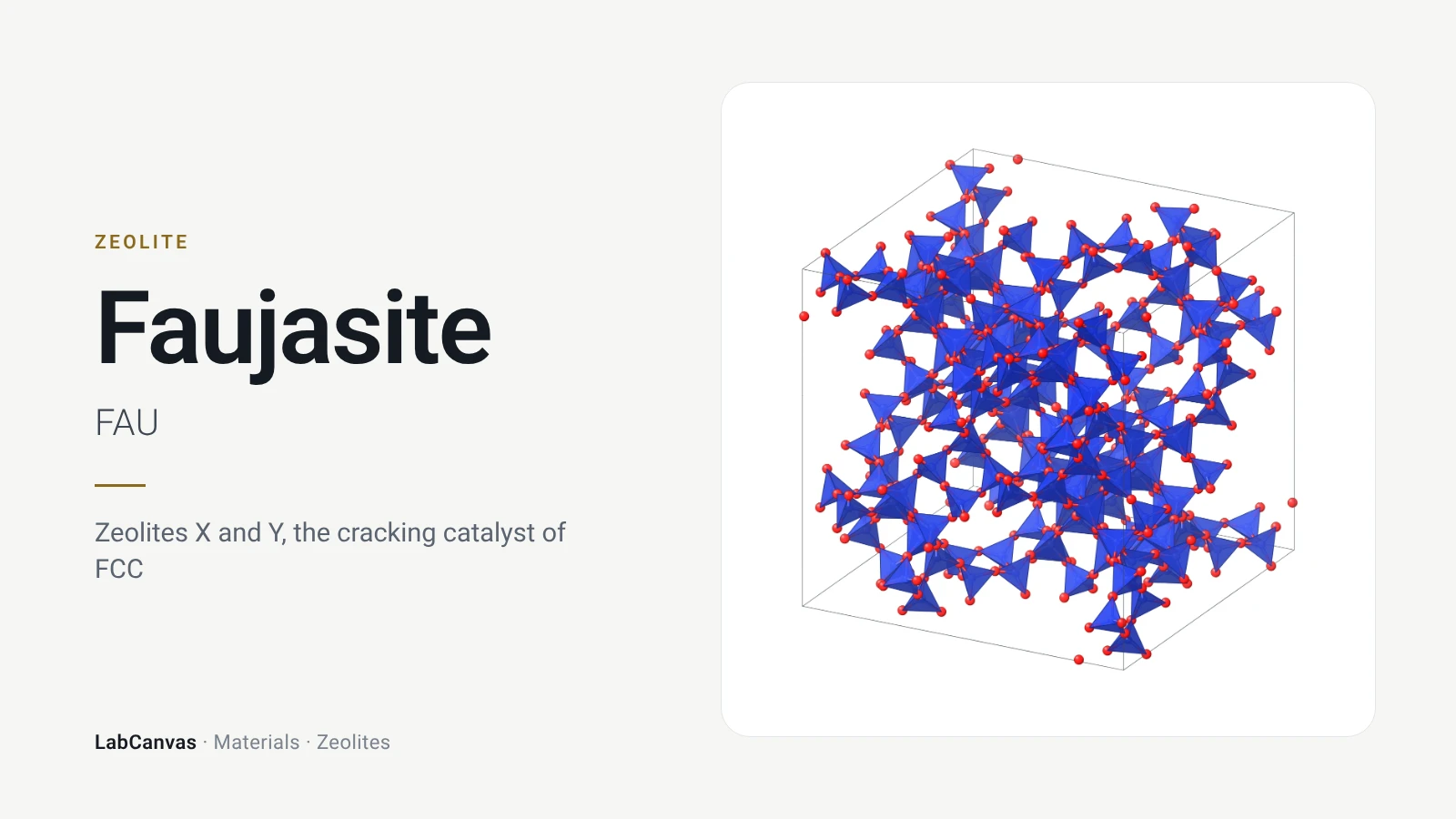
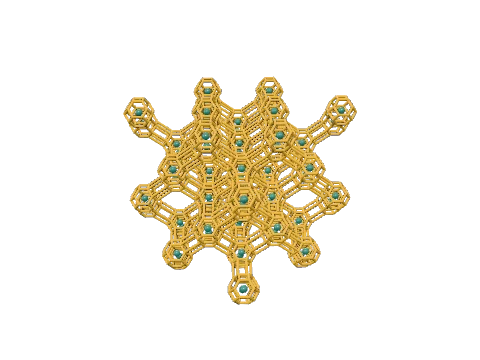
Faujasite, framework type FAU, is the zeolite framework of zeolites X and Y: sodalite cages joined to four neighbours through double six-rings, as carbon atoms are joined in diamond, enclosing supercages 12–13 Å across that connect through twelve-ring windows about 7.3 Å wide (Ooe et al. 2023; Vogt and Weckhuysen 2015; Pirngruber et al. 2010). X and Y have the same structure and differ only in Si/Al, about 1.25 for X and 2.5–2.8 for Y (Feldhoff et al. 2009; Liguori et al. 2019). Stabilised with rare earths or by steaming to ultrastable Y (USY), zeolite Y has been the main cracking component of fluid catalytic cracking (FCC) catalysts since 1964, and FCC makes most of the world’s gasoline (Vogt and Weckhuysen 2015).
Contents
Faujasite (zeolite X and Y) at a glance
| Formula | Framework type FAU; the composition varies with Si/Al: about 1 (LSX), about 1.25 (X) and 2.5–2.8 (Y) (Liguori et al. 2019) |
|---|---|
| Building units | Sodalite cages and double six-membered rings (D6R), also called hexagonal prisms (Ooe et al. 2023; Vogt and Weckhuysen 2015) |
| Connectivity | Each sodalite cage is joined to its four nearest sodalite cages through D6Rs, like carbon atoms in diamond (Ooe et al. 2023) |
| Supercage | Large cages 12–13 Å across (Ooe et al. 2023; Vogt and Weckhuysen 2015) |
| Windows | Twelve-membered rings join neighbouring supercages (Pirngruber et al. 2010); a 3-D pore system of about 7.3 Å (Vogt and Weckhuysen 2015) |
| Cell | Cubic, a = 24.345 Å (Ooe et al. 2023) |
| Framework density | 12.7 T atoms per 1000 ų (Liguori et al. 2019) |
| X vs Y | Isostructural; X differs from Y only by its lower Si/Al ratio (Feldhoff et al. 2009) |
| Polymorph | EMT, the hexagonal stacking of the same faujasite sheets; FAU twin boundaries look locally like EMT (Ooe et al. 2023) |
| Ultrastable Y (USY) | Zeolite Y made more stable to hot steam by controlled steaming and washing/leaching cycles (Vogt and Weckhuysen 2015) |
| Use in FCC | Main cracking component of FCC catalysts since 1964, first Mg-stabilised, now rare-earth-stabilised (Vogt and Weckhuysen 2015) |
| FCC conditions | Catalyst cycles between about 500 °C and 760 °C; average particle lifetime about one month (Vogt and Weckhuysen 2015) |
| Inventor of Y | D. W. Breck at Union Carbide (Vogt and Weckhuysen 2015) |
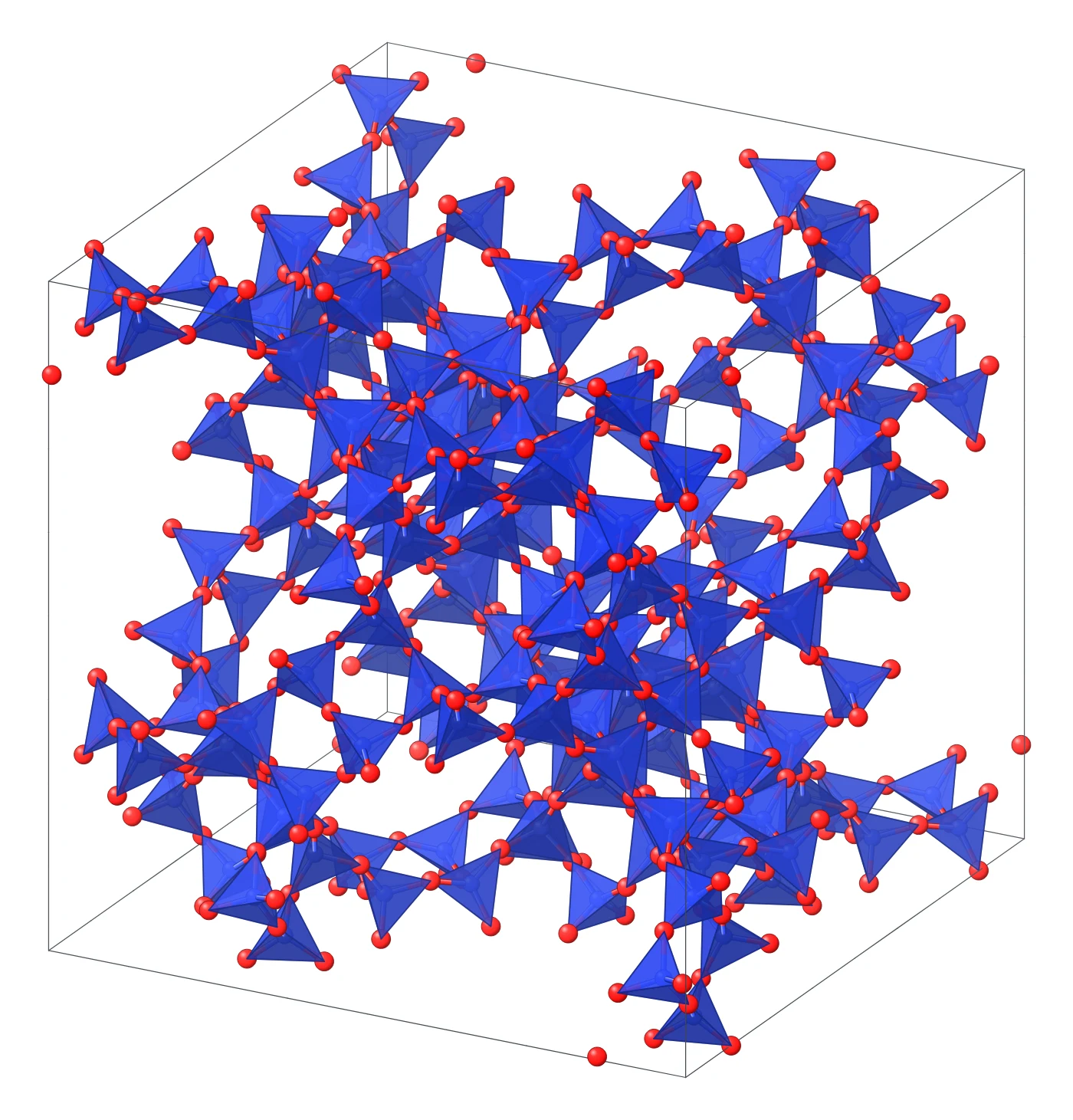
Faujasite (zeolite X and Y) crystal structure (high-resolution SVG)
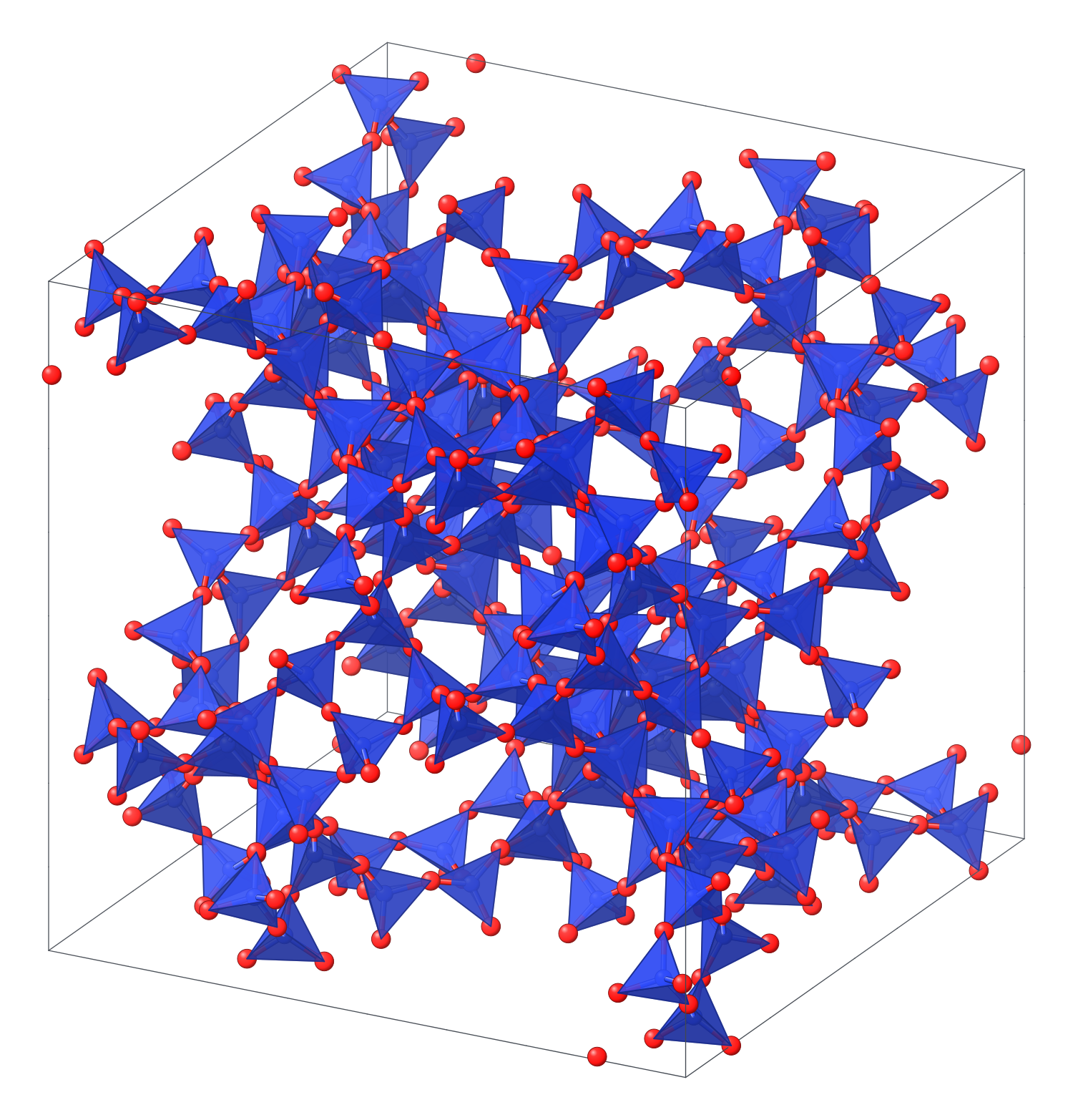
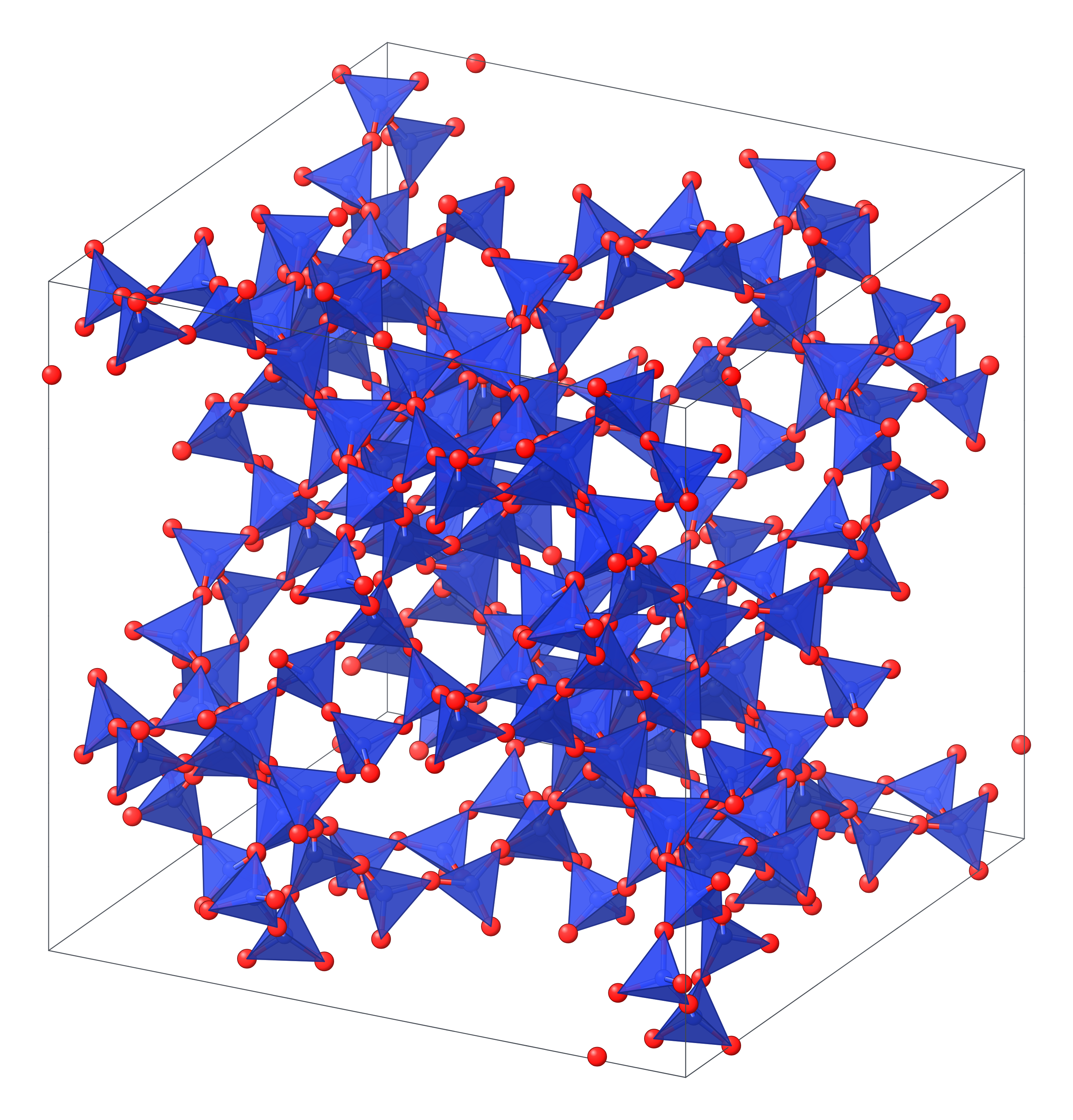
Faujasite (zeolite X and Y) in 3D (interactive)
Loading the 3D model…
Faujasite structure explained
Faujasite is one of the zeolites, and its framework type, FAU, is shared by the synthetic zeolites X and Y. It is built from two units: sodalite cages and double six-membered rings (D6R), also called hexagonal prisms. Every sodalite cage is joined through D6Rs to its four nearest sodalite cages, the way each carbon atom in diamond is joined to four others (Ooe et al. 2023). The space left between them forms the supercages, 12–13 Å across (Ooe et al. 2023; Vogt and Weckhuysen 2015).
Neighbouring supercages share twelve-membered rings (Pirngruber et al. 2010), giving a three-dimensional pore system about 7.3 Å wide (Vogt and Weckhuysen 2015), much more open than the 4.1 Å eight-rings of zeolite A (Chen et al. 2025). Each supercage also opens through a six-ring window into a sodalite cage, and exchangeable cations sit in these windows (Pirngruber et al. 2010). The cell is cubic with a = 24.345 Å (Ooe et al. 2023).
FAU can be described as a cubic stacking of layers called faujasite sheets. Stacked hexagonally, the same sheets give the polymorph EMT, and where the cubic stacking reverses at a twin boundary the local structure resembles EMT (Ooe et al. 2023). In zeolite X, mirror-twin stacking faults on (111) planes act as barriers to the diffusion of molecules through the crystals (Feldhoff et al. 2009).
Zeolite X vs zeolite Y
X and Y have the same FAU framework; X differs only by its lower Si/Al ratio (Feldhoff et al. 2009). In one study of the sodium forms, low-silica X (LSX) had Si/Al close to 1, X about 1.25 and Y 2.5–2.8; the commercial X was sold as Molecular Sieve 13X (Liguori et al. 2019).
More aluminium means more framework charge and more exchangeable cations, so LSX and X have a higher cation exchange capacity than Y (Liguori et al. 2019), and X has more and stronger basic sites than Y (Barthomeuf 2005). Zeolite 13X is a commercial high-performance CO₂ adsorbent, used as the benchmark for new ones (Li et al. 2026). The more siliceous Y, in its acid form, is the one used as a cracking catalyst.
Ultrastable Y and fluid catalytic cracking (FCC)
Fluid catalytic cracking is one of the main conversion processes in oil refining and produces most of the world’s gasoline; at the start of 2014 it ran in over 300 of 646 refineries (Vogt and Weckhuysen 2015). Zeolite Y, synthetic faujasite invented by Breck at Union Carbide, has been the main cracking component of FCC catalysts since 1964 (Vogt and Weckhuysen 2015).
- Why Y works. Framework aluminium creates Brønsted acid sites, and the supercages leave room for the bimolecular reactions of carbenium-ion cracking. Y is also easy to make, needing no organic structure-directing agent or autoclave (Vogt and Weckhuysen 2015).
- Why it must be stabilised. As made, Y is not very stable to hot steam. In the unit the catalyst cycles between about 500 °C and 760 °C, and steam in the regenerator pulls aluminium out of the framework (dealumination), removing acid sites and damaging the lattice (Vogt and Weckhuysen 2015).
- Ultrastable Y (USY). Controlled steaming and washing/leaching cycles make the so-called ultrastable Y (Vogt and Weckhuysen 2015).
- Rare-earth Y. The first FCC zeolite was Mg-stabilised; rare-earth-stabilised Y followed and is used today. Rare-earth ions are thought to sit in the hexagonal prisms (site S-I), holding framework aluminium in place, with excess rare earth in the supercage (site S-II) (Vogt and Weckhuysen 2015).
- In the catalyst particle. The zeolite sits in a matrix of alumina, silica and clay that pre-cracks large molecules and binds the particle; ZSM-5 is added to raise the propylene yield (Vogt and Weckhuysen 2015).
How to draw the faujasite structure
For a paper, slide or poster, show the two building units, a sodalite cage and a double six-ring, then one supercage with its tetrahedral arrangement of sodalite cages, and finally the cubic cell viewed along <110>, where the 12-ring pores line up. Draw the framework as T–T sticks or as SiO₄/AlO₄ tetrahedra, and mark the cation sites in the hexagonal prisms and supercage when acidity or ion exchange matters. In the LabCanvas figure editor the Library has a zeolite object and an FAU crystal file that draws the framework as a high-resolution SVG; the LabCanvas 3D Studio has an FAU model you can turn and export as an image.
Faujasite compared with other zeolite frameworks
| Framework | Examples | Largest ring | Pore size | Main use | Source |
|---|---|---|---|---|---|
| FAU | Zeolites X, Y, USY | 12-ring | ≈7.3 Å, into 12–13 Å supercages | FCC catalyst (Y); adsorbent (13X) | Vogt and Weckhuysen 2015; Ooe et al. 2023 |
| LTA | Zeolite A (3A, 4A, 5A) | 8-ring | 4.1 × 4.1 Å | Detergent builder; drying | Chen et al. 2025 |
| MFI | ZSM-5 | 10-ring | 5.1–5.6 Å channels | FCC additive for propylene | Vogt and Weckhuysen 2015 |
Related materials
Zeolites
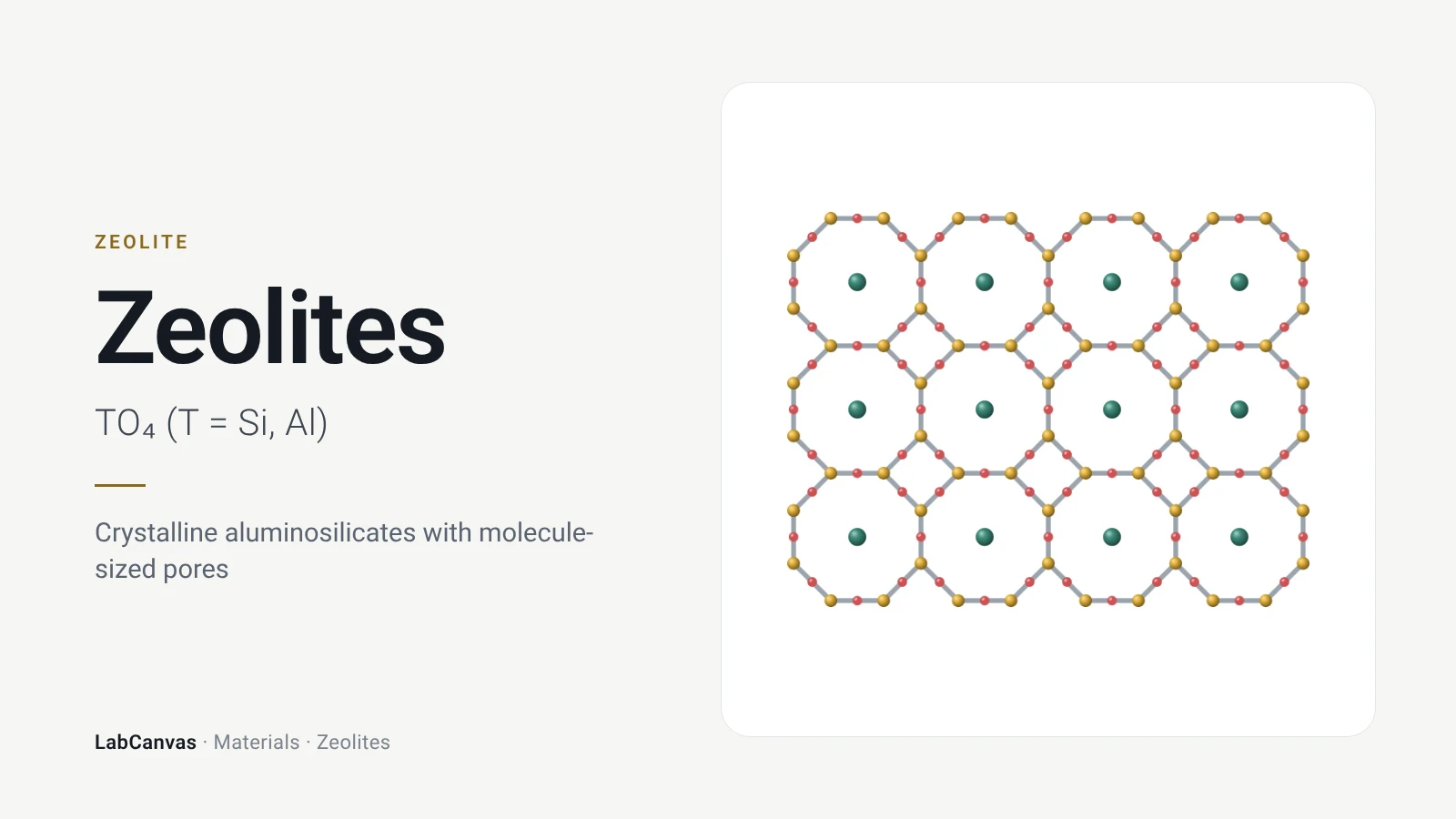
What zeolites are: TO₄ frameworks, 8-, 10- and 12-ring pores, IZA codes (MFI, FAU, LTA, CHA), Si/Al ratio, acid sites, synthesis and uses, with sources.
Zeolite A (LTA)
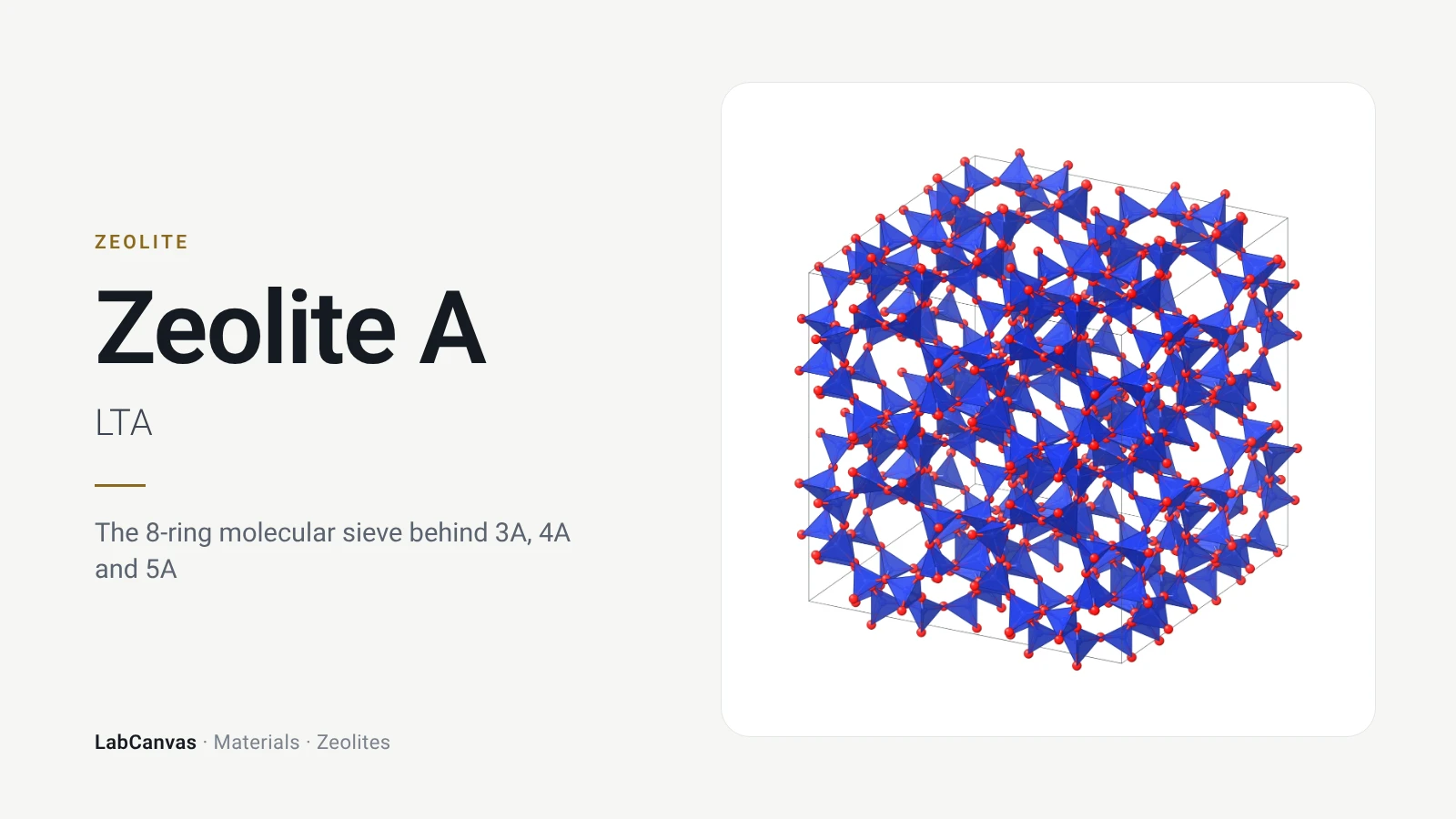
Zeolite A (LTA) structure: sodalite and α cages, 4.1 Å 8-ring windows, Si/Al = 1, the 3A, 4A and 5A molecular sieves, detergents and drying, with sources.
ZSM-5 (MFI)
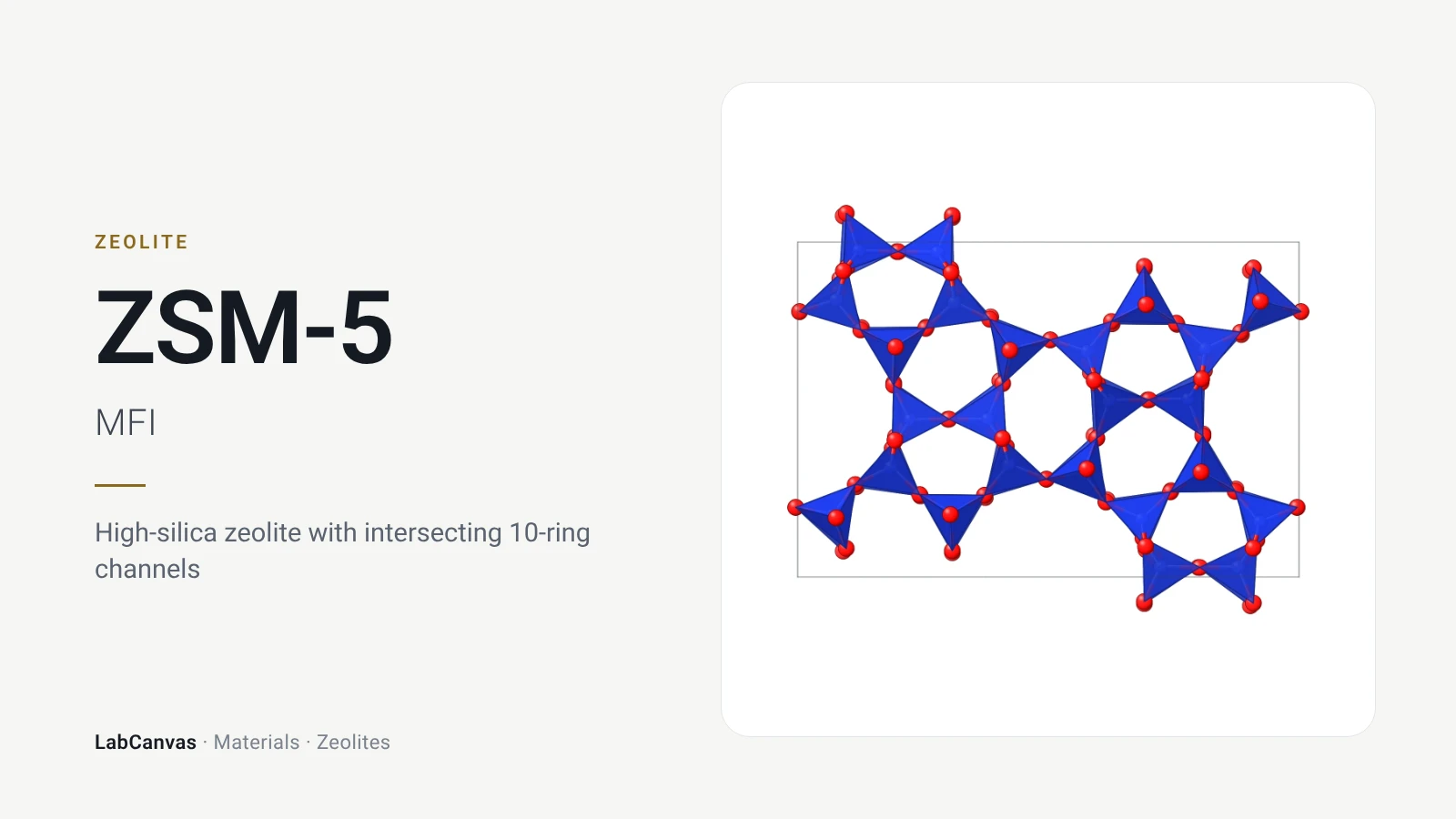
ZSM-5 zeolite (MFI): 10-ring straight and sinusoidal channels of 5.1–5.6 Å, Si/Al, silicalite-1, FCC additives, methanol to gasoline and xylene isomerisation.
SSZ-13 (CHA)
SSZ-13, the chabazite (CHA) zeolite: 8-ring windows of 3.8 Å and CHA cages, TMAda⁺ synthesis, Cu-SSZ-13 for NH₃-SCR of diesel NOₓ, and SAPO-34 for MTO.
More on LabCanvas
- Crystal structure figure software compared: VESTA, Mercury, CrystalMaker, Avogadro and LabCanvas
- XRD Scherrer crystallite size calculator: Free tool
- Molar mass calculator: Free tool
- Journal figure size guide: Column widths and resolutions for 38 journals
- 3D models gallery: Turn MOFs, COFs, perovskites and more in 3D
Frequently asked questions
What is faujasite?
Faujasite (framework code FAU) is the zeolite framework of zeolites X and Y: sodalite cages linked through double six-rings around large supercages that connect through twelve-ring windows (Ooe et al. 2023; Pirngruber et al. 2010).
What is the structure of zeolite Y?
Zeolite Y has the FAU framework: each sodalite cage is joined to four others through double six-rings, as in diamond, leaving supercages 12–13 Å across connected by pores of about 7.3 Å. The cell is cubic, a ≈ 24.3 Å (Ooe et al. 2023; Vogt and Weckhuysen 2015).
What is the difference between zeolite X and zeolite Y?
Only the Si/Al ratio: they share the FAU framework, with Si/Al about 1.25 for X and 2.5–2.8 for Y (Feldhoff et al. 2009; Liguori et al. 2019). X carries more cations and basic sites; the more siliceous Y is the cracking catalyst.
What is the pore size of faujasite?
The twelve-ring pores are about 7.3 Å and lead into supercages about 13 Å across (Vogt and Weckhuysen 2015).
What is USY zeolite?
Ultrastable Y: zeolite Y made more resistant to hot steam by controlled steaming and washing or leaching cycles (Vogt and Weckhuysen 2015).
Why is zeolite Y used in FCC?
It combines strong acidity and a high surface area with supercages roomy enough for bimolecular cracking reactions, and it is simple to make. Stabilised Y has been the main cracking component of FCC catalysts since 1964 (Vogt and Weckhuysen 2015).
What is 13X molecular sieve?
The commercial sodium form of zeolite X, with the FAU framework (Liguori et al. 2019). It is a commercial high-performance adsorbent, for example for CO₂ (Li et al. 2026).
How can I draw the faujasite structure for a paper?
Use the zeolite object or the FAU crystal file in the LabCanvas figure editor Library, which draws the framework as an editable high-resolution SVG, or open the FAU model in the LabCanvas 3D Studio and export a render.
References
- E. T. C. Vogt, B. M. Weckhuysen. Fluid catalytic cracking: recent developments on the grand old lady of zeolite catalysis. Chem. Soc. Rev. 2015, 44, 7342–7370. doi:10.1039/c5cs00376h
- K. Ooe, T. Seki, K. Yoshida, Y. Kohno, Y. Ikuhara, N. Shibata. Direct imaging of local atomic structures in zeolite using optimum bright-field scanning transmission electron microscopy. Sci. Adv. 2023, 9, eadf6865. doi:10.1126/sciadv.adf6865
- G. D. Pirngruber, P. Raybaud, Y. Belmabkhout, J. Čejka, A. Zukal. The role of the extra-framework cations in the adsorption of CO₂ on faujasite Y. Phys. Chem. Chem. Phys. 2010, 12, 13534–13546. doi:10.1039/b927476f
- A. Feldhoff, J. Caro, H. Jobic, J. Ollivier, C. B. Krause, P. Galvosas, J. Kärger. Intracrystalline transport resistances in nanoporous zeolite X. ChemPhysChem 2009, 10, 2429–2433. doi:10.1002/cphc.200900279
- B. Liguori, P. Aprea, B. de Gennaro, F. Iucolano, A. Colella, D. Caputo. Pozzolanic activity of zeolites: the role of Si/Al ratio. Materials 2019, 12, 4231. doi:10.3390/ma12244231
- D. Barthomeuf. Si,Al ordering and basicity clusters in faujasites. J. Phys. Chem. B 2005, 109, 2047–2054. doi:10.1021/jp031314m
- D. Chen, T. Zhang, X. Yin et al.. Size-inverse molecular sieving xenon/krypton separation through cation-tuned gating effect within Linde Type A zeolites. Nat. Commun. 2025, 16, 9849. doi:10.1038/s41467-025-64823-y
- J. Li, J. Li, S. Fang et al.. Kaolin-derived zeolite enables high-performance carbon capture with gigaton-scale potential. Natl. Sci. Rev. 2026, 13, nwag064. doi:10.1093/nsr/nwag064
Draw Faujasite (zeolite X and Y) for your paper or slides
LabCanvas is a browser workspace for scientific figures: framework clusters, linkers and nets, crystal structures in 2D and 3D, graphs and posters, all editable.
Draw Faujasite (zeolite X and Y) in LabCanvas