Zeolites: structure, framework types and uses
Zeolites are crystalline microporous aluminosilicates built from corner-sharing TO₄ tetrahedra (T = Si, Al) that enclose channels and cages with openings typically below 2 nm (Li J. et al. 2022). Every Al that replaces Si leaves one negative charge on the framework, balanced by a cation; when that cation is a proton the site is a strong Brønsted acid (Li J. et al. 2022). More than 250 framework types are known, each with a three-letter code from the International Zeolite Association such as MFI, FAU, LTA and CHA, and zeolites are used as cracking catalysts, adsorbents, ion exchangers and NOₓ-removal catalysts (Li J. et al. 2022; Vogt and Weckhuysen 2015; Shan et al. 2021).
Contents
Zeolites at a glance
| Building unit | Corner-sharing TO₄ tetrahedra, T = Si or Al, linked through shared oxygens (Li J. et al. 2022) |
|---|---|
| Pores | One- to three-dimensional channels or connected cages with apertures typically below 2 nm (Li J. et al. 2022) |
| Pore classes | Small-pore 8-rings ≈ 4.0 Å, medium-pore 10-rings ≈ 5.5 Å, large-pore 12-rings ≈ 7.5 Å, and extra-large pores above 12-rings (Shan et al. 2021) |
| Framework charge | A pure-silica framework is neutral; each Al³⁺ in place of Si⁴⁺ adds one negative charge that a cation must balance (Li J. et al. 2022) |
| Acid sites | A proton as the balancing cation gives a Brønsted acid site; fewer, more isolated Al give stronger sites (Li J. et al. 2022) |
| Si/Al ratio | Cannot fall below 1 (Löwenstein rule); ranges from 1 in zeolite A to pure silica (Li J. et al. 2022) |
| Framework types | More than 250 recognised by the IZA Structure Commission, each with a three-letter code (Li J. et al. 2022) |
| Industrial frameworks | About 20, including MFI, MOR, FAU, *BEA, MWW, LTA, FER and CHA (Li J. et al. 2022) |
| Largest use | Fluid catalytic cracking (FCC), the largest commercial catalytic process that uses zeolites (Vogt and Weckhuysen 2015) |
| Ion exchange | Exchange capacity is highest at Si/Al = 1, which suits Al-rich zeolites to water softening and heavy-metal removal (Li J. et al. 2022) |
| New structures | Odd 11- and 15-ring pores and extra-large 16- to 30-ring pores have been made with designed structure-directing agents and other strategies (Li et al. 2015) |
| Market | About USD 12.6 billion in 2021 (Li J. et al. 2022) |
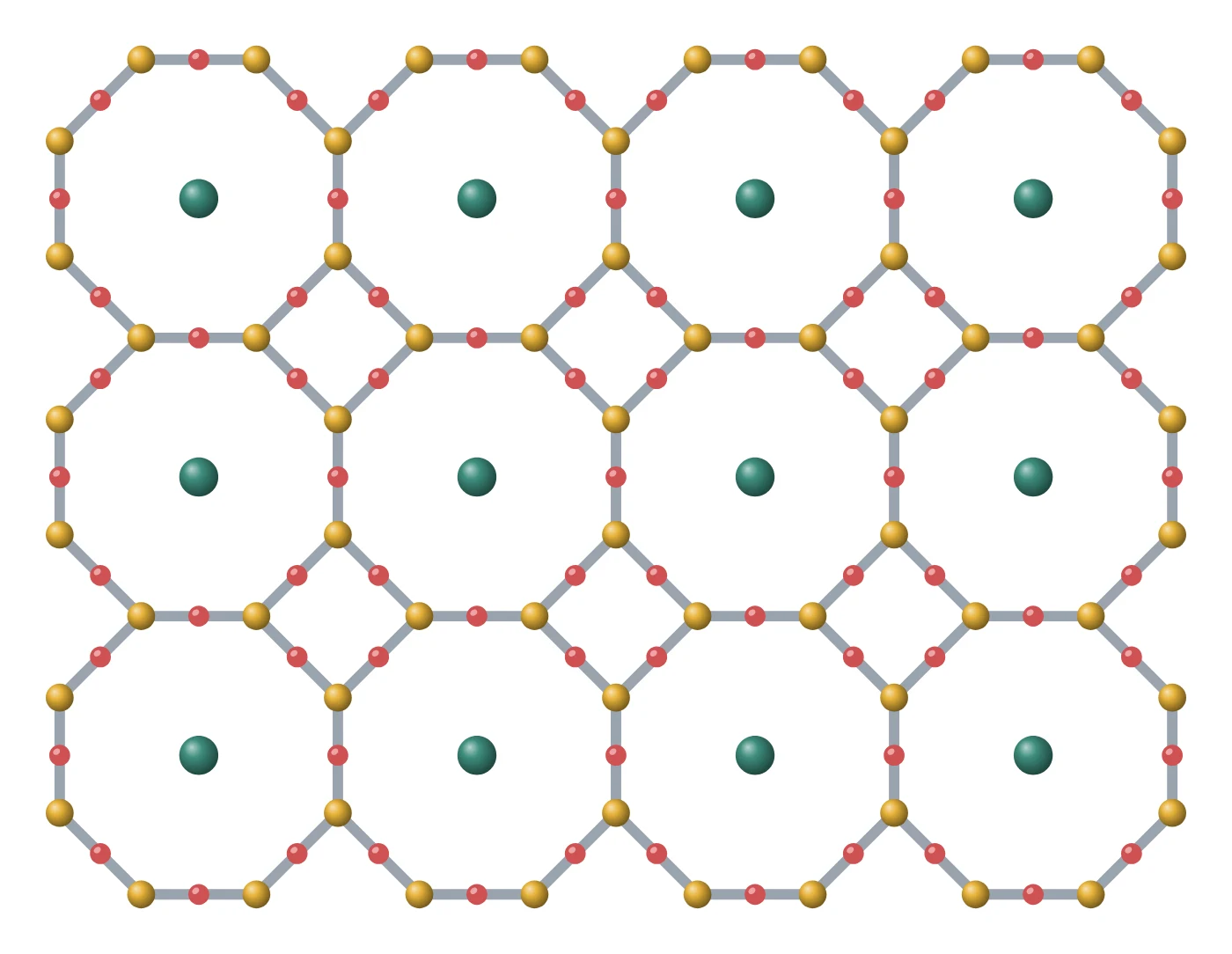
Zeolite crystal structure (high-resolution SVG)
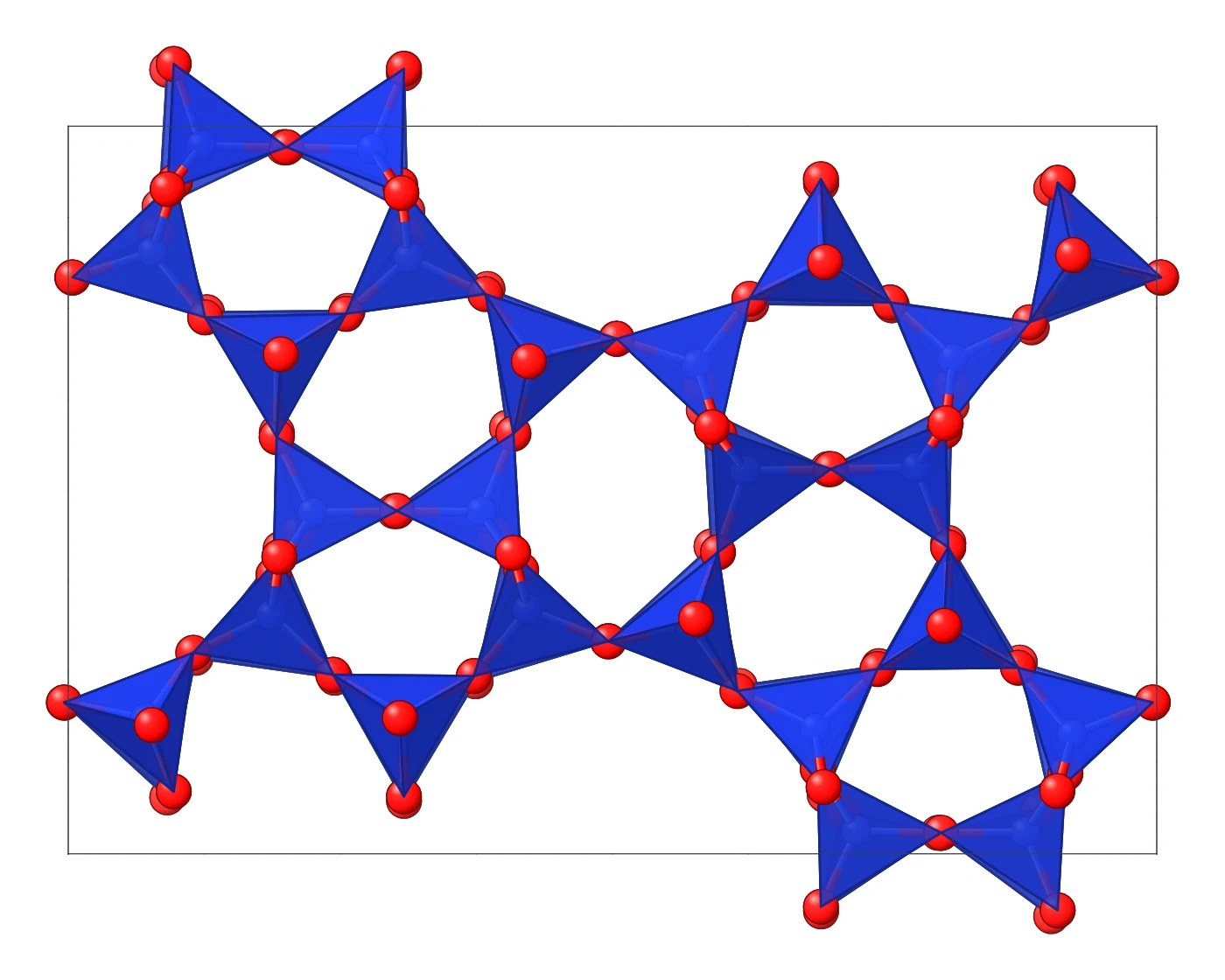
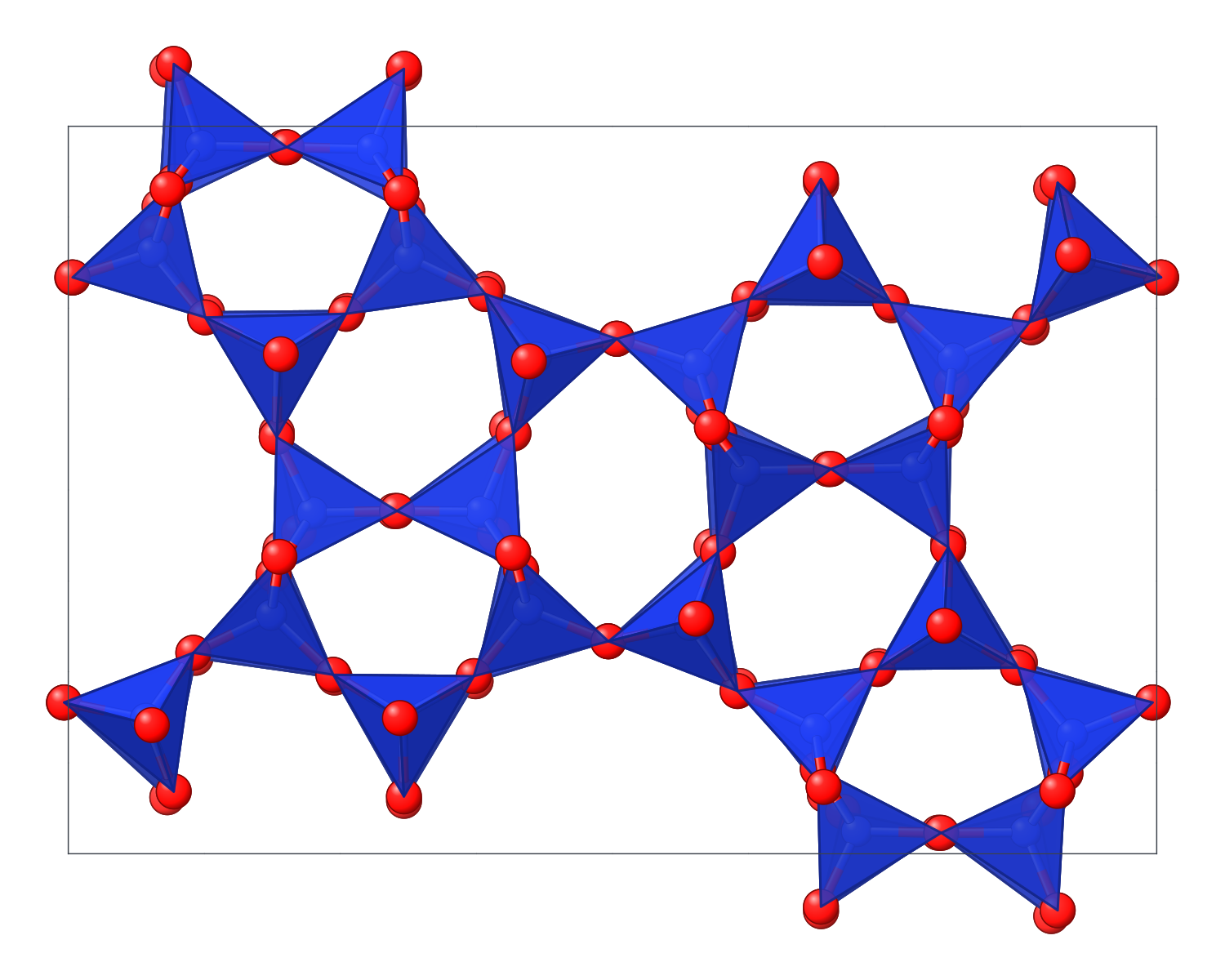
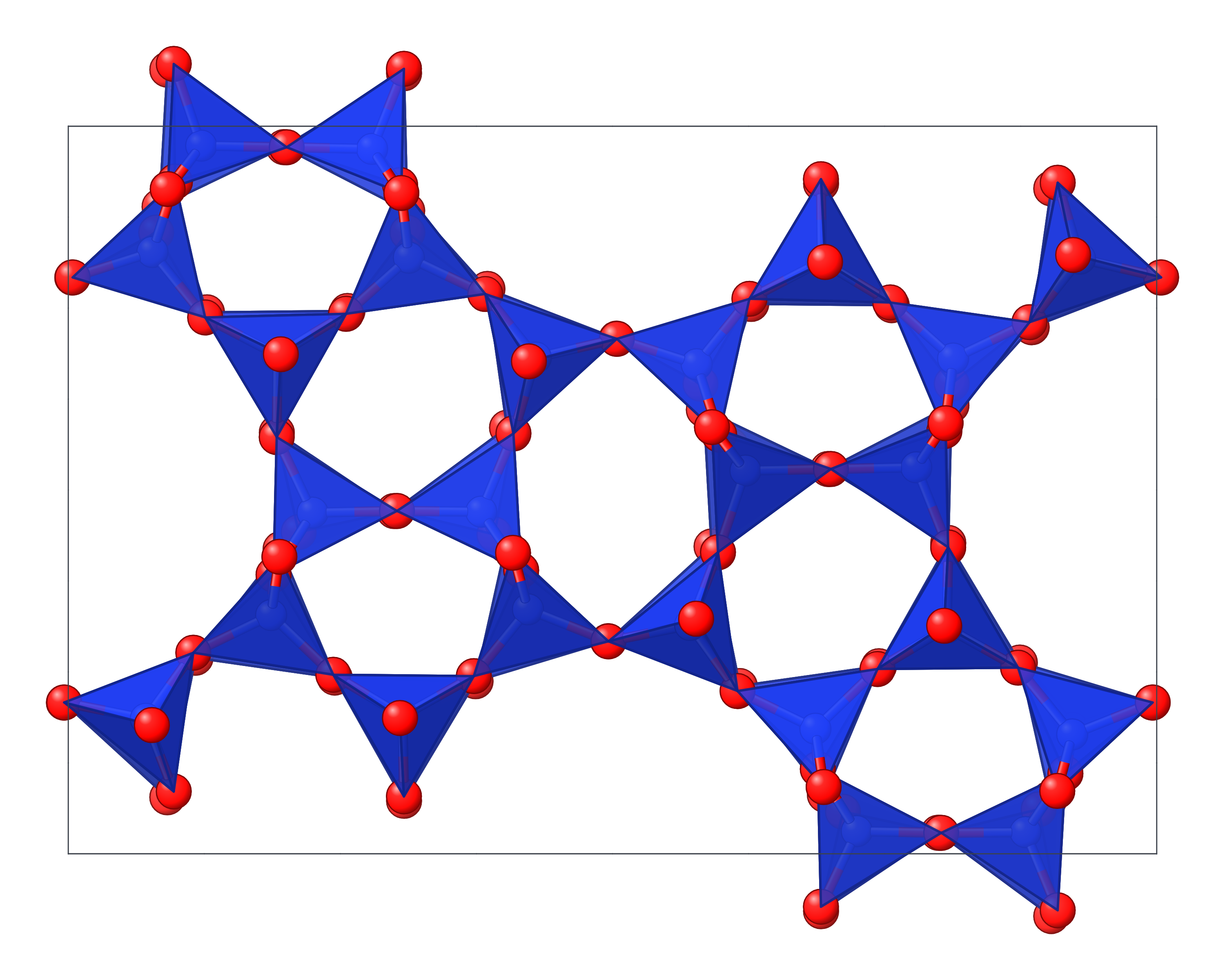
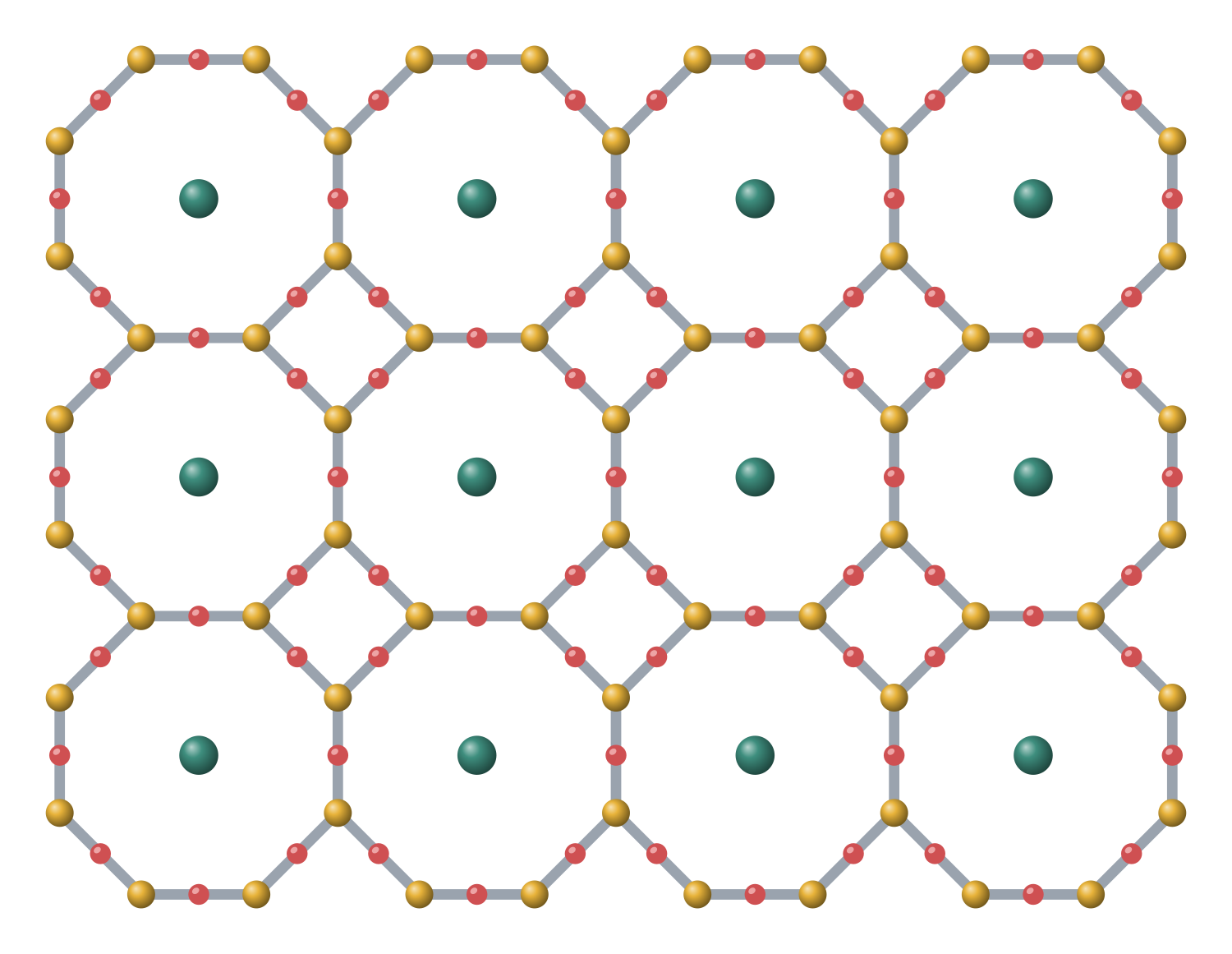
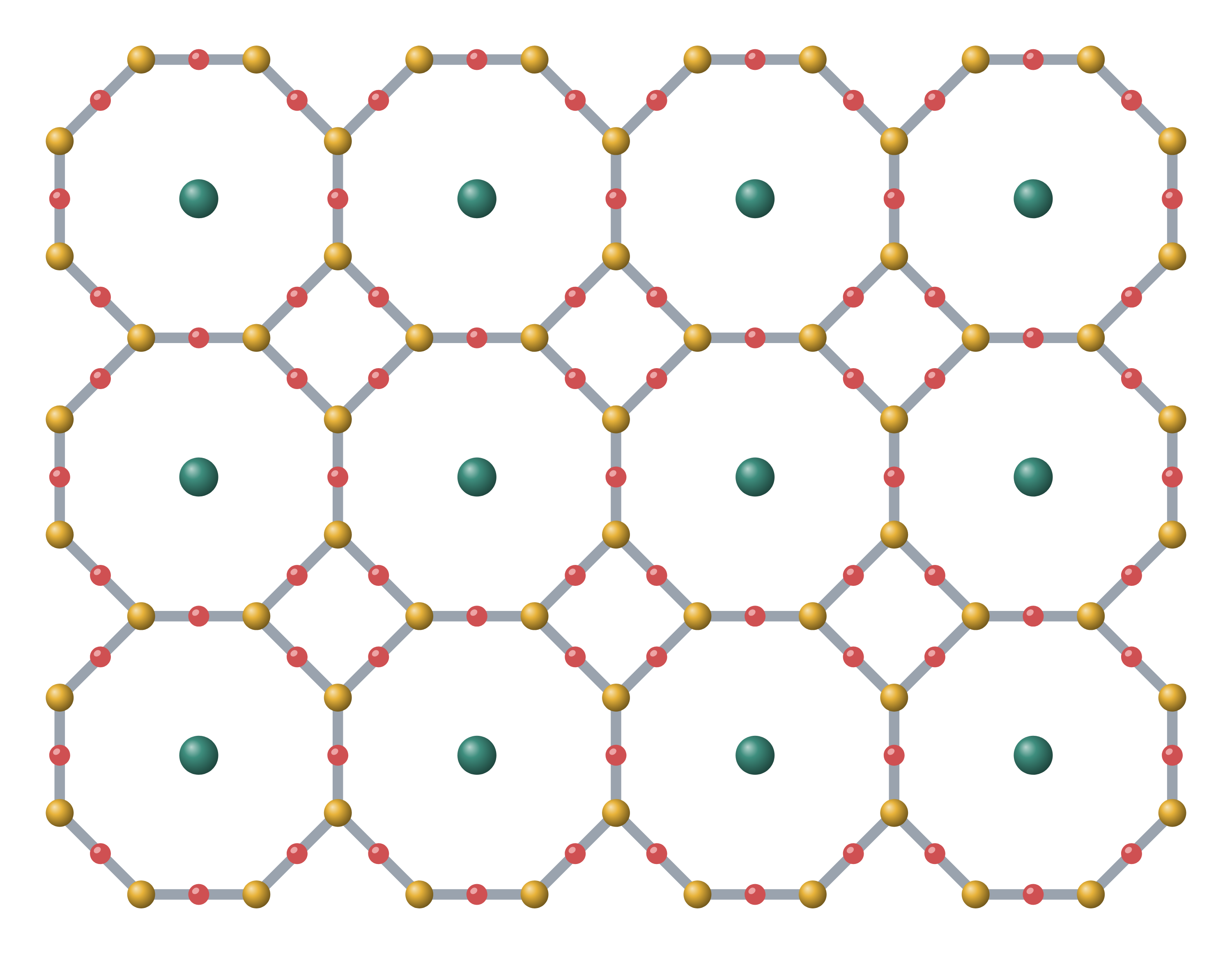
Zeolite structure drawing (high-resolution SVG)
Zeolite in 3D (interactive)
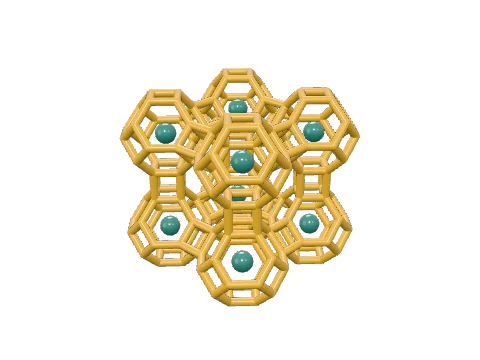
Loading the 3D model…
What is a zeolite?
A zeolite is a crystal whose framework is made only of TO₄ tetrahedra, where T is silicon or aluminium, each corner oxygen shared between two tetrahedra. The tetrahedra join into rings, the rings into cages and channels, and the result is a rigid solid full of regular pores, typically narrower than 2 nm and so about the size of small molecules (Li J. et al. 2022).
Silicon is 4+ and aluminium 3+. A framework of pure SiO₂ is neutral, but every Al that takes the place of a Si leaves one negative charge on the oxygens around it, and a cation sitting in the pores balances it (Li J. et al. 2022). Na⁺ or K⁺ from the synthesis can be exchanged for other cations, which is why zeolites are ion exchangers. When the balancing cation is a proton, the bridging Si–OH–Al group is a strong Brønsted acid site, the active site of zeolite cracking and methanol conversion (Li J. et al. 2022; Vogt and Weckhuysen 2015).
Pores, ring sizes and framework codes
Zeolite pores are named by the number of tetrahedra (T atoms) in the ring that forms the narrowest opening. Small-pore zeolites have 8-ring windows about 4.0 Å across, medium-pore zeolites 10-rings about 5.5 Å, large-pore zeolites 12-rings about 7.5 Å, and extra-large-pore zeolites larger rings still (Shan et al. 2021). Because these openings are about the size of molecules, a zeolite lets some molecules in and keeps others out: molecular sieving and shape-selective catalysis (Shan et al. 2021). Newer zeolites include odd 11- and 15-ring pores and extra-large pores of 16 to 30 rings (Li et al. 2015).
Each distinct framework topology gets a three-letter code from the Structure Commission of the International Zeolite Association; more than 250 have been recognised, and about 20 are used in industry, including MFI, MOR, FAU, *BEA, MWW, LTA, FER and CHA (Li J. et al. 2022). The code names the net of tetrahedra, not the composition: ZSM-5 and its all-silica form silicalite share the MFI framework (Vogt and Weckhuysen 2015), and the aluminosilicate SSZ-13 and the silicoaluminophosphate SAPO-34 are both CHA (Beale et al. 2015).
The Si/Al ratio
The Si/Al ratio sets how many acid sites and exchangeable cations a zeolite has, and through them its acidity, its affinity for water and its stability (Li J. et al. 2022). Lower Si/Al means more Al, more cations and more water uptake; higher Si/Al means fewer but stronger acid sites and a more hydrophobic, steam-stable framework (Li J. et al. 2022). The ratio cannot fall below 1, the limit set by the Löwenstein rule (Li J. et al. 2022).
- Zeolite A (LTA) made without organic templates has Si/Al = 1 (Li J. et al. 2022).
- Zeolite Y (FAU) made without templates usually has Si/Al below 3; steaming removes framework Al to make the more stable ultra-stable Y (USY) used in FCC (Li J. et al. 2022).
- ZSM-5 (MFI) is called high-silica above Si/Al = 20, and with tetrapropylammonium it can be made from Si/Al 20 to 220 (Li J. et al. 2022).
- SSZ-13 (CHA) typically has Si/Al from 10 to 54 (Li J. et al. 2022).
What zeolites are used for
- Catalysis and oil refining. Fluid catalytic cracking converts heavy oil fractions to gasoline, diesel and light gases (Li J. et al. 2022) and is the largest commercial process using zeolites; zeolite Y has been its main cracking component since 1964, and additives containing ZSM-5 raise the propylene yield (Vogt and Weckhuysen 2015).
- Ion exchange and detergents. Zeolites are used as detergents and ion exchangers; a low Si/Al gives a high exchange capacity, suited to water softening and removing heavy-metal cations from water (Li J. et al. 2022).
- Adsorption and separation. Zeolites dry natural gas, separate air, purify hydrogen, separate xylene and paraffin isomers and capture CO₂; Al-rich zeolites such as low-silica X (Si/Al = 1) are used for air separation (Li J. et al. 2022).
- Emissions control. Copper-exchanged small-pore SSZ-13 reduces NOₓ with ammonia (NH₃-SCR) in diesel exhaust (Shan et al. 2021; Beale et al. 2015).
- Methanol to hydrocarbons. Zeolite and zeotype catalysts turn methanol into gasoline or olefins, the choice of pore and cavity size steering the products (Olsbye et al. 2012).
How zeolites are made
Most zeolites are crystallised hydrothermally from a gel of a silicon source, an aluminium source, an alkali hydroxide and water; hydroxide acts as the mineraliser that forms Si–O–Si and Si–O–Al bonds, and the aluminosilicate species assemble around the cations into the crystal (Li J. et al. 2022). Alkali cations have a high charge density, so zeolites made with them alone are Al-rich (Li J. et al. 2022).
Organic structure-directing agents (OSDAs), usually quaternary ammonium cations, change that. An OSDA carries less charge per volume than Na⁺, so fewer Al are needed to balance it and the zeolite comes out with a higher Si/Al; fluoride media push further, to pure-silica frameworks (Li J. et al. 2022). Tetrapropylammonium directs ZSM-5 and N,N,N-trimethyl-1-adamantylammonium directs SSZ-13 (Li J. et al. 2022; Shan et al. 2021), and designing new OSDAs is one of the main routes to new framework types (Li et al. 2015). Seeds, interzeolite transformation and dry-gel conversion are other levers on the product and its Si/Al (Li J. et al. 2022). The organic template is burned out of the pores by calcination, for example at 550 °C for 6 h in one ZSM-5 synthesis (Feng P. et al. 2024).
Four zeolites to know
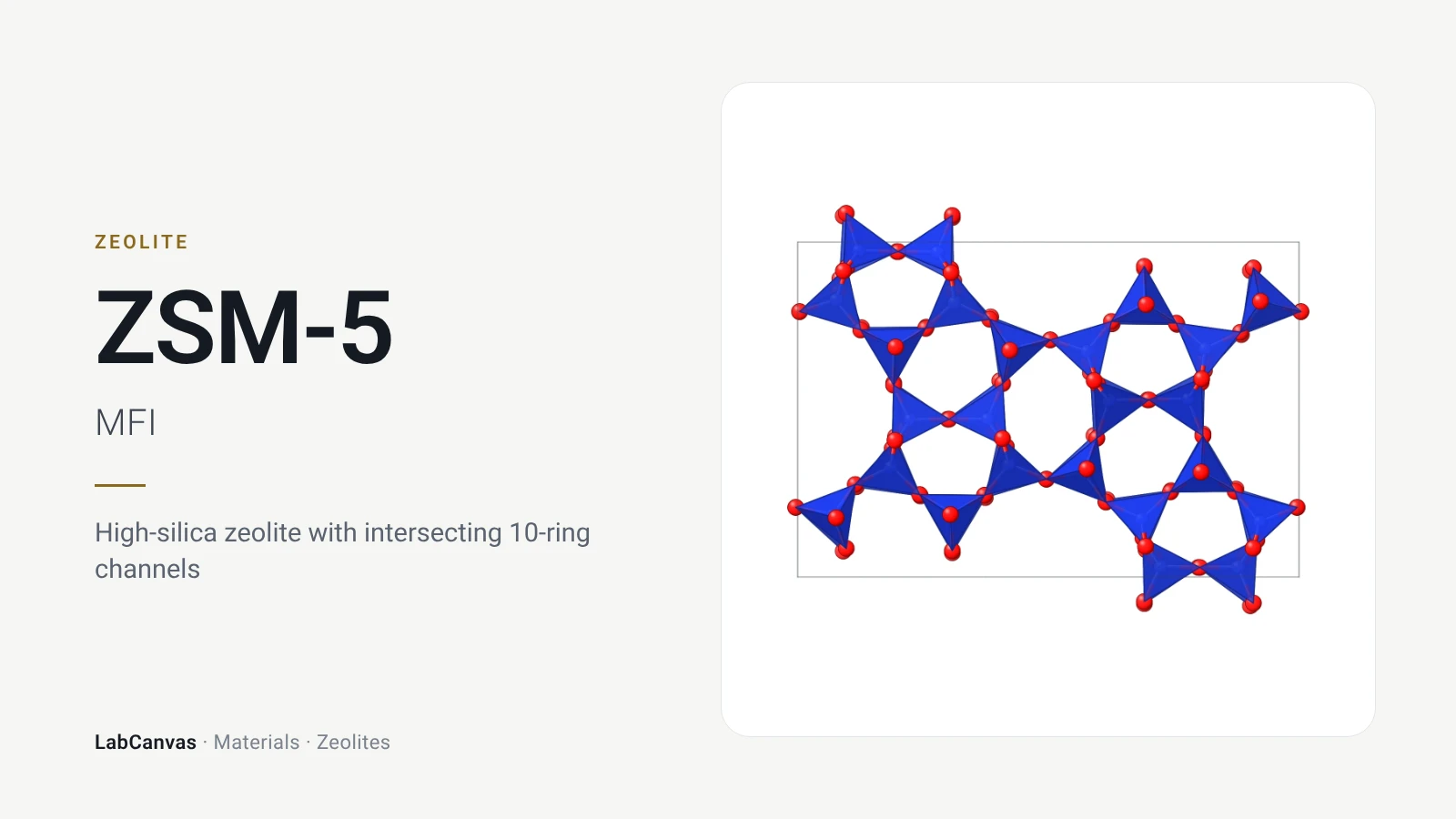
- ZSM-5 (MFI): a high-silica, medium-pore zeolite with intersecting 10-ring channels about 5.1–5.6 Å across, the shape-selective workhorse of FCC additives and methanol conversion (Vogt and Weckhuysen 2015).
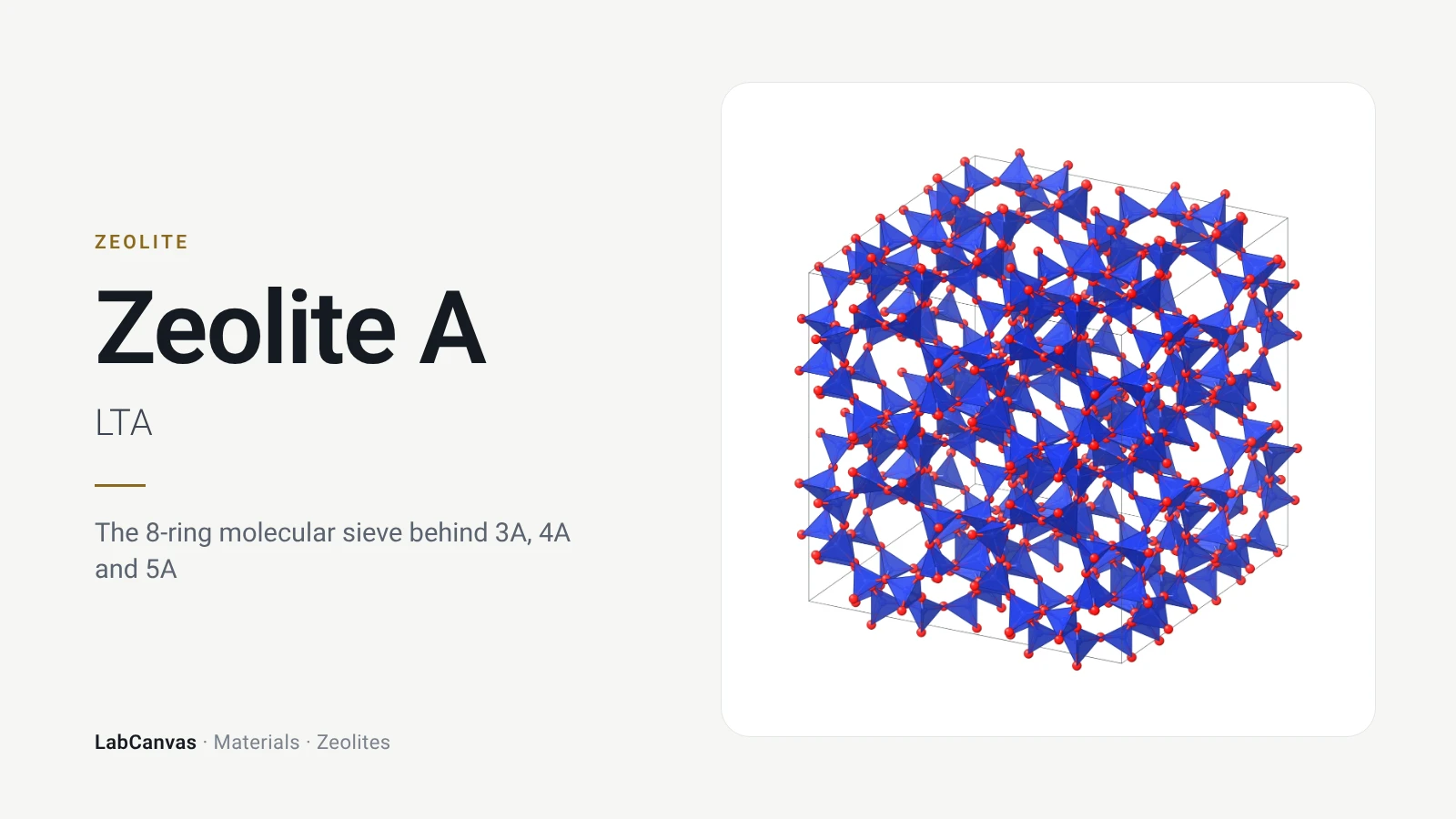
- Zeolite A (LTA): the most Al-rich framework, Si/Al = 1 when made without templates (Li J. et al. 2022), and so the highest ion-exchange capacity a zeolite can have (Li J. et al. 2022).
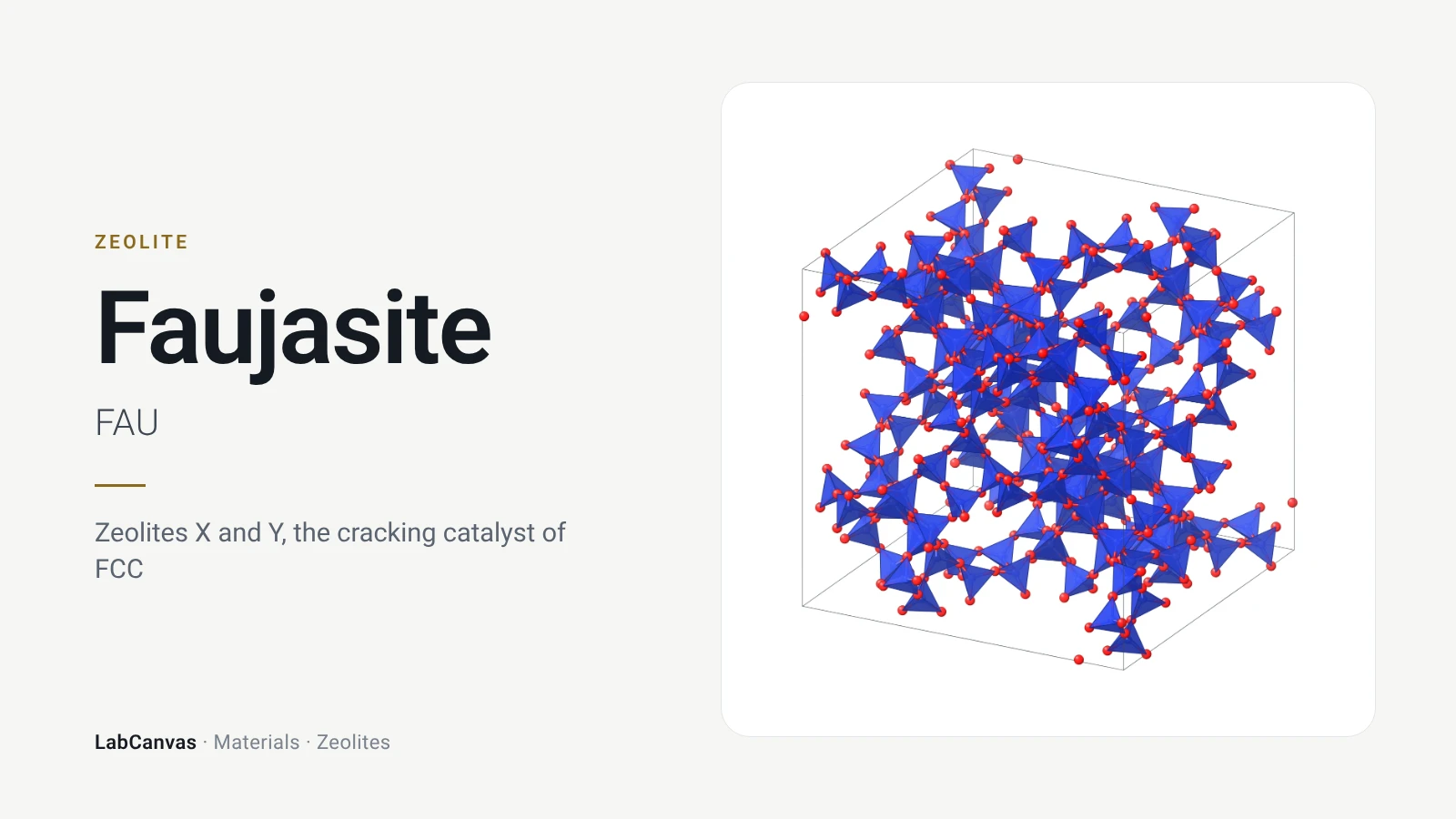
- Faujasite (FAU, zeolites X and Y): a large-pore zeolite whose ~7.3 Å windows open into 13 Å supercages; zeolite Y is the main cracking component of FCC catalysts (Vogt and Weckhuysen 2015).
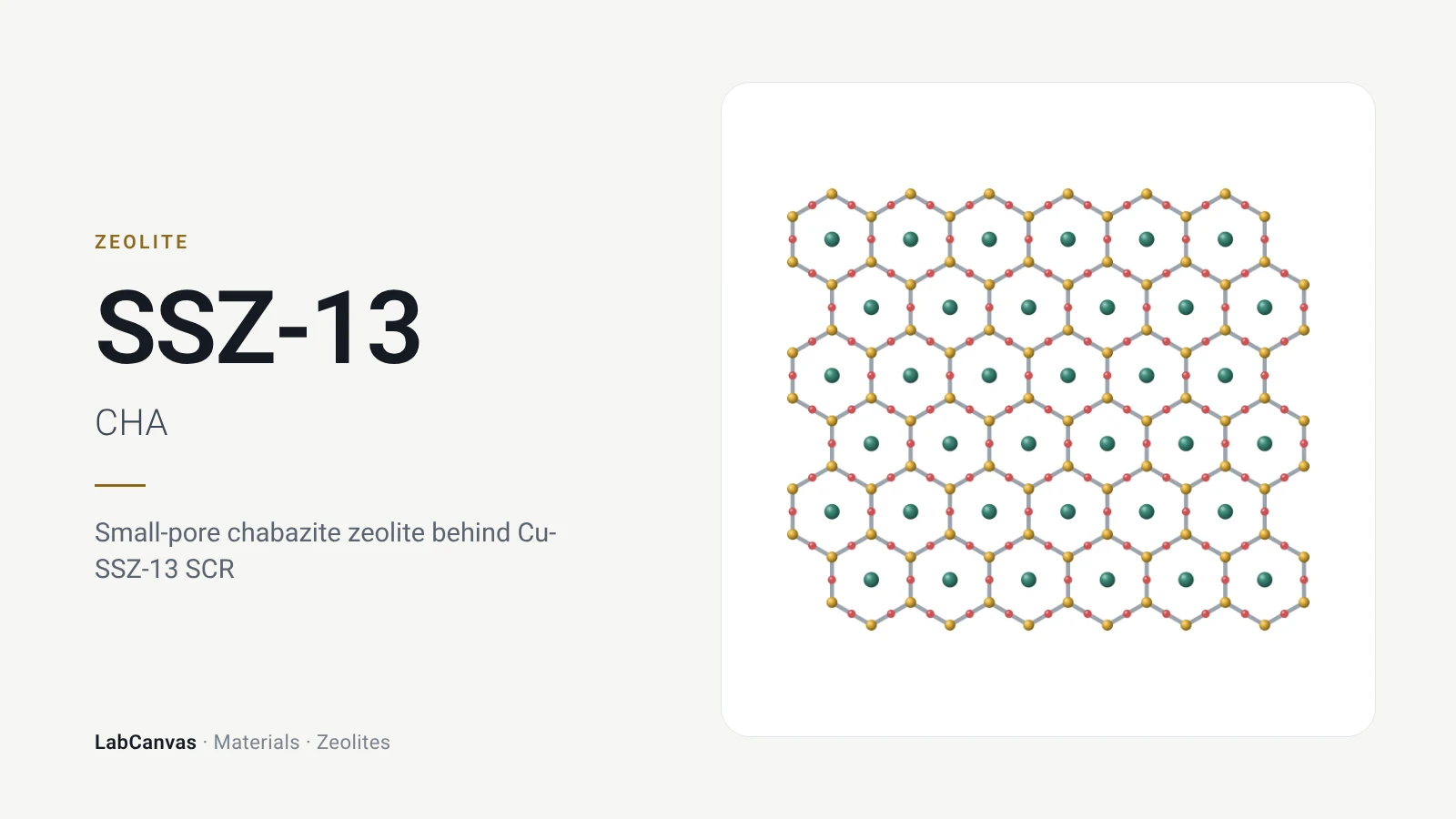
- SSZ-13 (CHA): a small-pore chabazite with 8-ring windows of about 3.8 × 3.8 Å; as Cu-SSZ-13 it cleans NOₓ from diesel exhaust (Shan et al. 2021).
Zeolites and MOFs
Metal–organic frameworks borrowed the zeolite idea. In zeolitic imidazolate frameworks (ZIFs) the tetrahedral Si(Al) of a zeolite is replaced by a transition-metal ion and the bridging oxygen by an imidazolate linker, so ZIFs take the nets of aluminosilicate zeolites; ZIF-8 is the best-known example (Park et al. 2006).
How to draw the zeolite structure
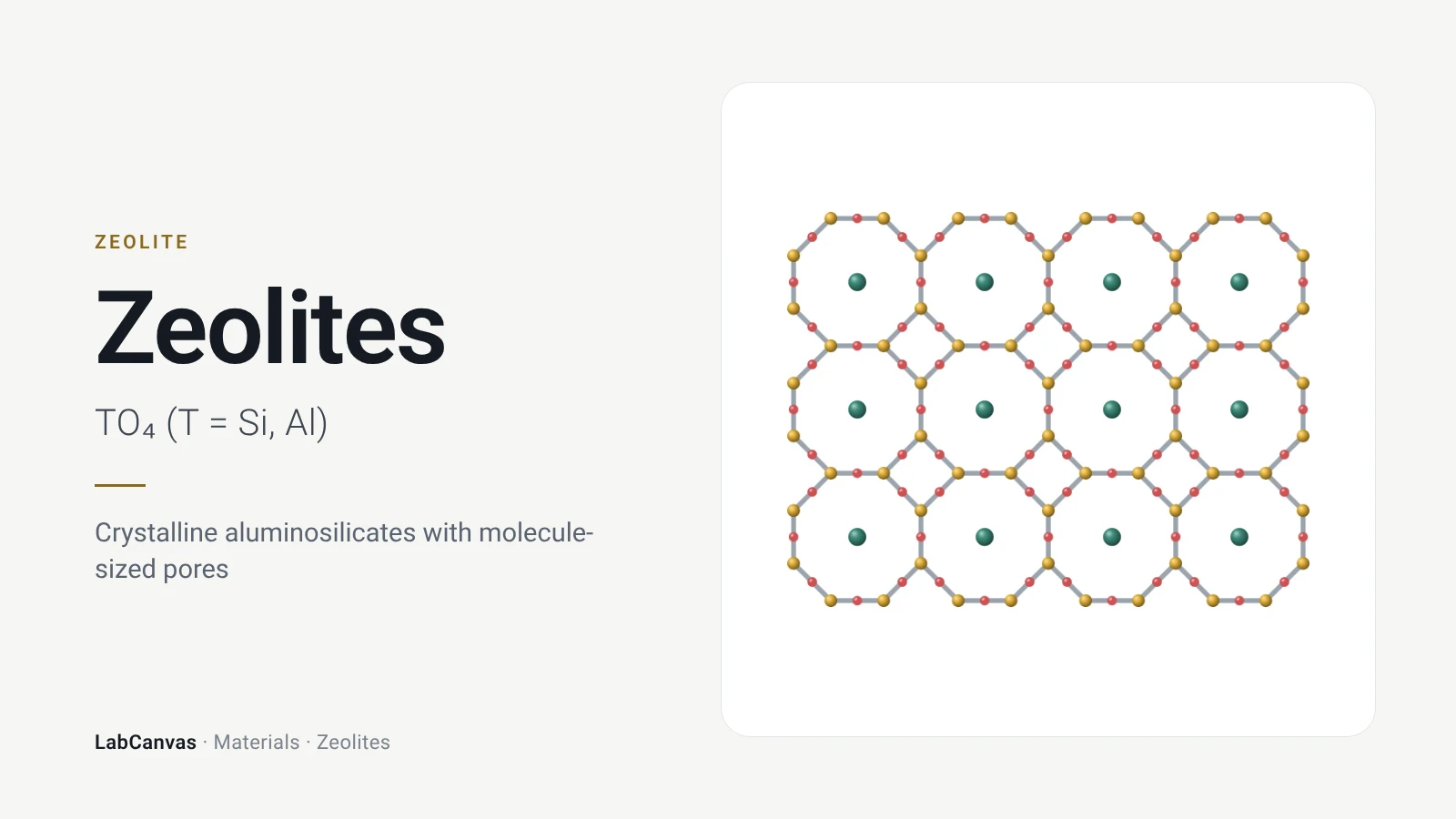
For a paper, slide or poster, draw a zeolite at two scales: the TO₄ tetrahedron and its shared corners, then the rings and pores they form. The LabCanvas figure editor Library has a zeolite object that draws a framework of rings (4- and 8-rings like LTA, or 6-rings) with Si/Al and oxygen atoms and optional cations in the pores; set the ring size and colours and export a high-resolution image. For real frameworks, the Library's crystal files for MFI (ZSM-5), LTA (zeolite A) and FAU (faujasite) draw the crystal structure, where you can switch between atoms and polyhedra and look down the channels, and the LabCanvas 3D Studio has zeolite models you can turn and render.
Four common zeolites compared
| Zeolite | IZA code | Pore type | Pore opening | Typical Si/Al | Known for |
|---|---|---|---|---|---|
| Zeolite A | LTA | Small-pore (8-ring) | — | 1 without templates | Highest cation content, ion exchange |
| ZSM-5 | MFI | Medium-pore (10-ring), intersecting channels | 5.1–5.6 Å | Above 20 (high-silica); 20–220 with TPA | FCC propylene additive, methanol to hydrocarbons |
| Faujasite (X, Y) | FAU | Large-pore, supercages | ~7.3 Å windows, 13 Å supercages | Below 3 for Y without templates; higher as USY | FCC cracking catalyst |
| SSZ-13 | CHA | Small-pore (8-ring), CHA cages | 3.8 × 3.8 Å | 10–54 | Cu-SSZ-13 for NH₃-SCR of NOₓ |
Related materials
ZSM-5 (MFI)
ZSM-5 zeolite (MFI): 10-ring straight and sinusoidal channels of 5.1–5.6 Å, Si/Al, silicalite-1, FCC additives, methanol to gasoline and xylene isomerisation.
Zeolite A (LTA)
Zeolite A (LTA) structure: sodalite and α cages, 4.1 Å 8-ring windows, Si/Al = 1, the 3A, 4A and 5A molecular sieves, detergents and drying, with sources.
Faujasite (zeolite X and Y)
Faujasite (FAU): sodalite cages, double 6-rings and 12-ring supercages; zeolite X vs Y by Si/Al; ultrastable Y and why zeolite Y is the FCC catalyst.
SSZ-13 (CHA)
SSZ-13, the chabazite (CHA) zeolite: 8-ring windows of 3.8 Å and CHA cages, TMAda⁺ synthesis, Cu-SSZ-13 for NH₃-SCR of diesel NOₓ, and SAPO-34 for MTO.
More on LabCanvas
- Crystal structure figure software compared: VESTA, Mercury, CrystalMaker, Avogadro and LabCanvas
- XRD Scherrer crystallite size calculator: Free tool
- Molar mass calculator: Free tool
- Journal figure size guide: Column widths and resolutions for 38 journals
- 3D models gallery: Turn MOFs, COFs, perovskites and more in 3D
Frequently asked questions
What is a zeolite?
A crystalline, microporous aluminosilicate: a framework of corner-sharing SiO₄ and AlO₄ tetrahedra enclosing channels and cages typically smaller than 2 nm (Li J. et al., Chem. Sci. 2022). Its pores are the size of small molecules, so zeolites act as molecular sieves, catalysts, adsorbents and ion exchangers.
What is the structure of a zeolite?
TO₄ tetrahedra (T = Si, Al) share every corner oxygen, forming rings that build up cages and one- to three-dimensional channels. The pores are classed by the ring that bounds them: 8-rings (≈ 4.0 Å), 10-rings (≈ 5.5 Å) or 12-rings (≈ 7.5 Å) (Shan et al., Natl. Sci. Rev. 2021).
Why are zeolites acidic?
Each Al³⁺ that replaces Si⁴⁺ leaves a negative framework charge. If a proton balances it, the Si–OH–Al group is a Brønsted acid site, and these sites catalyse cracking and methanol conversion (Li J. et al., Chem. Sci. 2022; Vogt and Weckhuysen, Chem. Soc. Rev. 2015).
What do zeolite codes like MFI, FAU and LTA mean?
They are framework type codes assigned by the Structure Commission of the International Zeolite Association: three letters for each confirmed framework topology. More than 250 have been recognised; MFI is ZSM-5, FAU is faujasite (zeolites X and Y), LTA is zeolite A and CHA is chabazite (Li J. et al., Chem. Sci. 2022).
What is the Si/Al ratio of a zeolite?
The ratio of silicon to aluminium in the framework. It cannot be below 1 (Löwenstein rule). A low ratio gives many cations and acid sites and a hydrophilic zeolite; a high ratio gives fewer, stronger acid sites and better steam stability (Li J. et al., Chem. Sci. 2022).
What are zeolites used for?
Fluid catalytic cracking of oil (the largest commercial zeolite process), propylene production, methanol-to-hydrocarbons conversion, gas drying and separation, CO₂ capture, ion exchange and water softening, detergents, and NOₓ removal from diesel exhaust (Vogt and Weckhuysen 2015; Li J. et al. 2022; Shan et al. 2021).
What is the pore size of zeolites?
Typically below 2 nm. Small-pore zeolites have 8-ring windows of about 4 Å (SSZ-13: 3.8 × 3.8 Å), medium-pore 10-rings of about 5.5 Å (ZSM-5: 5.1–5.6 Å) and large-pore 12-rings of about 7.5 Å (zeolite Y: ~7.3 Å) (Shan et al. 2021; Vogt and Weckhuysen 2015).
How are zeolites made?
By hydrothermal crystallisation of a silica–alumina gel with an alkali hydroxide and water, often with an organic structure-directing agent such as tetrapropylammonium (for ZSM-5) that fills the pores, raises the Si/Al ratio and is later removed by calcination (Li J. et al., Chem. Sci. 2022).
References
- J. Li, M. Gao, W. Yan, J. Yu. Regulation of the Si/Al ratios and Al distributions of zeolites and their impact on properties. Chem. Sci. 2022, 14, 1935–1959. doi:10.1039/d2sc06010h
- Y. Shan, J. Du, Y. Zhang, W. Shan, X. Shi, Y. Yu, R. Zhang, X. Meng, F.-S. Xiao, H. He. Selective catalytic reduction of NOx with NH3: opportunities and challenges of Cu-based small-pore zeolites. Natl. Sci. Rev. 2021, 8, nwab010. doi:10.1093/nsr/nwab010
- E. T. C. Vogt, B. M. Weckhuysen. Fluid catalytic cracking: recent developments on the grand old lady of zeolite catalysis. Chem. Soc. Rev. 2015, 44, 7342–7370. doi:10.1039/c5cs00376h
- J. Li, A. Corma, J. Yu. Synthesis of new zeolite structures. Chem. Soc. Rev. 2015, 44, 7112–7127. doi:10.1039/c5cs00023h
- A. M. Beale, F. Gao, I. Lezcano-Gonzalez, C. H. F. Peden, J. Szanyi. Recent advances in automotive catalysis for NOx emission control by small-pore microporous materials. Chem. Soc. Rev. 2015, 44, 7371–7405. doi:10.1039/c5cs00108k
- U. Olsbye, S. Svelle, M. Bjørgen, P. Beato, T. V. W. Janssens, F. Joensen, S. Bordiga, K. P. Lillerud. Conversion of methanol to hydrocarbons: how zeolite cavity and pore size controls product selectivity. Angew. Chem. Int. Ed. 2012, 51, 5810–5831. doi:10.1002/anie.201103657
- P. Feng et al.. Liquid-phase xylene isomerization on nano-sized ZSM-5. RSC Adv. 2024, 14, 19264–19270. doi:10.1039/d4ra02828g
- K. S. Park, Z. Ni, A. P. Côté, J. Y. Choi, R. Huang, F. J. Uribe-Romo, H. K. Chae, M. O’Keeffe, O. M. Yaghi. Exceptional chemical and thermal stability of zeolitic imidazolate frameworks. Proc. Natl. Acad. Sci. USA 2006, 103, 10186–10191. doi:10.1073/pnas.0602439103
Draw Zeolites for your paper or slides
LabCanvas is a browser workspace for scientific figures: framework clusters, linkers and nets, crystal structures in 2D and 3D, graphs and posters, all editable.
Draw Zeolites in LabCanvas