ZSM-5 (MFI): structure, channels and uses
ZSM-5 is a high-silica zeolite with the MFI framework: two sets of intersecting 10-ring channels, straight channels of 5.3 × 5.6 Å crossed by sinusoidal (zig-zag) channels, all 5.1–5.6 Å across (Feng Z. et al. 2021; Vogt and Weckhuysen 2015). First reported by Argauer and Landolt at Mobil in 1972, it is a shape-selective acid catalyst used in FCC additives that raise the propylene yield, in methanol-to-hydrocarbons conversion and in xylene isomerisation (Vogt and Weckhuysen 2015; Matam et al. 2023; Feng P. et al. 2024). Its essentially all-silica form, silicalite (silicalite-1), has the same framework (Vogt and Weckhuysen 2015; Dalena et al. 2026).
Contents
ZSM-5 (MFI) at a glance
| Framework type | MFI (Vogt and Weckhuysen 2015) |
|---|---|
| Channel system | Three-dimensional: straight 10-ring channels along [010] intersecting zig-zag 10-ring channels along [100] (Vogt and Weckhuysen 2015) |
| Pore size | Slightly elliptical 10-ring pores 5.1–5.6 Å across (Vogt and Weckhuysen 2015); straight channels 5.3 × 5.6 Å (Feng Z. et al. 2021) |
| Channel intersections | Radius about 3.6 Å (Matam et al. 2023) |
| Si/Al | High-silica above 20, Al-rich below 15; 20 to 220 with tetrapropylammonium (Li J. et al. 2022) |
| Template | Tetrapropylammonium (TPA) is the typical structure-directing agent; SiO₂/Al₂O₃ up to about 25 can be made without one (Vogt and Weckhuysen 2015) |
| All-silica form | Silicalite (silicalite-1), pure-silica MFI; monoclinic, while Al-rich ZSM-5 is orthorhombic, on the same framework (Vogt and Weckhuysen 2015; Dalena et al. 2026) |
| Al sites | In a commercial H-ZSM-5, single Al at T8 in the straight channel and Al pairs at T6 and T4 at the channel intersection (Li G. et al. 2025) |
| Crystals | Lozenge- or coffin-shaped, frequently twinned (Vogt and Weckhuysen 2015) |
| First reported | Argauer and Landolt, Mobil Oil, 1972; structure solved by Kokotailo in 1978 (Vogt and Weckhuysen 2015) |
| Natural form | The mineral mutinaite, found in Antarctica (Vogt and Weckhuysen 2015) |
| FCC additives | Usually 25–50% ZSM-5 as the only active zeolite, added to raise propylene above the < 5% of normal FCC (Vogt and Weckhuysen 2015) |
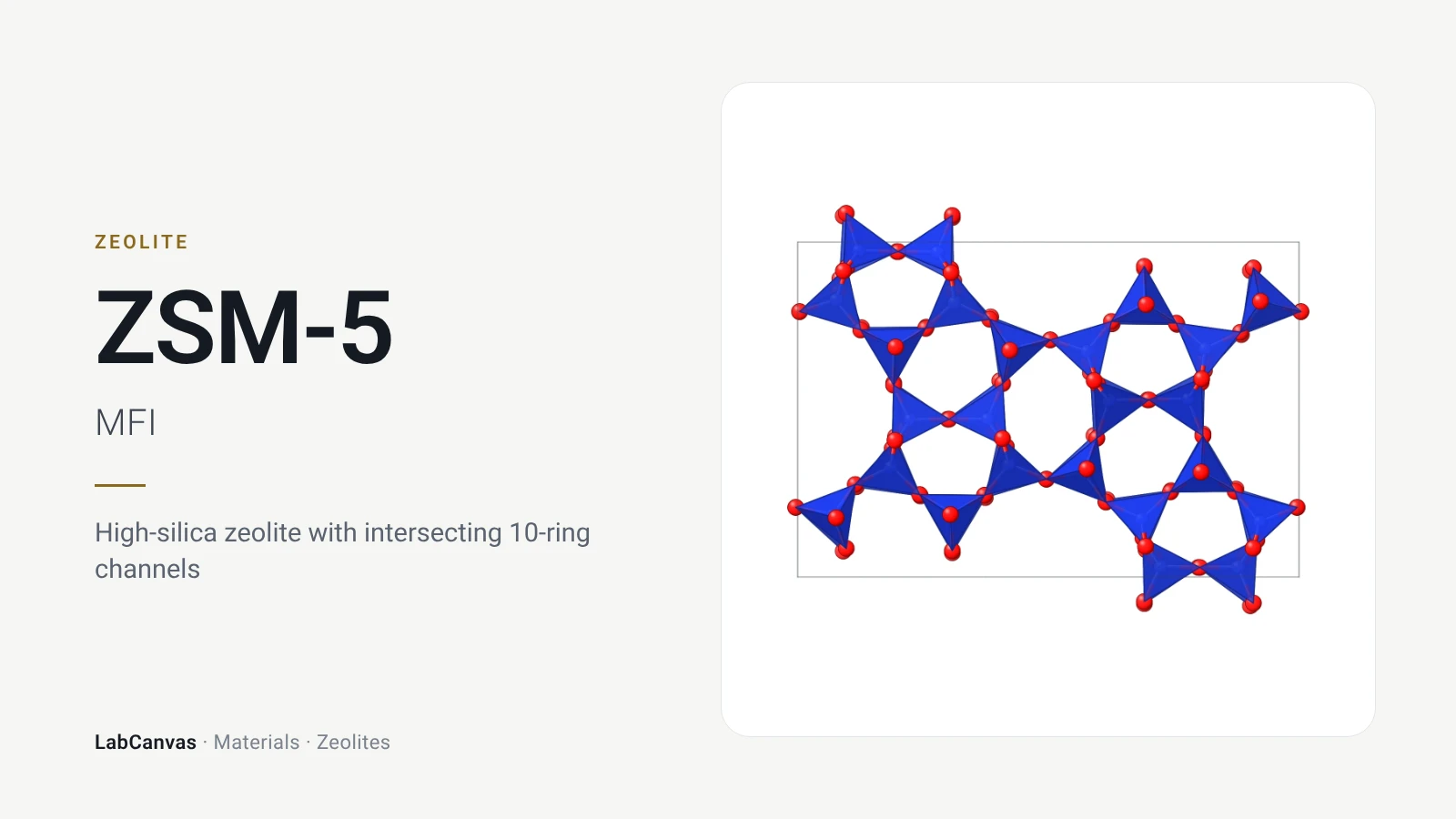
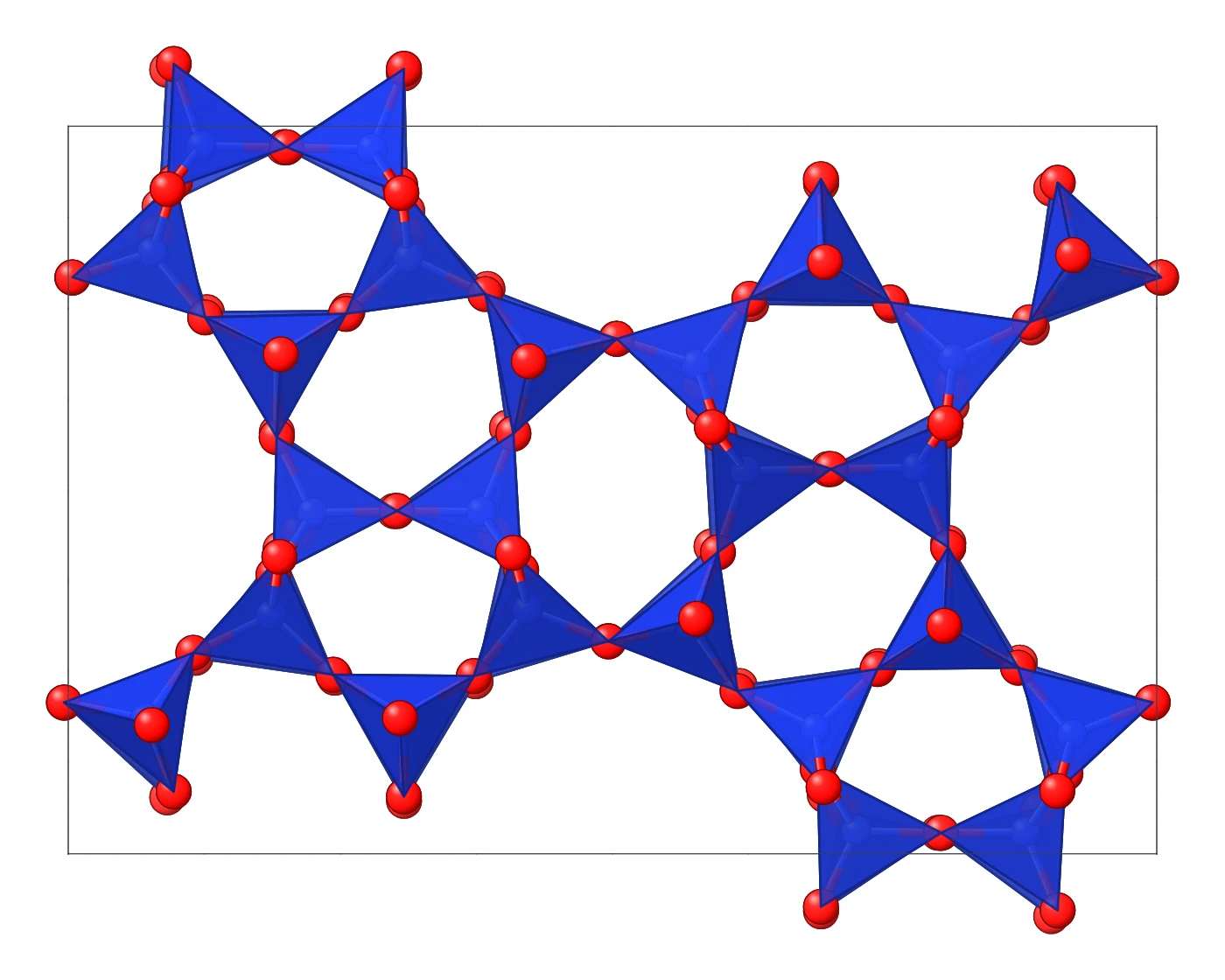
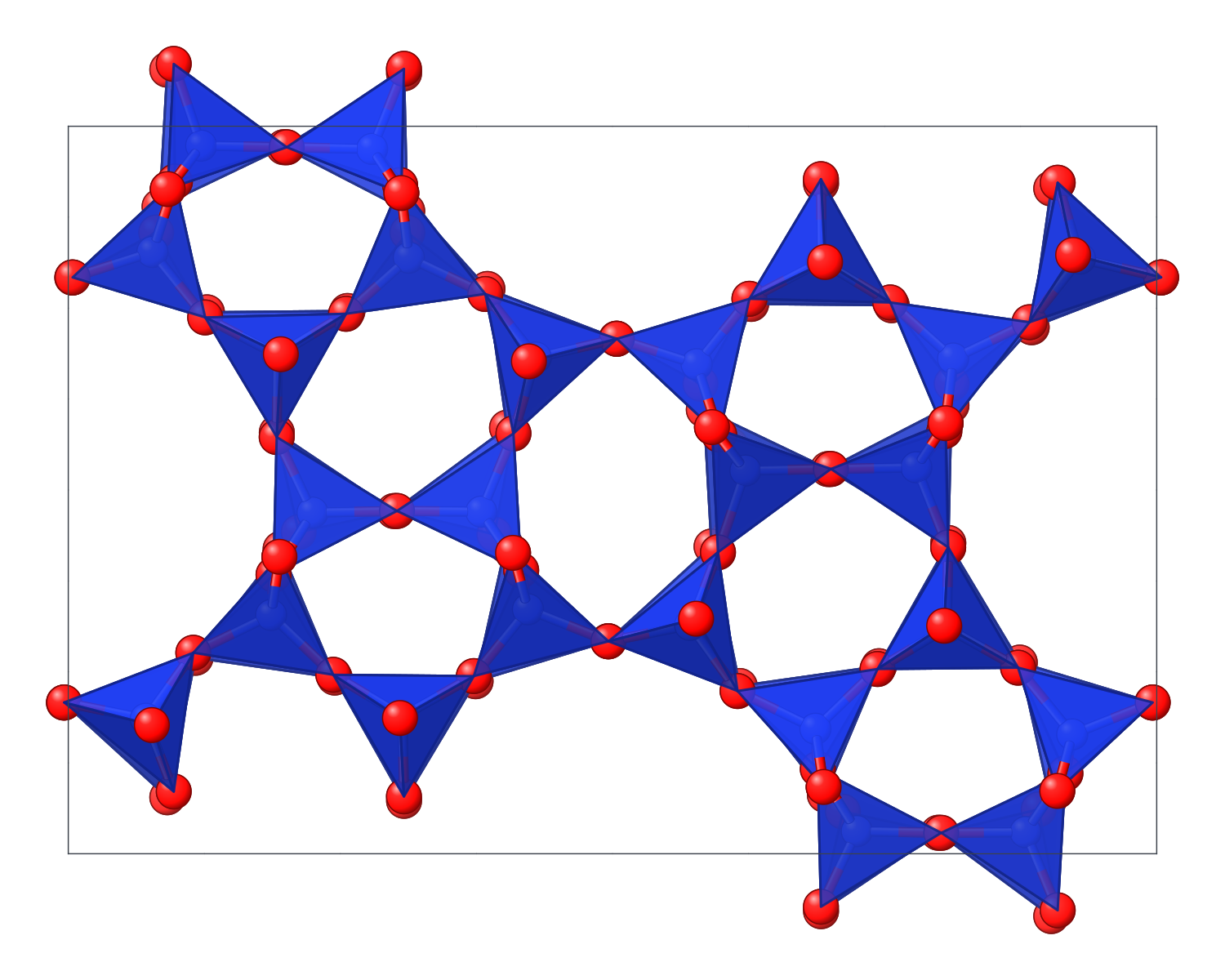
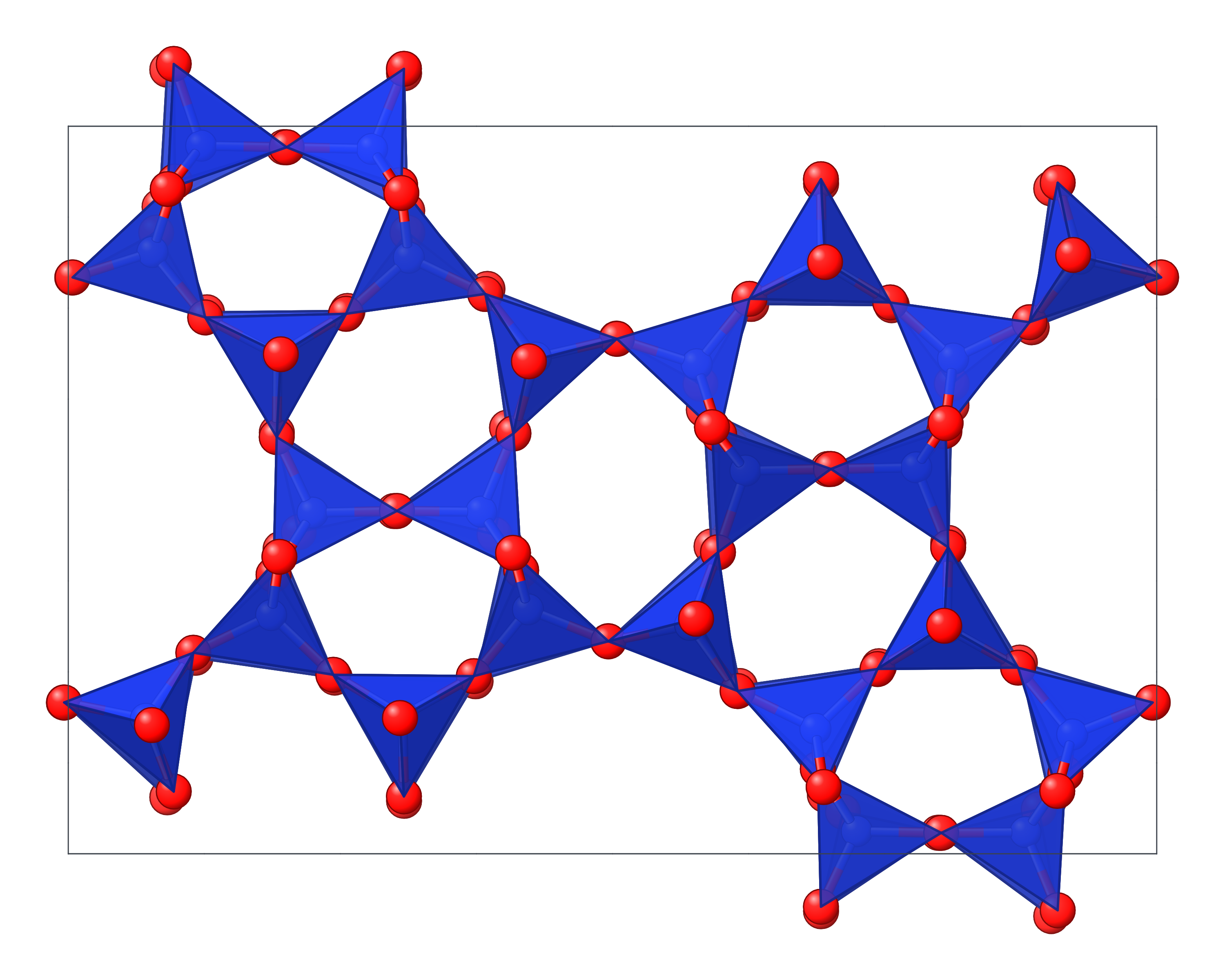
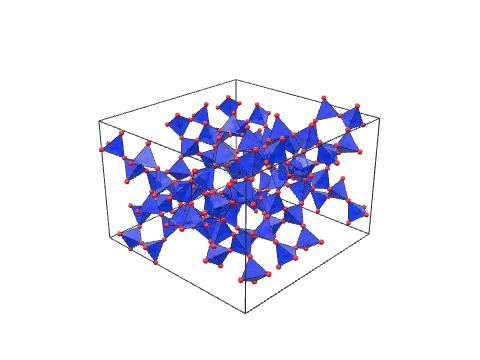
ZSM-5 (MFI) crystal structure (high-resolution SVG)
ZSM-5 (MFI) in 3D (interactive)
Loading the 3D model…
ZSM-5 structure explained
ZSM-5 is one of the zeolites, the crystalline aluminosilicates built of corner-sharing SiO₄ and AlO₄ tetrahedra; its framework type code is MFI (Vogt and Weckhuysen 2015). Every pore of MFI is bounded by a ring of 10 T atoms, a 10-ring, which makes ZSM-5 a medium-pore zeolite (Vogt and Weckhuysen 2015; Shan et al. 2021).
The 10-ring channels run in two directions. Straight channels run along the b axis ([010]) and sinusoidal (zig-zag) channels wind along the a axis ([100]); the two sets cross, so a molecule of the right size can reach any point of the pore system from any other (Vogt and Weckhuysen 2015). The pores are slightly elliptical, 5.1–5.6 Å across, and the straight channels measure 5.3 × 5.6 Å (Vogt and Weckhuysen 2015; Feng Z. et al. 2021). Where the channels cross, the intersections are wider, with a radius of about 3.6 Å (Matam et al. 2023).
Al atoms, and so the acid sites, are not spread evenly over the framework. Resonant X-ray diffraction of a commercial H-ZSM-5 placed single Al at the T8 site in the straight channel and Al pairs (Al–O–Si–O–Al) at T6 and T4 at the straight–sinusoidal intersection (Li G. et al. 2025).
Si/Al ratio and silicalite
ZSM-5 can be made over an unusually wide range of composition. It is called high-silica above Si/Al = 20 and Al-rich below 15, and with tetrapropylammonium (TPA) as the organic structure-directing agent Si/Al from 20 to 220 is reached by changing the gel (Li J. et al. 2022). Up to a SiO₂/Al₂O₃ ratio of about 25 it crystallises without any organic template (Vogt and Weckhuysen 2015).
The essentially all-silica end member is silicalite, also written silicalite-1: pure-silica MFI (Dalena et al. 2026). It has a monoclinic cell, while low-silica ZSM-5 is orthorhombic, but the framework is the same (Vogt and Weckhuysen 2015). Because each Al brings one acid site, the Si/Al ratio controls catalysis directly: in methanol conversion, lower acid density (higher Si/Al) lengthens catalyst lifetime, and Al placed in the narrow channels rather than at intersections favours olefins such as propylene (Li J. et al. 2022). Neutron scattering shows methanol moves more freely in the pores as Si/Al rises from 11 to 140 (Matam et al. 2023).
How ZSM-5 is made
- Gel. A silica source, an aluminium source, sodium hydroxide and water, usually with a quaternary ammonium template such as tetrapropylammonium hydroxide (TPAOH) or tetraethylammonium hydroxide (Feng P. et al. 2024; Vogt and Weckhuysen 2015).
- Hydrothermal crystallisation. The gel is heated in an autoclave; in one nano-ZSM-5 recipe, 170 °C for 36 h with silicalite-1 seeds gave crystals about 20 nm across (Feng P. et al. 2024).
- Calcination. The template is burned out of the channels, for example at 550 °C for 6 h (Feng P. et al. 2024).
- Acid form. Exchange with an ammonium salt and calcination converts Na-ZSM-5 to the Brønsted-acid form H-ZSM-5 (Feng P. et al. 2024).
Uses: shape-selective catalysis
- FCC additives for propylene. In fluid catalytic cracking the wide pores of zeolite Y allow bimolecular hydrogen-transfer reactions; the tighter channels of ZSM-5 cannot hold those large transition states, so it cracks gasoline-range molecules to light olefins. Additives with 25–50% ZSM-5 are used to raise the propylene yield (Vogt and Weckhuysen 2015). The market for propylene-selective FCC catalyst grew from about 10,000 t a year in 2005 to almost 90,000 t in 2014 (Vogt and Weckhuysen 2015).
- Methanol to hydrocarbons. ZSM-5 is a key catalyst for turning methanol into gasoline, olefins and aromatics (Matam et al. 2023); the methanol-to-hydrocarbons process can be tuned to gasoline (MTG) or olefins (MTO) by the choice of catalyst and conditions (Olsbye et al. 2012).
- Xylene isomerisation. ZSM-5 converts o- and m-xylene into p-xylene, the polyester raw material, a Brønsted-acid reaction limited to about 24% p-xylene at equilibrium (Feng P. et al. 2024).
- Other refinery and petrochemical uses. Hydroisomerisation, and light-alkane aromatisation over Ga-modified ZSM-5 (Feng P. et al. 2024; Feng Z. et al. 2021).
The intersecting channels also help the catalyst live longer: they keep acid sites from being blocked quickly by coke (Feng Z. et al. 2021). In FCC units steam slowly dealuminates ZSM-5, which is why it is often stabilised with phosphorus (Vogt and Weckhuysen 2015).
How to draw the ZSM-5 structure
For a paper, slide or poster, show ZSM-5 looking down the straight channels, where the 10-rings appear as open pores, and add a side view with the zig-zag channels crossing them. The LabCanvas figure editor Library has the MFI crystal file: it draws the ZSM-5 framework as a high-resolution SVG, where you can show Si as tetrahedra or atoms, repeat the cell and turn the view down [010] or [100]. The Library's zeolite object draws a schematic ring framework for simpler diagrams, and the LabCanvas 3D Studio has zeolite models you can rotate and export as images.
ZSM-5 compared with other zeolites
| Zeolite | Code | Pores | Pore opening | Main use |
|---|---|---|---|---|
| ZSM-5 | MFI | Intersecting 10-ring channels (medium-pore) | 5.1–5.6 Å | FCC propylene additive, methanol to hydrocarbons, xylene isomerisation |
| Zeolite Y | FAU | Large-pore, 13 Å supercages | ~7.3 Å | Main FCC cracking catalyst |
| SSZ-13 | CHA | 8-ring windows, CHA cages (small-pore) | 3.8 × 3.8 Å | Cu-SSZ-13 for NH₃-SCR of NOₓ |
Related materials
Zeolites
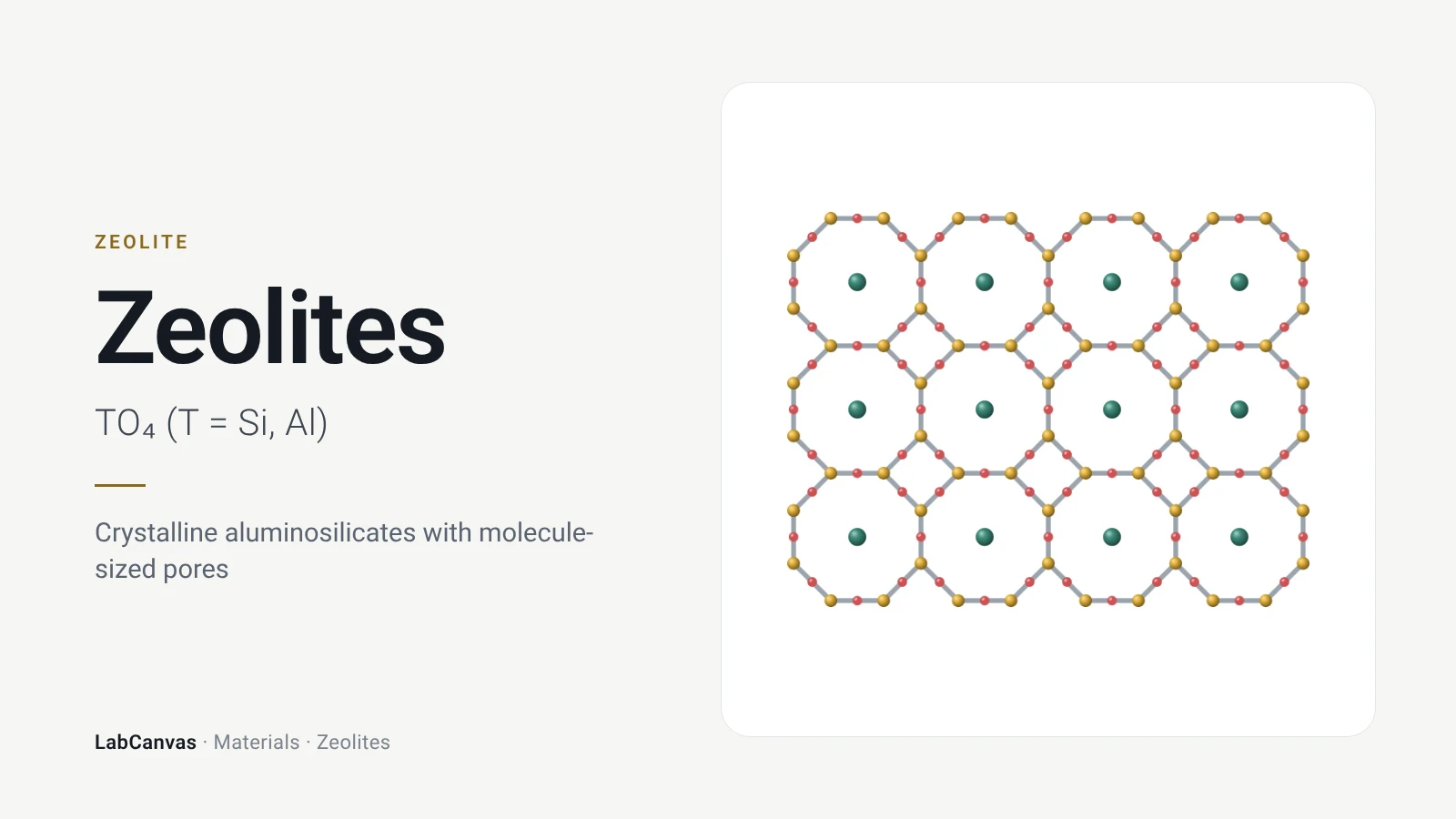
What zeolites are: TO₄ frameworks, 8-, 10- and 12-ring pores, IZA codes (MFI, FAU, LTA, CHA), Si/Al ratio, acid sites, synthesis and uses, with sources.
SSZ-13 (CHA)
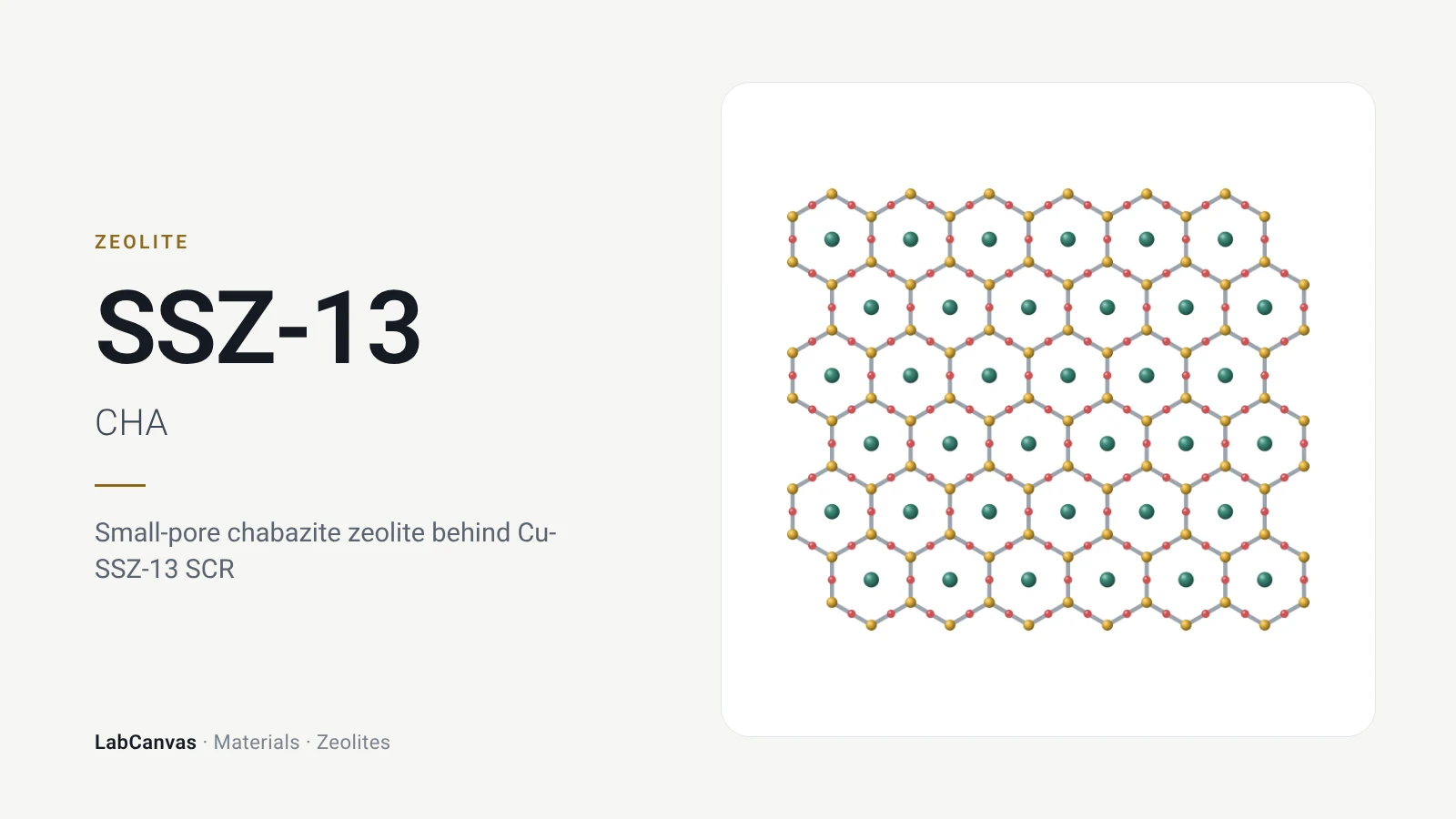
SSZ-13, the chabazite (CHA) zeolite: 8-ring windows of 3.8 Å and CHA cages, TMAda⁺ synthesis, Cu-SSZ-13 for NH₃-SCR of diesel NOₓ, and SAPO-34 for MTO.
Faujasite (zeolite X and Y)
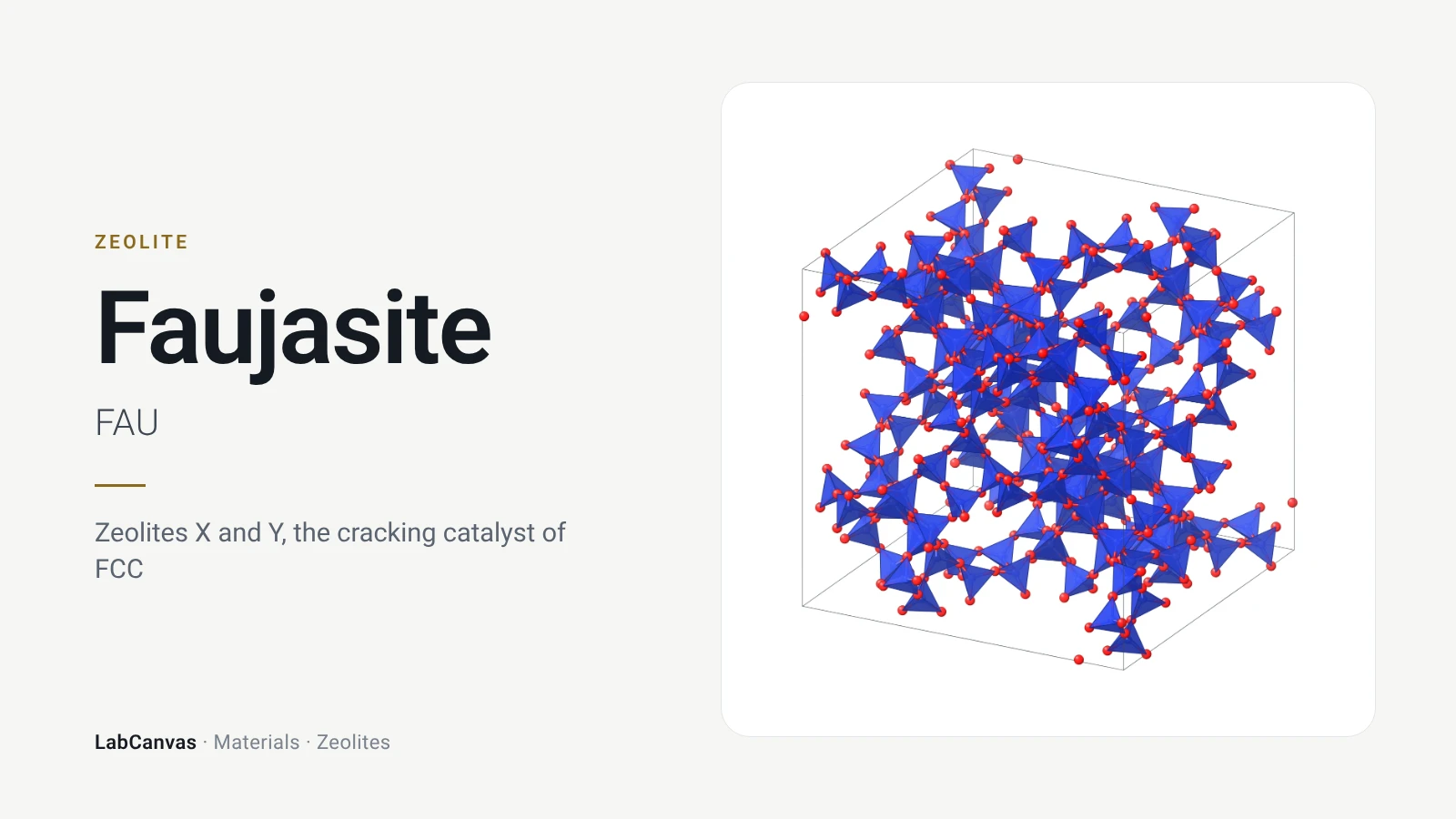
Faujasite (FAU): sodalite cages, double 6-rings and 12-ring supercages; zeolite X vs Y by Si/Al; ultrastable Y and why zeolite Y is the FCC catalyst.
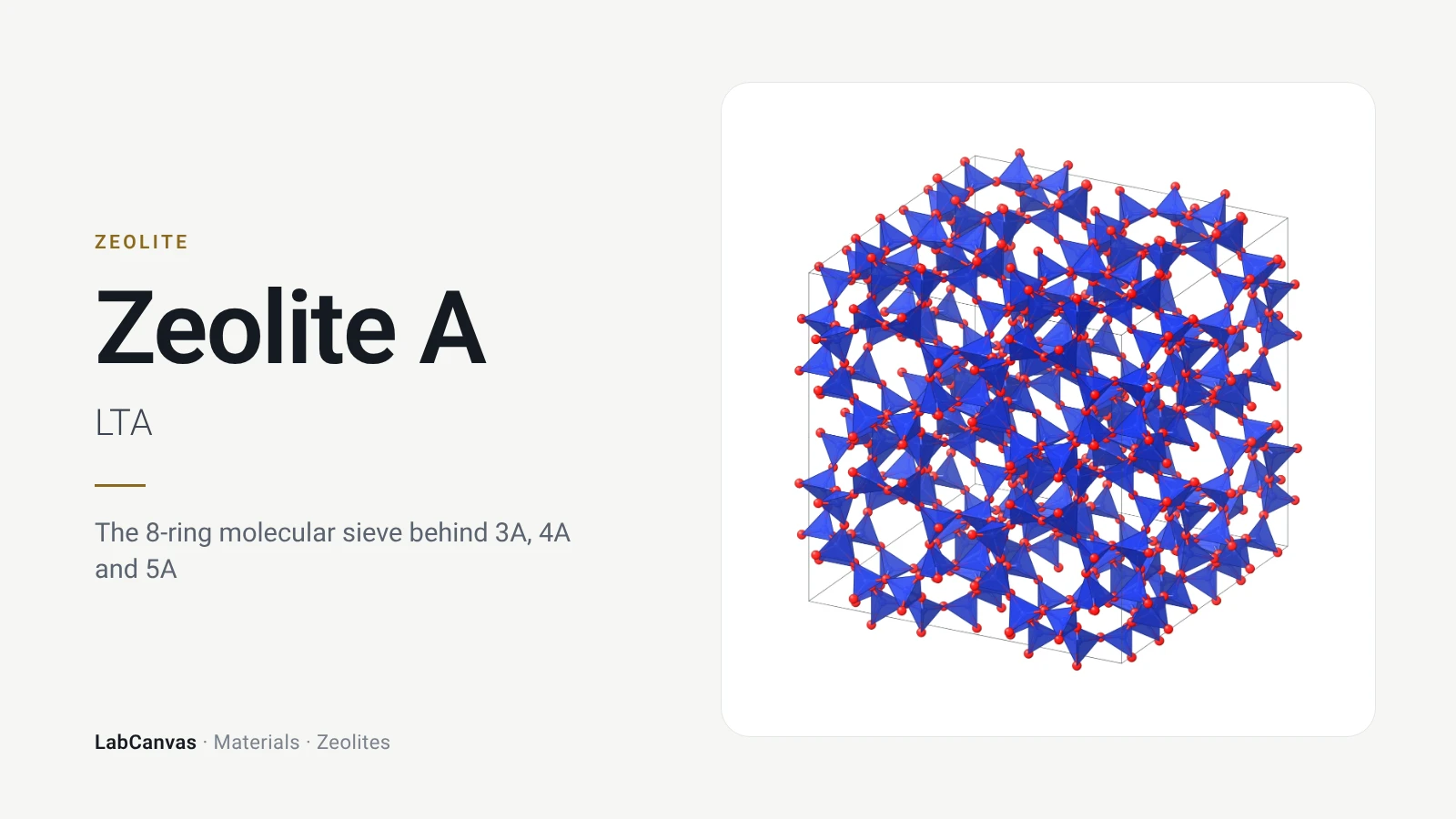
Zeolite A (LTA)
Zeolite A (LTA) structure: sodalite and α cages, 4.1 Å 8-ring windows, Si/Al = 1, the 3A, 4A and 5A molecular sieves, detergents and drying, with sources.
More on LabCanvas
- Crystal structure figure software compared: VESTA, Mercury, CrystalMaker, Avogadro and LabCanvas
- XRD Scherrer crystallite size calculator: Free tool
- Molar mass calculator: Free tool
- Journal figure size guide: Column widths and resolutions for 38 journals
- 3D models gallery: Turn MOFs, COFs, perovskites and more in 3D
Frequently asked questions
What is ZSM-5?
A high-silica aluminosilicate zeolite with the MFI framework, first reported by Argauer and Landolt at Mobil in 1972. Its intersecting 10-ring channels make it a shape-selective acid catalyst (Vogt and Weckhuysen, Chem. Soc. Rev. 2015).
What is the structure of ZSM-5?
A three-dimensional MFI framework of SiO₄ and AlO₄ tetrahedra with straight 10-ring channels along [010] crossing sinusoidal (zig-zag) 10-ring channels along [100] (Vogt and Weckhuysen 2015).
What is the pore size of ZSM-5?
About 5.1–5.6 Å: the 10-ring pores are slightly elliptical (Vogt and Weckhuysen 2015) and the straight channels are 5.3 × 5.6 Å (Feng Z. et al., Molecules 2021).
What does MFI stand for in ZSM-5?
MFI is the three-letter framework type code that the International Zeolite Association assigns to the ZSM-5 framework; every material with this topology, including silicalite-1, is an MFI zeolite (Li J. et al., Chem. Sci. 2022; Dalena et al., Small 2026).
What is the Si/Al ratio of ZSM-5?
It ranges widely. ZSM-5 above Si/Al = 20 is called high-silica and below 15 Al-rich; with a tetrapropylammonium template Si/Al from 20 to 220 can be made, and the pure-silica end member is silicalite-1 (Li J. et al., Chem. Sci. 2022).
What is the difference between ZSM-5 and silicalite-1?
Silicalite-1 is the essentially all-silica form of the MFI framework, with no Al and so no Brønsted acid sites. It is monoclinic, while Al-containing ZSM-5 is orthorhombic, but the framework is the same (Vogt and Weckhuysen 2015).
Why is ZSM-5 used in FCC?
As an additive it cracks gasoline-range molecules into light olefins, raising propylene yield; its narrow channels suppress the bimolecular hydrogen transfer that makes paraffins in the wide pores of zeolite Y (Vogt and Weckhuysen 2015).
What is ZSM-5 used for in methanol conversion?
ZSM-5 is a key catalyst for the methanol-to-hydrocarbons reaction that makes gasoline, olefins and aromatics from methanol (Matam et al., Phil. Trans. R. Soc. A 2023); the process can be steered to gasoline (MTG) or olefins (MTO) (Olsbye et al., Angew. Chem. 2012).
References
- E. T. C. Vogt, B. M. Weckhuysen. Fluid catalytic cracking: recent developments on the grand old lady of zeolite catalysis. Chem. Soc. Rev. 2015, 44, 7342–7370. doi:10.1039/c5cs00376h
- Z. Feng, X. Liu, Y. Wang, C. Meng. Recent advances on gallium-modified ZSM-5 for conversion of light hydrocarbons. Molecules 2021, 26, 2234. doi:10.3390/molecules26082234
- J. Li, M. Gao, W. Yan, J. Yu. Regulation of the Si/Al ratios and Al distributions of zeolites and their impact on properties. Chem. Sci. 2022, 14, 1935–1959. doi:10.1039/d2sc06010h
- G. Li et al.. Atomic locations and adsorbate interactions of Al single and pair sites in H-ZSM-5 zeolite. Science 2025, 387, 388–393. doi:10.1126/science.adq6644
- S. K. Matam, I. P. Silverwood, L. Boudjema, A. J. O’Malley, C. R. A. Catlow. Methanol diffusion and dynamics in zeolite H-ZSM-5 probed by quasi-elastic neutron scattering and classical molecular dynamics simulations. Philos. Trans. R. Soc. A 2023, 381, 20220335. doi:10.1098/rsta.2022.0335
- P. Feng et al.. Liquid-phase xylene isomerization on nano-sized ZSM-5. RSC Adv. 2024, 14, 19264–19270. doi:10.1039/d4ra02828g
- F. Dalena et al.. Silanol networks control methanol reactivity in nano- and micron-sized silicalite-1. Small 2026, 22, e73802. doi:10.1002/smll.73802
- U. Olsbye et al.. Conversion of methanol to hydrocarbons: how zeolite cavity and pore size controls product selectivity. Angew. Chem. Int. Ed. 2012, 51, 5810–5831. doi:10.1002/anie.201103657
- Y. Shan et al.. Selective catalytic reduction of NOx with NH3: opportunities and challenges of Cu-based small-pore zeolites. Natl. Sci. Rev. 2021, 8, nwab010. doi:10.1093/nsr/nwab010
Draw ZSM-5 (MFI) for your paper or slides
LabCanvas is a browser workspace for scientific figures: framework clusters, linkers and nets, crystal structures in 2D and 3D, graphs and posters, all editable.
Draw ZSM-5 (MFI) in LabCanvas