FAPbI₃ (formamidinium lead iodide): phases, band gap and solar cells
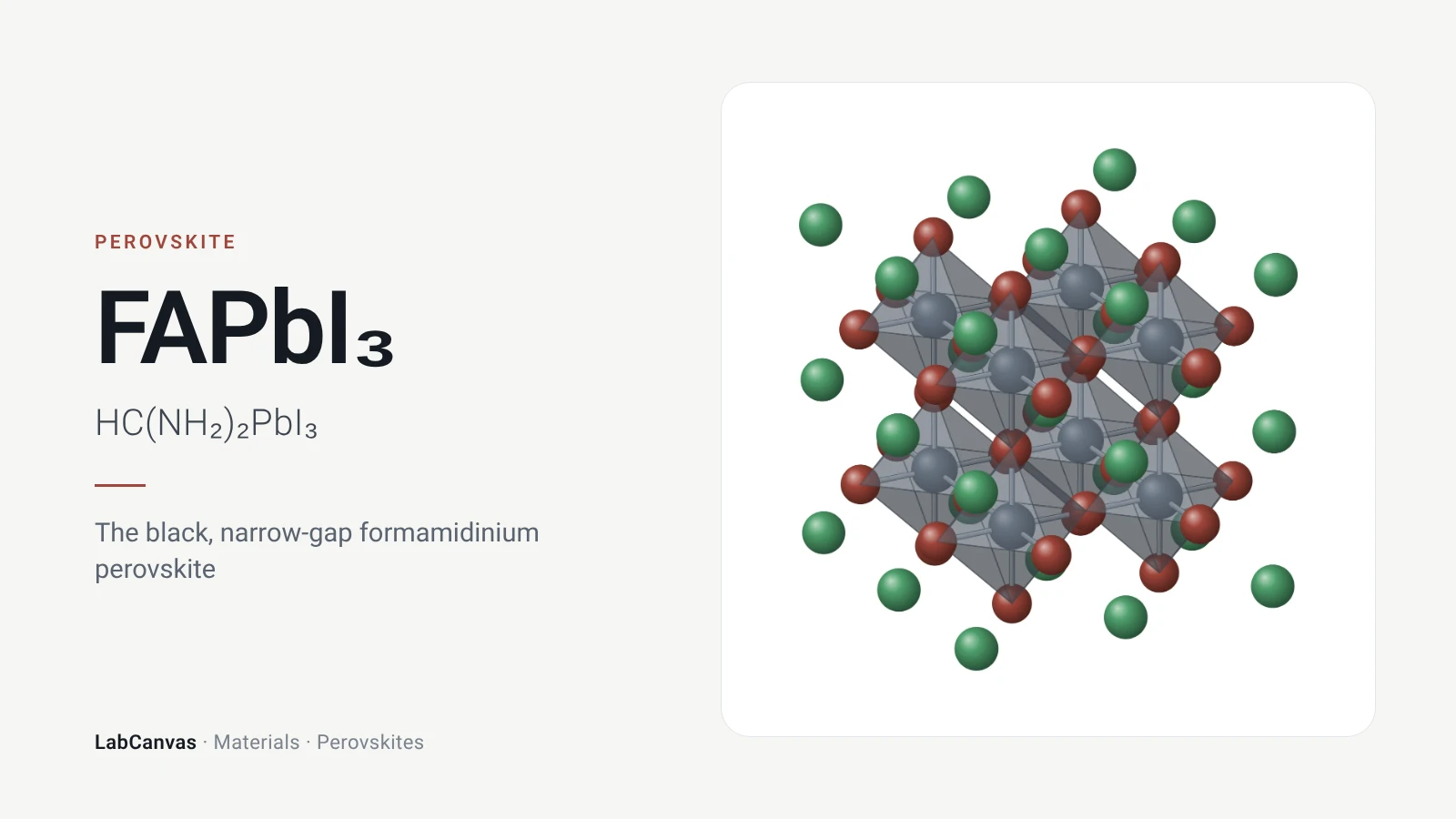
Formamidinium lead iodide, HC(NH₂)₂PbI₃ (FAPbI₃), is a hybrid halide perovskite with formamidinium on the A site (Stoumpos et al. 2013); its black α-phase is cubic (Jeong et al. 2021). Its band gap of 1.48 eV is narrower than the 1.55 eV of methylammonium lead iodide (Zheng et al. 2022), and FAPbI₃-based cells passed 20% in 2015 (Yang et al. 2015). Pure FAPbI₃ can also crystallise as a yellow, hexagonal, non-perovskite δ-phase, so most high-efficiency cells stabilise the black phase by mixing in other cations or anions (Jeon et al. 2015; Saliba et al. 2016).
Contents
FAPbI₃ at a glance
| Formula | HC(NH₂)₂PbI₃ (FAPbI₃) (Stoumpos et al. 2013) |
|---|---|
| Molar mass | 632.98 g mol⁻¹ (calculated from the formula) |
| A-site cation | Formamidinium, HC(NH₂)₂⁺ (Stoumpos et al. 2013); ionic radius 2.79 Å vs 2.70 Å for methylammonium and 1.81 Å for Cs⁺ (as given by Saliba et al. 2016) |
| Black α-phase | Cubic, photoactive perovskite (Jeong et al. 2021; Saliba et al. 2016); obtained only at high temperature in pure FAPbI₃ (Zheng et al. 2022) |
| Yellow δ-phase | Photoinactive, non-perovskite, hexagonal (Saliba et al. 2016); the stable form at low temperature (Zheng et al. 2022) |
| Band gap | 1.48 eV, vs 1.55 eV for MAPbI₃ (Zheng et al. 2022); 1.48 eV measured for component-pure α-FAPbI₃ (Wang et al. 2023) |
| Absorption edge | About 840 nm (calculated from the 1.48 eV gap) |
| FAPbI₃ films | Dense (111)-oriented films by intramolecular exchange; FAPbI₃-based cells above 20% (Yang et al. 2015) |
| Stabilised by MAPbBr₃ | Mixing MAPbBr₃ into FAPbI₃ stabilises the perovskite phase; cells above 18% (Jeon et al. 2015) |
| Triple cation | Cs/MA/FA mixtures suppress the yellow phase; stabilised output of 21.1% (Saliba et al. 2016) |
| α-FAPbI₃ cells | 25.6% (certified 25.2%) with formate anion engineering (Jeong et al. 2021) |
| Key reports | Jeon et al., Nature 517, 476 (2015); Saliba et al., Energy Environ. Sci. 9, 1989 (2016); Jeong et al., Nature 592, 381 (2021) |
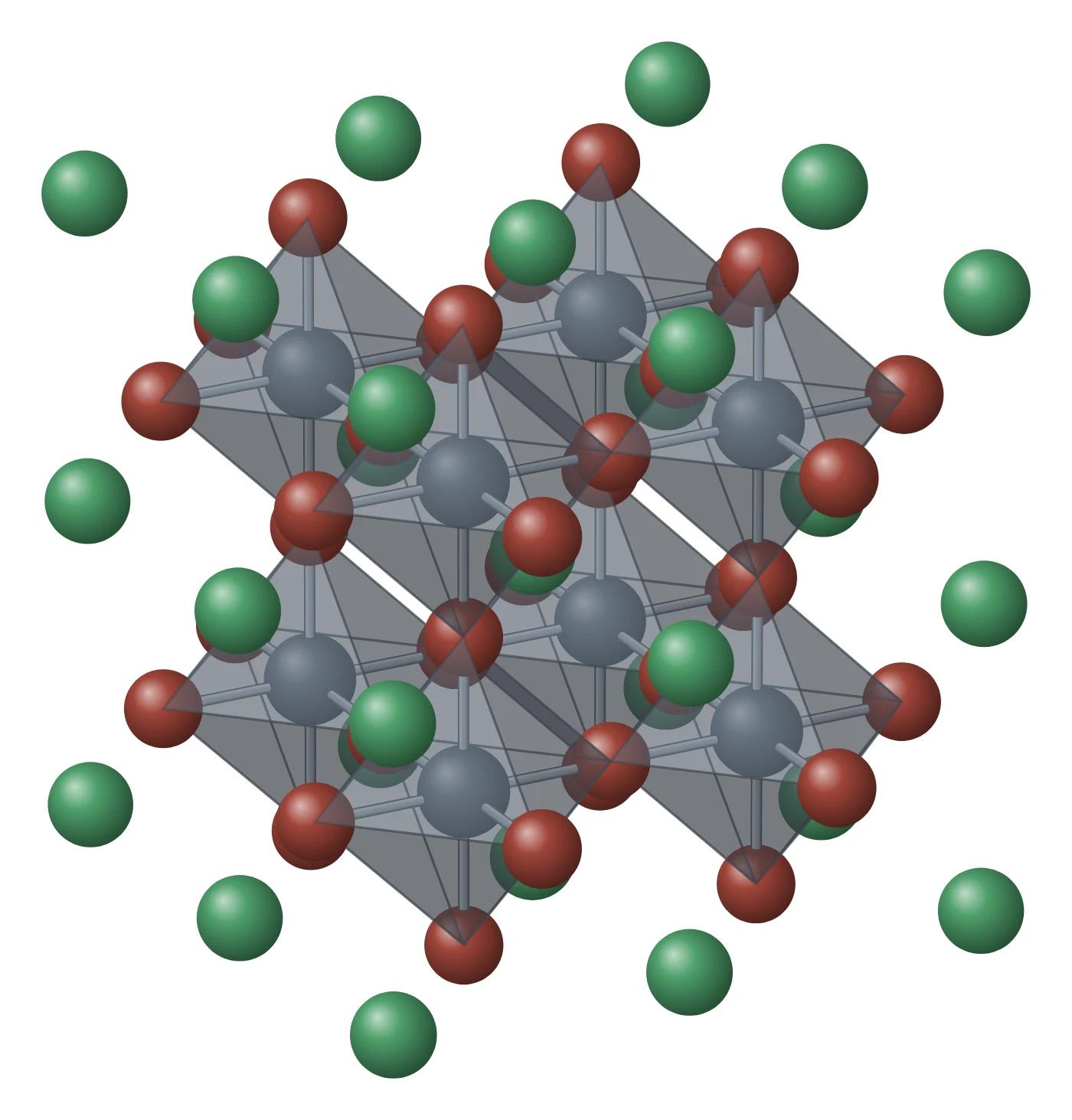
FAPbI₃ structure drawing (high-resolution SVG)
FAPbI₃ in 3D (interactive)
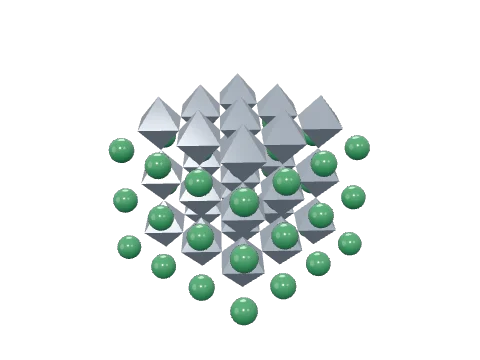
Loading the 3D model…
FAPbI₃ structure explained
FAPbI₃ has the ABX₃ formula of a perovskite: A is the organic formamidinium cation, HC(NH₂)₂⁺, B is lead and X is iodide (Stoumpos et al. 2013). The black α-phase is the cubic perovskite (Jeong et al. 2021): corner-sharing PbI₆ octahedra with formamidinium in the cages. For the general picture of corner-sharing octahedra and the A-site cage, see the perovskite structure hub.
Formamidinium (2.79 Å) is larger than methylammonium (2.70 Å) and much larger than caesium (1.81 Å) (radii as given by Saliba et al. 2016). That size is why pure FAPbI₃ does not always form a perovskite: it can instead crystallise as a yellow δ-phase, a photoinactive, hexagonal, non-perovskite structure, and the black α-phase is sensitive to solvents and humidity (Saliba et al. 2016). In pure FAPbI₃ the yellow non-perovskite phase is the stable one at low temperature and the black phase forms only at high temperature (Zheng et al. 2022).
Band gap: why FAPbI₃ matters for solar cells
Replacing methylammonium with formamidinium narrows the band gap: FAPbI₃ has a gap of 1.48 eV against 1.55 eV for MAPbI₃ (Zheng et al. 2022), and component-pure α-FAPbI₃ films stabilised with a volatile ammonium acetate additive showed 1.48 eV and cells above 21% (Wang et al. 2023). The narrower gap extends absorption to about 840 nm (calculated from 1.48 eV). Yang et al. (2015) likewise note that the band gap of FAPbI₃ allows broader absorption of the solar spectrum than MAPbI₃, and Saliba et al. (2016) that it lies closer to the single-junction optimum.
Stabilising the black phase: mixed cations and anions
- FA/MA cations. Mixing formamidinium and methylammonium on the A site extends the absorption onset further into the red and raised the short-circuit current over methylammonium-only cells (Pellet et al. 2014).
- Adding MAPbBr₃. Jeon et al. (2015) combined FAPbI₃ with MAPbBr₃; the bromide-containing mixture stabilised the perovskite phase of FAPbI₃ and gave cells above 18% under standard illumination.
- Triple cation (Cs/MA/FA). Saliba et al. (2016) added a small amount of caesium to FA/MA mixed-halide perovskites. The smaller Cs⁺ shifts the tolerance factor towards the cubic black phase, suppressing the yellow-phase impurities seen in Cs-free films; the films were more thermally stable, less sensitive to processing conditions, and reached a stabilised 21.1%, with about 18% after 250 hours under operation.
- Anion engineering of α-FAPbI₃. Jeong et al. (2021) used the pseudo-halide formate (HCOO⁻) to suppress anion-vacancy defects at grain boundaries and surfaces, reaching 25.6% (certified 25.2%).
FAPbI₃ in high-efficiency perovskite solar cells
Perovskite solar cells began with methylammonium lead halides as sensitisers at 3.8% (Kojima et al. 2009). By 2016, the best perovskite cells used a mixture of formamidinium and methylammonium as the A-site cations (Saliba et al. 2016). Yang et al. (2015) deposited dense FAPbI₃ films by intramolecular exchange of DMSO intercalated in PbI₂ with formamidinium iodide, and their FAPbI₃-based cells exceeded 20%. Jeong et al. (2021) describe the cubic α-phase of FAPbI₃ as the most promising semiconductor for highly efficient and stable perovskite solar cells, and their formate-treated α-FAPbI₃ cells reached 25.6%.
How FAPbI₃ is made
- Single crystals and powders. FAPbI₃ and related AMI₃ iodides have been prepared by several routes and their structures solved by single-crystal X-ray diffraction; their properties depend strongly on the preparation method (Stoumpos et al. 2013).
- Intramolecular exchange. Formamidinium iodide replaces DMSO intercalated in PbI₂, giving dense, large-grained (111)-oriented FAPbI₃ films without residual PbI₂ (Yang et al. 2015).
How to draw the FAPbI₃ structure
For a paper, slide or poster, draw the black α-phase as one cubic cell: a PbI₆ octahedron at each corner sharing iodides with its neighbours, and the formamidinium ion in the central cage. A side-by-side panel of the yellow δ-phase (hexagonal, non-perovskite) explains why phase stability matters. In the LabCanvas figure editor, the Library’s Perovskite crystal object draws the ABX₃ cell with its corner-sharing octahedra, which you can recolour, repeat over several cells and export as a high-resolution SVG, and the LabCanvas 3D Studio has a perovskite model you can turn and export as an image; the perovskite structure page shows the shared ABX₃ framework that FAPbI₃, MAPbI₃ and CsPbBr₃ all start from.
FAPbI₃ compared with other lead halide perovskites
| Material | A cation (radius) | Band gap | Room-temperature phase issue | Source |
|---|---|---|---|---|
| MAPbI₃ | Methylammonium (2.70 Å) | 1.55 eV | Structural phase transition at 55 °C; moisture sensitive | Zheng et al. 2022; Saliba et al. 2016 |
| FAPbI₃ | Formamidinium (2.79 Å) | 1.48 eV | Can form the yellow, hexagonal, non-perovskite δ-phase | Zheng et al. 2022; Saliba et al. 2016 |
| CsPbI₃ | Caesium (1.81 Å) | 1.73 eV (perovskite phase) | Orthorhombic yellow δ-phase at room temperature; black phase stable only above 300 °C | Saliba et al. 2016 |
| Cs/MA/FA triple cation | Mixture | Absorption and PL blue-shifted by ~10 nm vs the Cs-free mixture | Yellow phase suppressed; stabilised 21.1% cells | Saliba et al. 2016 |
Related materials
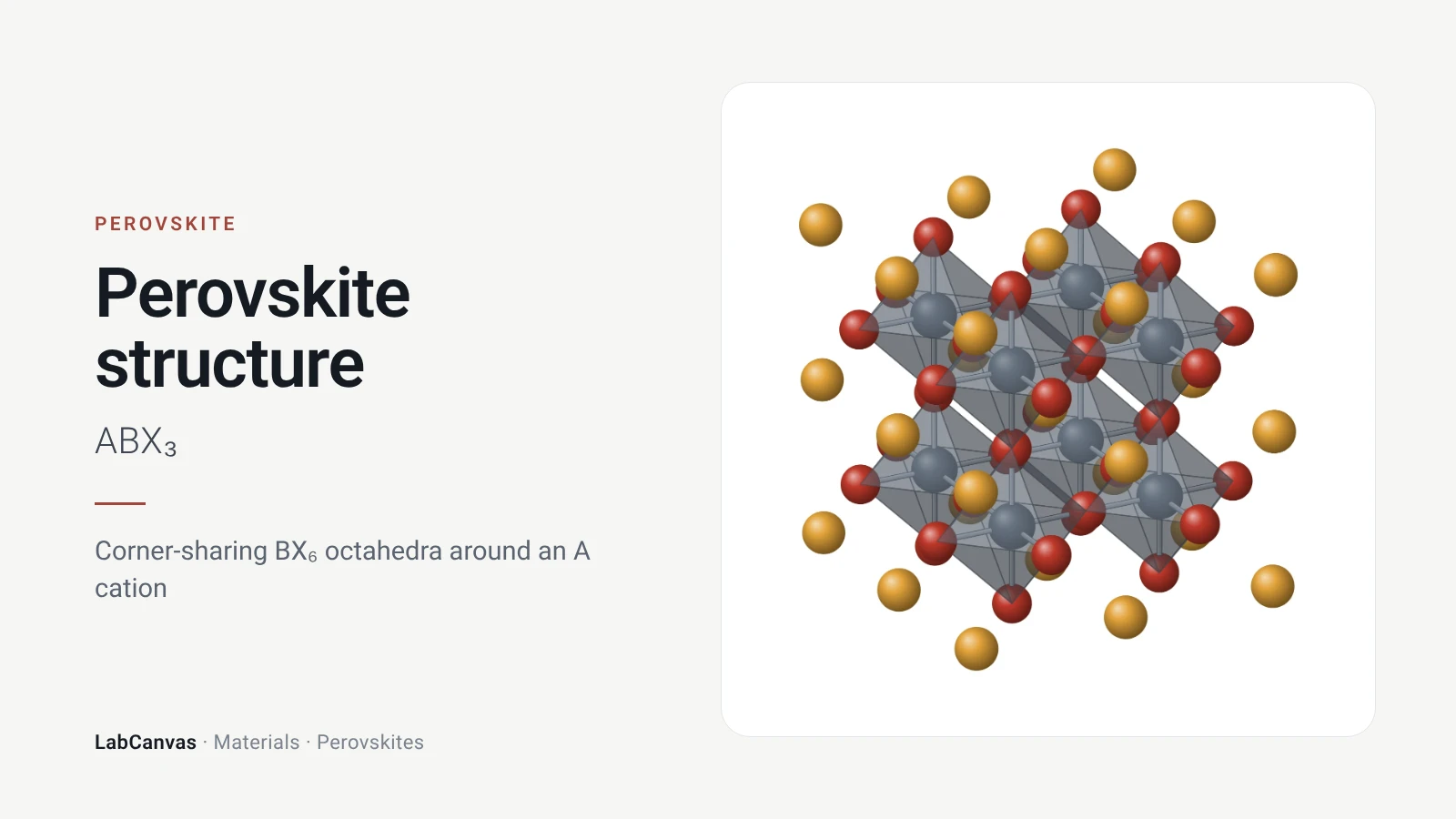
Perovskite structure
The perovskite structure explained: ABX₃ with corner-sharing BX₆ octahedra, the tolerance factor, octahedral tilts, and oxide vs halide perovskites.
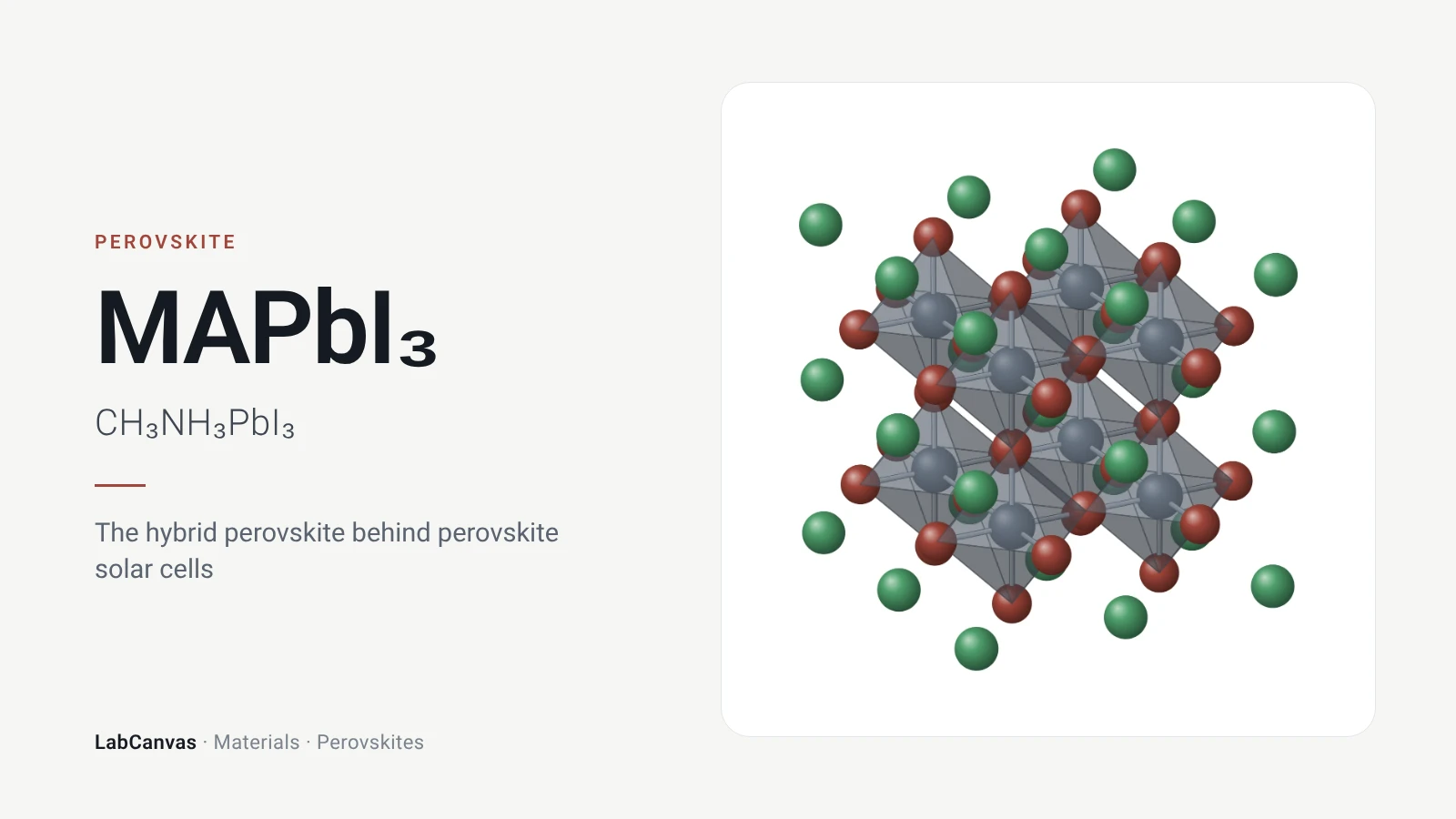
MAPbI₃
MAPbI₃ (CH₃NH₃PbI₃): tetragonal and cubic phases, 1.5 eV band gap, the first perovskite solar cells, long diffusion lengths, instability and lead toxicity.
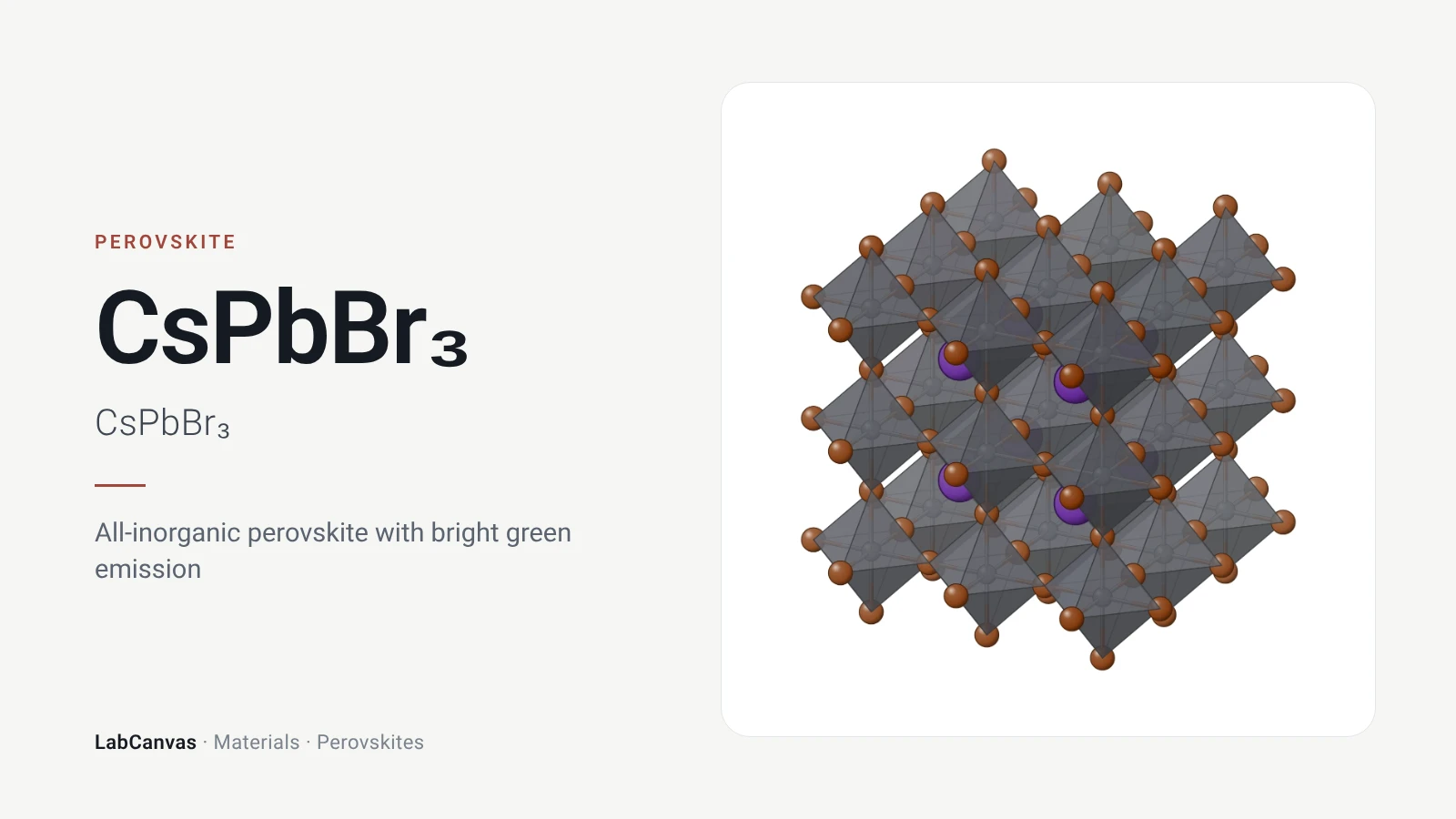
CsPbBr₃
CsPbBr₃ and CsPbX₃ perovskite quantum dots: orthorhombic structure, hot-injection synthesis, emission tunable over 410–700 nm, anion exchange and uses.
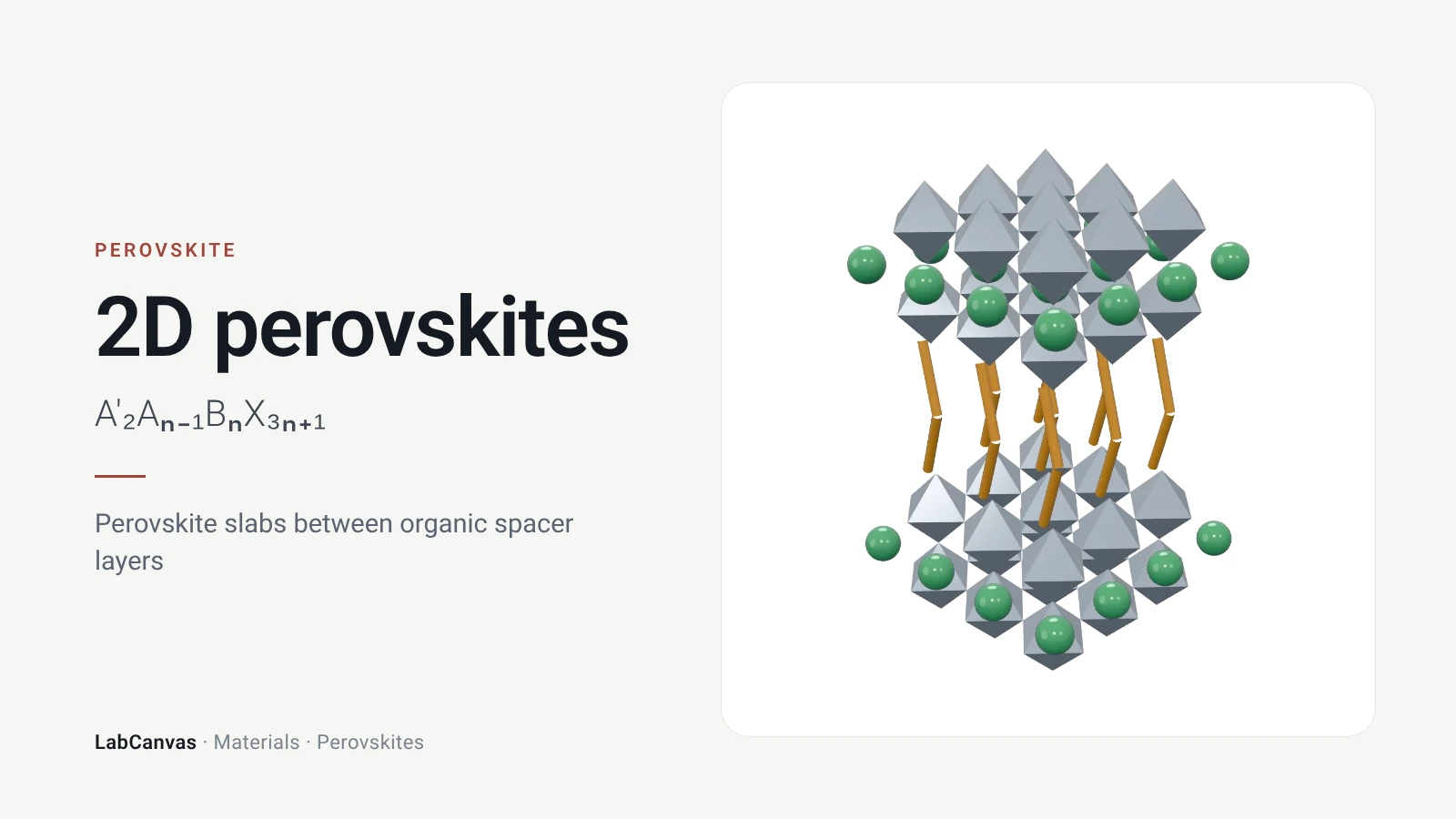
2D perovskites
Layered 2D halide perovskites explained: Ruddlesden–Popper and Dion–Jacobson phases, the n value, quantum wells, spacers, stability, solar cells and LEDs.
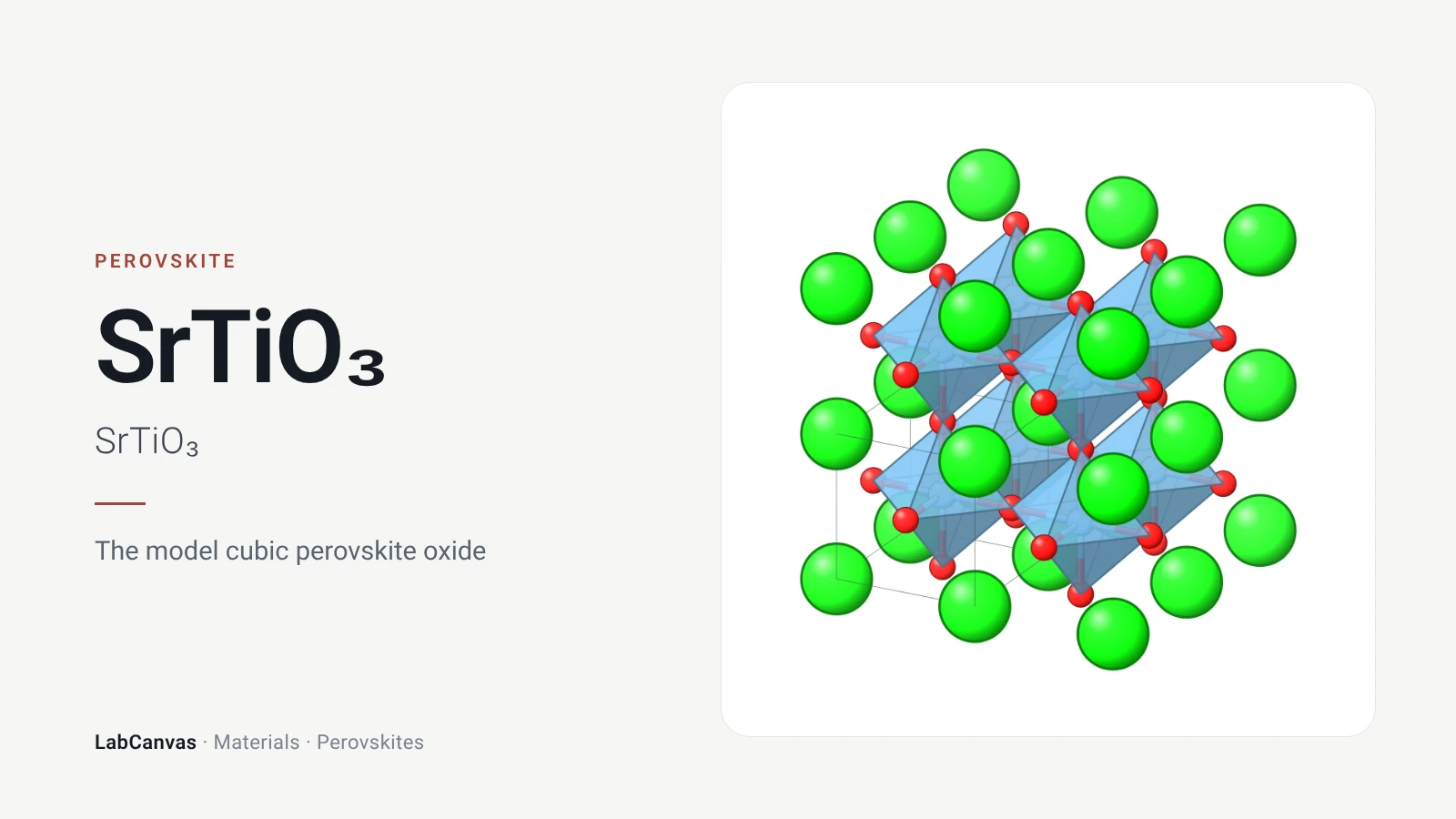
SrTiO₃ (strontium titanate)
SrTiO₃ structure and properties: cubic perovskite (a = 3.905 Å), the 105 K transition, quantum paraelectricity, LaAlO₃/SrTiO₃ interfaces and water splitting.
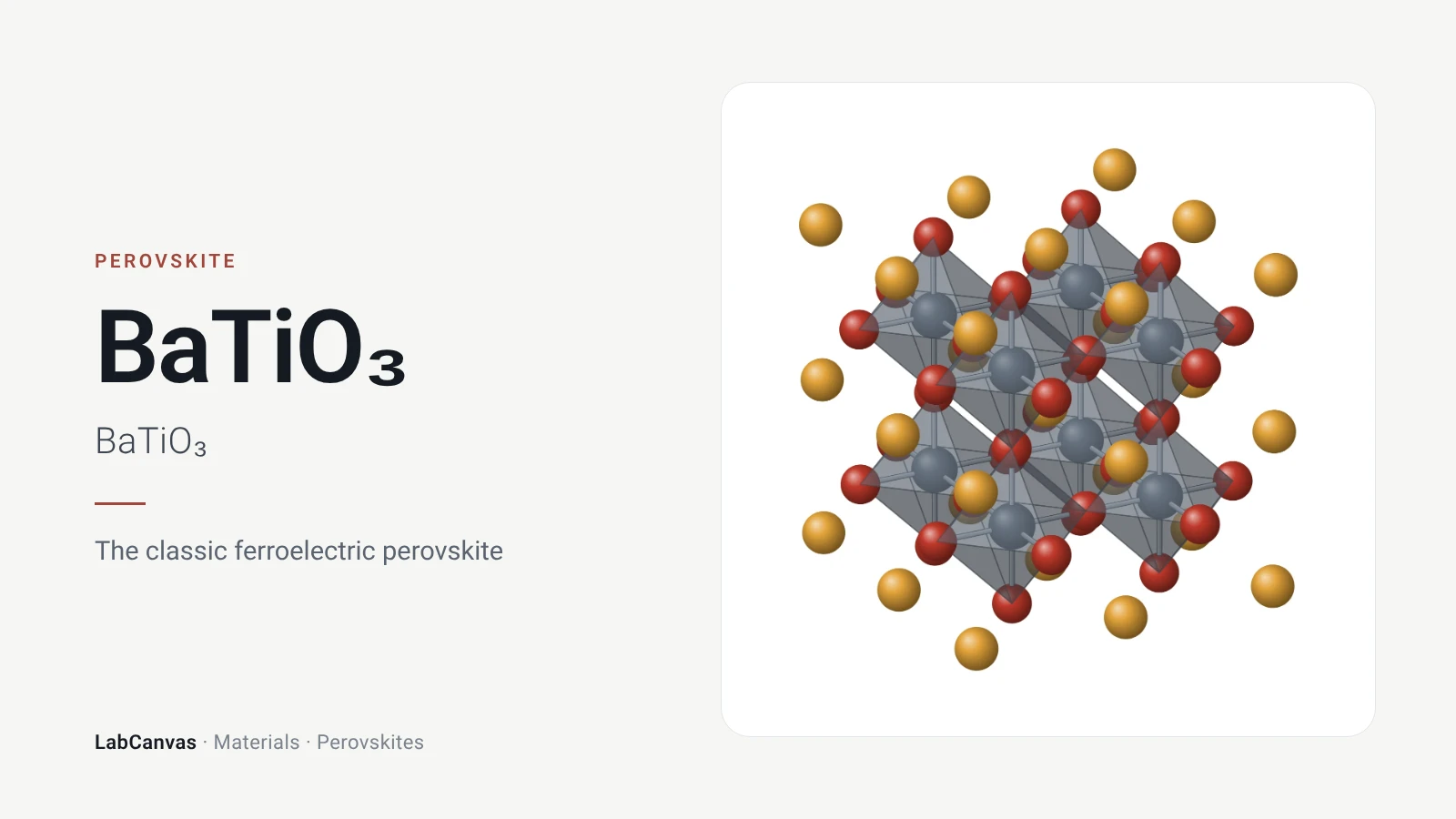
BaTiO₃ (barium titanate)
BaTiO₃, the classic ferroelectric perovskite: its ~120 °C Curie point, tetragonal, orthorhombic and rhombohedral phases, capacitors and piezoelectrics.
More on LabCanvas
- Crystal structure figure software compared: VESTA, Mercury, CrystalMaker, Avogadro and LabCanvas
- Tauc plot band gap calculator: Free tool: optical band gap from UV–vis
- XRD Scherrer crystallite size calculator: Free tool
- Molar mass calculator: Free tool
- Journal figure size guide: Column widths and resolutions for 38 journals
- 3D models gallery: Turn MOFs, COFs, perovskites and more in 3D
Frequently asked questions
What is FAPbI₃?
Formamidinium lead iodide, HC(NH₂)₂PbI₃: a hybrid halide perovskite with formamidinium on the A site, lead on the B site and iodide on the X site. Its black α-phase is a cubic perovskite (Jeong et al. 2021) used as the light absorber in perovskite solar cells.
What is the band gap of FAPbI₃?
About 1.48 eV, narrower than the 1.55 eV of MAPbI₃ (Zheng et al., Chem. Sci. 2022; Wang et al. 2023), so FAPbI₃ absorbs further into the near infrared (to about 840 nm, calculated from 1.48 eV).
What is the difference between α-FAPbI₃ and δ-FAPbI₃?
α-FAPbI₃ is the black, photoactive perovskite phase built from corner-sharing PbI₆ octahedra; δ-FAPbI₃ is a yellow, photoinactive, hexagonal non-perovskite phase. Pure FAPbI₃ can crystallise into either, and the black phase is sensitive to solvents and humidity (Saliba et al. 2016).
Why does FAPbI₃ turn yellow?
Because it converts to, or crystallises as, the hexagonal δ-phase, which is photoinactive and not a perovskite, unlike the black α-phase. The black phase is sensitive to solvents and humidity (Saliba et al. 2016).
How is the black phase of FAPbI₃ stabilised?
By mixing in other ions: methylammonium and bromide (MAPbBr₃; Jeon et al., Nature 2015), a small amount of caesium in a Cs/MA/FA triple cation (Saliba et al. 2016), or by treating α-FAPbI₃ films with additives such as formate, which suppresses anion-vacancy defects (Jeong et al. 2021).
Is FAPbI₃ better than MAPbI₃ for solar cells?
Its narrower band gap (1.48 eV) lets it harvest more of the solar spectrum than MAPbI₃ (Zheng et al. 2022; Yang et al. 2015), and α-FAPbI₃ cells have reached 25.6% (Jeong et al. 2021). Its drawback is phase stability: it needs stabilising against the yellow δ-phase.
What is a triple cation perovskite?
A lead mixed-halide perovskite with three A-site cations: caesium, methylammonium and formamidinium. Saliba et al. (2016) showed that adding Cs suppresses the yellow phase of FA perovskite, improves thermal stability and reproducibility, and gave a stabilised 21.1%.
What is the crystal structure of FAPbI₃?
The black α-phase is a cubic perovskite of corner-sharing PbI₆ octahedra with formamidinium in the cages (Jeong et al. 2021). The yellow δ-phase is hexagonal and not a perovskite (Saliba et al. 2016).
References
- Z. Zheng, S. Wang, Y. Hu, Y. Rong, A. Mei, H. Han. Development of formamidinium lead iodide-based perovskite solar cells: efficiency and stability. Chem. Sci. 2022, 13, 2167–2183. doi:10.1039/D1SC04769H
- D. Wang et al.. Stabilization of component-pure α-FAPbI₃ via volatile additives for stable photovoltaics. ACS Appl. Mater. Interfaces 2023, 15, 16818–16827. doi:10.1021/acsami.3c01973
- C. C. Stoumpos, C. D. Malliakas, M. G. Kanatzidis. Semiconducting tin and lead iodide perovskites with organic cations: phase transitions, high mobilities, and near-infrared photoluminescent properties. Inorg. Chem. 2013, 52, 9019–9038. doi:10.1021/ic401215x
- N. J. Jeon, J. H. Noh, W. S. Yang, Y. C. Kim, S. Ryu, J. Seo, S. I. Seok. Compositional engineering of perovskite materials for high-performance solar cells. Nature 2015, 517, 476–480. doi:10.1038/nature14133
- M. Saliba et al.. Cesium-containing triple cation perovskite solar cells: improved stability, reproducibility and high efficiency. Energy Environ. Sci. 2016, 9, 1989–1997. doi:10.1039/C5EE03874J
- N. Pellet, P. Gao, G. Gregori, T.-Y. Yang, M. K. Nazeeruddin, J. Maier, M. Grätzel. Mixed-organic-cation perovskite photovoltaics for enhanced solar-light harvesting. Angew. Chem. Int. Ed. 2014, 53, 3151–3157. doi:10.1002/anie.201309361
- W. S. Yang, J. H. Noh, N. J. Jeon, Y. C. Kim, S. Ryu, J. Seo, S. I. Seok. High-performance photovoltaic perovskite layers fabricated through intramolecular exchange. Science 2015, 348, 1234–1237. doi:10.1126/science.aaa9272
- J. Jeong et al.. Pseudo-halide anion engineering for α-FAPbI₃ perovskite solar cells. Nature 2021, 592, 381–385. doi:10.1038/s41586-021-03406-5
- A. Kojima, K. Teshima, Y. Shirai, T. Miyasaka. Organometal halide perovskites as visible-light sensitizers for photovoltaic cells. J. Am. Chem. Soc. 2009, 131, 6050–6051. doi:10.1021/ja809598r
Draw FAPbI₃ for your paper or slides
LabCanvas is a browser workspace for scientific figures: framework clusters, linkers and nets, crystal structures in 2D and 3D, graphs and posters, all editable.
Draw FAPbI₃ in LabCanvas