Graphene oxide (GO): structure, synthesis and properties
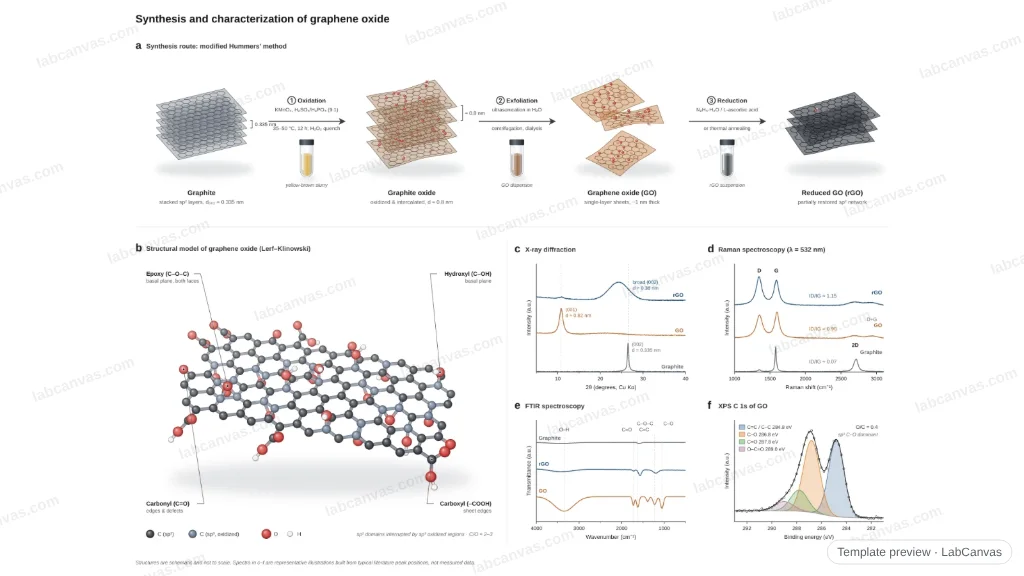
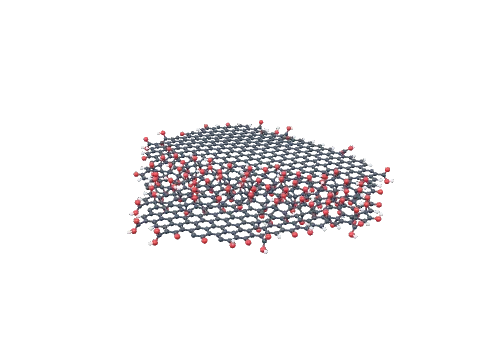
Graphene oxide (GO) is a single layer of graphite oxide: a graphene sheet carrying epoxide (C–O–C) and hydroxyl (C–OH) groups on both faces and carboxyl and carbonyl groups at its edges, the structure described by the Lerf–Klinowski model (1998). It has no fixed formula. Graphite oxide was first made by Brodie in 1859; GO is usually made by oxidising graphite with KMnO₄ in concentrated sulfuric acid (the Hummers method, 1958) and splitting the product into single sheets in water, and it can be reduced back towards graphene as reduced graphene oxide (rGO).
Last updated
Graphene oxide at a glance
| Formula | No fixed formula: carbon, oxygen and hydrogen in proportions that depend on the oxidation (Dreyer et al. 2010) |
|---|---|
| Structural model | Lerf–Klinowski: epoxides and hydroxyls on the basal plane, carboxyls and carbonyls at the edges (Lerf et al. 1998; Dreyer et al. 2010) |
| sp² carbon | About 24 % of the carbon in GO; 75 % after reduction by SnCl₂ at room temperature (¹³C NMR, Brisebois et al. 2020) |
| ¹³C NMR peaks | Epoxide 61, C–OH 70, lactol 101, sp² C=C 134, O–C=O 164 and C=O 190 ppm (Brisebois et al. 2020) |
| Interlayer spacing (XRD) | 8.85 Å for GO against 3.37 Å for the starting graphite (Zainab et al. 2023); 3.43 Å after thermal reduction (Muzyka et al. 2018) |
| Raman | D band at 1348 cm⁻¹, G band at 1589 cm⁻¹, I(D)/I(G) = 1.04 (Islam et al. 2024) |
| Classic synthesis | Hummers method: 100 g graphite and 50 g NaNO₃ in 2.3 L H₂SO₄, 300 g KMnO₄ added below 20 °C, held at about 35 °C, then water and H₂O₂ (Hummers & Offeman 1958) |
| Improved synthesis | No NaNO₃, more KMnO₄, in 9:1 H₂SO₄/H₃PO₄: more efficient oxidation and no toxic gas (Marcano et al. 2010) |
| Reduction | Hydrazine hydrate (Stankovich et al. 2007), sodium borohydride (Shin et al. 2009) or heat, giving reduced graphene oxide (rGO) |
| In water | Disperses as single sheets; reduced sheets aggregate (Dreyer et al. 2010; Stankovich et al. 2007) |
| First reported | Graphite oxide: Brodie, Phil. Trans. R. Soc. Lond. 149, 249 (1859); the standard method: Hummers & Offeman, J. Am. Chem. Soc. 80, 1339 (1958) |
Graphene oxide structure diagram
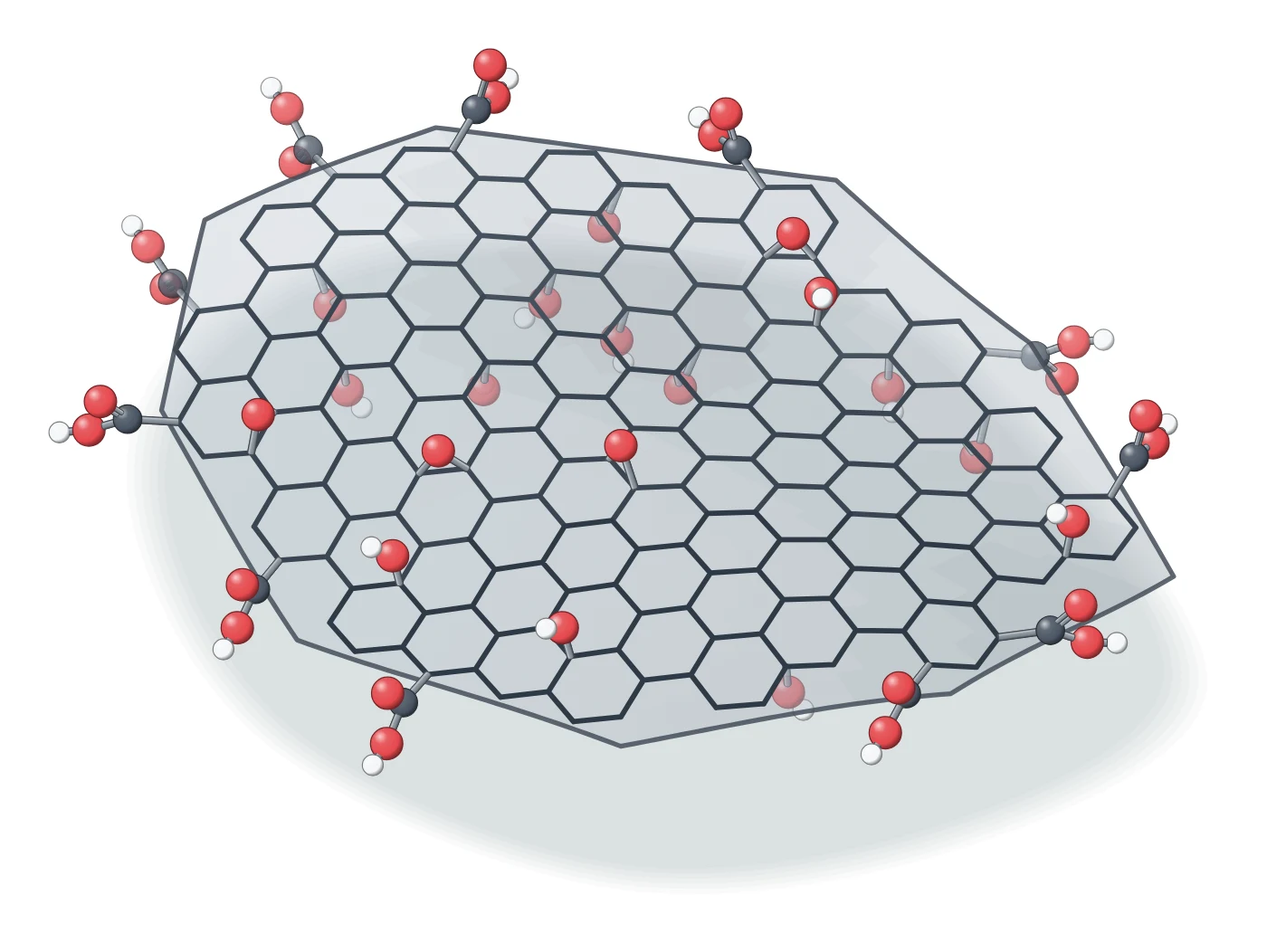
Graphene oxide structure drawing (high-resolution SVG)
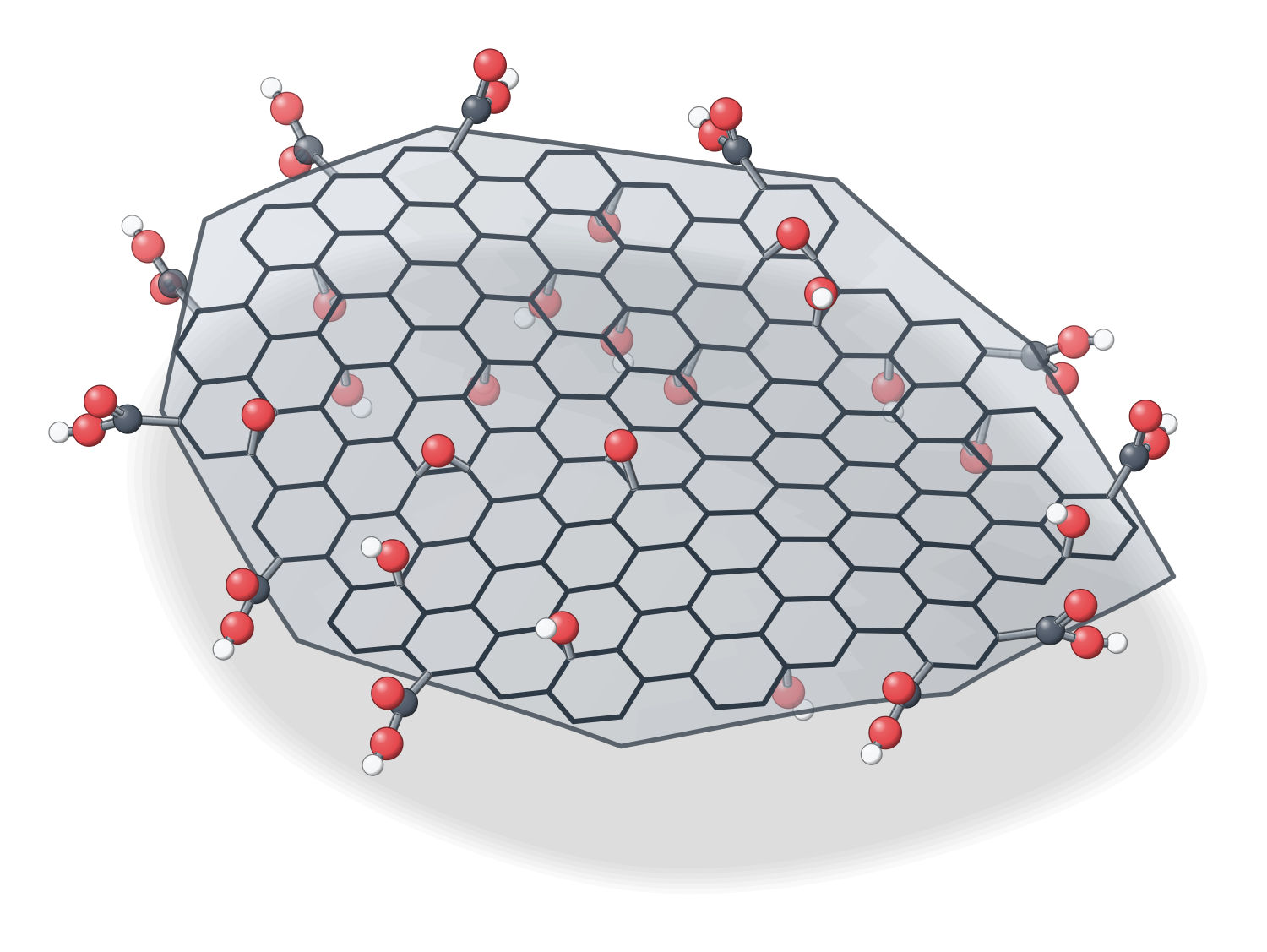
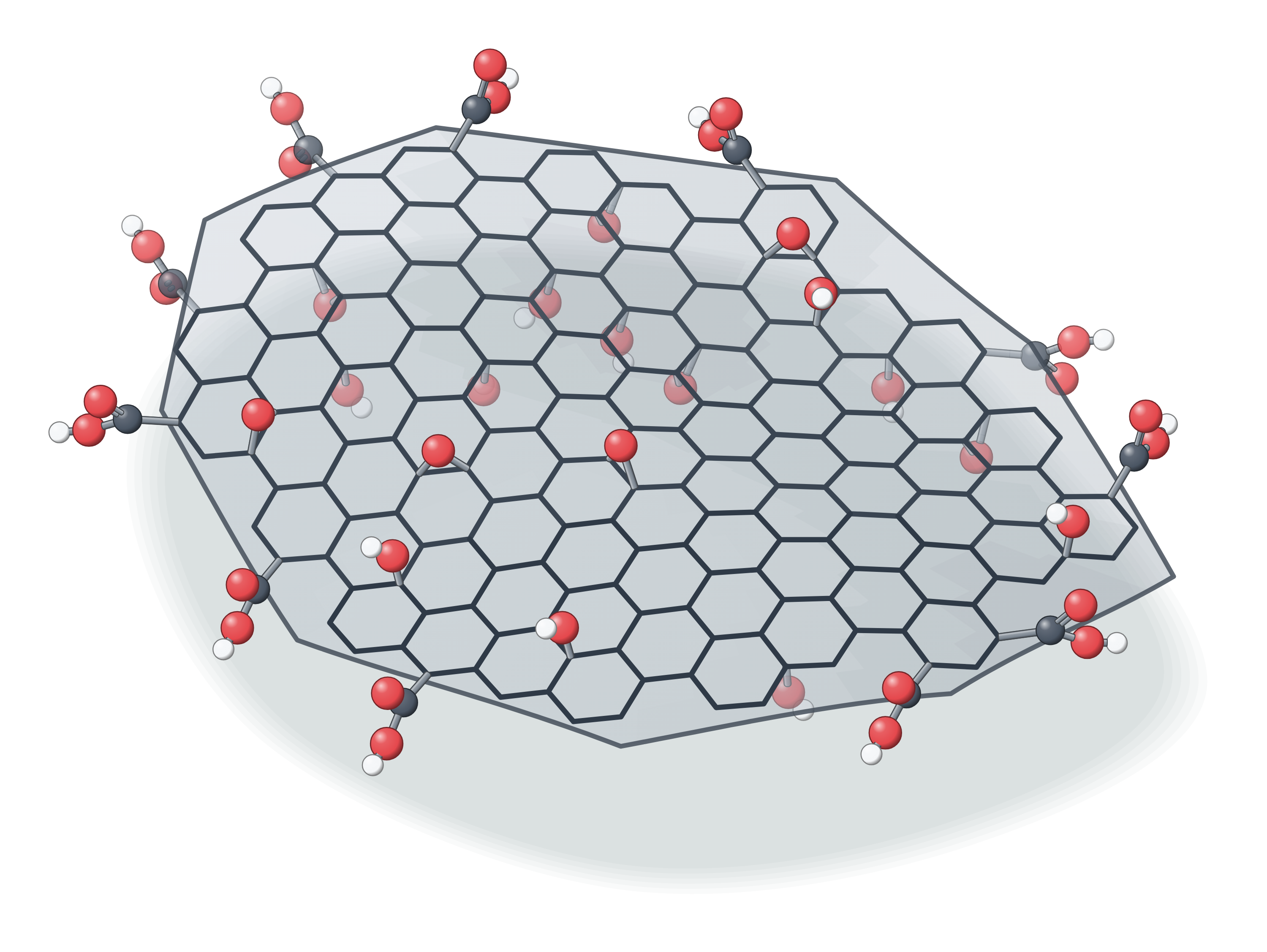
Graphene oxide in 3D (interactive)
Loading the 3D model…
More Graphene oxide figures

Graphene oxide structure explained
Graphene oxide starts from the graphene honeycomb, but oxidation bonds oxygen groups to many of its carbon atoms. In the model most used today, from solid-state NMR of graphite oxide (Lerf et al. 1998; reviewed by Dreyer et al. 2010):
- Epoxides (an oxygen bridging two neighbouring carbons, C–O–C) and hydroxyls (C–OH) sit on both faces of the basal plane.
- Carboxyls (–COOH) and carbonyls (C=O) sit at the sheet edges and at holes.
- The carbons carrying a group become sp³ and pucker out of the plane; between them remain unoxidised sp² patches.
¹³C NMR puts numbers on this: epoxide carbons at 61 ppm, C–OH at 70 ppm and sp² carbon at 134 ppm, with only about 24 % of the carbon still sp² in the GO measured (Brisebois et al. 2020). Lactols have also been identified in graphite oxide (Gao et al. 2009). Because the groups and their amounts depend on the oxidation, GO has no fixed formula.
Stacked, the sheets form graphite oxide: the groups and water between the layers push them apart, from 3.37 Å in graphite to 8.85 Å in GO (Zainab et al. 2023).
How graphene oxide is made
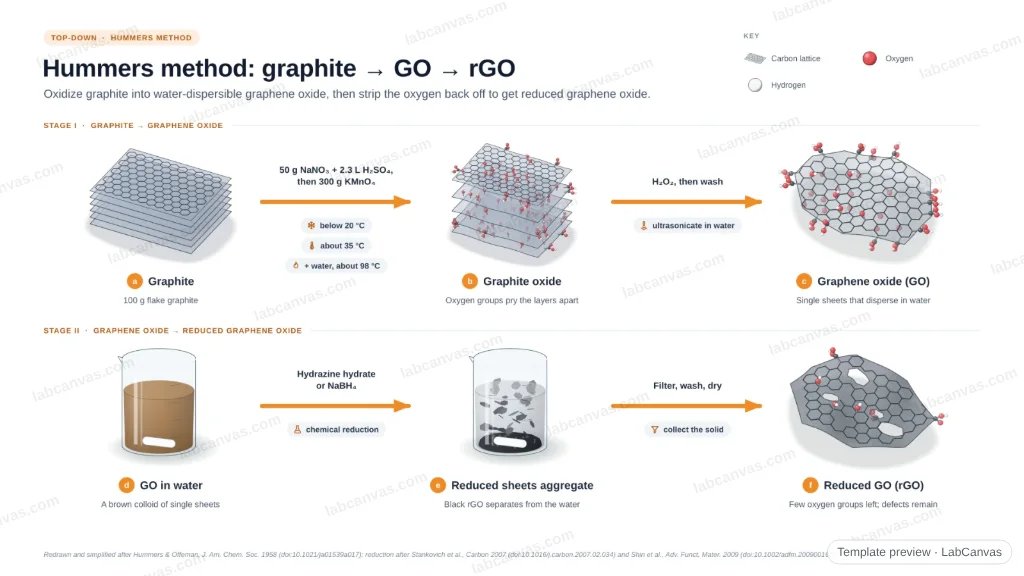
- Oxidation. In the Hummers method, 100 g graphite and 50 g NaNO₃ are stirred in 2.3 L concentrated H₂SO₄ and 300 g KMnO₄ is added while the mixture is kept below 20 °C; it is then held at about 35 °C (Hummers & Offeman 1958). Marcano et al. (2010) left out the NaNO₃, used more KMnO₄ and ran the reaction in 9:1 H₂SO₄/H₃PO₄, which oxidises graphite more efficiently and releases no toxic gas.
- Quench and wash. Water is added, which heats the mixture to about 98 °C, and hydrogen peroxide removes the leftover permanganate (Hummers & Offeman 1958). The graphite oxide is washed free of acid and salts.
- Exfoliation. Ultrasonication in water splits graphite oxide into single GO sheets, a brown colloid.
- Reduction (optional). Hydrazine hydrate (Stankovich et al. 2007), sodium borohydride (Shin et al. 2009) or heat removes most of the oxygen groups and gives reduced graphene oxide (rGO); the reduced sheets aggregate in water. Films reduced with NaBH₄ have a much lower sheet resistance than films reduced with hydrazine (Shin et al. 2009).
Key properties of graphene oxide
- Disperses in water. Its oxygen groups make GO hydrophilic, so it can be processed from water into films, papers and composites (Dreyer et al. 2010).
- Mostly sp³. With only about a quarter of its carbon sp² (Brisebois et al. 2020), GO has lost much of graphene’s π network; reduction restores part of it (75 % sp² after SnCl₂).
- Reduced GO conducts. Films of rGO can be tuned over several orders of magnitude in their opto-electronic properties: the thinnest show graphene-like ambipolar transistor behaviour, thicker ones behave as graphite-like semimetals (Eda et al. 2008). rGO keeps defects and some oxygen, so it is not the same as pristine graphene (Luong et al. 2020).
- Layer spacing. XRD follows the oxidation and reduction: 3.37 Å (graphite), 8.85 Å (GO) and 3.43 Å after thermal reduction (Zainab et al. 2023; Muzyka et al. 2018).
- Disorder. The Raman D band at 1348 cm⁻¹ is about as strong as the G band at 1589 cm⁻¹, I(D)/I(G) = 1.04 (Islam et al. 2024).
Why graphene oxide matters
Graphene oxide is the most common route to graphene-like sheets in bulk: it starts from cheap graphite, uses batch wet chemistry, and gives sheets that disperse in water.
It also made graphene composites practical: a polystyrene–graphene composite made by way of graphite oxide conducted electricity at room temperature above about 0.1 vol % (Stankovich et al. 2006).
Uses and research areas
- Membranes. GO laminates in water block solutes with hydrated radii above 4.5 Å while smaller ions pass thousands of times faster than by simple diffusion (Joshi et al. 2014).
- Transparent and flexible electronics. rGO thin films from one to several layers deposited over large areas from solution (Eda et al. 2008).
- Composites. Conducting polymer composites at low loading (Stankovich et al. 2006).
- Films and inks. Single GO layers assembled into Langmuir–Blodgett films (Cote, Kim & Huang 2009).
- Energy storage. Reduced graphite oxide and graphene oxide as anodes for lithium- and sodium-ion batteries (Sun et al. 2017).
How to draw the graphene oxide structure
For a paper, slide or poster, draw a graphene sheet with epoxides and hydroxyls on both faces and carboxyls at the edges, in patches rather than evenly spread, and if needed the same sheet after reduction with few groups and small holes. The synthesis and characterization figure above has the model, the route and the spectra, the Hummers figure shows graphite to GO to rGO, and the characterization figure shows XPS, FTIR, NMR, XRD, Raman and NEXAFS; each opens as an editable LabCanvas figure. The structure drawing is a high-resolution SVG of the figure editor’s graphene oxide sheet, where you can change the amount of oxidation and the edge groups. The 3D model opens in the LabCanvas 3D Studio, where you can reduce it, stack layers and export a high-resolution image. GO has no single crystal structure, so there is no crystal file for it.
Graphene oxide compared with other 2D materials
| Material | Composition | Layer structure | Electronic character | Made by | Key paper |
|---|---|---|---|---|---|
| Graphene oxide | C, O, H (no fixed formula) | Honeycomb carrying epoxides and hydroxyls; carboxyls at the edges | Only about a quarter of the carbon sp²; reduced to rGO to conduct | Oxidising graphite (Hummers), then exfoliation in water | Hummers & Offeman, JACS 1958 |
| Graphene | C | Flat honeycomb, one atom thick, a = 2.46 Å | Zero-gap semimetal (Dirac cones) | Tape, CVD on Cu, SiC, liquid exfoliation | Novoselov et al., Science 2004 |
| h-BN | BN | Honeycomb of alternating B and N, a = 2.504 Å | Wide direct-gap insulator (luminescence at 215 nm) | Exfoliated from crystals | Dean et al., Nat. Nanotechnol. 2010 |
| MoS₂ | MoS₂ | S–Mo–S sandwich, three atoms thick | Semiconductor; 1.8 eV direct gap as a monolayer | Exfoliation, CVD | Mak et al., PRL 2010; Radisavljevic et al. 2011 |
| MXene (Ti₃C₂Tₓ) | Ti₃C₂ with –O, –OH, –F | Ti–C–Ti–C–Ti layers with terminated faces | — | Etching Al out of the MAX phase Ti₃AlC₂ | Naguib et al., Adv. Mater. 2011 |
Related materials
Graphene
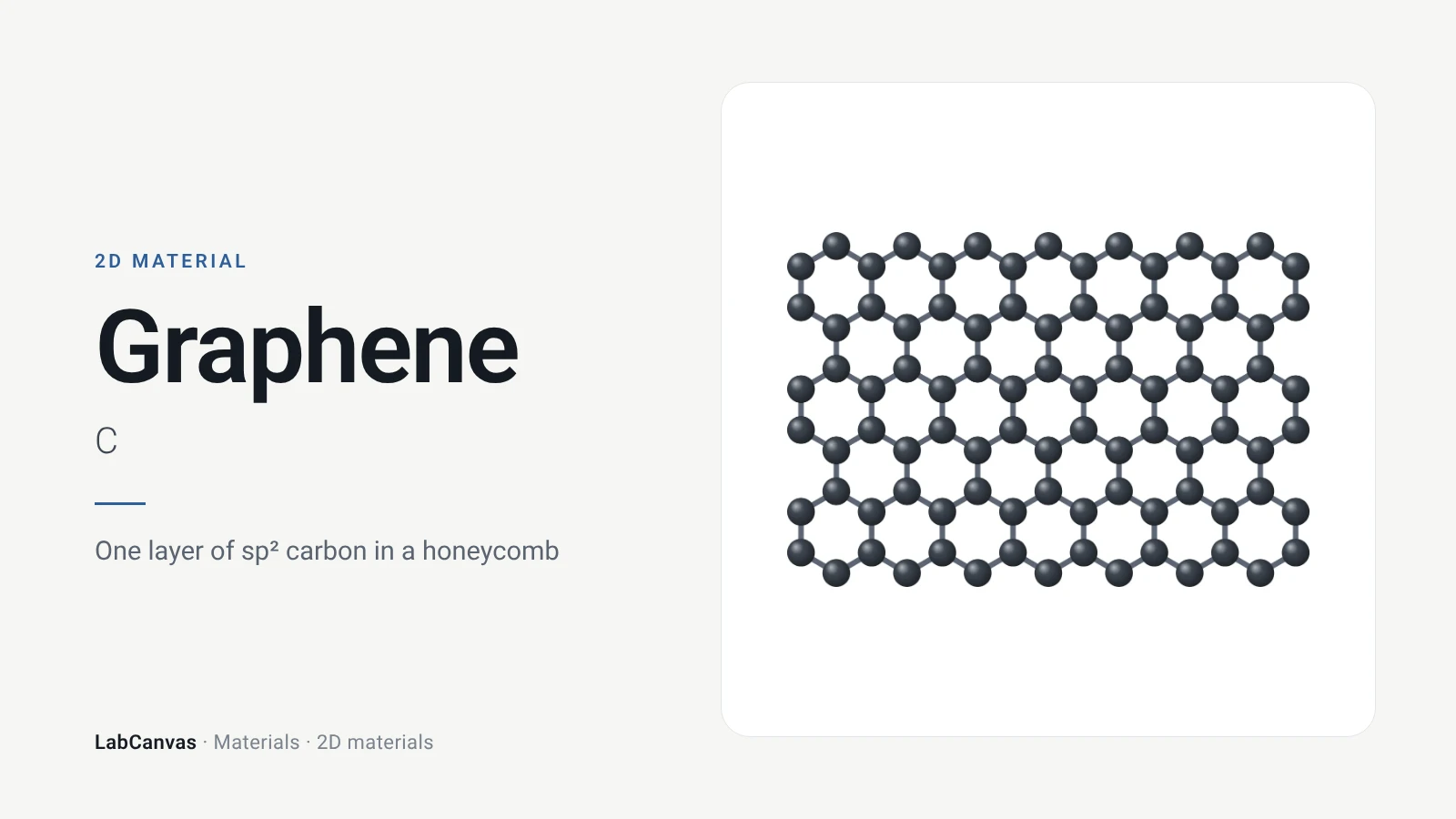
Graphene structure explained: the one-atom-thick honeycomb of sp² carbon, its Dirac bands, strength and conductivity, how it is made and used. Cited facts.
Twisted bilayer graphene
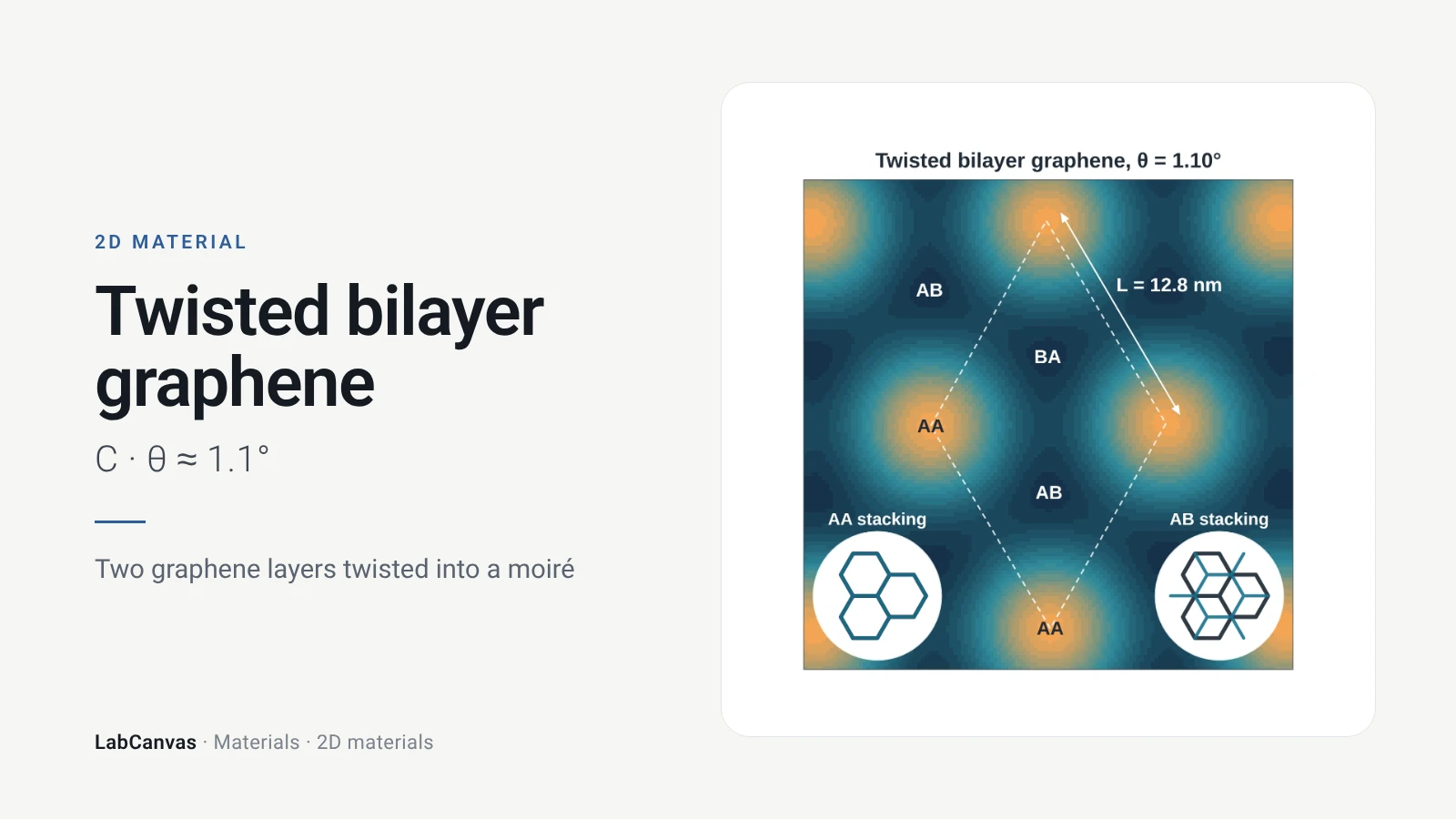
Twisted bilayer graphene explained: two layers turned by a small angle, the moiré, the 1.1° magic angle, flat bands and superconductivity. Cited papers.
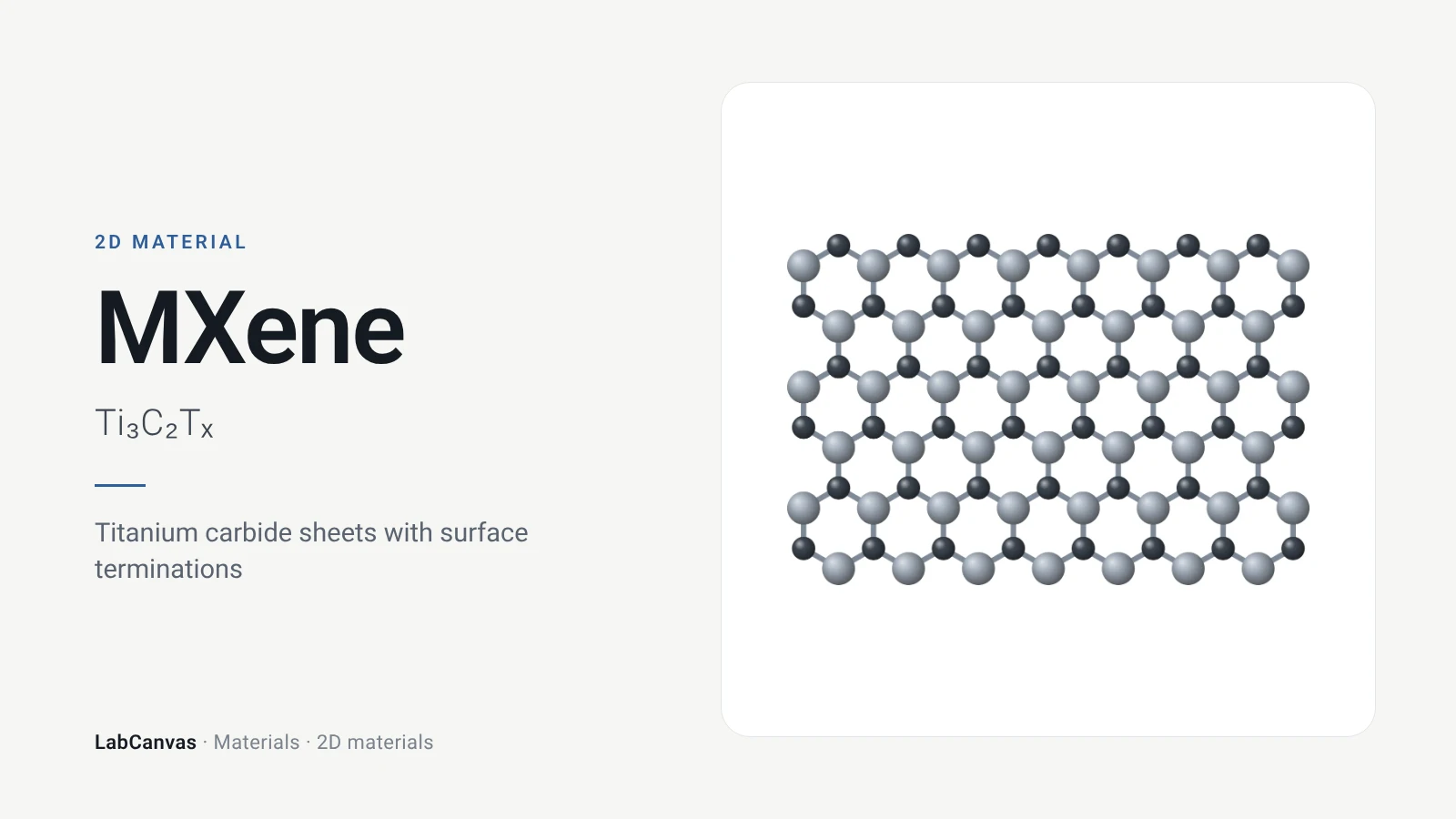
MXene (Ti₃C₂Tₓ)
MXene Ti₃C₂Tₓ explained: 2D titanium carbide etched from the MAX phase Ti₃AlC₂, its surface terminations, synthesis, conductivity and uses. Editable figures.
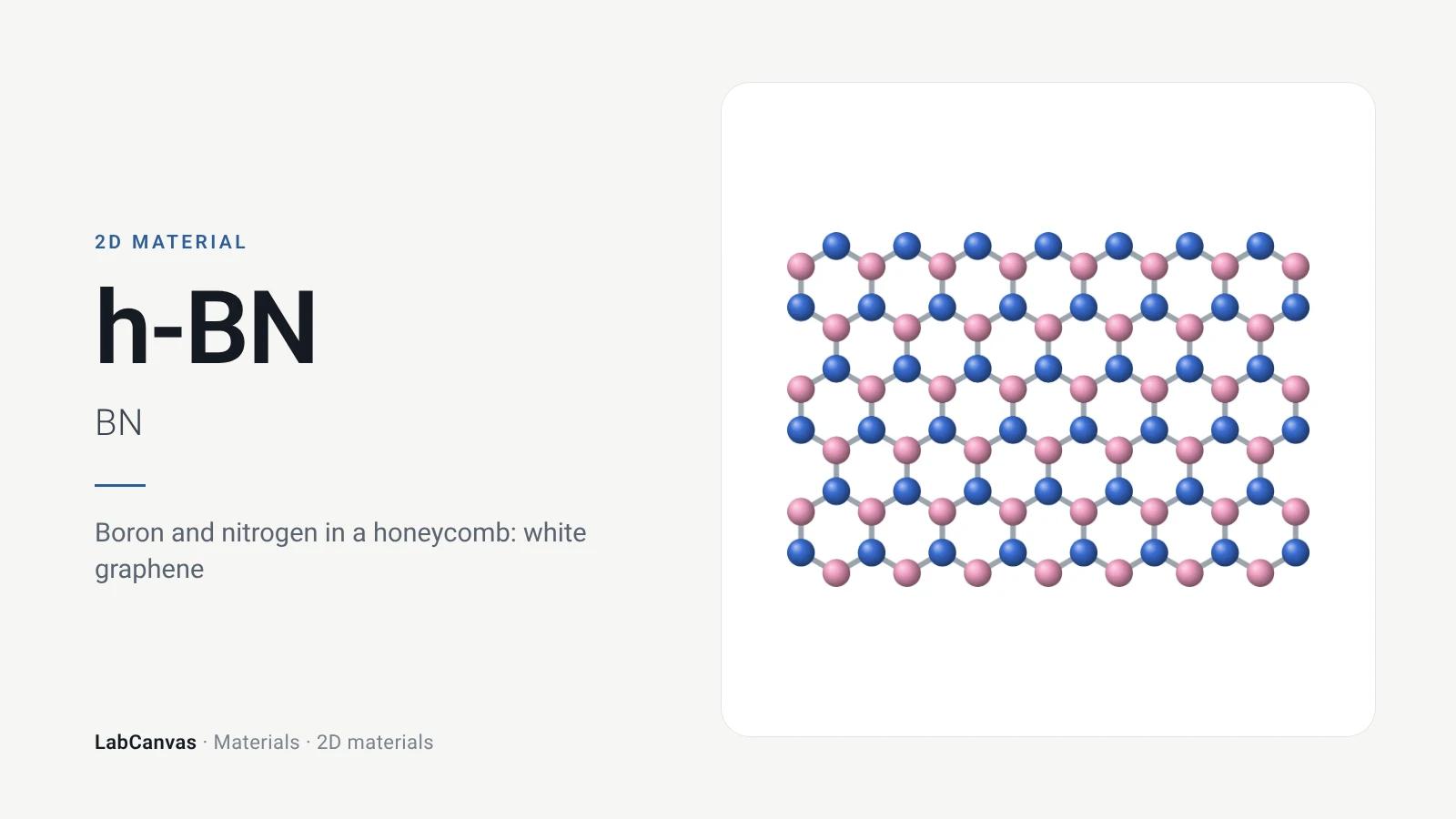
Hexagonal boron nitride (h-BN)
Hexagonal boron nitride (h-BN), “white graphene”: its B–N honeycomb structure, ~6 eV band gap, how it is made and why 2D devices sit on it. Editable figures.
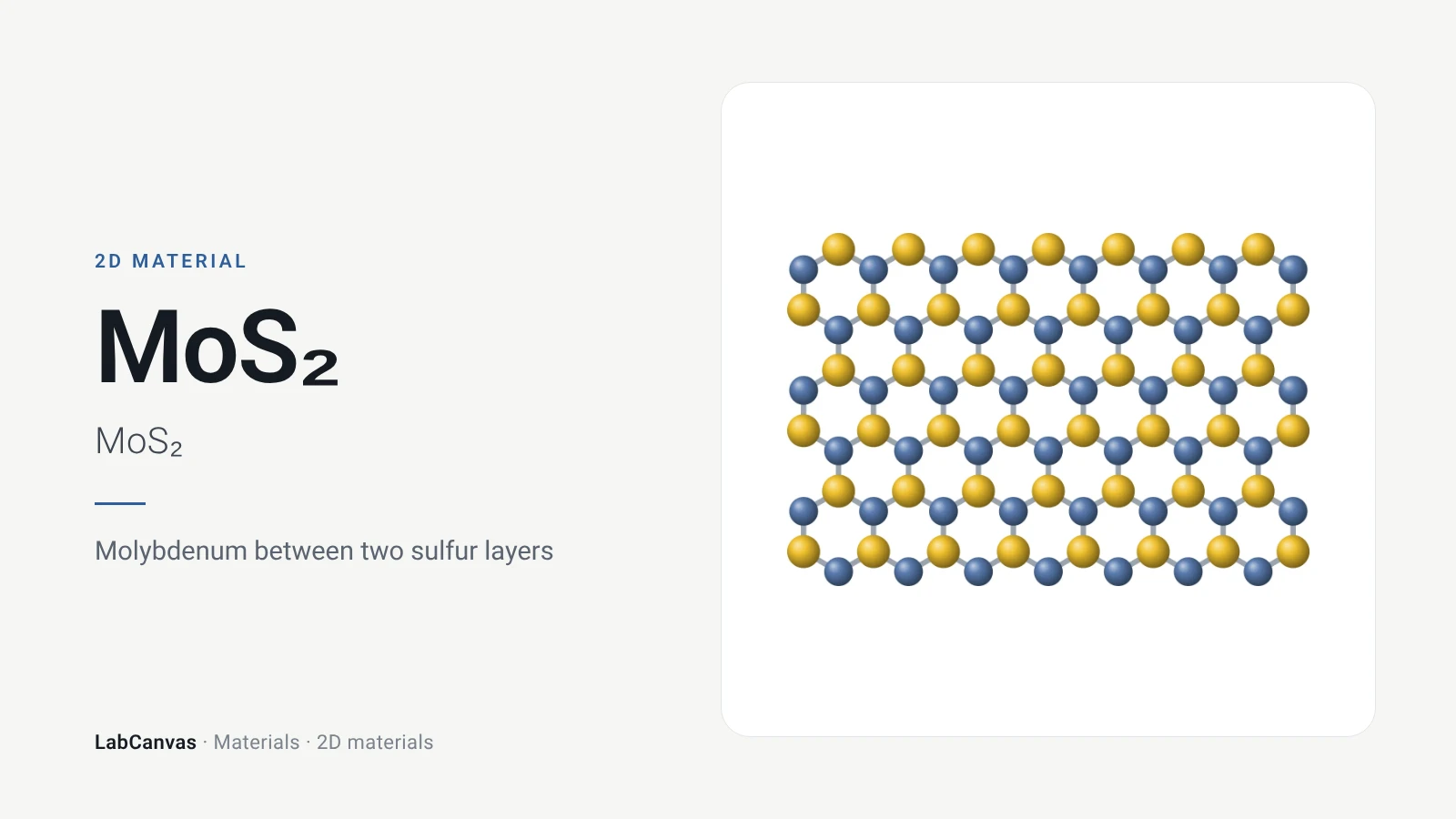
MoS₂ (molybdenum disulfide)
MoS₂ structure and band gap: the S–Mo–S layer, 2H and 1T phases, the 1.8 eV direct gap of monolayer MoS₂, transistors and HER catalysis. Editable figures.
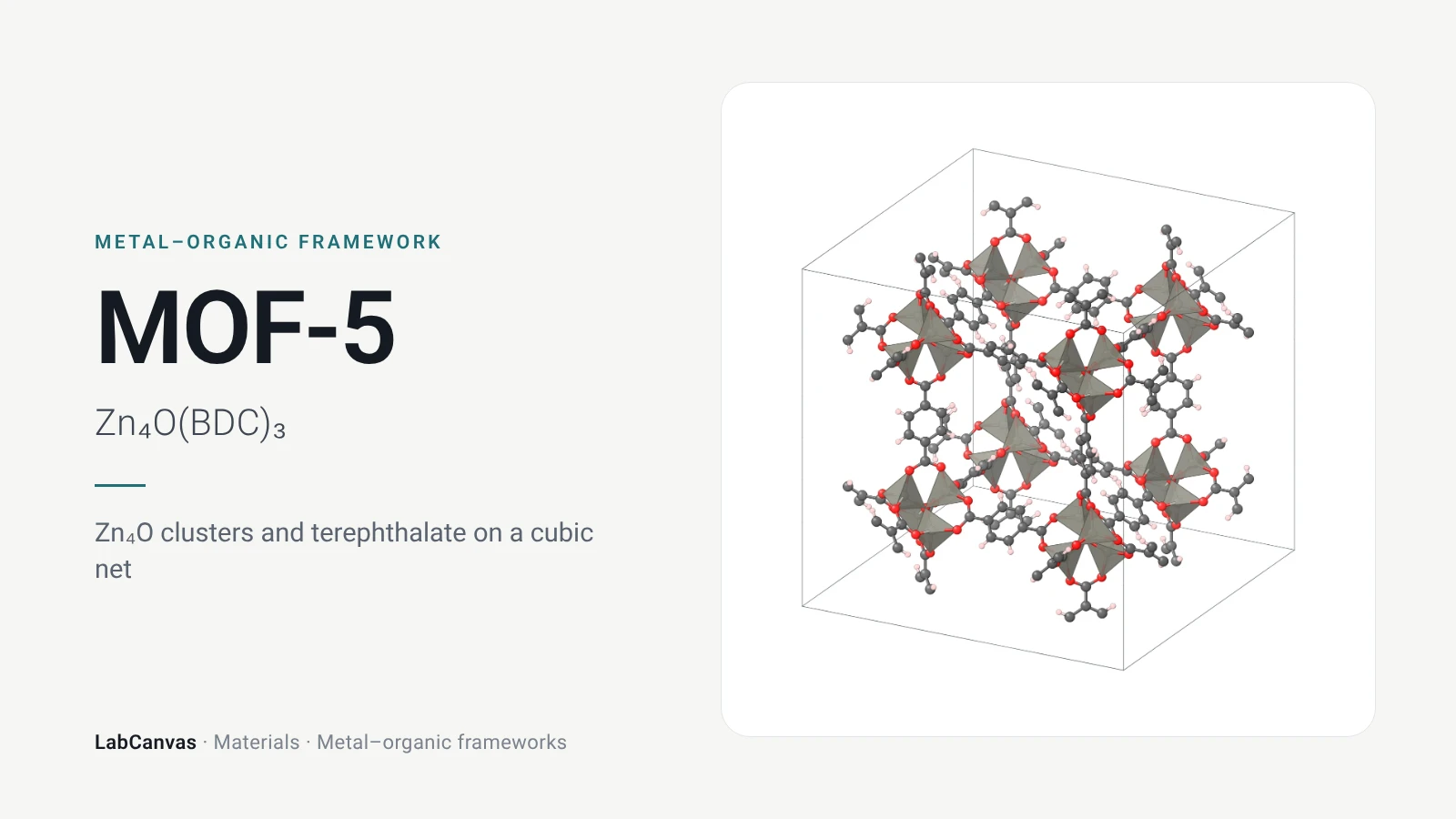
MOF-5
MOF-5, Zn₄O(BDC)₃: its cubic structure in 2D and interactive 3D, how it is made, surface area, stability and uses, with the original papers. Edit the figures free.
More on LabCanvas
- Graphene oxide: synthesis and characterization: Editable figure template
- Hummers method: graphite to GO to rGO: Editable figure template
- Characterizing graphene oxide: Editable figure template
- More figure templates in this category: Ready-made, cited figures to edit
- More figure templates in this category: Ready-made, cited figures to edit
- Crystal structure figure software compared: VESTA, Mercury, CrystalMaker, Avogadro and LabCanvas
- XRD Scherrer crystallite size calculator: Free tool
- Molar mass calculator: Free tool
- Journal figure size guide: Column widths and resolutions for 38 journals
- 3D models gallery: Turn MOFs, COFs and more in 3D
Frequently asked questions
What is graphene oxide?
Graphene oxide (GO) is a single sheet of graphite oxide: graphene with oxygen groups (epoxides and hydroxyls on its faces, carboxyls and carbonyls at its edges) bonded to many of its carbon atoms. It is made by oxidising graphite and disperses in water.
What is the structure of graphene oxide?
In the Lerf–Klinowski model, a carbon sheet with epoxide (C–O–C) and hydroxyl (C–OH) groups on both faces of the basal plane and carboxyl and carbonyl groups at the edges. The oxidised carbons are sp³; unoxidised sp² patches remain between them. ¹³C NMR finds only about 24 % of the carbon sp² (Brisebois et al. 2020).
What is the chemical formula of graphene oxide?
It has none. The kind and number of oxygen groups depend on the oxidation method and how long it runs, so GO is described by its groups and its carbon-to-oxygen ratio rather than a formula.
How is graphene oxide made?
By oxidising graphite in concentrated sulfuric acid with potassium permanganate (the Hummers method, 1958, which also uses NaNO₃; the improved method of Marcano et al. 2010 uses H₂SO₄/H₃PO₄ instead), quenching with water and H₂O₂, washing, and ultrasonicating the graphite oxide in water into single sheets.
What is the difference between graphene oxide and reduced graphene oxide?
Reduced graphene oxide (rGO) is GO with most of its oxygen groups removed, by hydrazine, sodium borohydride or heat. Its layers pack closer (3.43 Å against 8.85 Å for GO in XRD) and it conducts, but it keeps defects and some oxygen, so it is not pristine graphene.
Is graphene oxide conductive?
Much of its π network is broken: only about a quarter of its carbon is sp². Reducing it restores conduction; thin rGO films behave like graphene in transistors and thicker ones like graphite-like semimetals (Eda et al. 2008).
What is the difference between graphite oxide and graphene oxide?
Graphite oxide is the stacked, bulk product of oxidising graphite, with its layers about 8.85 Å apart. Graphene oxide is a single layer of it, obtained by exfoliating graphite oxide in water, usually by ultrasonication.
Why does graphene oxide disperse in water?
Its hydroxyl, epoxide and carboxyl groups make the sheets hydrophilic, so they spread as single layers in water, which is why GO is easy to process into films, membranes and composites.
How can I draw graphene oxide for a paper or presentation?
Open the graphene oxide figures on this page in LabCanvas (free), add the editable GO sheet from the figure editor’s Library and set its oxidation, or open the 3D model in the LabCanvas 3D Studio and export a render.
References
- W. S. Hummers, R. E. Offeman. Preparation of graphitic oxide. J. Am. Chem. Soc. 1958, 80, 1339. doi:10.1021/ja01539a017
- B. C. Brodie. On the atomic weight of graphite. Phil. Trans. R. Soc. Lond. 1859, 149, 249–259. doi:10.1098/rstl.1859.0013
- A. Lerf et al.. Structure of graphite oxide revisited. J. Phys. Chem. B 1998, 102, 4477. doi:10.1021/jp9731821
- D. R. Dreyer et al.. The chemistry of graphene oxide. Chem. Soc. Rev. 2010, 39, 228. doi:10.1039/B917103G
- D. C. Marcano et al.. Improved synthesis of graphene oxide. ACS Nano 2010, 4, 4806–4814. doi:10.1021/nn1006368
- S. Stankovich et al.. Synthesis of graphene-based nanosheets via chemical reduction of exfoliated graphite oxide. Carbon 2007, 45, 1558. doi:10.1016/j.carbon.2007.02.034
- H.-J. Shin et al.. Efficient reduction of graphite oxide by sodium borohydride and its effect on electrical conductance. Adv. Funct. Mater. 2009, 19, 1987–1992. doi:10.1002/adfm.200900167
- P. Brisebois, R. Izquierdo, M. Siaj. Room-temperature reduction of graphene oxide in water by metal chloride hydrates: a cleaner approach for the preparation of graphene@metal hybrids. Nanomaterials 2020, 10, 1255. doi:10.3390/nano10071255
- W. Gao et al.. New insights into the structure and reduction of graphite oxide. Nat. Chem. 2009, 1, 403. doi:10.1038/nchem.281
- Zainab et al.. Optimization of bandgap reduction in 2-dimensional GO nanosheets and nanocomposites of GO/iron-oxide for electronic device applications. Sci. Rep. 2023, 13, 6954. doi:10.1038/s41598-023-33200-4
- R. Muzyka et al.. Characterization of graphite oxide and reduced graphene oxide obtained from different graphite precursors and oxidized by different methods using Raman spectroscopy. Materials 2018, 11, 1050. doi:10.3390/ma11071050
- Islam et al.. Green coffee bean extract assisted facile synthesis of reduced graphene oxide and its dye removal activity. Glob. Chall. 2024, 8, 2300247. doi:10.1002/gch2.202300247
- G. Eda, G. Fanchini, M. Chhowalla. Large-area ultrathin films of reduced graphene oxide as a transparent and flexible electronic material. Nat. Nanotechnol. 2008, 3, 270–274. doi:10.1038/nnano.2008.83
- R. K. Joshi et al.. Precise and ultrafast molecular sieving through graphene oxide membranes. Science 2014, 343, 752. doi:10.1126/science.1245711
- S. Stankovich et al.. Graphene-based composite materials. Nature 2006, 442, 282. doi:10.1038/nature04969
- L. J. Cote, F. Kim, J. Huang. Langmuir–Blodgett assembly of graphite oxide single layers. J. Am. Chem. Soc. 2009, 131, 1043. doi:10.1021/ja806262m
- Y. Sun et al.. Comparison of reduction products from graphite oxide and graphene oxide for anode applications in lithium-ion batteries and sodium-ion batteries. Nanoscale 2017, 9, 2585. doi:10.1039/c6nr07650e
- D. X. Luong et al.. Gram-scale bottom-up flash graphene synthesis. Nature 2020, 577, 647. doi:10.1038/s41586-020-1938-0
- K. S. Novoselov et al.. Electric field effect in atomically thin carbon films. Science 2004, 306, 666–669. doi:10.1126/science.1102896
Draw Graphene oxide for your paper or slides
LabCanvas is a browser workspace for scientific figures: framework clusters, linkers and nets, crystal structures in 2D and 3D, graphs and posters, all editable.
Edit the Graphene oxide figure