LiCoO₂ (lithium cobalt oxide): structure, capacity and uses
Lithium cobalt oxide (LiCoO₂, LCO) is a layered oxide in which lithium and cobalt ions sit on alternate planes between close-packed oxygen layers, so Li⁺ can slide in and out of the CoO₂ sheets at about 4 V versus lithium (Manthiram 2020). Found in Goodenough’s group in the 1980s and paired with graphite by Sony in 1991, it was the cathode of the first commercial lithium-ion batteries (Manthiram 2020). Only about half of its lithium is used in classic cells charged to 4.2 V, about 140 of the theoretical 274 mAh g⁻¹, which is why high-voltage LCO for phones and laptops is an active research field (Lin et al. 2026).
Contents
LiCoO₂ at a glance
| Formula | LiCoO₂ (Manthiram 2020) |
|---|---|
| Molar mass | 97.87 g mol⁻¹ (calculated from the formula) |
| Structure type | Layered α-NaFeO₂ type (Hashem et al. 2019), called O3: Li⁺ and Co³⁺ ordered on alternate (111) planes of a rock-salt arrangement with cubic close-packed oxygen (Manthiram 2020) |
| Space group | R-3m, the α-NaFeO₂-type layered structure (Hashem et al. 2019); Li on 3a, transition metal on 3b and O on 6c sites (Liao et al. 2022) |
| Li transport | Two-dimensional, within the Li planes: octahedral site → neighbouring tetrahedral void → octahedral site (Manthiram 2020) |
| Electronic behaviour | Becomes metallic on charging as holes enter the low-spin Co band (Manthiram 2020); insulator–metal transition at x = 0.93–0.75 in LiₓCoO₂ (Lin et al. 2026) |
| Average voltage | About 4 V vs Li⁺/Li (Manthiram 2020) |
| Theoretical capacity | 274 mAh g⁻¹ (Lin et al. 2026); 274 mAh g⁻¹ for one Li per formula unit (calculated from the molar mass) |
| Practical capacity | About 140 mAh g⁻¹ at 4.2 V, 51% of the theoretical value (Lin et al. 2026); ~130 mAh g⁻¹ with Δx ≈ 0.5 for 2.7–4.2 V (Hashem et al. 2019) |
| Why only half the Li | The Co³⁺/⁴⁺ band overlaps the top of the O 2p band, so oxygen is lost from the lattice when more than 50% of the Li is removed (Manthiram 2020) |
| High-voltage capacity | 220 mAh g⁻¹ at 4.6 V vs 175 mAh g⁻¹ at 4.45 V (Zhang et al. 2022) |
| Density | 4.2 g cm⁻³ (Lin et al. 2026) |
| First commercial use | Sony Li-ion batteries with a LiCoO₂ cathode and graphite anode, announced 1991 (Manthiram 2020) |
| Main uses | Portable electronics: phones, laptops and wearables (Lin et al. 2026) |
| Drawbacks | High cost and toxicity of cobalt, limited practical capacity, poor thermal stability (Hashem et al. 2019; Wang et al. 2025) |
LiCoO₂ structure diagram
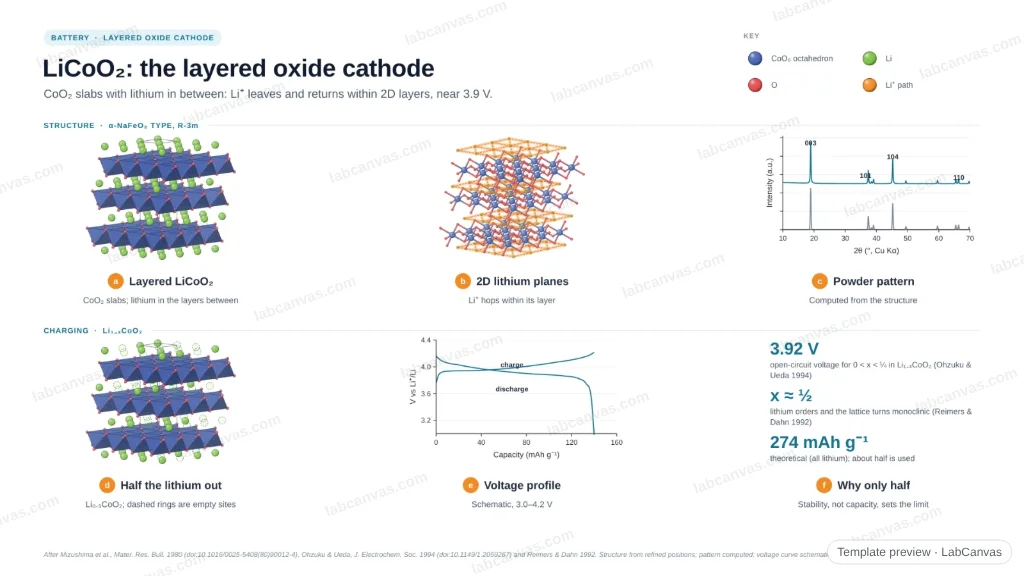
LiCoO₂ crystal structure (high-resolution SVG)
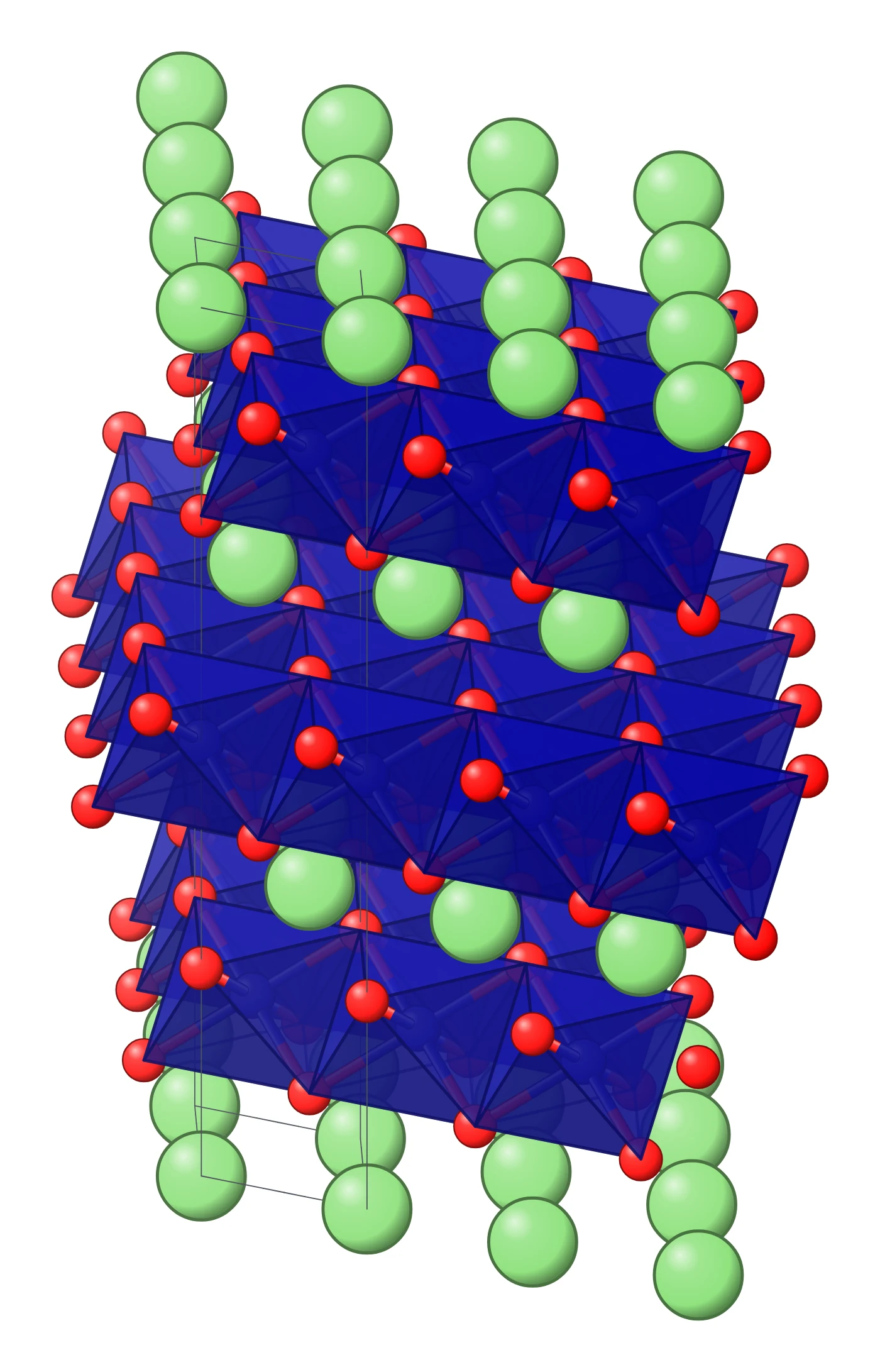
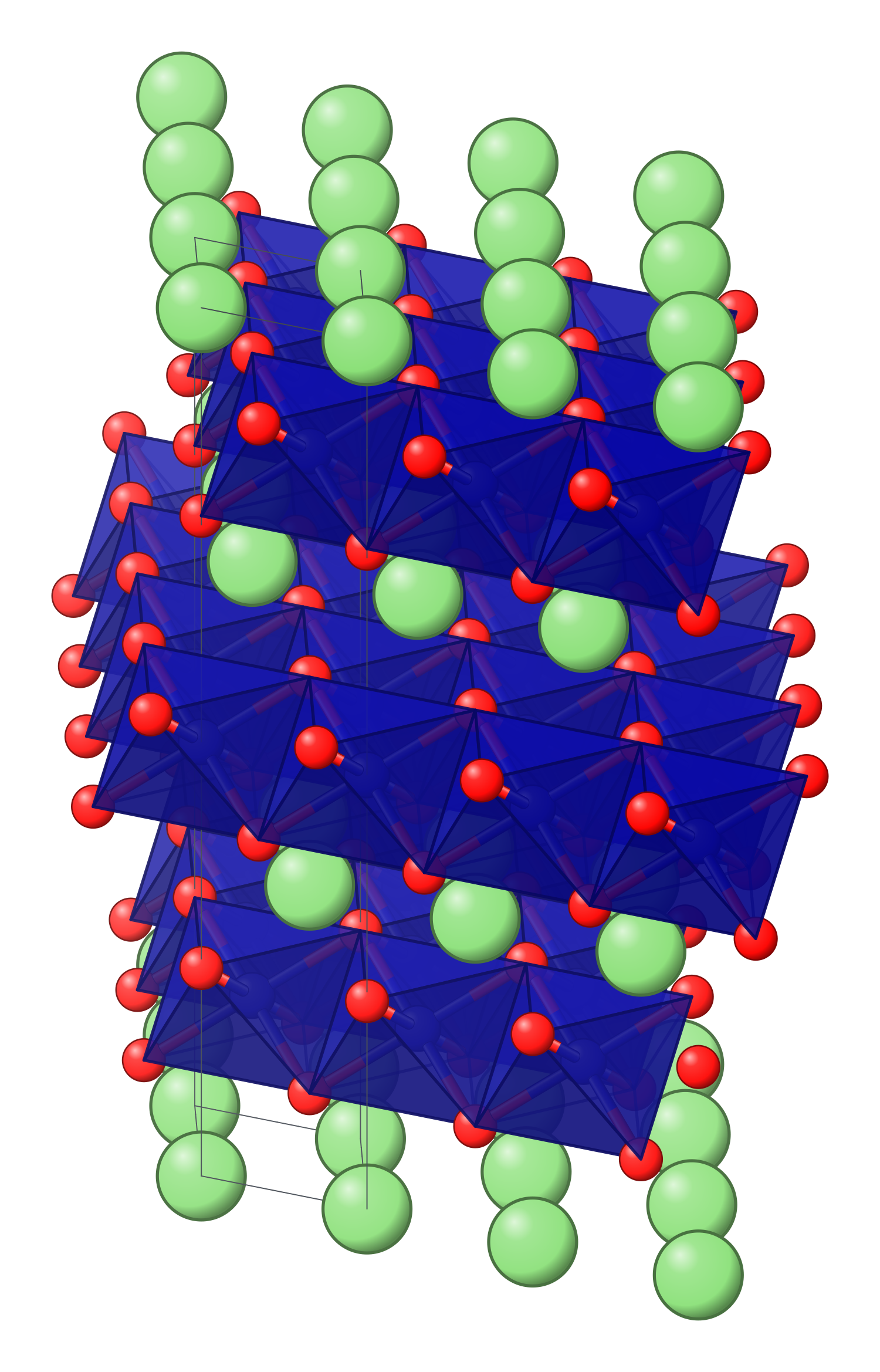
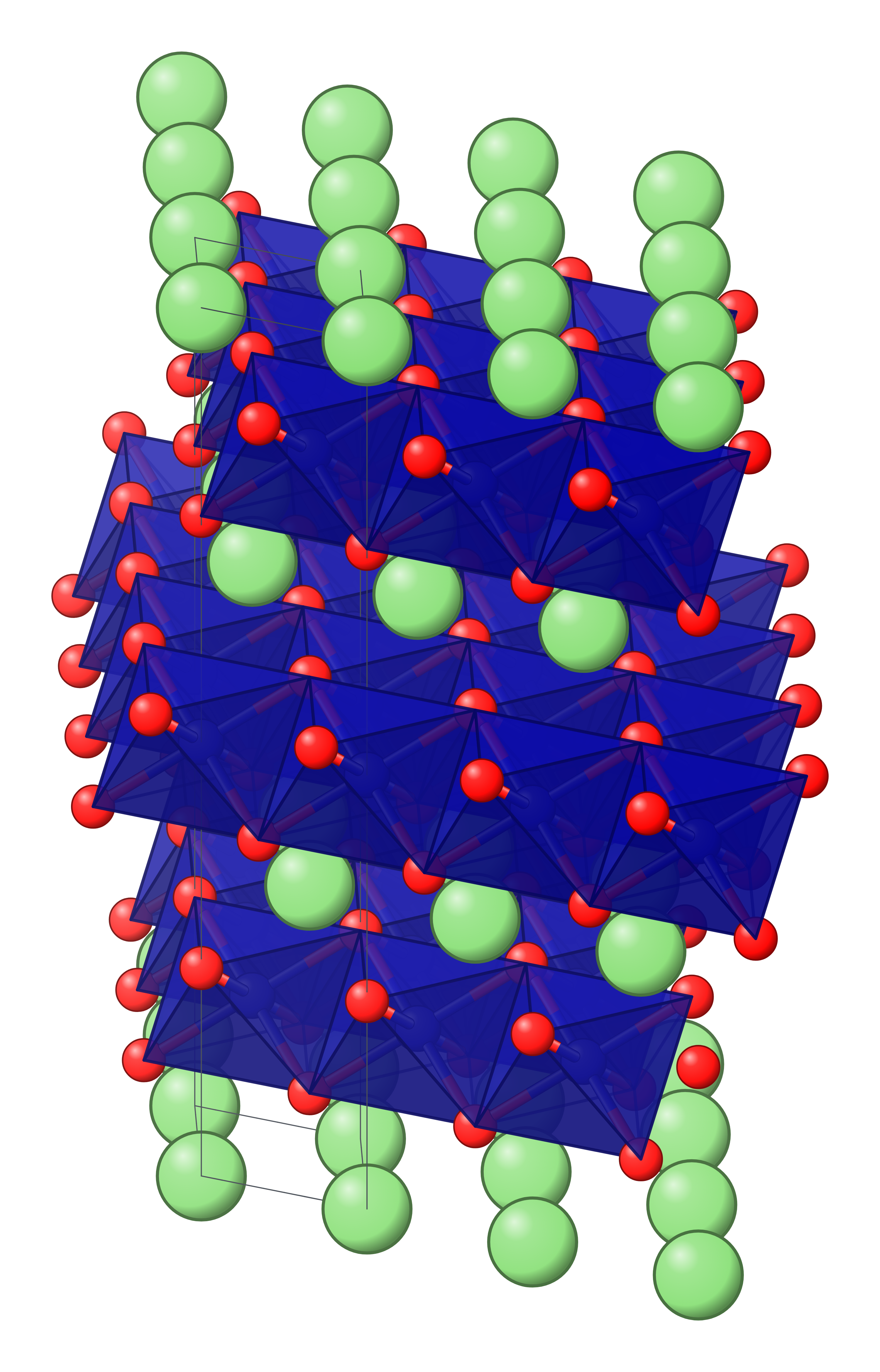
LiCoO₂ structure drawing (high-resolution SVG)
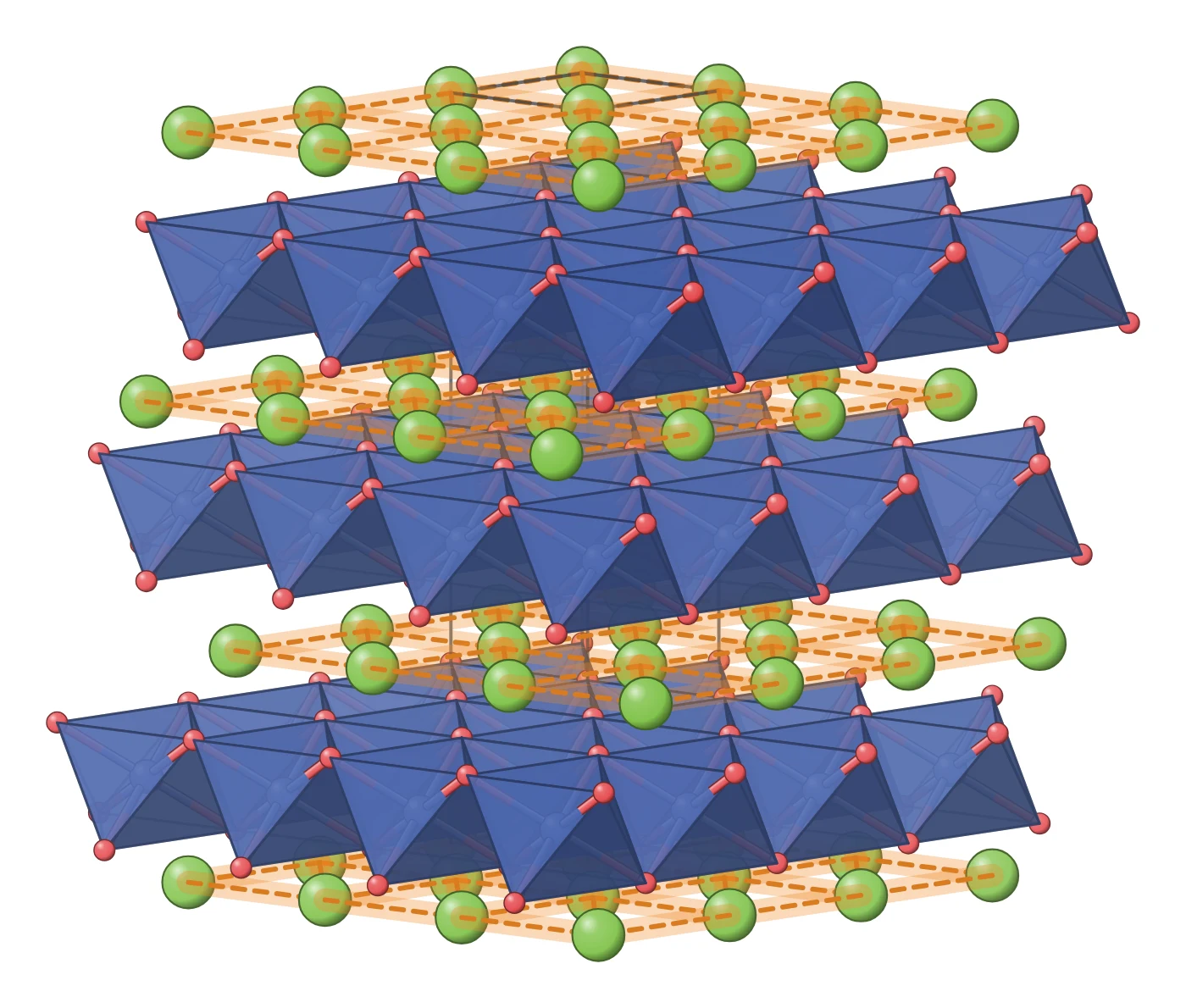
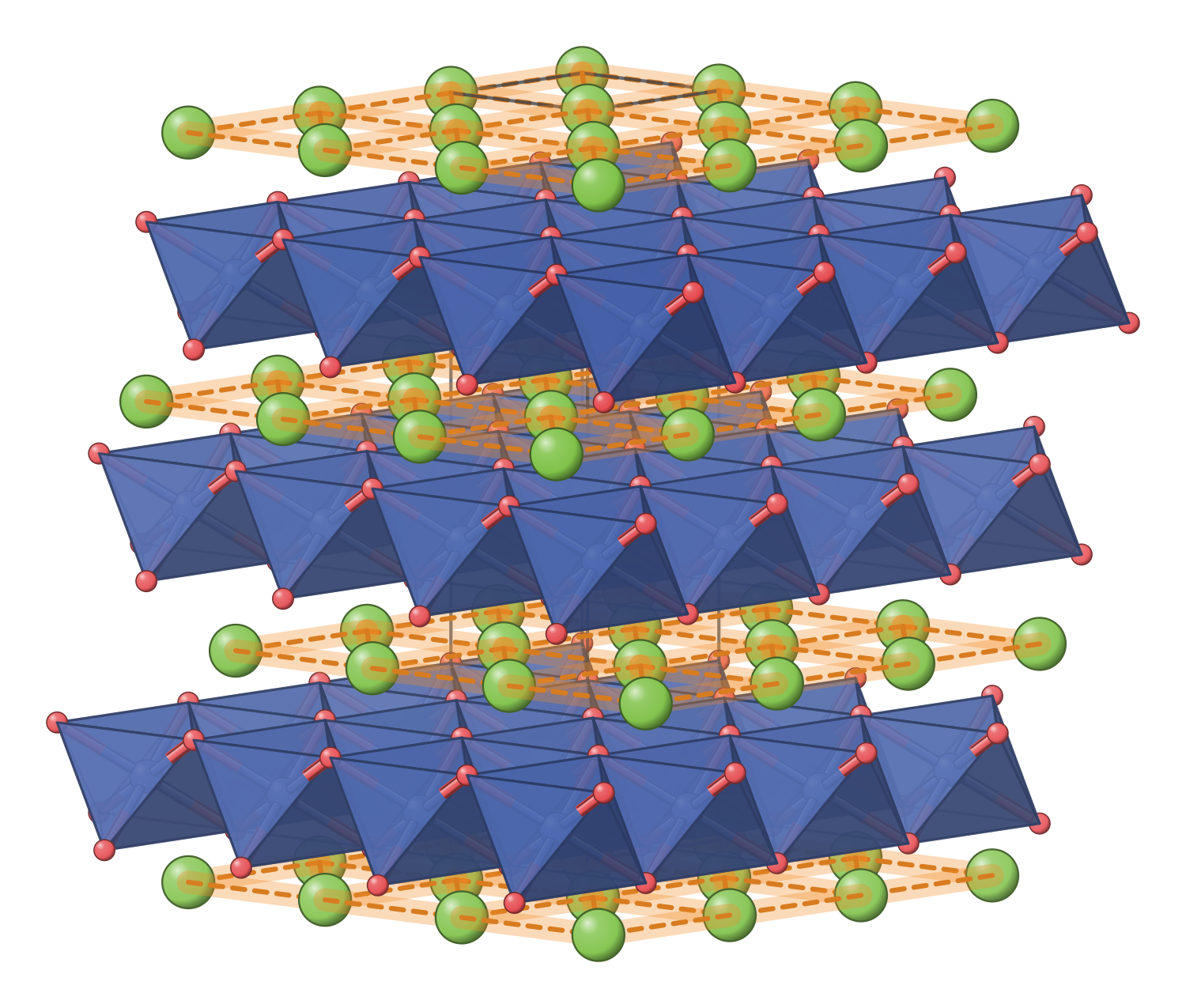
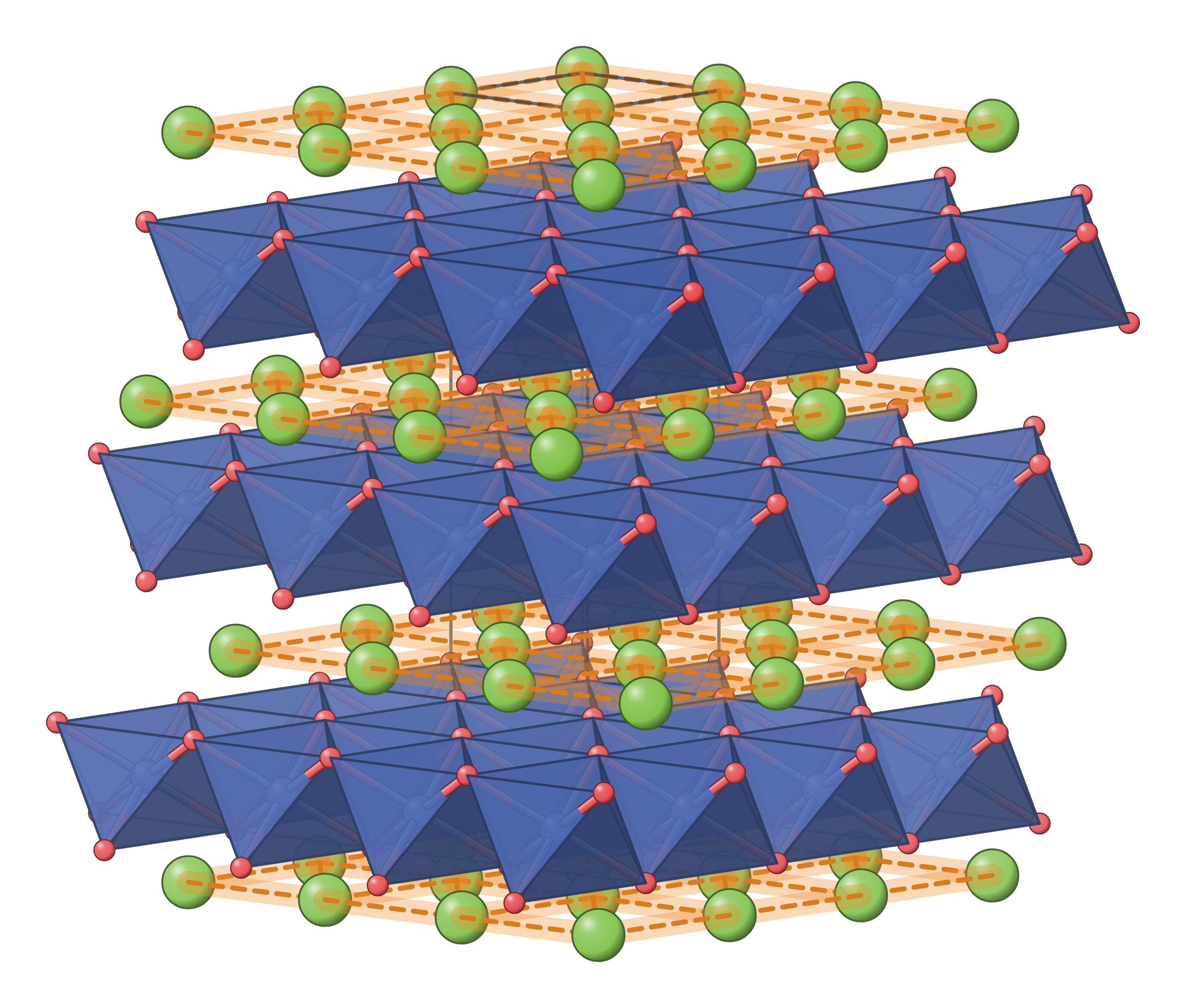
LiCoO₂ in 3D (interactive)
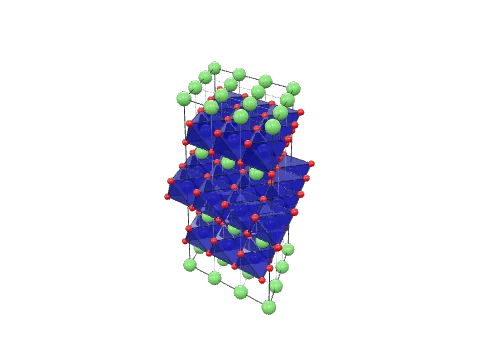
Loading the 3D model…
LiCoO₂ structure explained
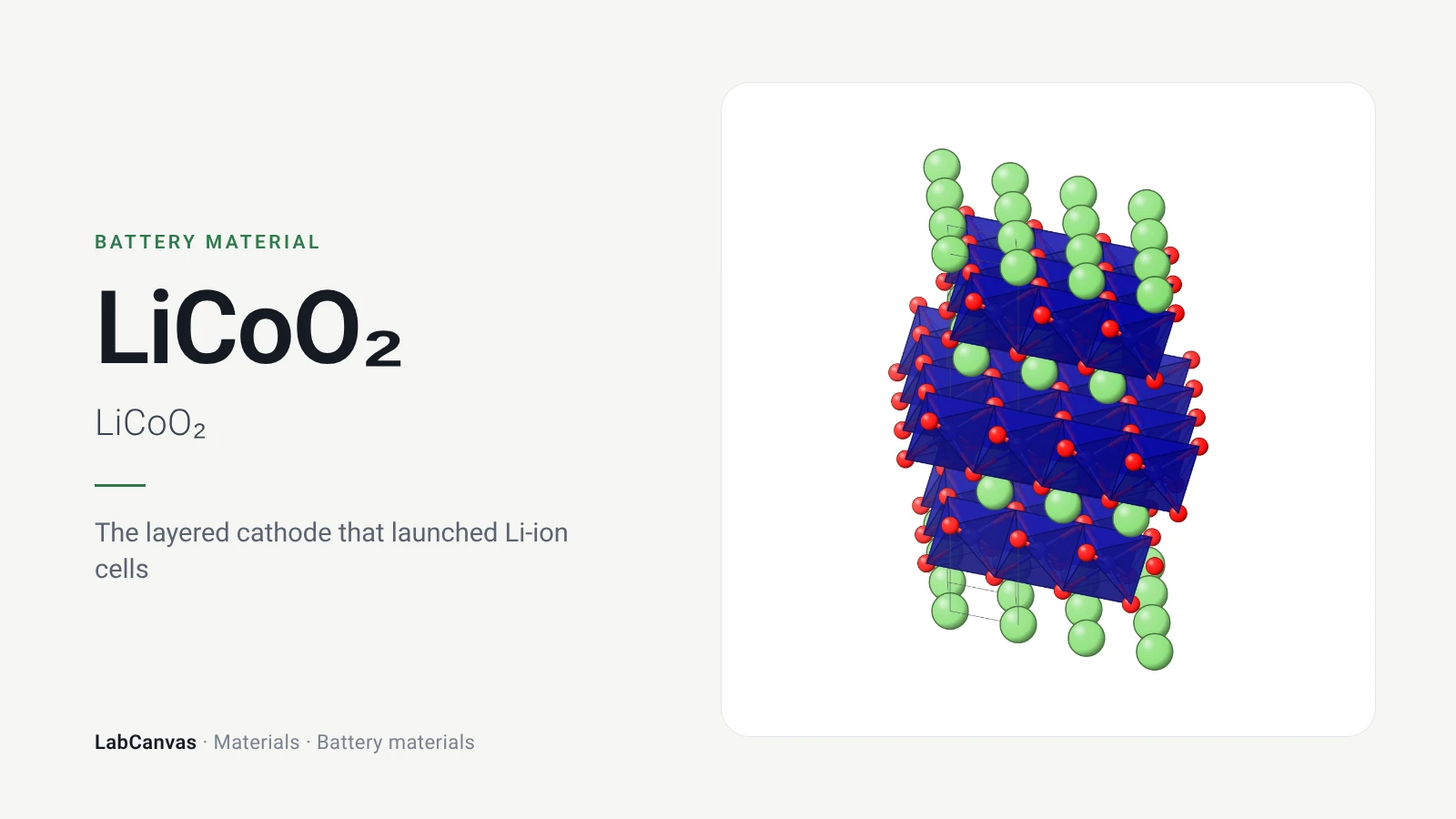
LiCoO₂ is the archetypal layered oxide cathode (Huang et al. 2026). Its oxygen ions form a cubic close-packed array, and the cations fill the octahedral holes between them in an ordered way: one plane of Li⁺, then one plane of Co³⁺, and so on along the stacking direction. Seen another way, it is a stack of edge-sharing CoO₂ sheets with lithium in the gaps between them. This ordered rock-salt arrangement is called the O3 structure (Manthiram 2020) and is of the α-NaFeO₂ type (Hashem et al. 2019), with space group R-3m, Li on the 3a sites, Co on 3b and O on 6c (Hashem et al. 2019; Liao et al. 2022).
Because Li⁺ and Co³⁺ differ a lot in size and charge they order well, and the Li planes stay clean, so lithium moves quickly in two dimensions, hopping from one octahedral site to the next through an empty tetrahedral site. Co–Co contact across shared octahedral edges makes the CoO₂ sheets good electronic conductors, and LiCoO₂ turns metallic as it is charged (Manthiram 2020). Many of its properties, from ion transport to mechanical behaviour, differ along and across the CoO₂ planes (Huang et al. 2026).
How LiCoO₂ works in a battery
On charging, Li⁺ leaves the gaps between the CoO₂ sheets, crosses the electrolyte and enters the anode while Co³⁺ is oxidized towards Co⁴⁺; on discharge the process runs backwards (Lin et al. 2026). The oxide was the key to the modern cell for two reasons: it raised the voltage from below 2.5 V for the sulfide cathodes of the 1970s to about 4 V, and because it is made with lithium already in it, it can be paired with a lithium-free anode such as graphite (Manthiram 2020).
LiCoO₂ came from John Goodenough’s group at Oxford in the 1980s, in work by Koichi Mizushima, and in 1991 Sony announced lithium-ion batteries with a LiCoO₂ cathode and a graphite anode (Manthiram 2020). It remains the main cathode for portable electronics because of its high Li-ion and electronic conductivity, high density (4.2 g cm⁻³) and good cycling (Lin et al. 2026). For an overview of the other cathodes, anodes and electrolytes, see battery materials.
Why only half the lithium is used
The theoretical capacity of LiCoO₂, one lithium per formula unit, is 274 mAh g⁻¹ (Lin et al. 2026; also calculated from the molar mass of 97.87 g mol⁻¹). Classic cells charged to 4.2 V take out only about half of it, roughly 140 mAh g⁻¹ (Lin et al. 2026; Manthiram 2020).
The reason is chemical: the Co³⁺/Co⁴⁺ band overlaps the top of the oxygen 2p band, so pulling out more than about 50% of the lithium starts to oxidize the oxide ions and release oxygen from the lattice (Manthiram 2020). Structurally, near 4.2 V (about half the Li removed) the crystal goes through a hexagonal–monoclinic–hexagonal order–disorder transition, and near 4.55 V the O3 stacking glides into the H1-3 phase, which builds up anisotropic stress and slows Li diffusion; that is why early commercial cells stopped at 4.2 V (Lin et al. 2026).
High-voltage LiCoO₂
Raising the charge cut-off voltage is the most direct way to get more out of LiCoO₂ with existing manufacturing (Lin et al. 2026). In layered oxides, going from 4.2 V to 4.6 V raises the lithium extracted from about 50% to about 80% (Lin et al. 2026); for LCO, 4.6 V gives about 220 mAh g⁻¹ against 175 mAh g⁻¹ at 4.45 V (Zhang et al. 2022), and cathode energy densities reach 740 Wh kg⁻¹ at 4.45 V and 840 Wh kg⁻¹ at 4.55 V (Lin et al. 2026).
The price is faster degradation, through three linked processes (Lin et al. 2026):
- Phase transitions and strain. The O3 → H1-3 transition and large changes of the c axis cause interlayer sliding and microcracks; charging beyond 4.6 V damages the structure irreversibly.
- Cobalt dissolution and oxygen loss. The surface becomes unstable, Co dissolves into the electrolyte and lattice oxygen is released; the surface turns into a defective spinel.
- Electrolyte oxidation. A cathode–electrolyte interphase (CEI) forms, cracks as the particles breathe, and keeps regrowing, consuming lithium and electrolyte and raising the impedance.
The fixes are doping with traces of Mg, Al, Ti and other elements (Al suppresses Co dissolution; Mg on Li sites props the layers apart), surface coatings, particle design and electrolyte additives (Lin et al. 2026). One hybrid coating, a sol-gel coating on the powder followed by an ultrathin atomic-layer-deposited oxide on the electrode, improved energy density and voltage retention at 4.55 V and 45 °C (Kalluri et al. 2017).
Cobalt: cost and alternatives
Cobalt is the weak point of LiCoO₂. Its drawbacks listed in the literature are high cost and toxicity, limited practical capacity and poor thermal stability (Hashem et al. 2019). The high cost and limited capacity have driven the substitution of cobalt by nickel and manganese in NMC (LiNiₓMnᵧCo_zO₂); manganese, used in the LiMn₂O₄ spinel, is about two orders of magnitude cheaper than cobalt (Manthiram 2020). Nickel-based layered oxides offer higher capacity, greater abundance and lower cost than the costly and toxic LiCoO₂ (Wang et al. 2025), and polyanion cathodes such as LiFePO₄ are built on abundant iron (Manthiram 2020).
How to draw the LiCoO₂ structure
For a paper, slide or poster, show LiCoO₂ side on so the stacking is visible: a CoO₂ sheet of edge-sharing CoO₆ octahedra, a plane of Li⁺ ions, the next CoO₂ sheet, and so on. Drawing the CoO₆ units as polyhedra and the lithium as separate spheres makes the layers and the 2D lithium pathways obvious; an arrow through the Li plane shows where the ions move on charge and discharge. The LabCanvas figure editor’s Library has battery crystal objects, including the layered oxide structure shared by LiCoO₂ and NMC, which you can drop into a figure as high-resolution vector drawings and recolour. The LabCanvas 3D Studio has battery models you can rotate, show as polyhedra and export as high-resolution images.
LiCoO₂ compared with other lithium-ion cathodes
| Cathode | Structure | Voltage vs Li | Capacity | Key strengths and issues |
|---|---|---|---|---|
| LiCoO₂ (LCO) | Layered O3 | ~4 V | ~140 mAh g⁻¹ practical; 274 theoretical | High density and conductivity; cobalt cost; O loss beyond half delithiation (Manthiram 2020; Lin et al. 2026) |
| NMC (LiNi₁/₃Mn₁/₃Co₁/₃O₂) | Layered α-NaFeO₂ type | Ni²⁺/Ni⁴⁺ redox peaks at ~3.7–3.8 V; Co³⁺/Co⁴⁺ above 4.6 V | ~200 mAh g⁻¹ for 2.8–4.6 V | Less cobalt; capacity fade at high voltage (Hashem et al. 2019) |
| LiMn₂O₄ | Spinel, 3D Li paths | ~4 V | Below 130 mAh g⁻¹ | Cheap Mn, fast rate; Mn dissolution (Manthiram 2020) |
| LiMn₁.₅Ni₀.₅O₄ | Spinel | ~4.7 V | ~135 mAh g⁻¹ | High voltage; electrolyte not stable enough (Manthiram 2020) |
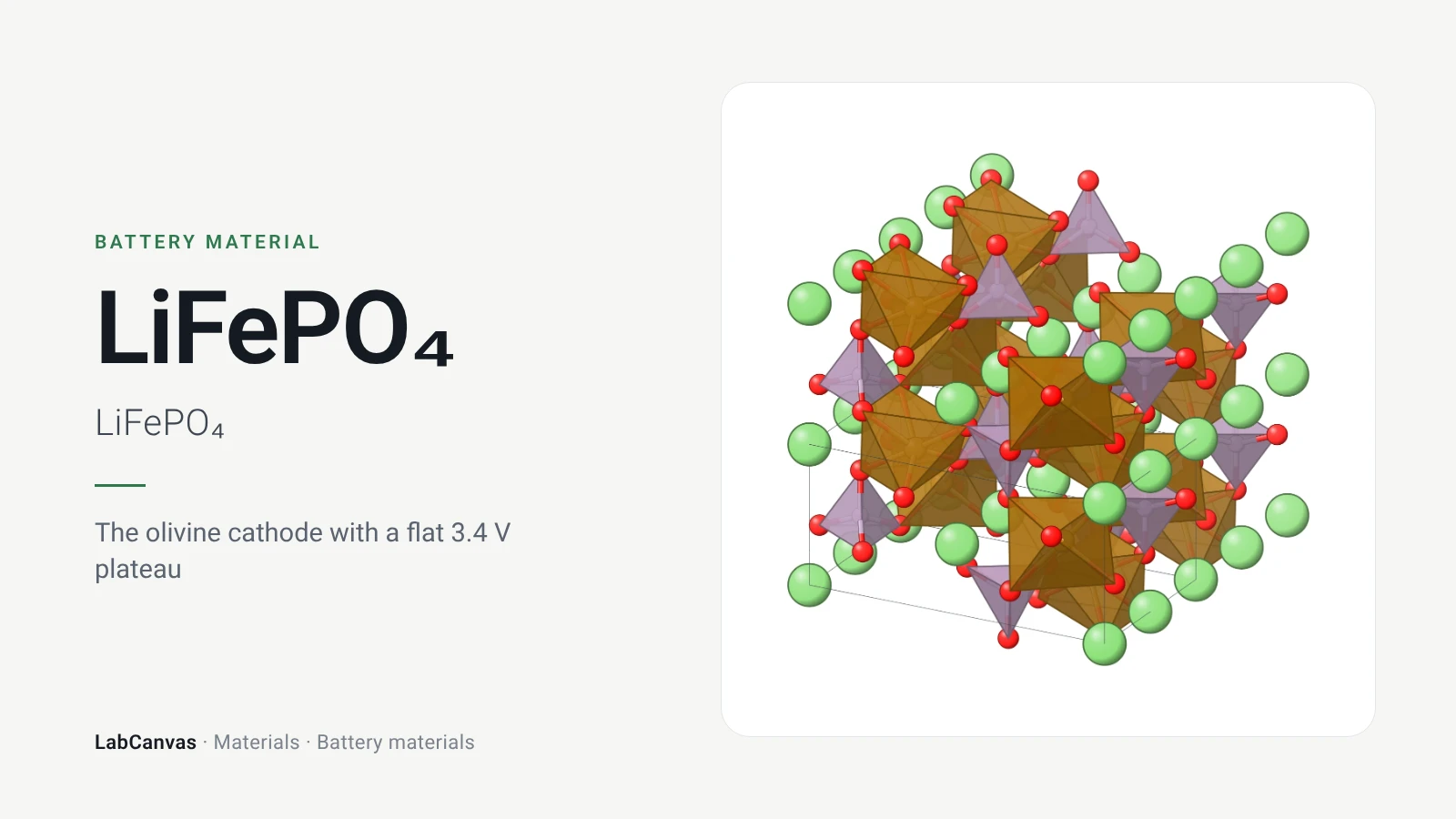
| LiFePO₄ | Olivine (polyanion) | — | 170 mAh g⁻¹ theoretical | Thermally stable, Fe-based; low conductivity, needs carbon coating (Manthiram 2020; Jung et al. 2022) |
Related materials
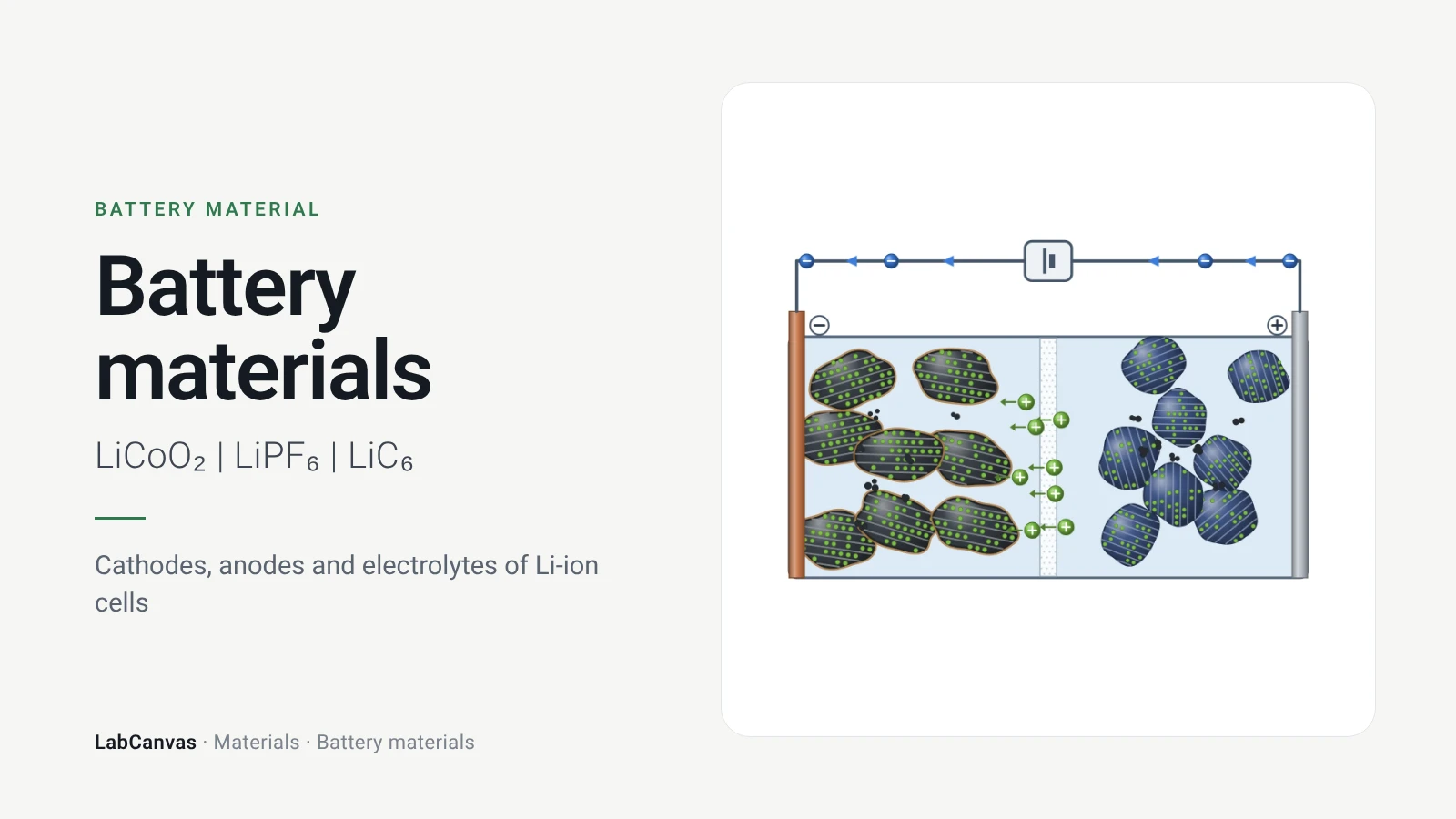
Battery materials
How a lithium-ion cell works and what is inside it: layered, spinel and olivine cathodes, graphite, silicon and lithium anodes, liquid and solid electrolytes.
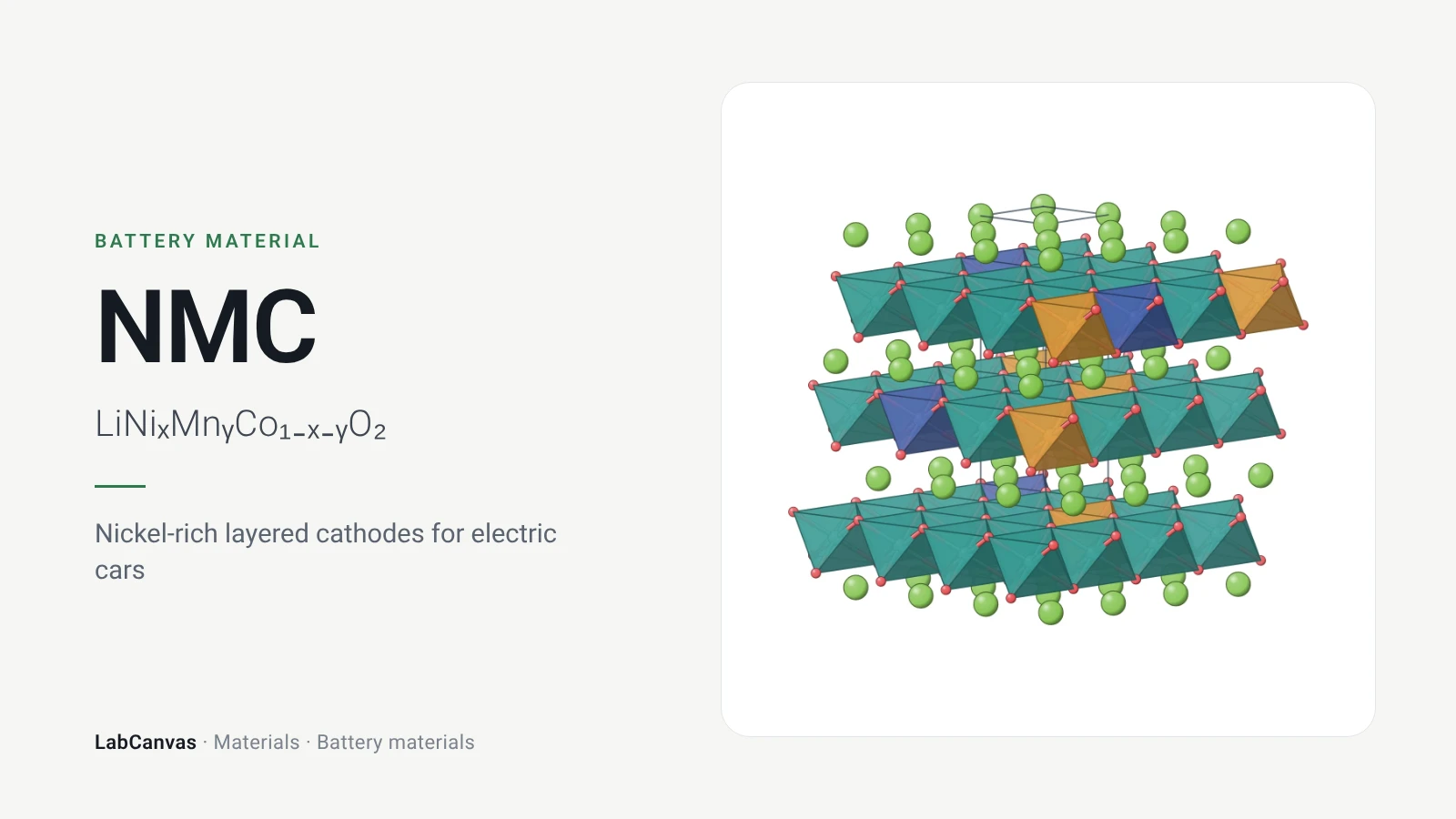
NMC (LiNiₓMnᵧCo₁₋ₓ₋ᵧO₂)
NMC cathodes (LiNiₓMnᵧCo₁₋ₓ₋ᵧO₂): layered structure, NMC111 to 811, why more nickel means more capacity but less stability, and the fixes.
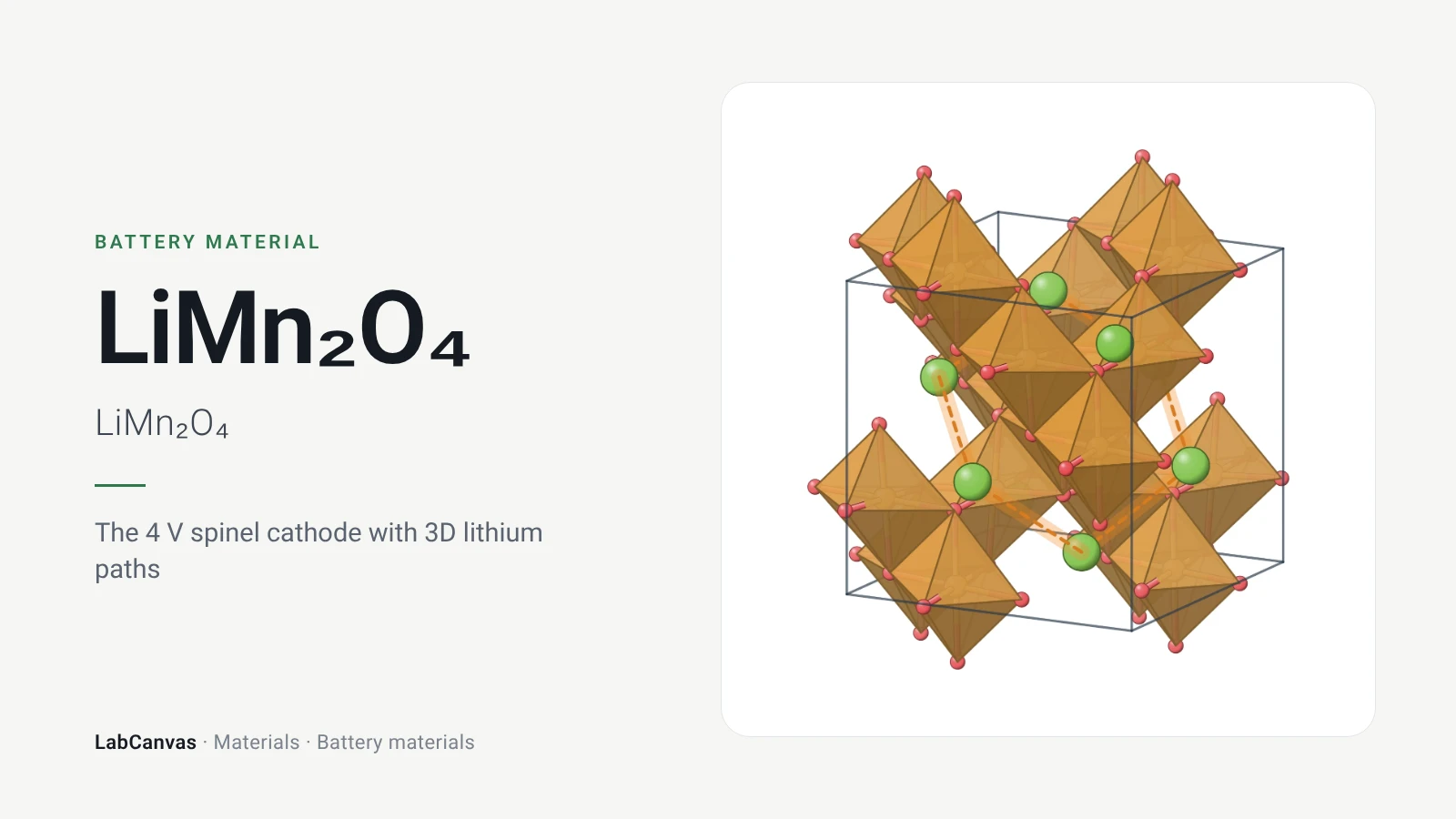
LiMn₂O₄ (spinel)
LiMn₂O₄ (LMO) spinel cathode: cubic Fd-3m structure, 3D lithium diffusion, 4.1 V plateaus, 148 mAh/g, Mn dissolution, Jahn–Teller fade and LiNi₀.₅Mn₁.₅O₄.
LiFePO₄ (LFP)
LiFePO₄ (LFP) cathode: olivine structure (Pnma), 1D lithium channels, the flat 3.4 V two-phase plateau, 170 mAh/g, carbon coating and why LFP is safe.
Graphite anode
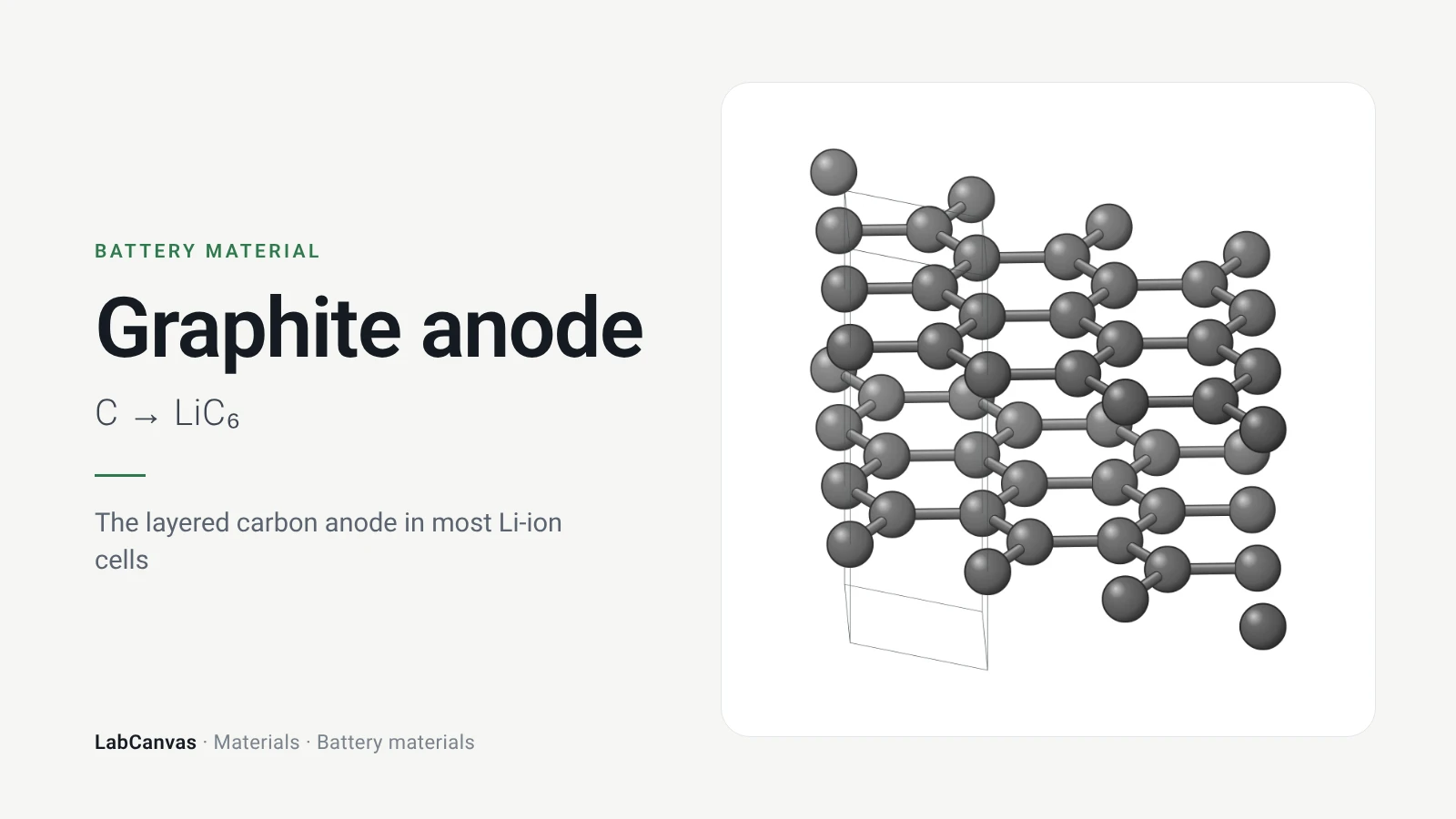
Graphite anode in lithium-ion batteries: LiC₆ and 372 mAh/g, staging, intercalation near 0.1 V, the SEI from ethylene carbonate and lithium plating.
More on LabCanvas
- LiCoO₂: the layered oxide cathode: Editable figure template
- More battery figure templates: Ready-made, cited figures to edit
- Crystal structure figure software compared: VESTA, Mercury, CrystalMaker, Avogadro and LabCanvas
- Supercapacitor calculator: Free tool: capacitance, energy and power from cycling data
- Faradaic efficiency calculator: Free tool
- Battery figure templates: Cited, editable battery figures
- XRD Scherrer crystallite size calculator: Free tool
- Molar mass calculator: Free tool
- Journal figure size guide: Column widths and resolutions for 38 journals
- 3D models gallery: Turn MOFs, COFs, perovskites and more in 3D
Frequently asked questions
What is LiCoO₂?
Lithium cobalt oxide, a layered oxide used as the positive electrode (cathode) of lithium-ion batteries. Lithium ions sit between CoO₂ sheets and move in and out as the battery is charged and discharged; it was the cathode of the first commercial Li-ion cells, which Sony announced in 1991 (Manthiram 2020).
What is the crystal structure of LiCoO₂?
A layered α-NaFeO₂-type structure, space group R-3m (Hashem et al. 2019), also called O3: close-packed oxygen with Li⁺ and Co³⁺ ordered on alternate (111) planes of a rock-salt arrangement, so CoO₂ sheets of edge-sharing octahedra alternate with planes of lithium (Manthiram 2020).
What is the theoretical capacity of LiCoO₂?
274 mAh g⁻¹, for removing all the lithium (Lin et al. 2026). In practice cells charged to 4.2 V deliver about 140 mAh g⁻¹, about half (Lin et al. 2026; Manthiram 2020).
Why can only half the lithium be removed from LiCoO₂?
Beyond about 50% delithiation the cobalt redox band overlaps the oxygen 2p band, so the oxide ions are oxidized and oxygen leaves the lattice (Manthiram 2020). Deep charging also drives phase transitions, near 4.2 V and the O3 → H1-3 transition near 4.55 V, that strain and crack the particles (Lin et al. 2026).
What is the voltage of a LiCoO₂ cathode?
About 4 V versus lithium metal (Manthiram 2020). Classic cells were charged to 4.2 V; high-voltage LCO is charged to 4.45–4.6 V to get more capacity (Lin et al. 2026; Zhang et al. 2022).
Who invented the lithium cobalt oxide cathode?
It came from John Goodenough’s group at the University of Oxford in the 1980s, in work by Koichi Mizushima on layered oxide cathodes (Manthiram 2020). Goodenough shared the 2019 Nobel Prize in Chemistry with Stanley Whittingham and Akira Yoshino for the lithium-ion battery (Manthiram 2020).
Is LiCoO₂ used in electric vehicles?
LiCoO₂ is mainly the cathode of portable electronics such as phones and laptops; electric vehicles and grid storage mostly use LiMn₂O₄, LiFePO₄, NCM and NCA cathodes (Lin et al. 2026).
What is the difference between LiCoO₂ and NMC?
Both have the same layered α-NaFeO₂-type structure (Hashem et al. 2019). In NMC much of the cobalt is replaced by nickel, which carries most of the capacity, and manganese, which stabilizes the structure; this lowers cost and raises capacity compared with LiCoO₂ (Manthiram 2020; Hashem et al. 2019).
References
- A. Manthiram. A reflection on lithium-ion battery cathode chemistry. Nat. Commun. 2020, 11, 1550. doi:10.1038/s41467-020-15355-0
- Z. Lin, Y. Ying, H. Li, Y. Ren, T. Liu, P. Hou, H. Huang. Decoding high-voltage LiCoO₂: from degradation to stabilization toward durable Li-ion batteries. Adv. Mater. 2026, 38, e23570. doi:10.1002/adma.202523570
- A. M. Hashem, A. E. Abdel-Ghany, M. Scheuermann, S. Indris, H. Ehrenberg, A. Mauger, C. M. Julien. Doped nanoscale NMC333 as cathode materials for Li-ion batteries. Materials 2019, 12, 2899. doi:10.3390/ma12182899
- C. Liao, F. Li, J. Liu. Challenges and modification strategies of Ni-rich cathode materials operating at high-voltage. Nanomaterials 2022, 12, 1888. doi:10.3390/nano12111888
- S.-D. Zhang et al.. Advancing to 4.6 V review and prospect in developing high-energy-density LiCoO₂ cathode for lithium-ion batteries. Small Methods 2022, 6, e2200148. doi:10.1002/smtd.202200148
- S. Kalluri, M. Yoon, M. Jo, H. K. Liu, S. X. Dou, J. Cho, Z. Guo. Feasibility of cathode surface coating technology for high-energy lithium-ion and beyond-lithium-ion batteries. Adv. Mater. 2017, 29, 1605807. doi:10.1002/adma.201605807
- Y. Huang, H. Yang, L. Xiong, S. Moradi, B. Shyam, B. Zahiri, P. V. Braun. Lattice, grain, and texture: opportunities for performance enhancement of layered oxide cathodes informed by LiCoO₂. Chem. Rev. 2026, 126, 6409–6496. doi:10.1021/acs.chemrev.5c00985
- L. Wang et al.. A review of Ni-based layered oxide cathode materials for alkali-ion batteries. Chem. Soc. Rev. 2025, 54, 4419–4467. doi:10.1039/d3cs00911d
- J. H. Jung, V. Vijayakumar, A. K. Haridas, J.-H. Ahn, S. Y. Nam. Effect of cross-linking and surface treatment on the functional properties of electrospun polybenzimidazole separators for lithium metal batteries. ACS Omega 2022, 7, 47784–47795. doi:10.1021/acsomega.2c05472
Draw LiCoO₂ for your paper or slides
LabCanvas is a browser workspace for scientific figures: framework clusters, linkers and nets, crystal structures in 2D and 3D, graphs and posters, all editable.
Edit the LiCoO₂ figure