NMC (LiNiₓMnᵧCo₁₋ₓ₋ᵧO₂): structure, nickel content and stability
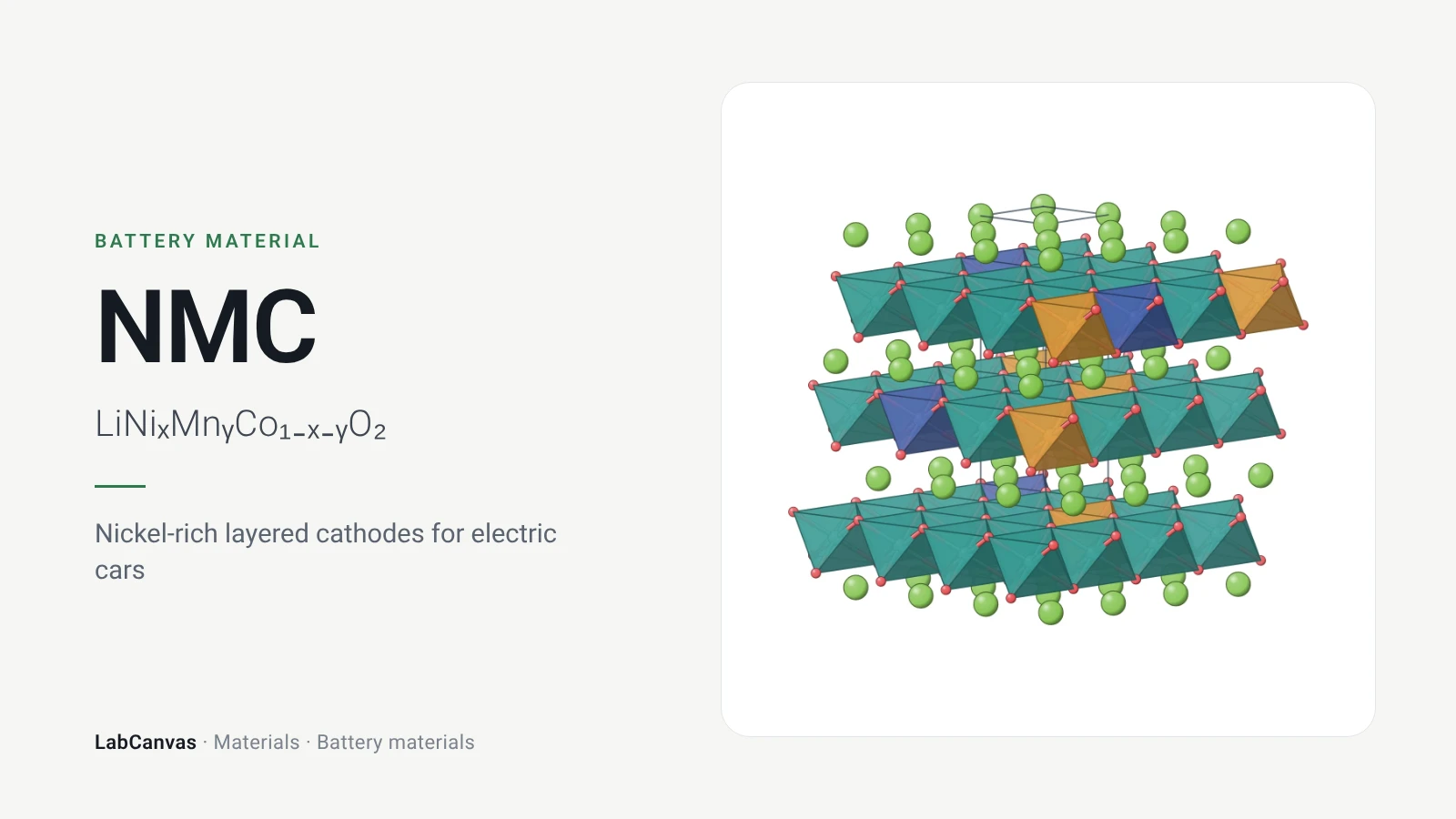
NMC, lithium nickel manganese cobalt oxide LiNiₓMnᵧCo₁₋ₓ₋ᵧO₂ (nickel, manganese and cobalt fractions adding up to 1), is a layered cathode with the same α-NaFeO₂-type R-3m structure as LiCoO₂, in which nickel, manganese and cobalt share the transition-metal layer (Hashem et al. 2019). Nickel carries most of the capacity, Mn⁴⁺ stabilizes the structure and cobalt limits Li/Ni mixing; NMC111 (LiNi₁/₃Mn₁/₃Co₁/₃O₂) gives about 200 mAh g⁻¹ between 2.8 and 4.6 V (Hashem et al. 2019). Raising nickel towards NMC811 increases capacity and lowers cost but makes the cathode less stable through cracking, oxygen loss and surface reconstruction (Manthiram 2020; Liao et al. 2022), and nickel-rich NMC now powers millions of electric vehicles (Lu et al. 2024).
Contents
NMC (LiNiₓMnᵧCo₁₋ₓ₋ᵧO₂) at a glance
| Formula | LiNiₓMnᵧCo₁₋ₓ₋ᵧO₂, the three metal fractions adding up to 1 (Fan et al. 2021; Hashem et al. 2019) |
|---|---|
| Naming | The digits give the Ni:Mn:Co ratio, e.g. NMC111 = NMC333 = LiNi₁/₃Mn₁/₃Co₁/₃O₂ (Hashem et al. 2019); NMC811 = LiNi₀.₈Mn₀.₁Co₀.₁O₂ (from the naming convention); also written NCM (Liao et al. 2022) |
| Structure | Hexagonal α-NaFeO₂-type layered structure, space group R-3m (Hashem et al. 2019); Li on 3a, transition metals on 3b, O on 6c (Liao et al. 2022) |
| Oxidation states (NMC111) | Ni²⁺, Mn⁴⁺, Co³⁺ (Hashem et al. 2019) |
| Role of each metal | Ni: redox-active, gives capacity; Mn⁴⁺: structural stabilizer, not redox-active; Co: reduces Li/Ni cation mixing (Hashem et al. 2019; Manthiram 2020) |
| Cation mixing | Ni²⁺ (0.69 Å) is close in size to Li⁺ (0.74–0.76 Å) and can occupy Li sites (Hashem et al. 2019; Liao et al. 2022) |
| Capacity (NMC111) | About 200 mAh g⁻¹ for 2.8–4.6 V vs Li⁺/Li (Hashem et al. 2019) |
| Theoretical capacity | About 278 mAh g⁻¹ for NMC111 and 276 mAh g⁻¹ for NMC811, one Li per formula unit (calculated from molar masses of 96.46 and 97.28 g mol⁻¹) |
| Redox | Ni²⁺/Ni⁴⁺ in 2.5–4.5 V, with CV peaks at 3.83 and 3.72 V in NMC111; Co³⁺/Co⁴⁺ above 4.6 V (Hashem et al. 2019) |
| Phase changes on charge | H1 → M → H2 → H3; in NMC811 the H2 → H3 transition starts above 4.11 V with an abrupt c-axis contraction (Liao et al. 2022) |
| Ni-rich problems | Cycle, thermal and air instability (Manthiram 2020); microcracking, oxygen and CO₂ release, surface reconstruction to rock salt (Liao et al. 2022) |
| Fixes | Doping, surface coating, single crystals, concentration gradients and electrolyte additives (Liao et al. 2022; Wang et al. 2025) |
| Main use | Electric vehicles: millions run on Ni-rich layered oxide cathodes (Lu et al. 2024) |
NMC (LiNiₓMnᵧCo₁₋ₓ₋ᵧO₂) structure diagram
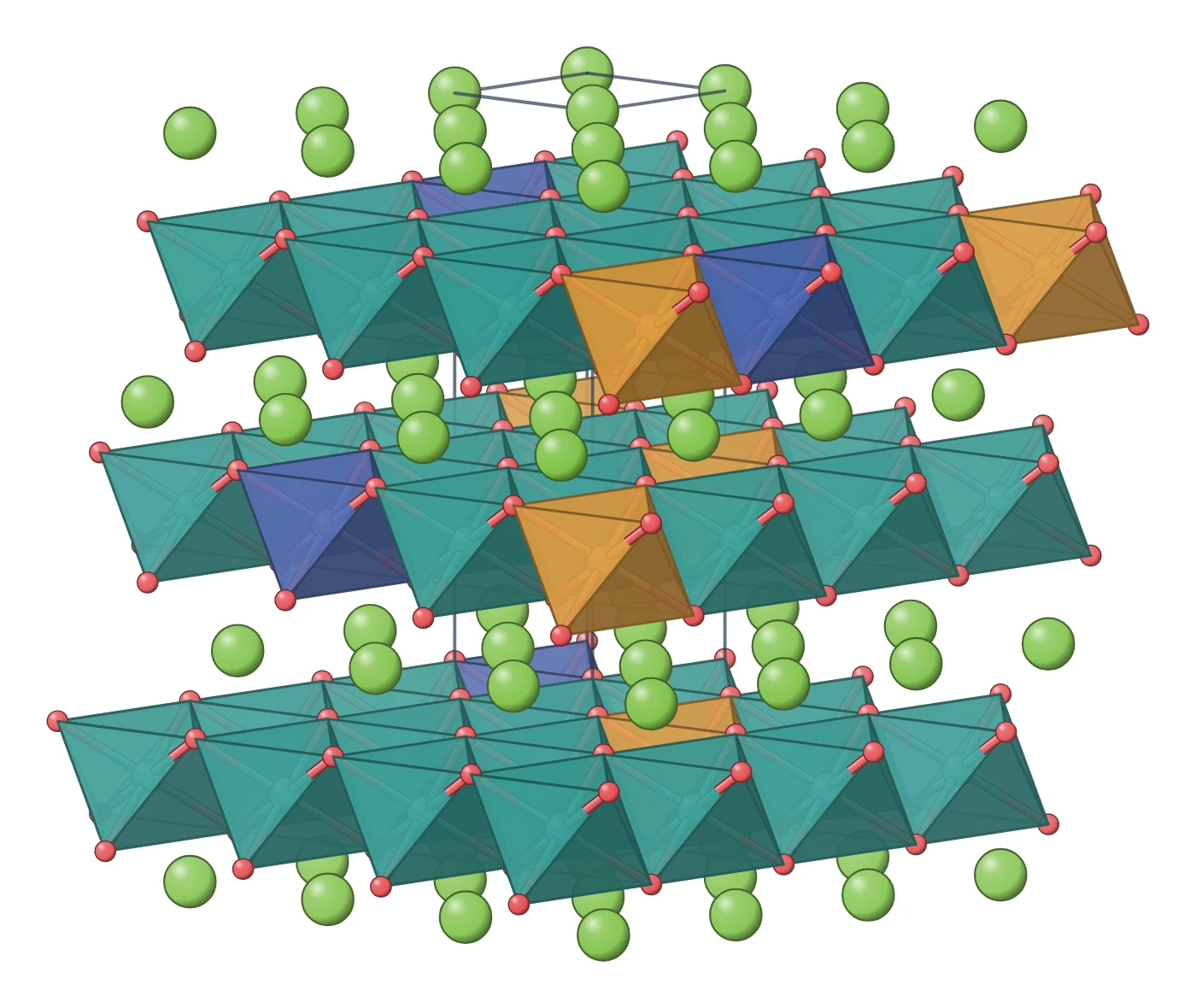
NMC (LiNiₓMnᵧCo₁₋ₓ₋ᵧO₂) structure drawing (high-resolution SVG)
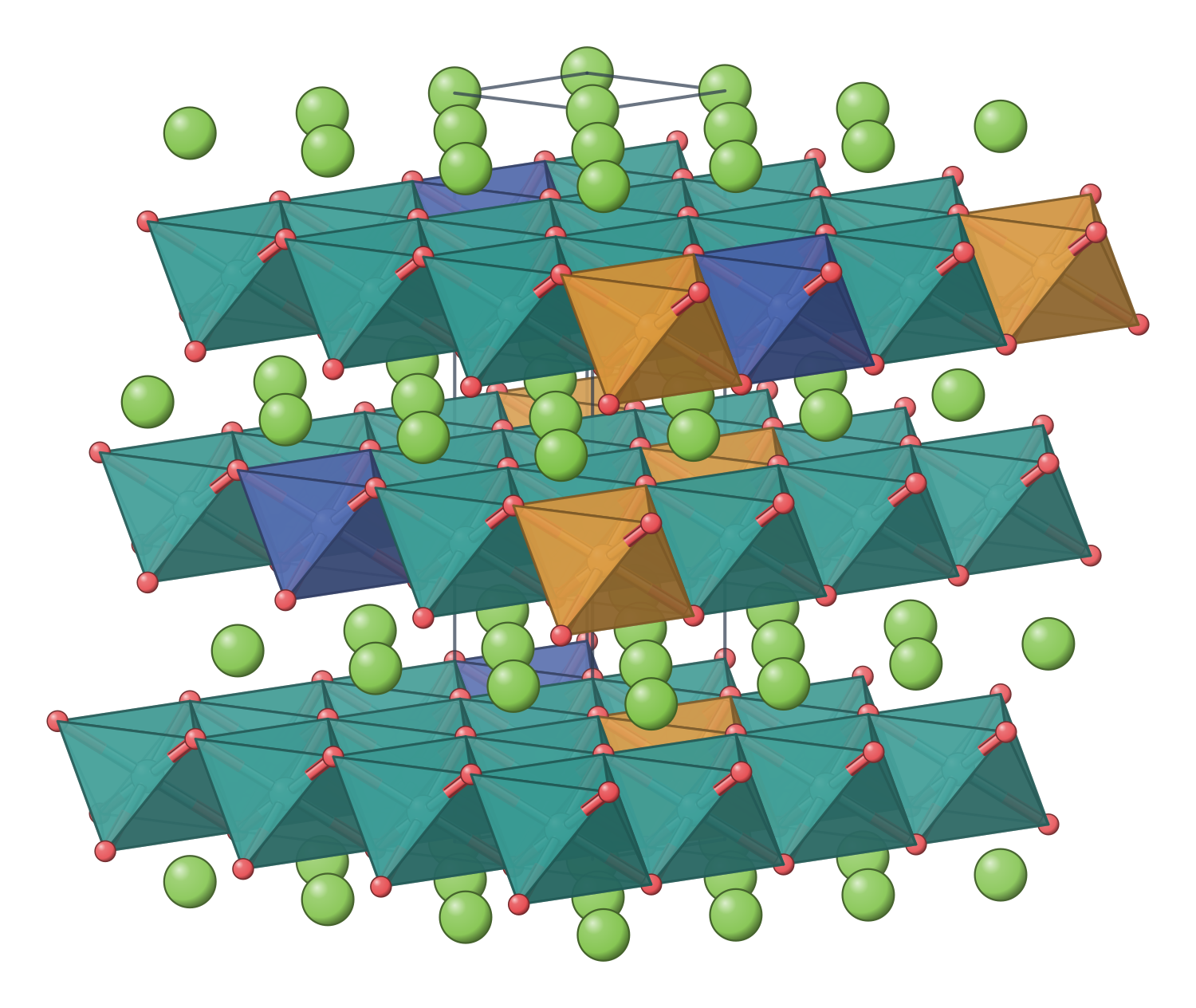
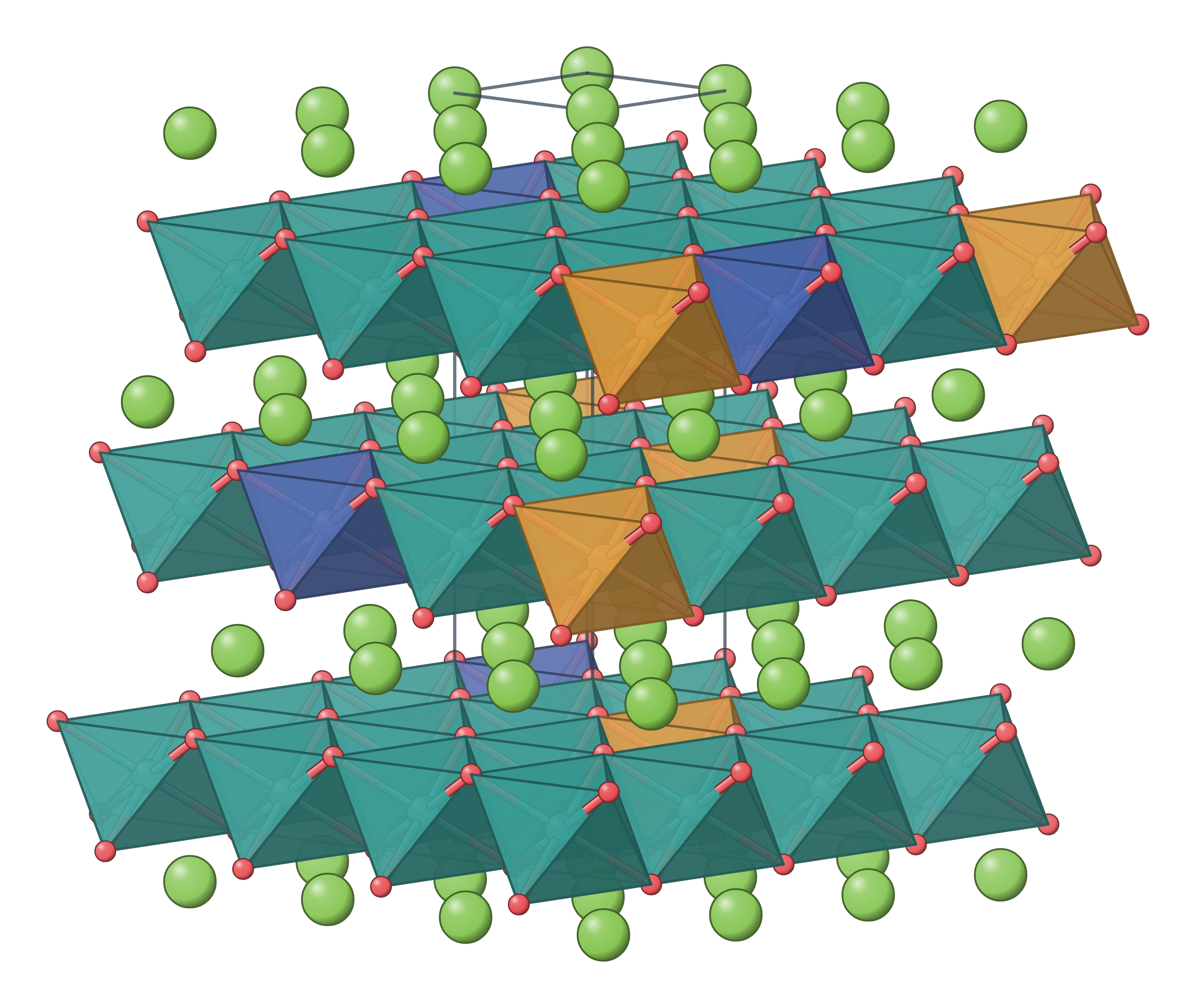
NMC (LiNiₓMnᵧCo₁₋ₓ₋ᵧO₂) in 3D (interactive)
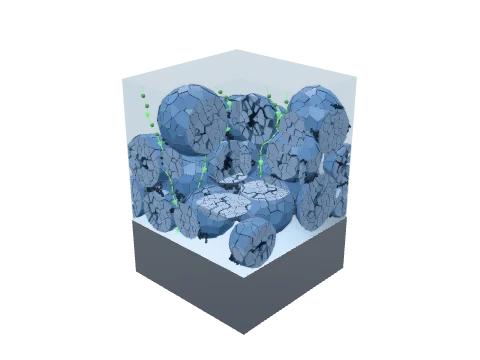
Loading the 3D model…
NMC structure explained
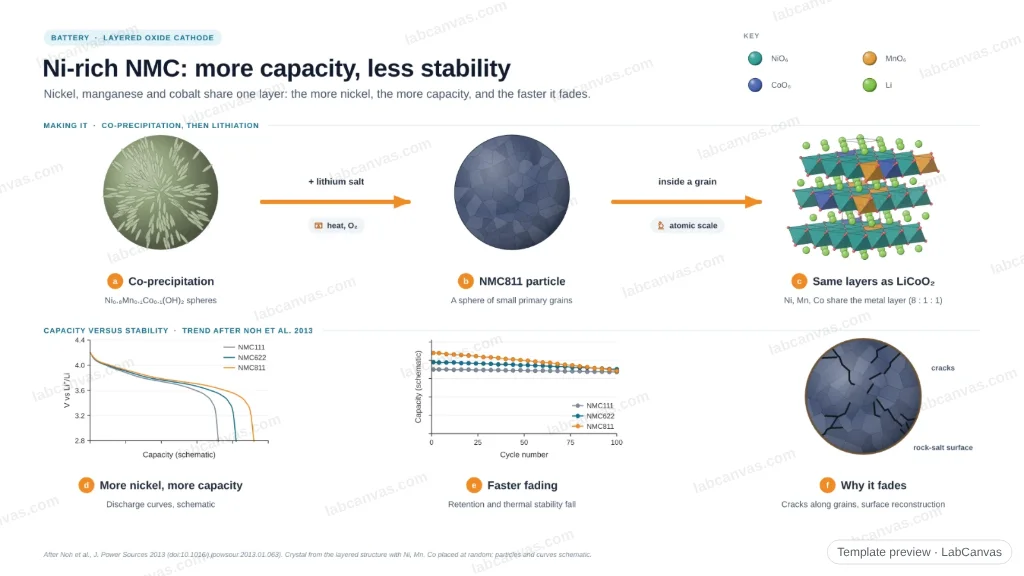
NMC has the same layered structure as LiCoO₂: a hexagonal α-NaFeO₂-type lattice, space group R-3m (Hashem et al. 2019), with lithium on the 3a sites, transition metals on the 3b sites and oxygen on the 6c sites, so layers of LiO₆ octahedra alternate with layers of MO₆ octahedra (Liao et al. 2022). The difference is that the metal layer holds a mixture of nickel, manganese and cobalt instead of cobalt alone.
In NMC111 (LiNi₁/₃Mn₁/₃Co₁/₃O₂) nickel is Ni²⁺ and manganese Mn⁴⁺ (Hashem et al. 2019). Manganese oxidizes to Mn⁴⁺ during synthesis by reducing nickel to Ni²⁺, so Mn helps incorporate nickel stably and acts as a structural stabilizer without taking part in charge and discharge (Manthiram 2020). Because Ni²⁺ (0.69 Å) is almost the same size as Li⁺, some nickel ends up on lithium sites; this cation mixing blocks Li diffusion, and cobalt helps reduce it (Hashem et al. 2019; Liao et al. 2022).
NMC111, 532, 622 and 811
The name gives the nickel:manganese:cobalt ratio: NMC111 has equal amounts (Hashem et al. 2019), NMC532 is LiNi₀.₅Mn₀.₃Co₀.₂O₂, NMC622 LiNi₀.₆Mn₀.₂Co₀.₂O₂ and NMC811 LiNi₀.₈Mn₀.₁Co₀.₁O₂ (from the naming convention; many papers write NCM, Liao et al. 2022). In practice the trend has been to raise nickel and cut cobalt: nickel can be cycled from Ni²⁺ to Ni⁴⁺ without losing much lattice oxygen, unlike cobalt, so more nickel gives more capacity at lower cost (Manthiram 2020).
Each metal brings something: cobalt has good structural stability but releases oxygen at high charge, manganese is chemically stable but tends to migrate into the lithium layer, and nickel lies in between (Manthiram 2020). The theoretical capacity barely changes with composition, about 278 mAh g⁻¹ for NMC111 and 276 mAh g⁻¹ for NMC811 (calculated from the molar masses); what nickel changes is how much of the lithium can be used within a practical voltage window.
Why more nickel means less stability
Nickel-rich layered oxides suffer from cycle, thermal and air instability, all linked to highly oxidized nickel in contact with the liquid electrolyte or air (Manthiram 2020). The main mechanisms are:
- Microcracking. On deep charge NMC goes from H1 through a monoclinic phase to H2 and H3; in NMC811 the H2 → H3 transition above 4.11 V shrinks the c axis abruptly, and the more nickel, the larger the collapse. The anisotropic volume change cracks secondary particles apart along grain boundaries (Liao et al. 2022). In nickel-rich NCA the unit-cell volume drops by 5.63%, 7.10% and 8.37% at 80%, 88% and 95% Ni (Liao et al. 2022).
- Oxygen release. Lattice oxygen escapes at high states of charge and reacts with the electrolyte, releasing O₂ and CO₂; the gas release correlates with Ni content (Liao et al. 2022).
- Surface reconstruction. The surface turns from layered to spinel to a NiO-like rock-salt structure that blocks lithium (Liao et al. 2022). In LiNiₓMnₓCo₁₋₂ₓO₂ this reconstruction runs mainly along the lithium diffusion channels, and the surface reaction layer is LiF in an organic matrix; together they cause much of the capacity fading and impedance rise at high voltage (Lin et al. 2014). After cycling, the rock-salt layer was at most 3 nm thick on NCM622 at 4.5 V but about 5 nm on a 90% Ni cathode already at 4.3 V (Liao et al. 2022).
- Metal dissolution. Ni and Mn dissolve, migrate to the graphite anode and thicken its SEI, more so the higher the Ni content (Manthiram 2020).
Single-crystal NMC, coatings and doping
Single crystals. Conventional NMC is made of polycrystalline secondary particles; their randomly oriented primary grains build up stress at grain boundaries and crack apart. Single-crystal particles avoid intergranular cracks, show phase change to rock salt only at the surface and cycle better, especially at high voltage, and they release less gas (Liao et al. 2022). Their limits are slower Li diffusion through large particles (Fan et al. 2021) and gliding of the layers inside the crystal, which is largely reversible but can create cracks near the surface; keeping crystals below about 3.5 µm helps (Liao et al. 2022). In single-crystal NCM with 65% Ni, capacity loss tracked the thickness of a rock-salt NiO-type surface layer rather than cracking (Zhao et al. 2023).
Coatings. Oxides such as Al₂O₃, ZrO₂ and TiO₂, fluorides, phosphates, conductive polymers and fast Li-ion conductors are coated on the particles to block side reactions with the electrolyte and HF (Liao et al. 2022).
Doping. Small amounts of Mg, Al, Ti, Zr, B and others stabilize the lattice; 2 mol% Mg on lithium sites acts as a pillar that reduces anisotropic strain and microcracking (Liao et al. 2022), and Al or Mg doping improved the cycling of NMC111 (Hashem et al. 2019). Al doping also strengthens metal–oxygen bonds and suppresses dissolution in nickel-rich cathodes (Manthiram 2020). Concentration gradients across the particles are another strategy (Lu et al. 2024; Wang et al. 2025).
Where NMC is used
Nickel-rich NMC cathodes, with their high capacity, are the principal candidates for long-range electric vehicles (Liao et al. 2022), and millions of electric vehicles run on nickel-rich layered oxide cathodes (Lu et al. 2024). Alongside NCA, LiMn₂O₄ and LiFePO₄, NCM is used in electric vehicles and stationary storage, while LiCoO₂ stays in portable electronics (Lin et al. 2026). For the place of NMC among cathodes, anodes and electrolytes, see battery materials.
How to draw the NMC structure
Draw NMC as you would LiCoO₂, side on so the alternating layers show, but colour the metal layer with three kinds of octahedra, nickel, manganese and cobalt, in the right ratio: for NMC811, eight Ni to every Mn and Co. To explain degradation, add a cracked secondary particle and a thin rock-salt shell on the surface. The LabCanvas figure editor’s Library has battery crystal objects, including a layered oxide and NMC811, that drop into a figure as high-resolution vector drawings you can recolour and label. The LabCanvas 3D Studio has battery models you can rotate, show as polyhedra and export as high-resolution images.
NMC compared with other cathodes
| Cathode | Structure | Capacity | Strengths | Weaknesses |
|---|---|---|---|---|
| LiCoO₂ | Layered O3 | ~140 mAh g⁻¹ at 4.2 V; 274 theoretical | Dense, conductive | Cobalt cost; O loss beyond half delithiation (Manthiram 2020; Lin et al. 2026) |
| NMC111 | Layered α-NaFeO₂ type | ~200 mAh g⁻¹, 2.8–4.6 V | Less cobalt than LCO | Fades at high voltage (Hashem et al. 2019) |
| Ni-rich NMC (e.g. NMC811) | Layered α-NaFeO₂ type | Higher with more Ni | High energy, low cobalt | Cracking, gas release, surface reconstruction (Manthiram 2020; Liao et al. 2022) |
| LiMn₂O₄ | Spinel | Below 130 mAh g⁻¹ at ~4 V | Cheap, fast | Mn dissolution (Manthiram 2020) |
| LiFePO₄ | Olivine | 170 mAh g⁻¹ theoretical | Safe, thermally stable, Fe-based | Lower density, needs carbon coating (Manthiram 2020; Jung et al. 2022) |
Related materials
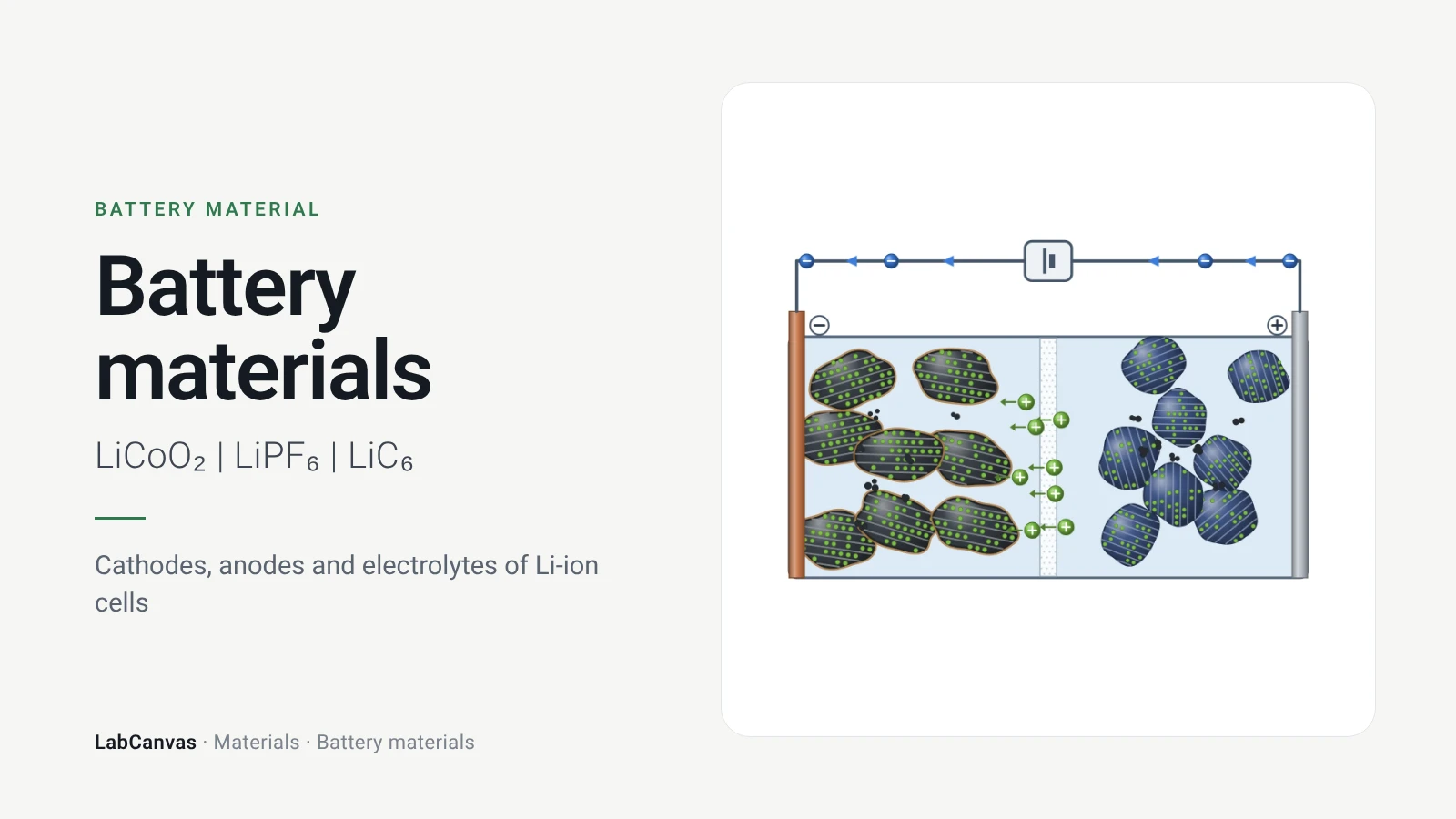
Battery materials
How a lithium-ion cell works and what is inside it: layered, spinel and olivine cathodes, graphite, silicon and lithium anodes, liquid and solid electrolytes.
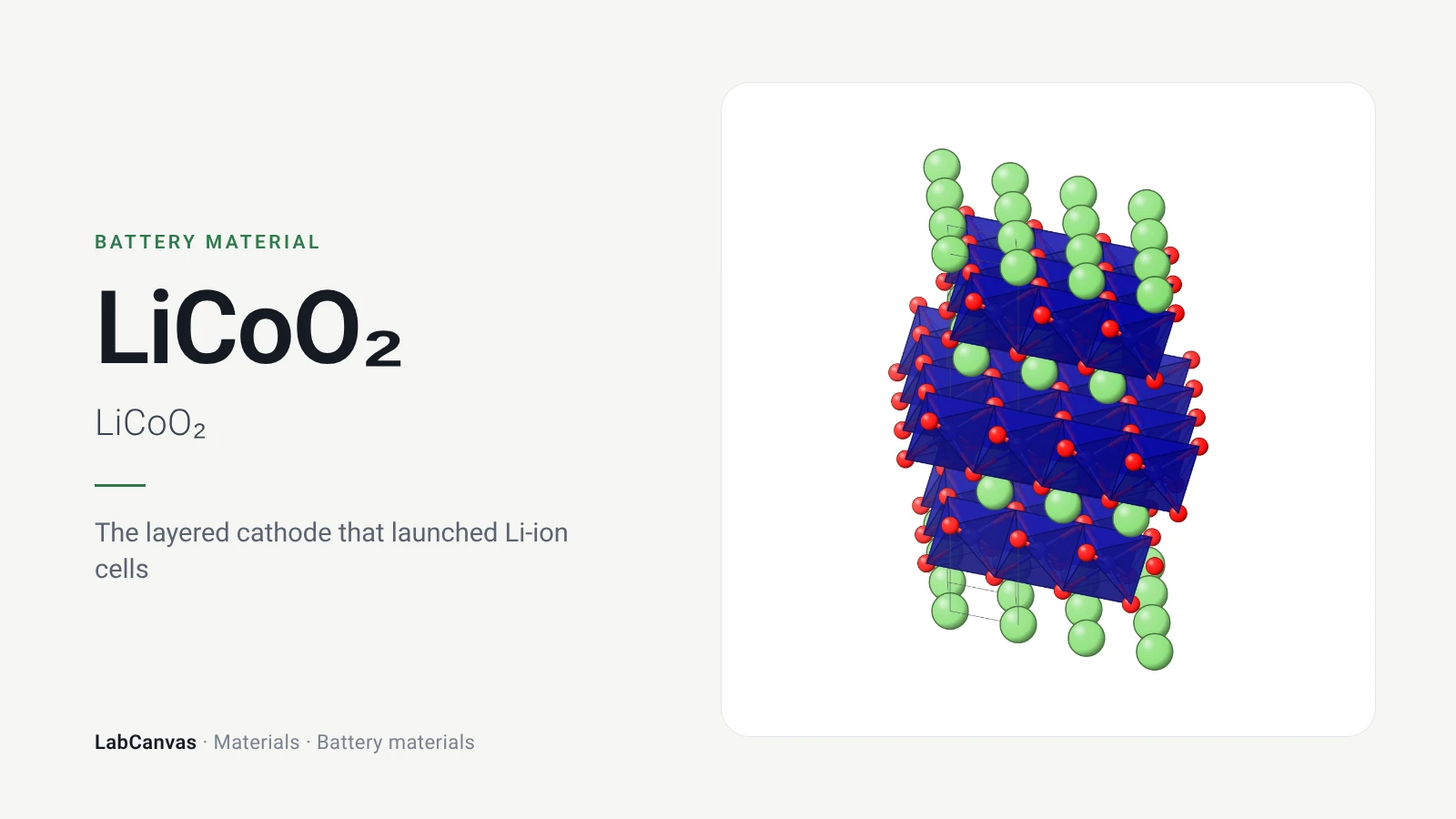
LiCoO₂
LiCoO₂ structure and properties: the layered O3 (α-NaFeO₂-type) cathode, why only half its lithium is used, ~4 V vs Li, phones and laptops, high-voltage LCO.
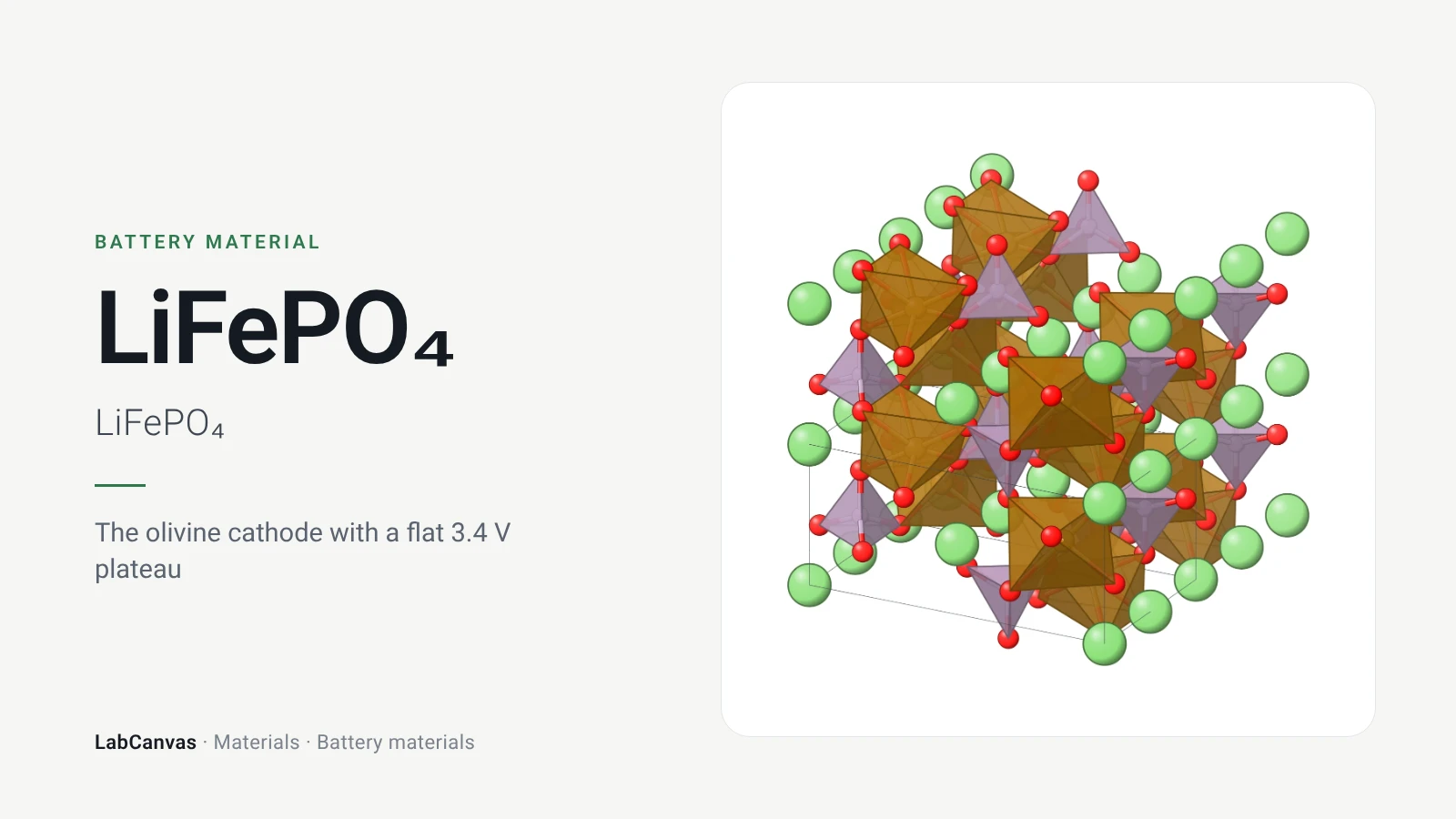
LiFePO₄ (LFP)
LiFePO₄ (LFP) cathode: olivine structure (Pnma), 1D lithium channels, the flat 3.4 V two-phase plateau, 170 mAh/g, carbon coating and why LFP is safe.
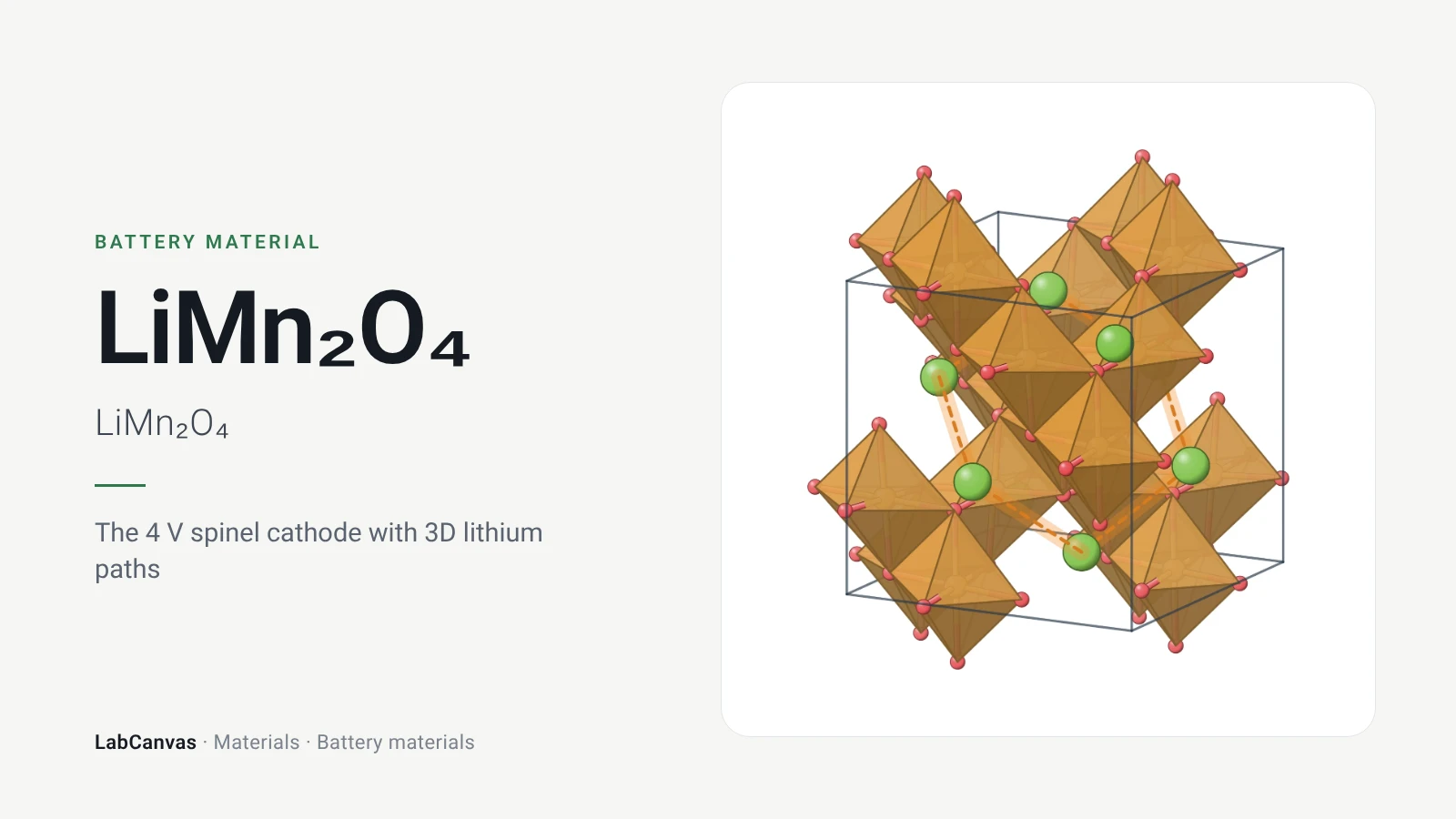
LiMn₂O₄ (spinel)
LiMn₂O₄ (LMO) spinel cathode: cubic Fd-3m structure, 3D lithium diffusion, 4.1 V plateaus, 148 mAh/g, Mn dissolution, Jahn–Teller fade and LiNi₀.₅Mn₁.₅O₄.
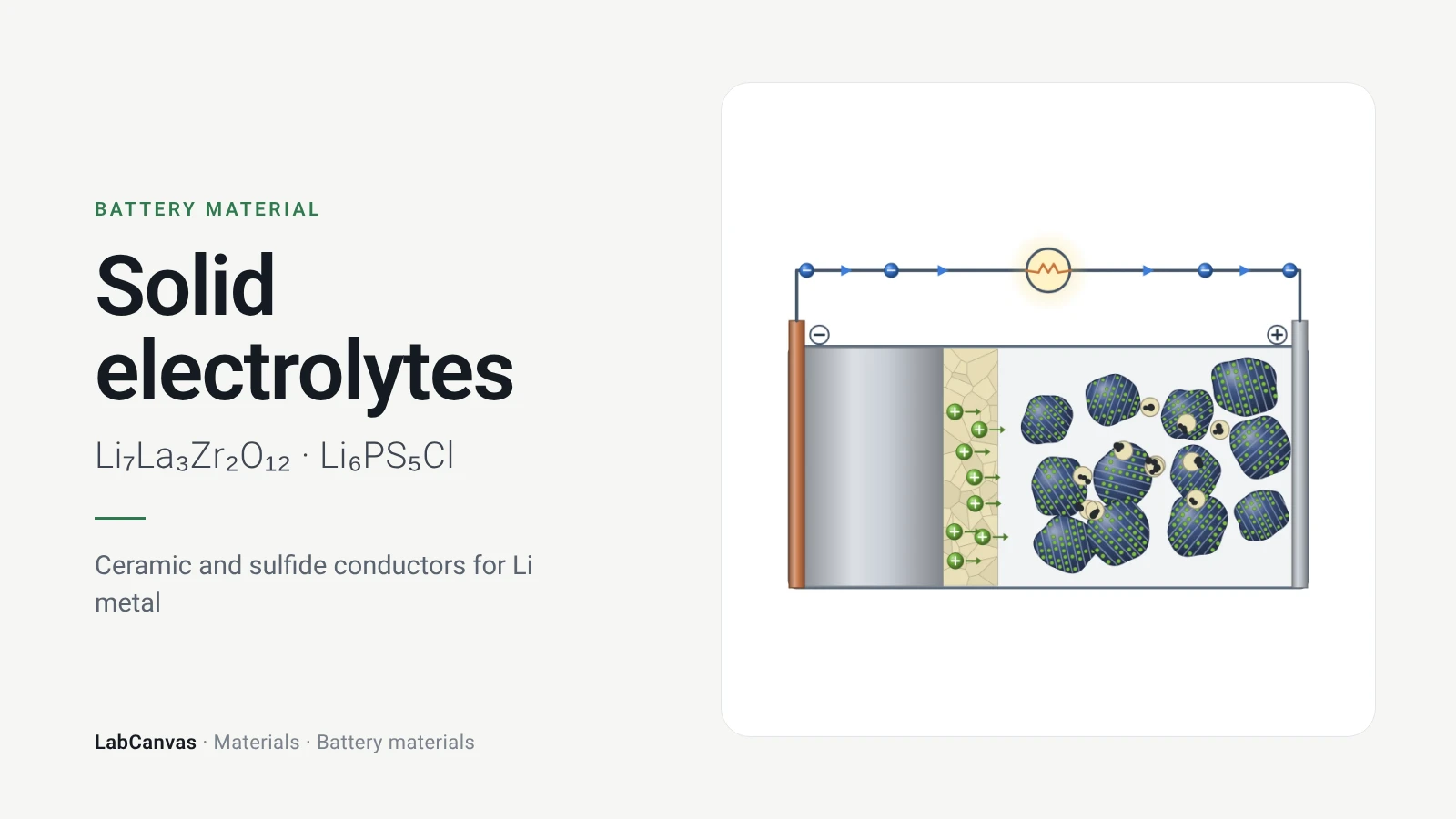
Solid electrolytes (LLZO, argyrodite)
Solid electrolytes for solid-state batteries: garnet LLZO (cubic vs tetragonal, Al/Ga/Ta doping), argyrodite Li₆PS₅Cl, LGPS, PEO, dendrites and Li metal.
More on LabCanvas
- Ni-rich NMC: more capacity, less stability: Editable figure template
- More battery figure templates: Ready-made, cited figures to edit
- Crystal structure figure software compared: VESTA, Mercury, CrystalMaker, Avogadro and LabCanvas
- Supercapacitor calculator: Free tool: capacitance, energy and power from cycling data
- Faradaic efficiency calculator: Free tool
- Battery figure templates: Cited, editable battery figures
- XRD Scherrer crystallite size calculator: Free tool
- Molar mass calculator: Free tool
- Journal figure size guide: Column widths and resolutions for 38 journals
- 3D models gallery: Turn MOFs, COFs, perovskites and more in 3D
Frequently asked questions
What is an NMC cathode?
A lithium nickel manganese cobalt oxide, LiNiₓMnᵧCo₁₋ₓ₋ᵧO₂, used as the positive electrode of lithium-ion batteries. It has the layered structure of LiCoO₂ with nickel, manganese and cobalt sharing the metal layer (Hashem et al. 2019).
What does NMC 811 mean?
The digits are the Ni:Mn:Co ratio: NMC811 is LiNi₀.₈Mn₀.₁Co₀.₁O₂, 80% nickel, 10% manganese and 10% cobalt in the metal layer. Likewise NMC622 is 6:2:2, NMC532 is 5:3:2 and NMC111 (also called NMC333) has equal amounts (Hashem et al. 2019).
What is the difference between NMC and NCM?
None: they are two orders of the same letters for LiNiₓMnᵧCo₁₋ₓ₋ᵧO₂. Many papers write NCM, for example NCM622 and NCM811 (Liao et al. 2022).
What is the crystal structure of NMC?
A hexagonal α-NaFeO₂-type layered structure, space group R-3m (Hashem et al. 2019): layers of lithium on 3a sites alternate with layers of Ni, Mn and Co on 3b sites between oxygen layers (Liao et al. 2022).
Why is high-nickel NMC less stable?
Highly oxidized nickel reacts with the electrolyte and air (Manthiram 2020). At high charge Ni-rich NMC goes through an H2 → H3 transition with an abrupt c-axis contraction that cracks particles, releases lattice oxygen and gases, and reconstructs its surface into a NiO-like rock salt that blocks lithium; all of these get worse as nickel rises (Liao et al. 2022).
What is single-crystal NMC?
NMC made as separate single crystals instead of spherical secondary particles packed with small grains. Without grain boundaries it avoids intergranular cracking and releases less gas, at the cost of slower lithium diffusion through large crystals (Liao et al. 2022; Fan et al. 2021).
What is the role of manganese and cobalt in NMC?
Manganese is Mn⁴⁺, does not change oxidation state during cycling and stabilizes the structure; cobalt reduces the mixing of nickel into the lithium layer (Hashem et al. 2019; Manthiram 2020). Nickel provides most of the capacity.
Is NMC better than LFP?
It depends on the use. Layered oxides such as NMC have higher gravimetric and volumetric energy density, so they suit electric vehicles; LiFePO₄ has lower density but higher thermal stability, better safety and uses abundant iron, which suits grid storage (Manthiram 2020).
References
- A. M. Hashem, A. E. Abdel-Ghany, M. Scheuermann, S. Indris, H. Ehrenberg, A. Mauger, C. M. Julien. Doped nanoscale NMC333 as cathode materials for Li-ion batteries. Materials 2019, 12, 2899. doi:10.3390/ma12182899
- A. Manthiram. A reflection on lithium-ion battery cathode chemistry. Nat. Commun. 2020, 11, 1550. doi:10.1038/s41467-020-15355-0
- C. Liao, F. Li, J. Liu. Challenges and modification strategies of Ni-rich cathode materials operating at high-voltage. Nanomaterials 2022, 12, 1888. doi:10.3390/nano12111888
- F. Lin, I. M. Markus, D. Nordlund, T.-C. Weng, M. D. Asta, H. L. Xin, M. M. Doeff. Surface reconstruction and chemical evolution of stoichiometric layered cathode materials for lithium-ion batteries. Nat. Commun. 2014, 5, 3529. doi:10.1038/ncomms4529
- J. Lu, C. Xu, W. Dose, S. Dey, X. Wang, Y. Wu, D. Li, L. Ci. Microstructures of layered Ni-rich cathodes for lithium-ion batteries. Chem. Soc. Rev. 2024, 53, 4707–4740. doi:10.1039/d3cs00741c
- L. Wang et al.. A review of Ni-based layered oxide cathode materials for alkali-ion batteries. Chem. Soc. Rev. 2025, 54, 4419–4467. doi:10.1039/d3cs00911d
- X. Fan et al.. In situ inorganic conductive network formation in high-voltage single-crystal Ni-rich cathodes. Nat. Commun. 2021, 12, 5320. doi:10.1038/s41467-021-25611-6
- W. Zhao et al.. Quantifying degradation parameters of single-crystalline Ni-rich cathodes in lithium-ion batteries. Angew. Chem. Int. Ed. 2023, 62, e202305281. doi:10.1002/anie.202305281
- Z. Lin, Y. Ying, H. Li, Y. Ren, T. Liu, P. Hou, H. Huang. Decoding high-voltage LiCoO₂: from degradation to stabilization toward durable Li-ion batteries. Adv. Mater. 2026, 38, e23570. doi:10.1002/adma.202523570
- J. H. Jung, V. Vijayakumar, A. K. Haridas, J.-H. Ahn, S. Y. Nam. Effect of cross-linking and surface treatment on the functional properties of electrospun polybenzimidazole separators for lithium metal batteries. ACS Omega 2022, 7, 47784–47795. doi:10.1021/acsomega.2c05472
Draw NMC (LiNiₓMnᵧCo₁₋ₓ₋ᵧO₂) for your paper or slides
LabCanvas is a browser workspace for scientific figures: framework clusters, linkers and nets, crystal structures in 2D and 3D, graphs and posters, all editable.
Edit the NMC (LiNiₓMnᵧCo₁₋ₓ₋ᵧO₂) figure