LiMn₂O₄ (LMO): spinel structure, voltage and capacity fade
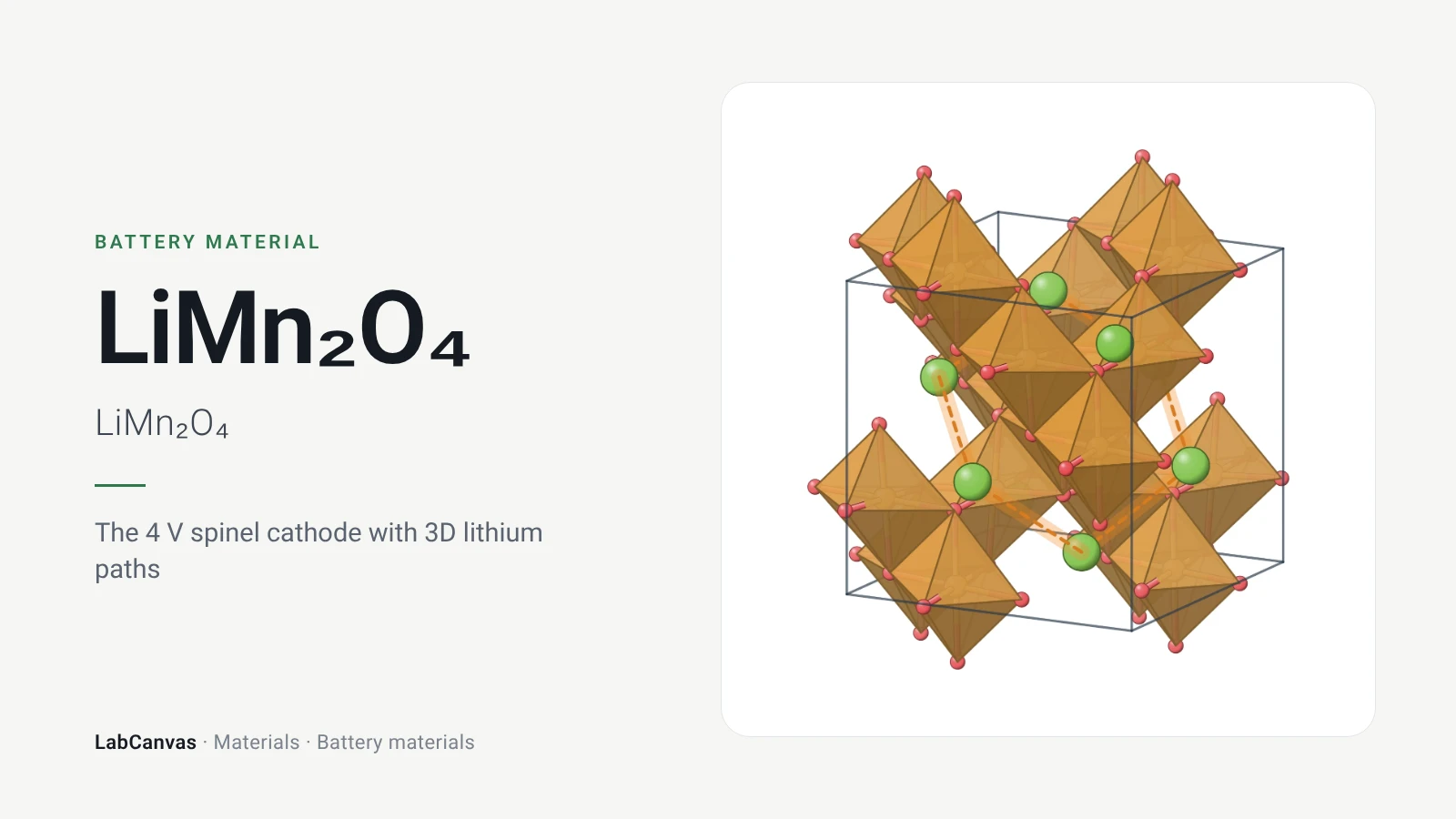
Lithium manganese oxide (LiMn₂O₄, LMO) is a spinel cathode for lithium-ion batteries: a cubic crystal (space group Fd-3m) with lithium on tetrahedral 8a sites and manganese on octahedral 16d sites, giving a theoretical capacity of about 148 mAh g⁻¹ and two voltage plateaus near 4.1 V (Bakierska et al. 2016). Its three-dimensional lithium diffusion network gives it good rate capability for high-power cells, and manganese is cheap, abundant and less toxic than cobalt (Liu et al. 2026). Its weakness is capacity fade, caused by the Jahn–Teller distortion of Mn³⁺ and by manganese dissolving into the electrolyte (Bakierska et al. 2016); replacing a quarter of the Mn with Ni gives the 4.7 V spinel LiNi₀.₅Mn₁.₅O₄ (Zhang et al. 2025).
Contents
LiMn₂O₄ (spinel) at a glance
| Formula | LiMn₂O₄ (Bakierska et al. 2016) |
|---|---|
| Molar mass | 180.81 g mol⁻¹ (calculated from the formula) |
| Structure type | Cubic spinel (Bakierska et al. 2016) |
| Space group | Fd-3m; Li on 8a (tetrahedral), Mn on 16d (octahedral), O on 32e (Bakierska et al. 2016) |
| Lithium pathway | Three-dimensional diffusion network (Liu et al. 2026) |
| Voltage | Two plateaus near 4.1 V vs Li/Li⁺ from the Mn³⁺/Mn⁴⁺ couple (Bakierska et al. 2016) |
| Theoretical capacity | About 148 mAh g⁻¹ (Bakierska et al. 2016); 148.2 mAh g⁻¹ for one Li per formula unit (calculated from the molar mass) |
| Strengths | Low cost, abundant and environmentally benign, high working potential, good safety (Bakierska et al. 2016); good rate capability (Liu et al. 2026) |
| Capacity fade | Jahn–Teller distortion of high-spin Mn³⁺ and a phase transition near room temperature; Mn dissolution into the electrolyte (Bakierska et al. 2016) |
| Worst conditions | Elevated temperature, high rate and extended cycling (Liu et al. 2026) |
| High-voltage relative | LiNi₀.₅Mn₁.₅O₄: ≈4.7 V, ≈650 Wh kg⁻¹, cobalt-free (Zhang et al. 2025); 147 mAh g⁻¹ theoretical (Madinabeitia et al. 2022) |
LiMn₂O₄ (spinel) structure diagram
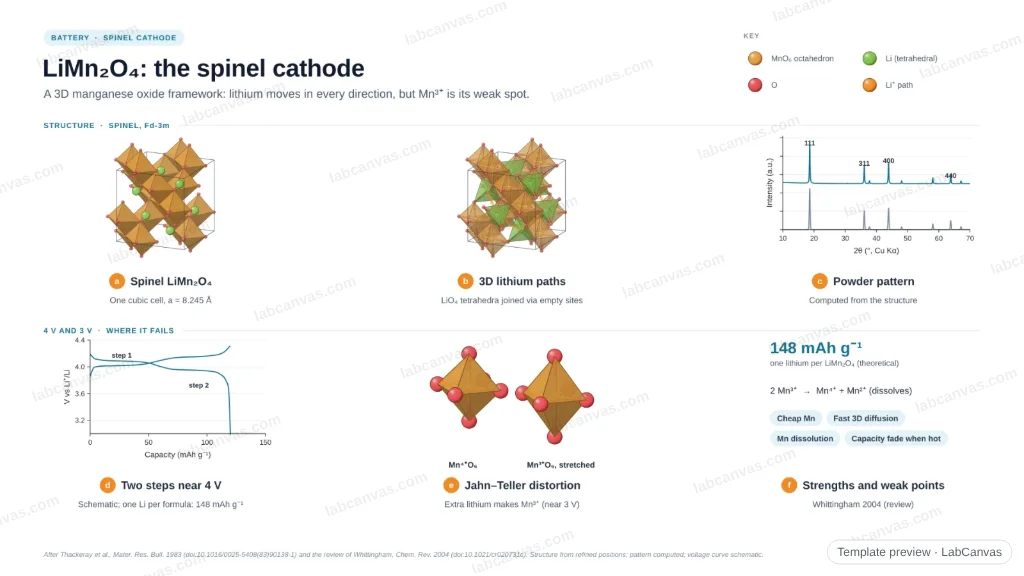
LiMn₂O₄ (spinel) structure drawing (high-resolution SVG)
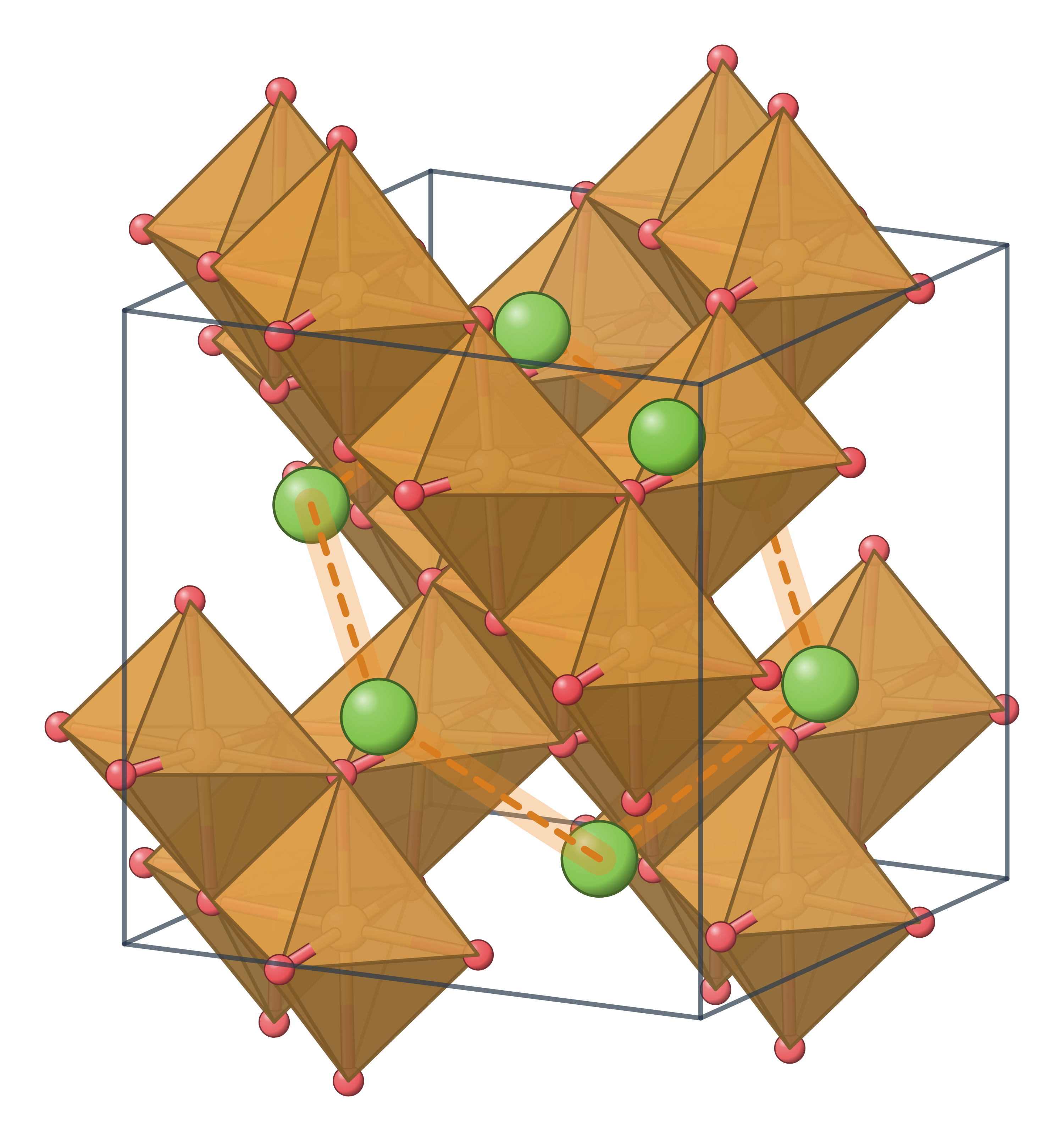
LiMn₂O₄ spinel structure explained
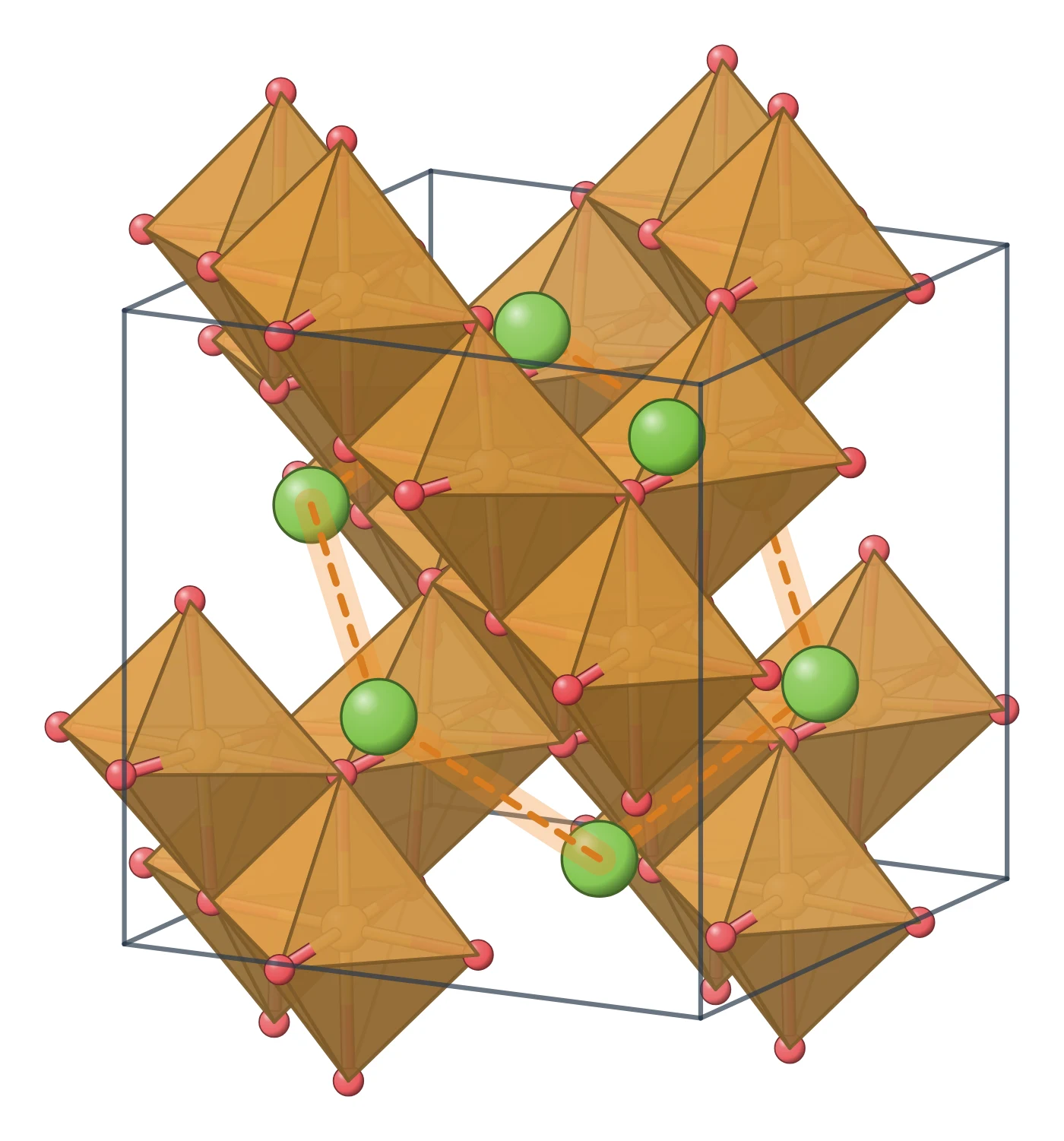
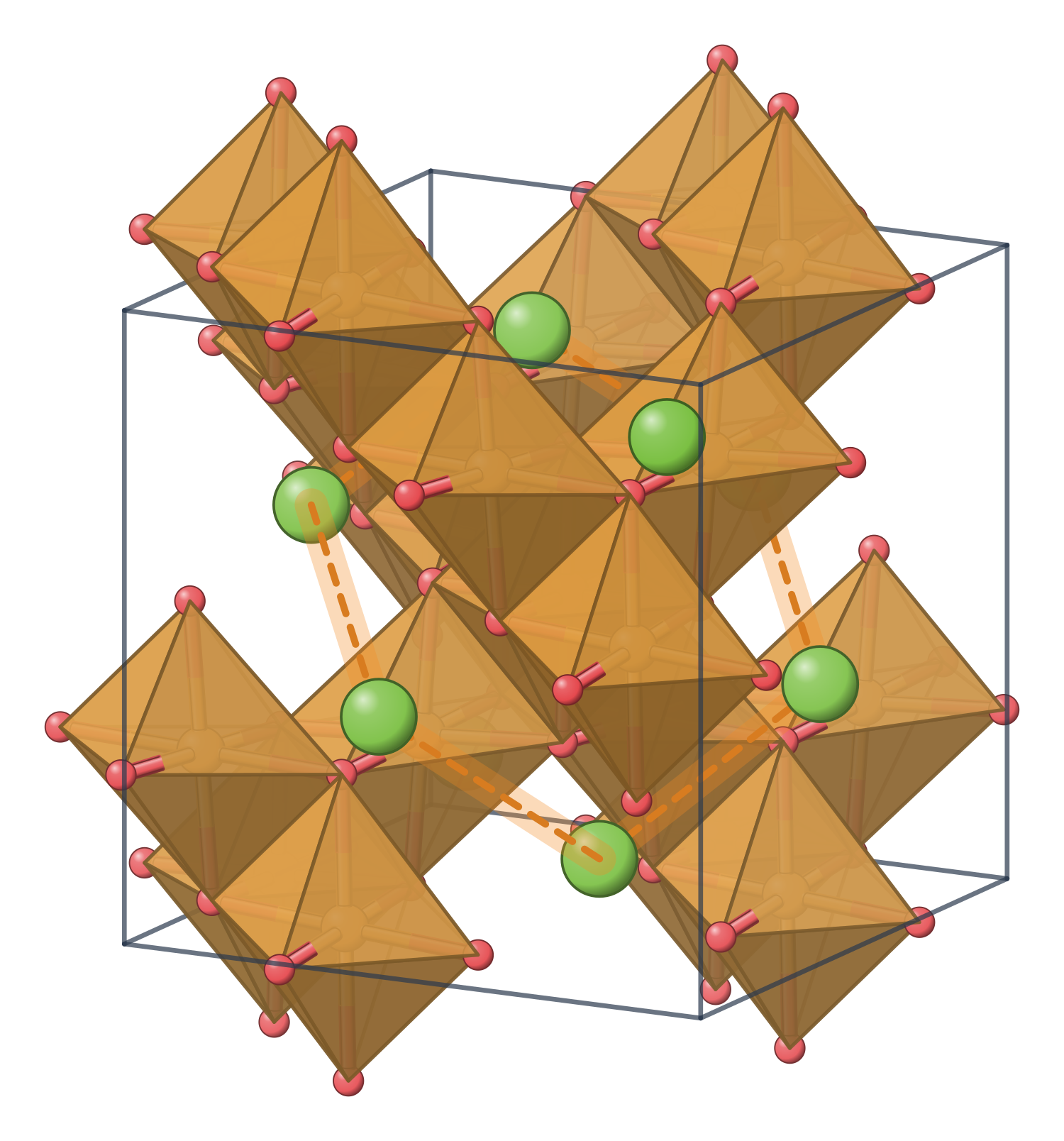
LiMn₂O₄ crystallizes in the cubic spinel structure, space group Fd-3m: oxygen ions occupy the 32e sites, manganese the octahedral 16d sites and lithium the tetrahedral 8a sites (Bakierska et al. 2016). The MnO₆ octahedra form the framework, and the lithium sites are connected into a three-dimensional diffusion network (Liu et al. 2026). In the closely related spinel LiNi₀.₅Mn₁.₅O₄, lithium moves from a tetrahedral 8a site through an empty octahedral 16c site, the 8a–16c path (Zhang et al. 2025).
This 3D network is the main structural difference from olivine LiFePO₄, where lithium can move only along one direction. It is why spinel LMO has good rate capability and suits power-oriented applications (Liu et al. 2026).
Voltage and capacity
On charge, lithium leaves the 8a sites and manganese is oxidized from Mn³⁺ to Mn⁴⁺. The charge–discharge curve shows two plateaus near 4.1 V vs Li/Li⁺, both from the Mn³⁺/Mn⁴⁺ couple, and cyclic voltammetry shows them as a doublet of peaks around 4.1 V (Bakierska et al. 2016). The theoretical capacity is about 148 mAh g⁻¹ (Bakierska et al. 2016), which matches one lithium per LiMn₂O₄ (148.2 mAh g⁻¹, calculated from the molar mass of 180.81 g mol⁻¹), a little lower than the 170 mAh g⁻¹ of LiFePO₄ but delivered at a higher voltage.
Why LiMn₂O₄ loses capacity: Mn dissolution and Jahn–Teller distortion
Stoichiometric LiMn₂O₄ suffers from severe capacity fading during cycling (Bakierska et al. 2016), above all at elevated temperature, high rate or over long cycling (Liu et al. 2026). Two causes dominate:
- Jahn–Teller distortion. High-spin Mn³⁺ in an octahedron has a single electron in the doubly degenerate eg orbitals, so the MnO₆ octahedron distorts and the lattice turns tetragonal (Zhang et al. 2025). In LMO this drives a cubic-to-orthorhombic phase transition near room temperature (Bakierska et al. 2016).
- Manganese dissolution. The surface of the highly delithiated cathode reacts with the electrolyte and manganese dissolves (Bakierska et al. 2016). Mn³⁺ disproportionation generates soluble manganese that migrates through the electrolyte and can deposit on the anode, consuming active manganese and damaging the spinel framework (Liu et al. 2026); divalent manganese has been detected in the electrolyte (Zhang et al. 2025).
The remedies attack both causes: cation substitution (for example Ni for Mn) to reduce the Jahn–Teller distortion, and surface coatings to limit contact with the electrolyte (Liu et al. 2026). Spinel co-doped with Ni and S no longer showed the room-temperature phase transition and kept 80.6% of its capacity after 650 cycles at 5C (Bakierska et al. 2016).
LiNi₀.₅Mn₁.₅O₄: the high-voltage spinel
Replacing a quarter of the manganese with nickel gives LiNi₀.₅Mn₁.₅O₄ (LNMO), a cobalt-free spinel that works at about 4.7 V vs Li/Li⁺ with a theoretical energy density of about 650 Wh kg⁻¹ (Zhang et al. 2025) and a theoretical capacity of 147 mAh g⁻¹ (Madinabeitia et al. 2022). The capacity now comes from nickel: plateaus near 4.6 and 4.8 V from the Ni²⁺/Ni³⁺ and Ni³⁺/Ni⁴⁺ couples. In the disordered (Fd-3m) form a small plateau near 4.0 V from residual Mn³⁺ remains; the Ni/Mn-ordered form lacks it (Zhang et al. 2025). Uncoated LNMO can crystallize in the ordered space group P4₃32 (Chong et al. 2014).
The high voltage is also its problem. Conventional ethylene-carbonate-based electrolytes are stable only to about 4.3 V and decompose on the LNMO surface (Zhang et al. 2025), and manganese dissolution still causes capacity fading (Cho et al. 2015). Coatings such as Al₂O₃, TiO₂ and Li₃PO₄ are used to protect the surface (Cho et al. 2015; Chong et al. 2014).
Uses of LiMn₂O₄
LMO is unlikely to compete with Ni-rich layered oxides in energy density; its place is in cost-sensitive, safety-sensitive and high-power applications (Liu et al. 2026). It is one of the cathodes compared on our battery materials page, alongside olivine LiFePO₄ and layered oxides.
How to draw the LiMn₂O₄ spinel structure
For a paper, slide or poster, draw the cubic spinel cell with MnO₆ octahedra as polyhedra and lithium as isolated spheres in the tetrahedral sites between them, or a slab of edge-sharing octahedra with the lithium sites above; arrows between the tetrahedral 8a sites through the empty 16c octahedra show the 3D diffusion path. To show capacity fade, add a distorted, elongated Mn³⁺O₆ octahedron and Mn ions leaving the surface into the electrolyte. The LabCanvas figure editor Library has a battery crystal object for spinel LMO that you can drop into a figure, recolour and resize, and export as a high-resolution image.
Spinel LiMn₂O₄ compared with LiNi₀.₅Mn₁.₅O₄ and LiFePO₄
| Cathode | Structure | Li⁺ pathway | Voltage vs Li/Li⁺ | Theoretical capacity | Main limitation |
|---|---|---|---|---|---|
| LiMn₂O₄ (LMO) | Cubic spinel, Fd-3m | 3D network | ≈4.1 V (two plateaus, Mn³⁺/Mn⁴⁺) | ≈148 mAh g⁻¹ | Mn dissolution, Jahn–Teller distortion |
| LiNi₀.₅Mn₁.₅O₄ (LNMO) | Spinel, Fd-3m (disordered) or P4₃32 (ordered) | 3D network | ≈4.7 V (Ni²⁺/Ni³⁺/Ni⁴⁺) | 147 mAh g⁻¹ | Electrolyte oxidation, Mn dissolution |
| LiFePO₄ (LFP) | Olivine, Pnma | 1D channels along b | ≈3.4 V, flat two-phase plateau | 170 mAh g⁻¹ | Low electronic conductivity |
Related materials
Battery materials
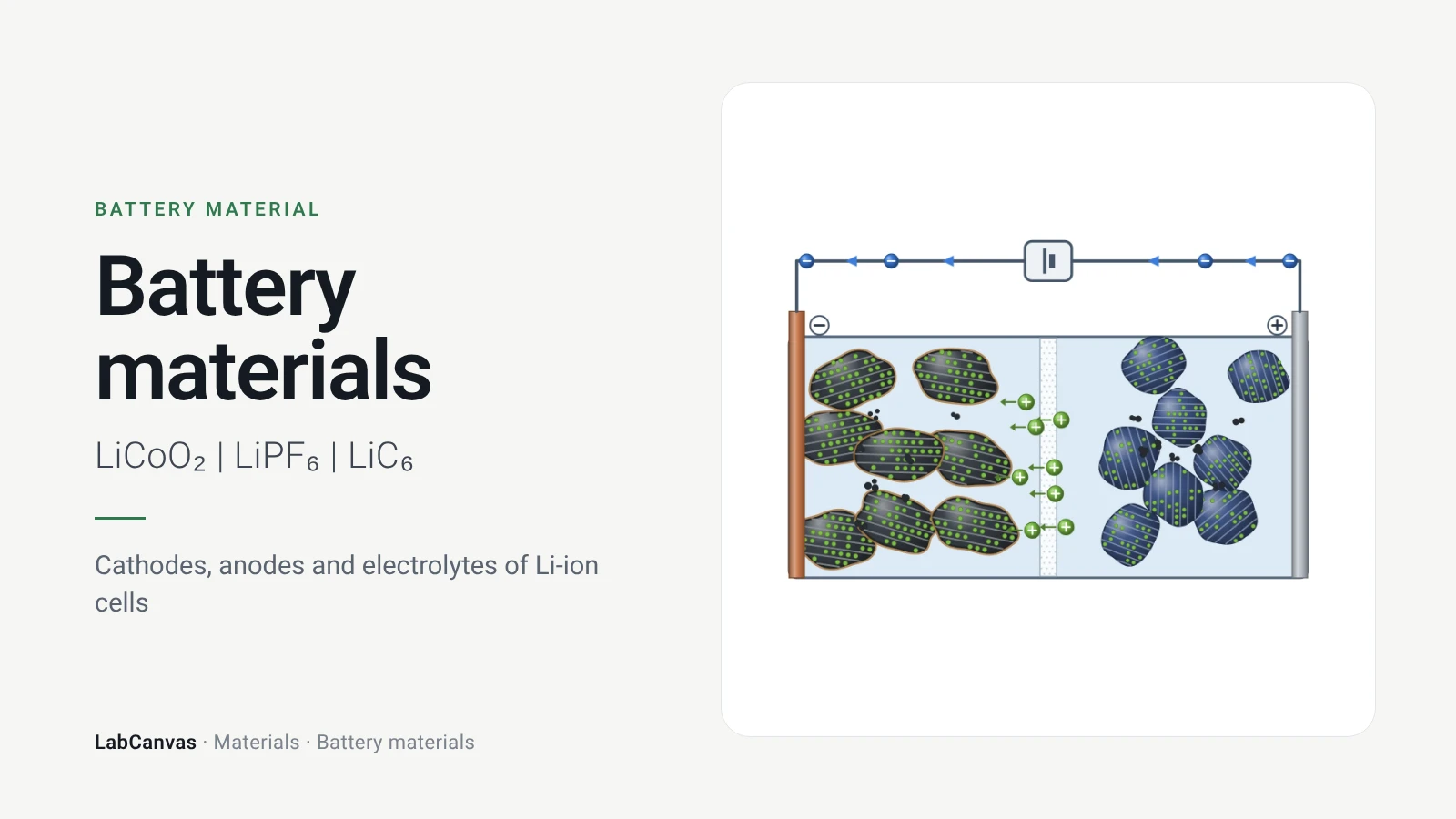
How a lithium-ion cell works and what is inside it: layered, spinel and olivine cathodes, graphite, silicon and lithium anodes, liquid and solid electrolytes.
LiFePO₄ (LFP)
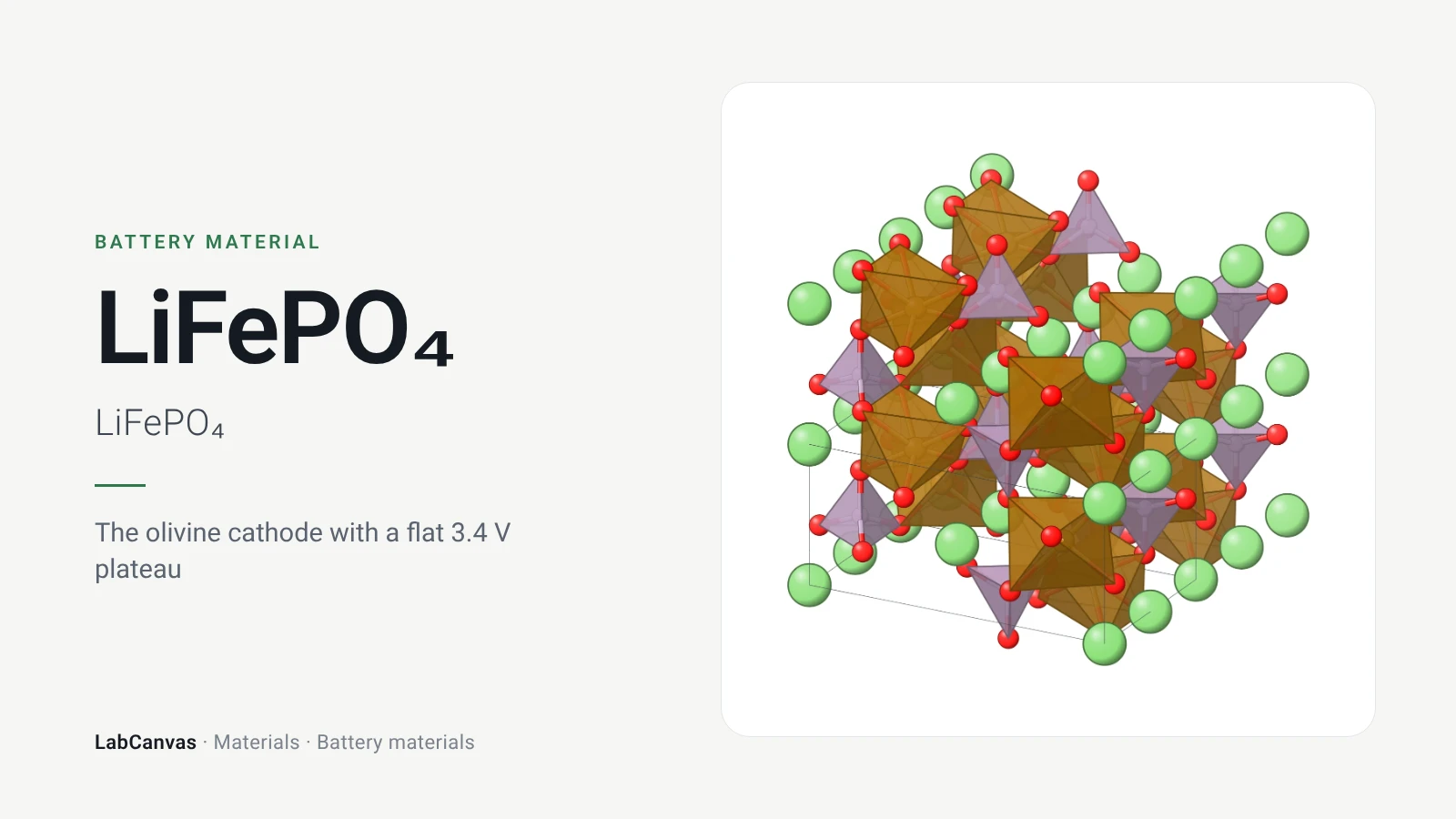
LiFePO₄ (LFP) cathode: olivine structure (Pnma), 1D lithium channels, the flat 3.4 V two-phase plateau, 170 mAh/g, carbon coating and why LFP is safe.
NMC (LiNiₓMnᵧCo₁₋ₓ₋ᵧO₂)
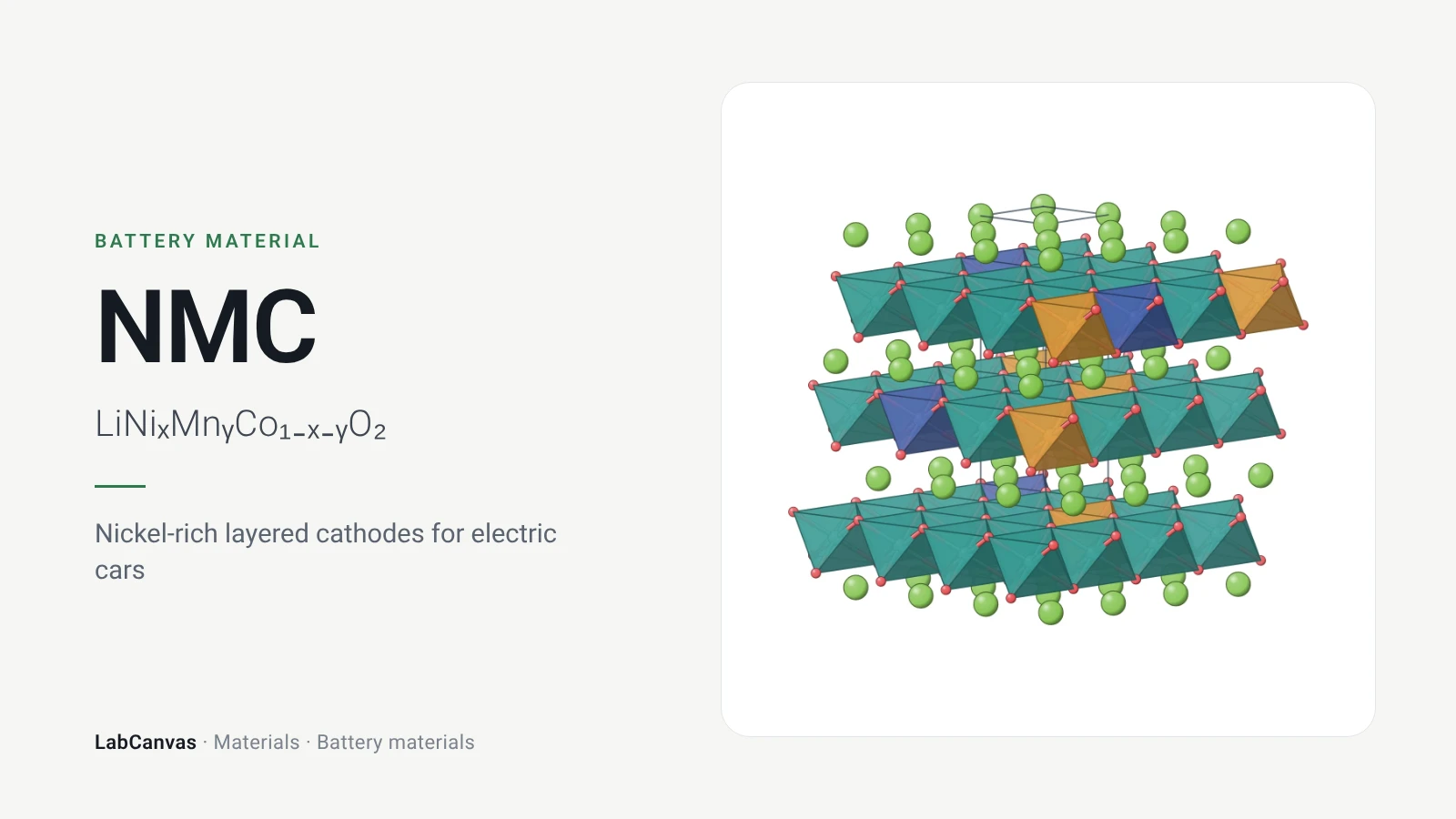
NMC cathodes (LiNiₓMnᵧCo₁₋ₓ₋ᵧO₂): layered structure, NMC111 to 811, why more nickel means more capacity but less stability, and the fixes.
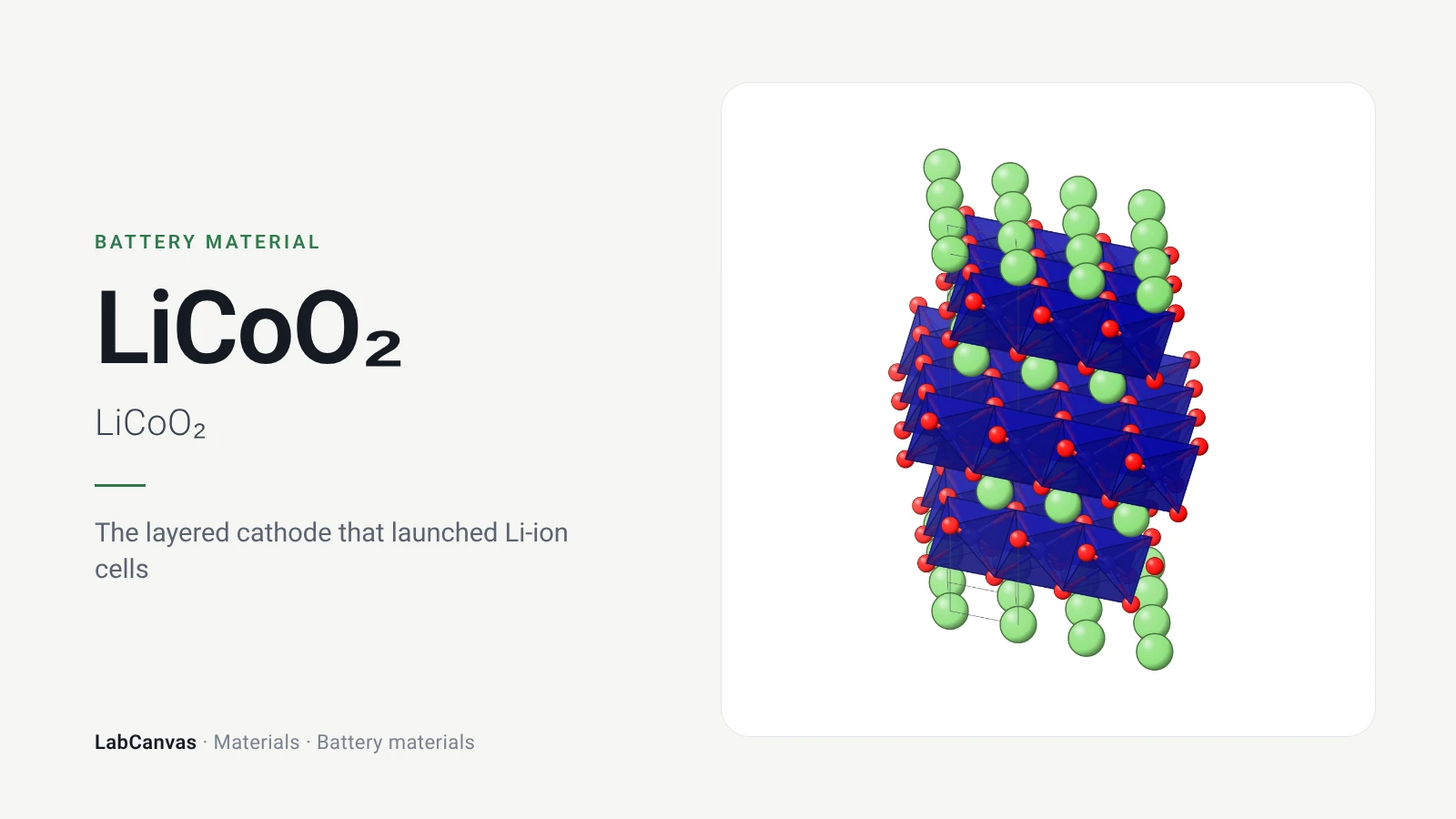
LiCoO₂
LiCoO₂ structure and properties: the layered O3 (α-NaFeO₂-type) cathode, why only half its lithium is used, ~4 V vs Li, phones and laptops, high-voltage LCO.
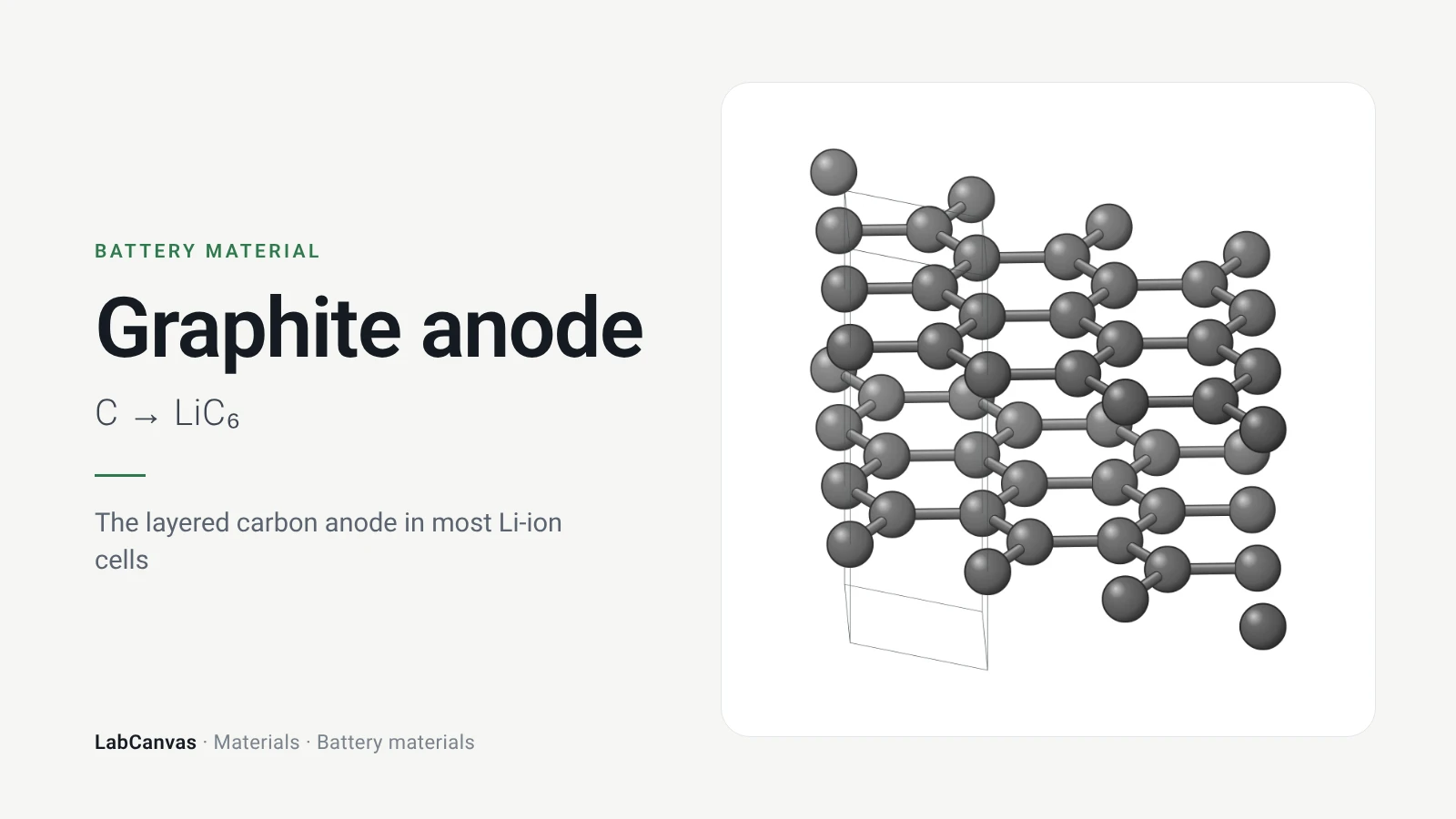
Graphite anode
Graphite anode in lithium-ion batteries: LiC₆ and 372 mAh/g, staging, intercalation near 0.1 V, the SEI from ethylene carbonate and lithium plating.
More on LabCanvas
- LiMn₂O₄: the spinel cathode: Editable figure template
- More battery figure templates: Ready-made, cited figures to edit
- Crystal structure figure software compared: VESTA, Mercury, CrystalMaker, Avogadro and LabCanvas
- Supercapacitor calculator: Free tool: capacitance, energy and power from cycling data
- Faradaic efficiency calculator: Free tool
- Battery figure templates: Cited, editable battery figures
- XRD Scherrer crystallite size calculator: Free tool
- Molar mass calculator: Free tool
- Journal figure size guide: Column widths and resolutions for 38 journals
- 3D models gallery: Turn MOFs, COFs, perovskites and more in 3D
Frequently asked questions
What is LiMn₂O₄?
Lithium manganese oxide, a spinel-structured cathode material for lithium-ion batteries (LMO). It works near 4.1 V with a theoretical capacity of about 148 mAh g⁻¹ and is valued for low cost, abundance and safety (Bakierska et al. 2016).
What is the crystal structure of LiMn₂O₄?
Cubic spinel, space group Fd-3m, with lithium on tetrahedral 8a sites, manganese on octahedral 16d sites and oxygen on 32e sites (Bakierska et al. 2016).
What is the voltage of a LiMn₂O₄ battery?
The LMO cathode shows two plateaus near 4.1 V vs Li/Li⁺, both from the Mn³⁺/Mn⁴⁺ redox couple (Bakierska et al. 2016).
What is the theoretical capacity of LiMn₂O₄?
About 148 mAh g⁻¹ (Bakierska et al. 2016), from one lithium per LiMn₂O₄ (148.2 mAh g⁻¹ calculated from the molar mass of 180.81 g mol⁻¹).
Why does LiMn₂O₄ lose capacity?
Mainly because of the Jahn–Teller distortion of high-spin Mn³⁺, which drives a phase transition near room temperature, and because manganese dissolves into the electrolyte at the surface of the delithiated cathode (Bakierska et al. 2016). Fading is worst at elevated temperature and high rate (Liu et al. 2026).
What is the Jahn–Teller effect in LiMn₂O₄?
High-spin Mn³⁺ has a single electron in its doubly degenerate eg orbitals, so its MnO₆ octahedron distorts and the lattice becomes tetragonal (Zhang et al. 2025). In LiMn₂O₄ this distortion is behind the structural transition and part of the capacity fade (Bakierska et al. 2016).
Is lithium diffusion in LiMn₂O₄ 3D?
Yes. The spinel has a three-dimensional lithium diffusion network, which gives LMO good rate capability for power-oriented cells (Liu et al. 2026), unlike olivine LiFePO₄, where lithium moves along one-dimensional channels.
What is LNMO (LiNi₀.₅Mn₁.₅O₄)?
The high-voltage, cobalt-free relative of LMO in which nickel replaces a quarter of the manganese. It works at about 4.7 V with a theoretical energy density of about 650 Wh kg⁻¹ (Zhang et al. 2025) and a theoretical capacity of 147 mAh g⁻¹ (Madinabeitia et al. 2022), but needs electrolytes and coatings that survive the high voltage.
References
- M. Bakierska, M. Świętosławski, M. Gajewska, A. Kowalczyk, Z. Piwowarska, L. Chmielarz, R. Dziembaj, M. Molenda. Enhancement of electrochemical performance of LiMn₂O₄ spinel cathode material by synergetic substitution with Ni and S. Materials 2016, 9, 366. doi:10.3390/ma9050366
- X. Liu, F. Li, B. Yin, G. Wang, H. Wu. Failure-mode-oriented design of cathode materials for practical lithium-ion batteries: from crystal stability to electrode-level durability. Front. Chem. 2026, 14, 1873892. doi:10.3389/fchem.2026.1873892
- B. Zhang et al.. Progress on the attenuation mechanism and modification of the cobalt-free spinel LiNi₀.₅Mn₁.₅O₄. Adv. Sci. 2025, 12, e08121. doi:10.1002/advs.202508121
- J. Chong, S. Xun, J. Zhang, X. Song, H. Xie, V. Battaglia, R. Wang. Li₃PO₄-coated LiNi₀.₅Mn₁.₅O₄: a stable high-voltage cathode material for lithium-ion batteries. Chem. Eur. J. 2014, 20, 7479–7485. doi:10.1002/chem.201304744
- I. Madinabeitia, J. Rikarte, G. Baraldi, F. J. Fernández-Carretero, I. Garbayo, A. García-Luis, M. Á. Muñoz-Márquez. Growth parameters and diffusion barriers for functional high-voltage thin-film batteries based on spinel LiNi₀.₅Mn₁.₅O₄ cathodes. ACS Appl. Mater. Interfaces 2022, 14, 2720–2730. doi:10.1021/acsami.1c18247
- H.-M. Cho, M. V. Chen, A. C. MacRae, Y. S. Meng. Effect of surface modification on nano-structured LiNi₀.₅Mn₁.₅O₄ spinel materials. ACS Appl. Mater. Interfaces 2015, 7, 16231–16239. doi:10.1021/acsami.5b01392
- J. Lim, S.-W. Kang, J. Moon, S. Kim, H. Park, J. P. Baboo, J. Kim. Low-temperature synthesis of LiFePO₄ nanocrystals by solvothermal route. Nanoscale Res. Lett. 2012, 7, 3. doi:10.1186/1556-276X-7-3
- U. Boesenberg et al.. Mesoscale phase distribution in single particles of LiFePO₄ following lithium deintercalation. Chem. Mater. 2013, 25, 1664–1672. doi:10.1021/cm400106k
- L. Yin et al.. Comprehensive review of synthesis, structure, and electrochemical performance of LiFePO₄. Adv. Sci. 2026, 13, e77203. doi:10.1002/advs.77203
Draw LiMn₂O₄ (spinel) for your paper or slides
LabCanvas is a browser workspace for scientific figures: framework clusters, linkers and nets, crystal structures in 2D and 3D, graphs and posters, all editable.
Edit the LiMn₂O₄ (spinel) figure