Solid electrolytes: garnet LLZO, argyrodite Li₆PS₅Cl and LGPS
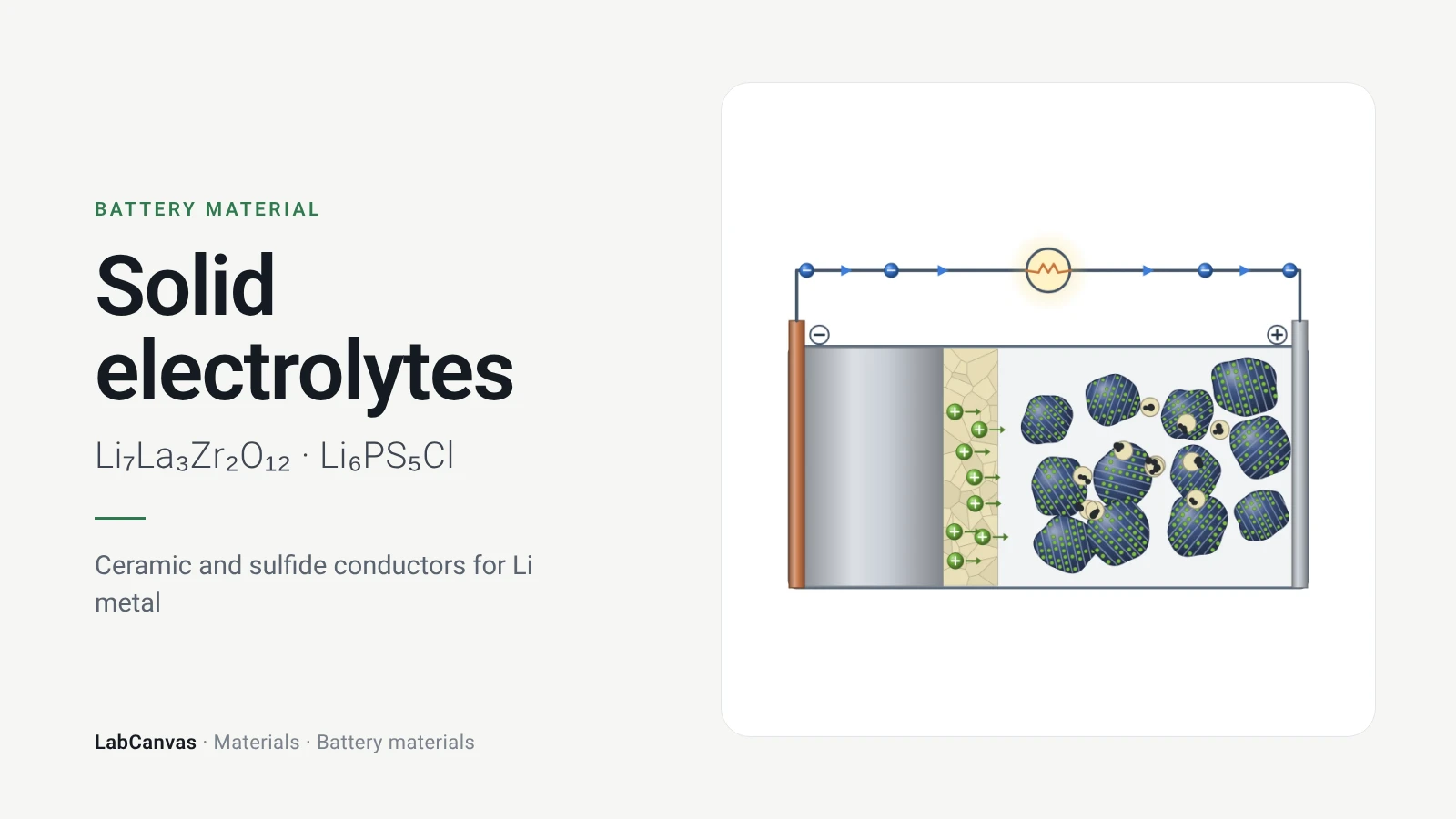
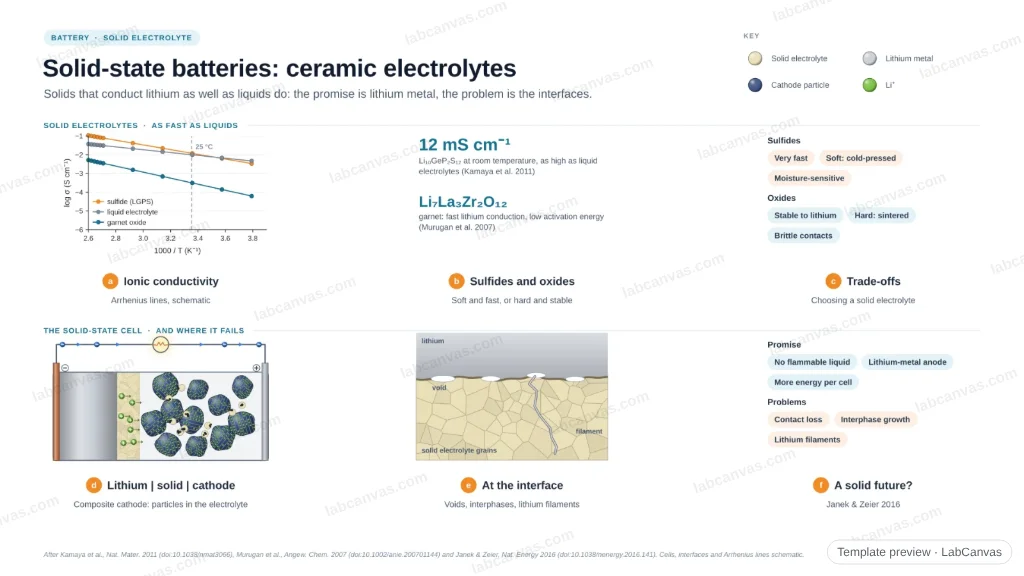
A solid electrolyte conducts lithium ions through a solid, replacing the flammable liquid of a lithium-ion cell and opening the way to lithium metal anodes (Lee et al. 2024). The two leading inorganic families are oxide garnets such as cubic Li₇La₃Zr₂O₁₂ (LLZO), stable against lithium and reaching about 0.2–1.5 mS cm⁻¹ when doped with Al, Ga or Ta (Wu et al. 2017; Tong et al. 2015; Fukuda et al. 2025), and soft sulfides such as argyrodite Li₆PS₅Cl (~10 mS cm⁻¹) and Li₁₀GeP₂S₁₂, whose 12 mS cm⁻¹ beat liquid electrolytes (Kim et al. 2026; Kamaya et al. 2011). Their weak points are interfaces and lithium dendrites.
Contents
Solid electrolytes (LLZO, argyrodite) at a glance
| Formula (garnet) | Li₇La₃Zr₂O₁₂, LLZO (Murugan et al. 2007) |
|---|---|
| Formula (argyrodite) | Li₆PS₅Cl, LPSCl (Kim et al. 2026) |
| LLZO phases | Tetragonal at room temperature when undoped, with ordered Li and poor conductivity; cubic with disordered Li above ~650 °C (Kang et al. 2025) |
| Cubic LLZO space group | Ia3̅d (Tong et al. 2015) |
| Stabilising the cubic phase | Aliovalent doping (Al, Ga, Ta) creates Li vacancies; Ga above 0.20 per formula unit gives fully cubic LLZO (Kang et al. 2025; Wu et al. 2017) |
| LLZO conductivity, 25 °C | Ga-doped 1.46 mS cm⁻¹ (Wu et al. 2017); Ta-doped 0.72 mS cm⁻¹ bulk (Tong et al. 2015); Al-doped >0.45 mS cm⁻¹ (Fukuda et al. 2025) |
| LLZO conductivity in S cm⁻¹ | About 2 × 10⁻⁴ to 1.5 × 10⁻³ S cm⁻¹ (calculated from the mS cm⁻¹ values above; Weller et al. 2019 for 0.24 mS cm⁻¹) |
| LLZO stability window | Above 5.5 V vs Li/Li⁺ (Kang et al. 2025) |
| Li₆PS₅Cl conductivity | ~10 mS cm⁻¹ at room temperature (Kim et al. 2026); 2.4 mS cm⁻¹ for <100 nm particles (Zhang et al. 2026) |
| LGPS conductivity | Li₁₀GeP₂S₁₂: 12 mS cm⁻¹ at room temperature (Kamaya et al. 2011) |
| Sulfide weak points | Moisture: Li₆PS₅Cl lost 36% of its conductivity in three days in dry-room air (Kim et al. 2026); reduced by Li metal to Li₂S and Li₃P (Lee S. et al. 2026) |
| Oxide weak points | Li₂CO₃ from air and rigid point contacts raise the Li/LLZO interfacial resistance (Lee H. et al. 2024) |
| PEO | Ions move in the amorphous part; PEO is mainly crystalline below 65 °C; Li⁺ transference number generally <0.5 (Lee H. et al. 2024) |
| Key reports | Murugan et al., Angew. Chem. Int. Ed. 46, 7778 (2007); Kamaya et al., Nat. Mater. 10, 682 (2011) |
Solid electrolytes (LLZO, argyrodite) structure diagram
Solid electrolytes (LLZO, argyrodite) structure drawing (high-resolution SVG)
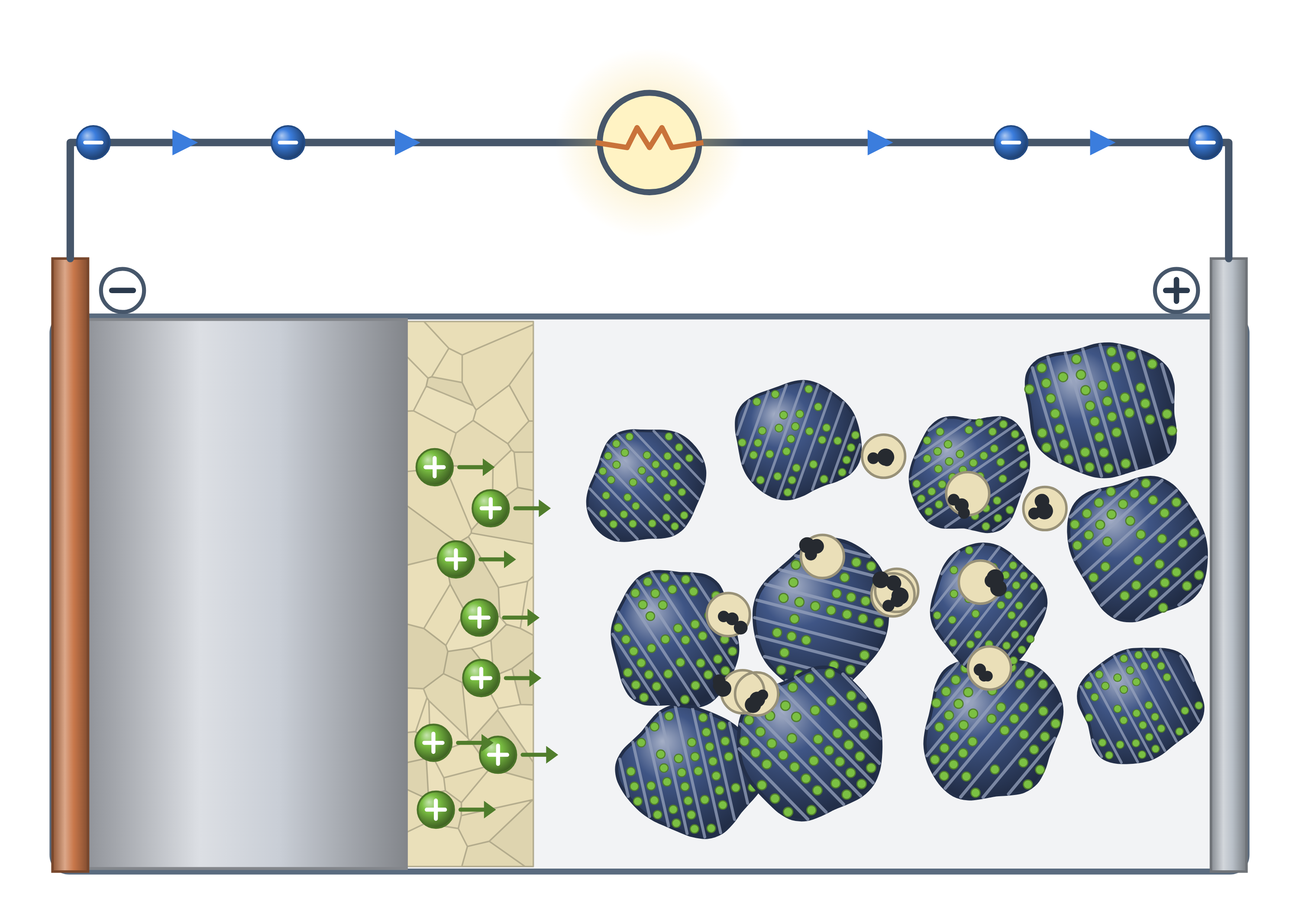
What a solid electrolyte does
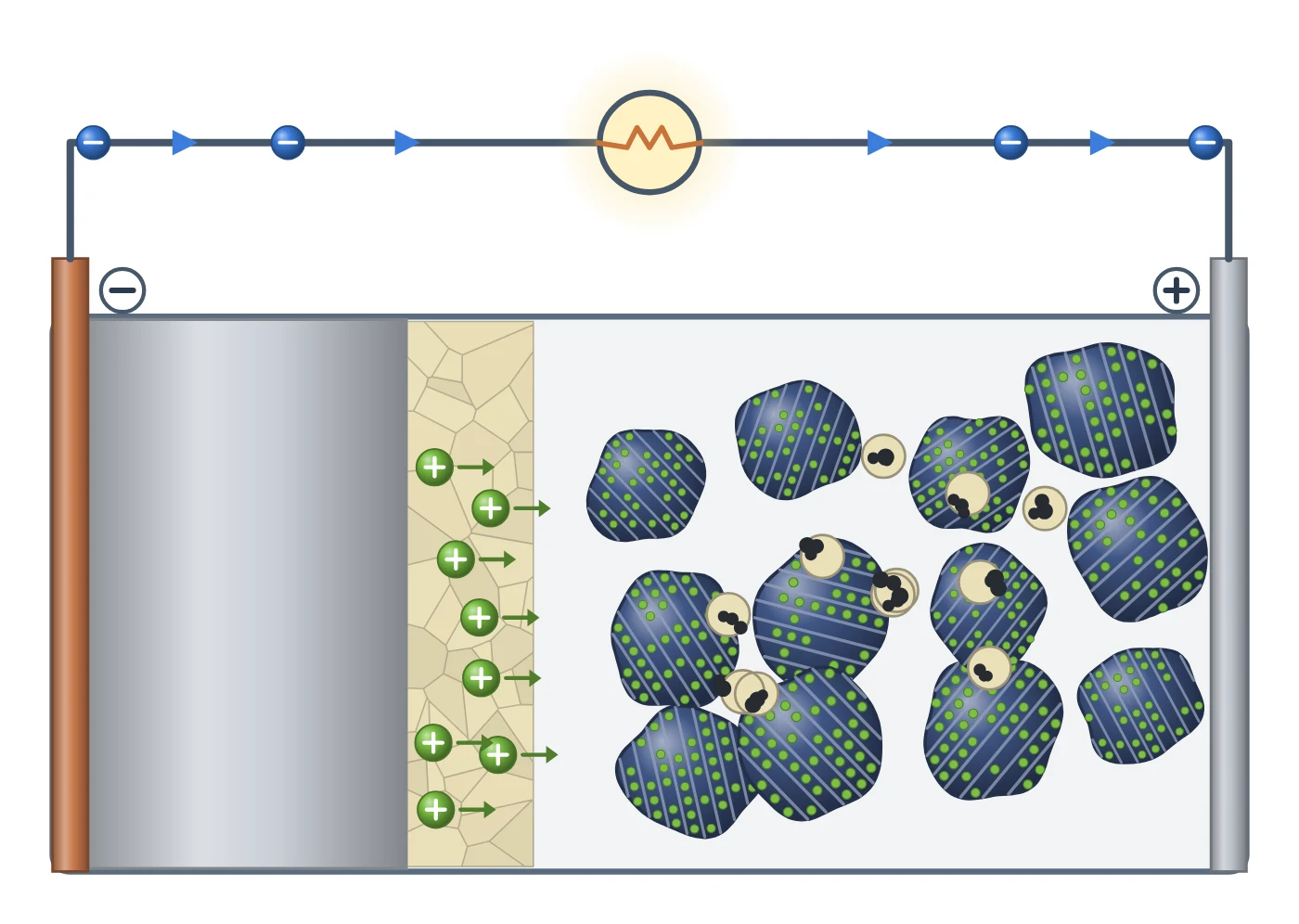
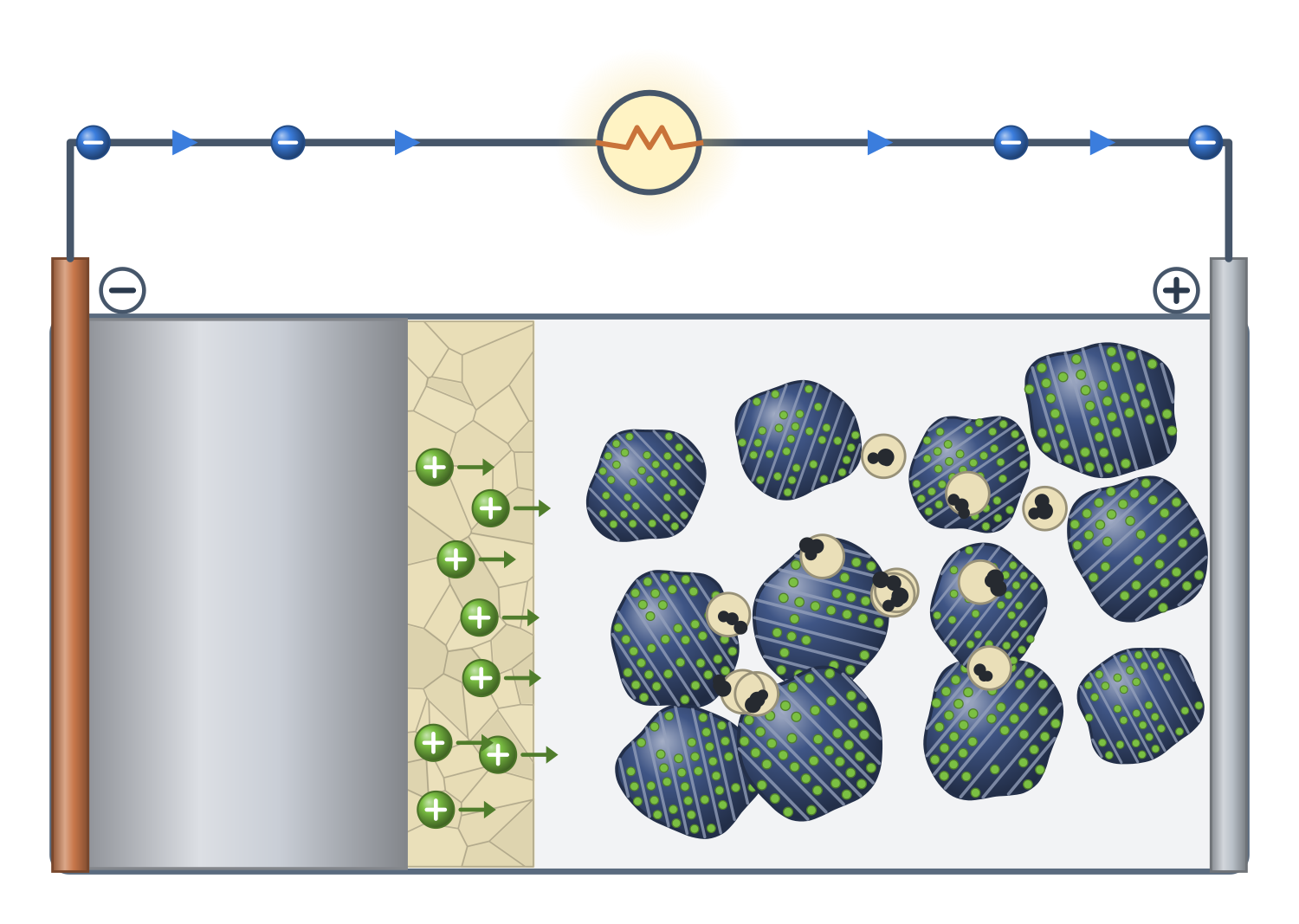
In a lithium-ion cell a liquid organic electrolyte carries Li⁺ between the electrodes. Lithium metal, with the lowest reduction potential (−3.04 V vs SHE), would be a far better anode than graphite (372 mAh g⁻¹), but in liquids it grows dendrites that can cause fires. Replacing the liquid with a solid electrolyte that also acts as the separator is meant to suppress dendrites and make all-solid-state lithium metal batteries safe (Lee H. et al. 2024).
A useful solid electrolyte needs high ionic conductivity at room temperature, a wide electrochemical window and chemical compatibility with lithium metal and the cathode. The candidates fall into three families: oxides, sulfides and polymers (Lee H. et al. 2024). This page sits in the battery materials hub.
Garnet LLZO: cubic vs tetragonal
Garnet Li₇La₃Zr₂O₁₂ was reported as a fast lithium-ion conductor by Murugan, Thangadurai and Weppner in 2007 (Murugan et al. 2007). It is attractive for its stability against lithium metal, wide electrochemical window and easy handling (Lee H. et al. 2024; Fukuda et al. 2025).
Undoped LLZO is tetragonal at room temperature: its lithium ions are ordered and the conductivity is poor. Near 650 °C it turns cubic (Ia3̅d), with disordered lithium and a much higher conductivity (Kang et al. 2025; Tong et al. 2015). To keep the cubic phase at room temperature, aliovalent dopants are added that create lithium vacancies and disrupt the ordering (Kang et al. 2025):
- Ga sits on lithium sites; above 0.20 Ga per formula unit the garnet is fully cubic, and Li₇₋₃ₓGaₓLa₃Zr₂O₁₂ reached 1.46 mS cm⁻¹ at 25 °C (Wu et al. 2017).
- Ta substitutes for Zr; Al-free Li₆.₄La₃Zr₁.₄Ta₀.₆O₁₂ gave 0.72 mS cm⁻¹ bulk conductivity at 25 °C with an activation energy of 0.26 eV (Tong et al. 2015). Ta-doped LLZO kept its cubic phase in contact with Li–Si at 500 °C, where Ga-doped LLZO reverted to tetragonal (Kang et al. 2025).
- Al-doped cubic LLZO densified by hot pressing exceeded 0.45 mS cm⁻¹ (Fukuda et al. 2025).
In S cm⁻¹ these doped garnets span roughly 2 × 10⁻⁴ to 1.5 × 10⁻³ S cm⁻¹ (calculated from the reported mS cm⁻¹ values).
Sulfides: argyrodite Li₆PS₅Cl and LGPS
Sulfide electrolytes conduct lithium about as well as liquids. Li₁₀GeP₂S₁₂ (LGPS), with a new three-dimensional framework, reached 12 mS cm⁻¹ at room temperature, the highest of any solid electrolyte at the time and above liquid organic electrolytes (Kamaya et al. 2011).
Argyrodite Li₆PS₅Cl combines a conductivity of about 10 mS cm⁻¹ with mechanical softness, which makes it the flagship electrolyte for all-solid-state batteries (Kim et al. 2026). Liquid-phase synthesis gives particles below 100 nm with 2.4 mS cm⁻¹ that improve contact in composite cathodes (Zhang et al. 2026).
The drawbacks: even the trace moisture of an industrial dry room degrades the surface into an oxygen-rich layer and cut the conductivity by 36% within three days (Kim et al. 2026); against lithium metal Li₆PS₅Cl keeps decomposing into Li₂S and Li₃P (Lee S. et al. 2026); and sulfides have a narrow electrochemical window (Lee H. et al. 2024).
Polymer electrolytes (PEO), briefly
Poly(ethylene oxide) dissolves lithium salts through its ether oxygens and is the most studied dry polymer electrolyte host; it is flexible and can be made into self-supporting films. But ions move only in its amorphous regions, PEO is mainly crystalline below 65 °C, so room-temperature conductivity is low, and the Li⁺ transference number is generally below 0.5, which causes concentration polarisation (Lee H. et al. 2024). Thin PEO layers are also used as soft buffers between LLZO and lithium (Lee H. et al. 2024).
Interfaces, dendrites and the lithium metal anode
- Point contacts. A rigid ceramic touches lithium only at points, so the local current density is high (Lee H. et al. 2024). Garnets also pick up Li₂CO₃ from air, which raises the interfacial resistance; polishing, polymer buffers and ALD coatings bring it down (Lee H. et al. 2024).
- Dendrites through ceramics. In LLZO, lithium grows along voids, cracks and grain boundaries (Hoinkis et al. 2023). Al, Ta and La segregate to grain boundaries during sintering, deplete lithium there and raise the electronic conductivity, which promotes lithium nucleation and dendrites (Yao et al. 2026). Porosity, electron leakage at grain boundaries and poor solid contact cause short circuits in LLZO cells (Cheng et al. 2026). A glass-ceramic Ta-LLZO with an amorphous grain-boundary phase reached a critical current density of 1.15 mA cm⁻² (Hoinkis et al. 2023).
- Dendrites through sulfides. Lithium deposits on existing cracks and defects; even Li–In alloy dendrites grow along pores and grain boundaries in Li₆PS₅Cl layers (Lee H. et al. 2024).
Silicon is an alternative anode for solid-state cells; see silicon anode.
How to draw a solid-state battery
For a paper, slide or poster, draw the cell as a stack: cathode composite (cathode particles mixed with electrolyte particles), a dense solid electrolyte layer, and a lithium metal anode, with a zoom on the anode interface showing point contacts, a dendrite running along a grain boundary and an interlayer that fixes it. In LabCanvas, the figure editor's Library has battery objects, including a solid-state cell you can edit and label, and the 3D Studio has battery models for a cell-level view; export the figure as a high-resolution image.
Solid electrolyte families compared
| Family | Example | Room-temperature conductivity | Strength | Weakness | Source |
|---|---|---|---|---|---|
| Oxide garnet | Ga-doped Li₇La₃Zr₂O₁₂ | 1.46 mS cm⁻¹ | Stable against Li metal, wide window | Rigid contacts, Li₂CO₃, dendrites at grain boundaries | Wu et al. 2017; Lee H. et al. 2024 |
| Sulfide argyrodite | Li₆PS₅Cl | ~10 mS cm⁻¹ | Soft, highly conductive | Moisture, reduced by Li metal | Kim et al. 2026; Lee S. et al. 2026 |
| Sulfide LGPS | Li₁₀GeP₂S₁₂ | 12 mS cm⁻¹ | Highest conductivity at its report | Narrow window, reacts with Li | Kamaya et al. 2011; Lee H. et al. 2024 |
| Polymer | PEO + Li salt | Low (mainly crystalline below 65 °C) | Flexible films | Low conductivity, transference number <0.5 | Lee H. et al. 2024 |
Related materials
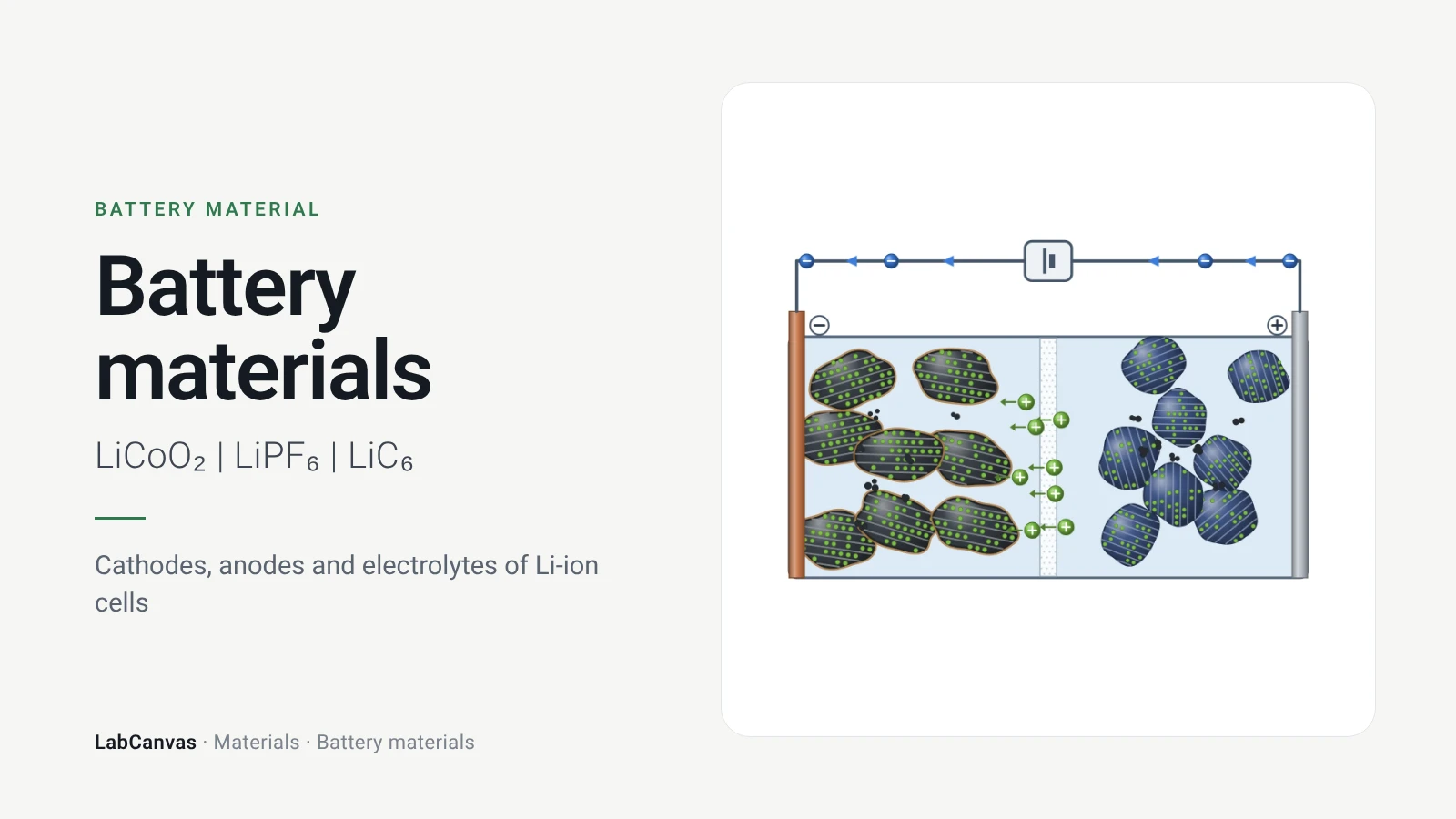
Battery materials
How a lithium-ion cell works and what is inside it: layered, spinel and olivine cathodes, graphite, silicon and lithium anodes, liquid and solid electrolytes.
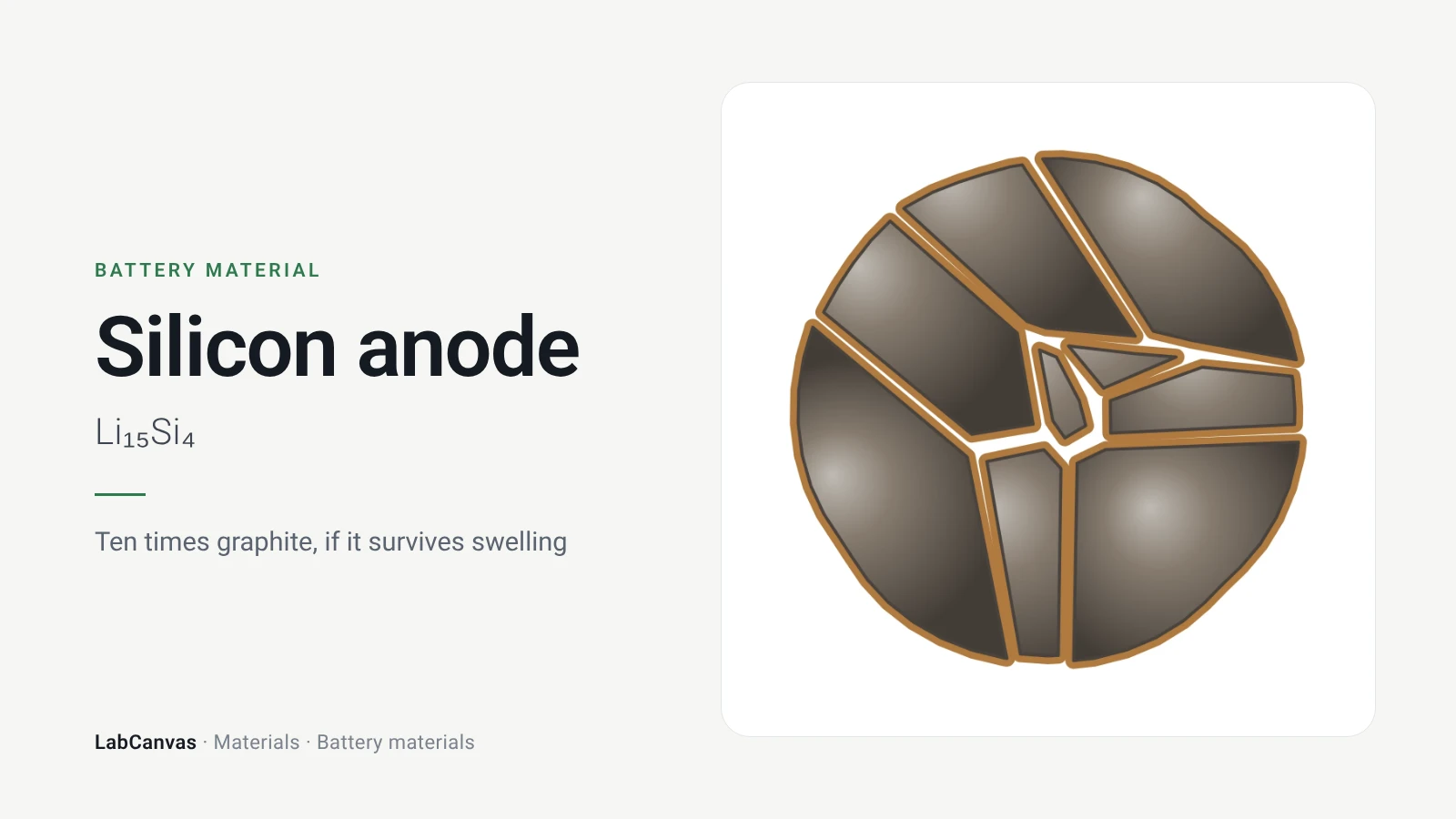
Silicon anode
Silicon anodes for Li-ion batteries: 3,579 mAh/g as Li₁₅Si₄, ~300% volume expansion, cracking and SEI, nanowires, yolk–shell, SiOx, Si–graphite, binders.
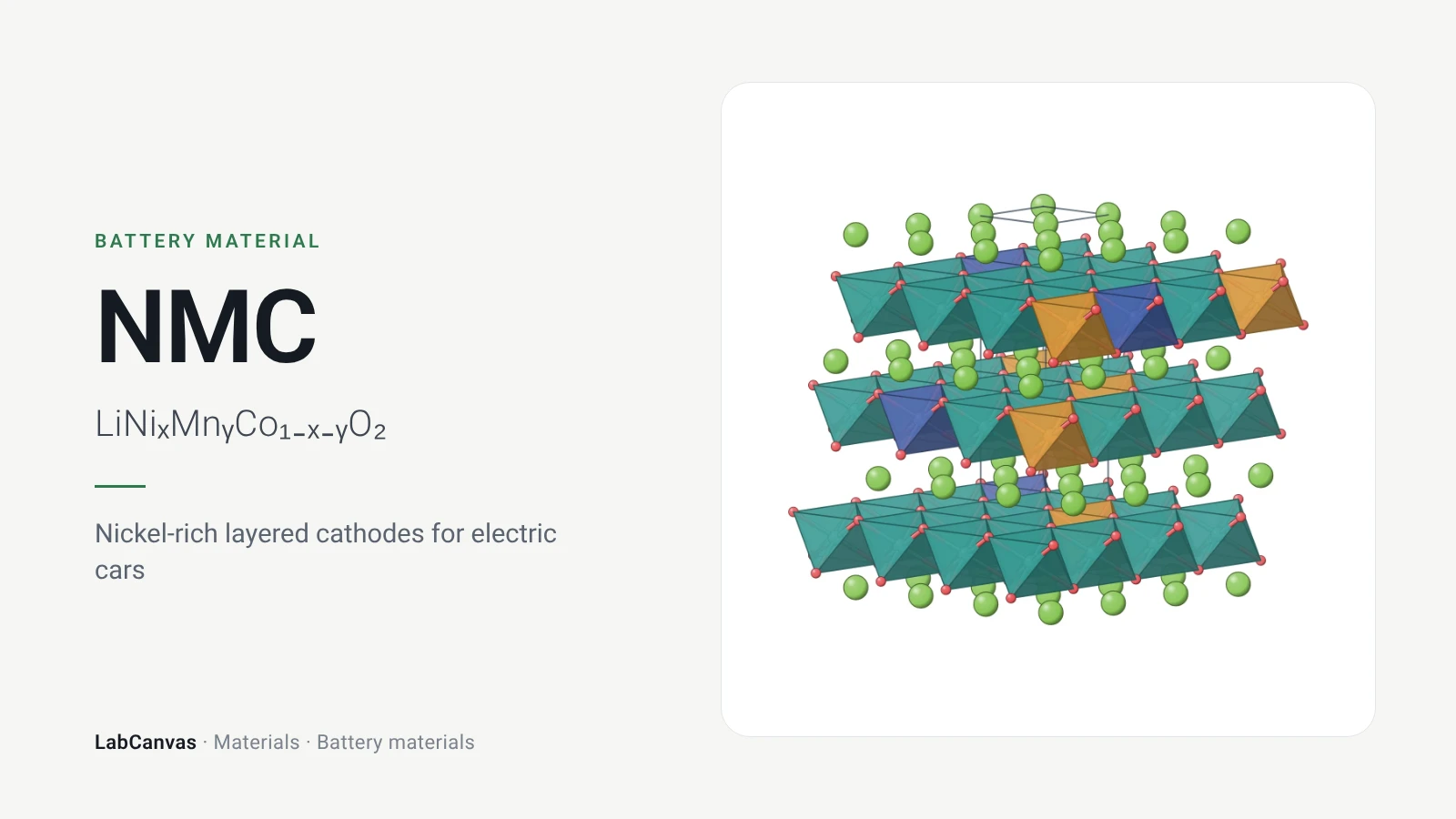
NMC (LiNiₓMnᵧCo₁₋ₓ₋ᵧO₂)
NMC cathodes (LiNiₓMnᵧCo₁₋ₓ₋ᵧO₂): layered structure, NMC111 to 811, why more nickel means more capacity but less stability, and the fixes.
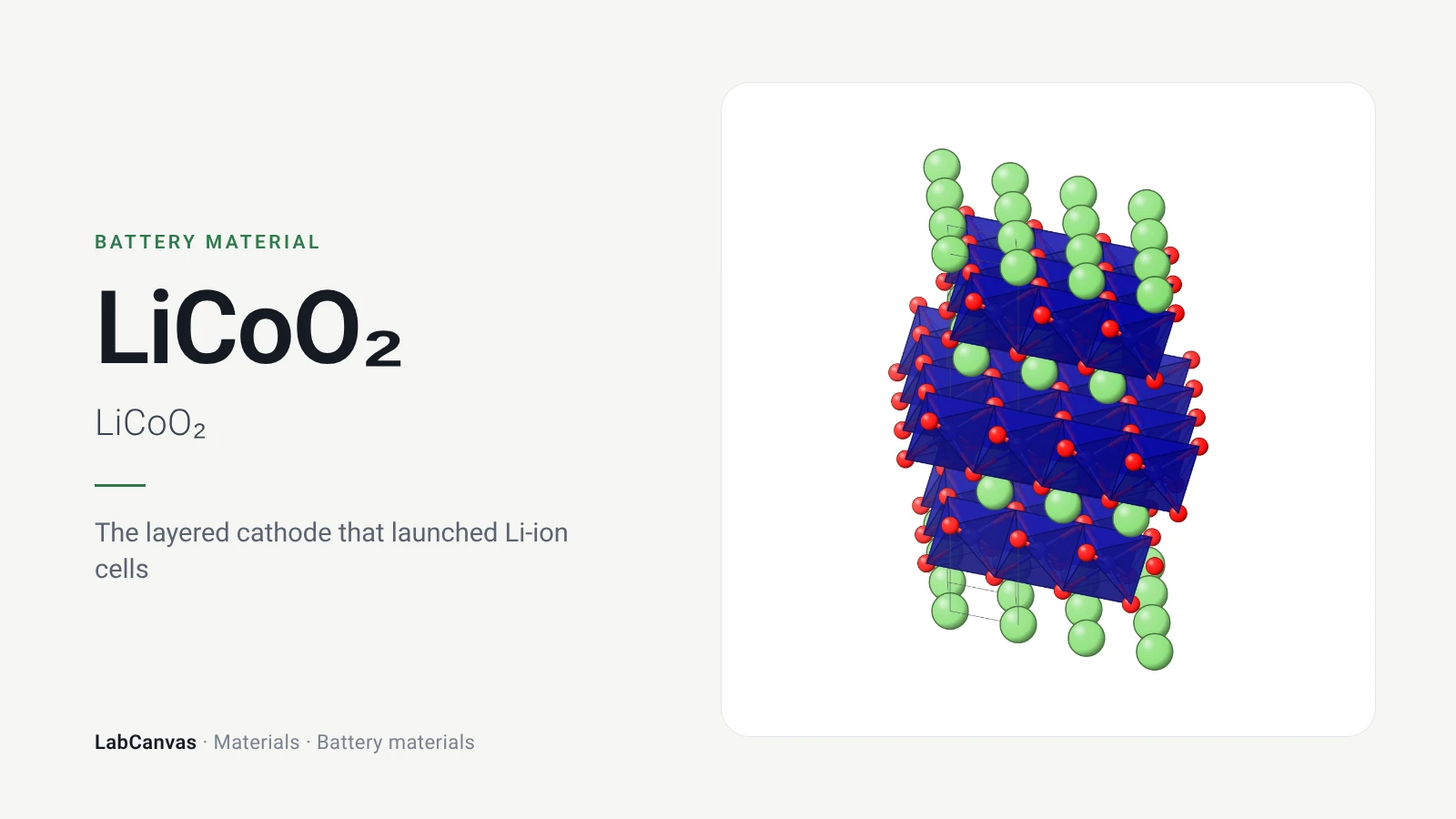
LiCoO₂
LiCoO₂ structure and properties: the layered O3 (α-NaFeO₂-type) cathode, why only half its lithium is used, ~4 V vs Li, phones and laptops, high-voltage LCO.
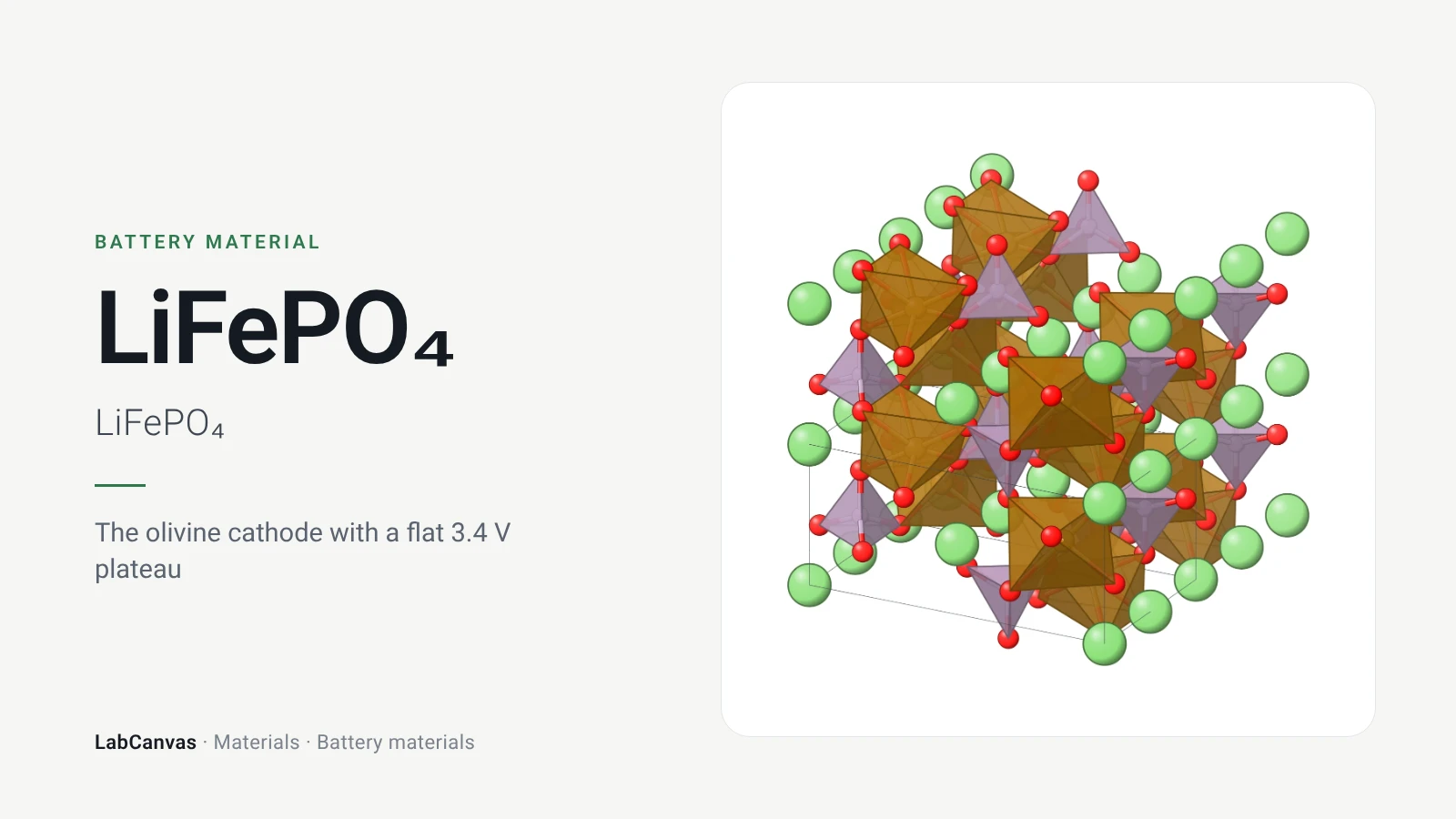
LiFePO₄ (LFP)
LiFePO₄ (LFP) cathode: olivine structure (Pnma), 1D lithium channels, the flat 3.4 V two-phase plateau, 170 mAh/g, carbon coating and why LFP is safe.
More on LabCanvas
- Solid-state batteries: ceramic electrolytes: Editable figure template
- More battery figure templates: Ready-made, cited figures to edit
- Crystal structure figure software compared: VESTA, Mercury, CrystalMaker, Avogadro and LabCanvas
- Supercapacitor calculator: Free tool: capacitance, energy and power from cycling data
- Faradaic efficiency calculator: Free tool
- Battery figure templates: Cited, editable battery figures
- XRD Scherrer crystallite size calculator: Free tool
- Molar mass calculator: Free tool
- Journal figure size guide: Column widths and resolutions for 38 journals
- 3D models gallery: Turn MOFs, COFs, perovskites and more in 3D
Frequently asked questions
What is LLZO?
Lithium lanthanum zirconate, Li₇La₃Zr₂O₁₂, a garnet-type oxide solid electrolyte first reported as a fast Li-ion conductor in 2007 (Murugan et al., Angew. Chem. 2007). It is valued for its stability against lithium metal and is used in its doped, cubic form.
What is the difference between cubic and tetragonal LLZO?
Undoped LLZO is tetragonal at room temperature, with ordered lithium and poor conductivity; the cubic phase (Ia3̅d) has disordered lithium and conducts far better. Doping with Al, Ga or Ta creates lithium vacancies that keep LLZO cubic at room temperature (Kang et al. 2025; Wu et al. 2017).
What is the ionic conductivity of LLZO?
Doped cubic LLZO reaches about 0.2–1.5 mS cm⁻¹ (2 × 10⁻⁴ to 1.5 × 10⁻³ S cm⁻¹, calculated) at room temperature: 1.46 mS cm⁻¹ with Ga (Wu et al. 2017), 0.72 mS cm⁻¹ bulk with Ta (Tong et al. 2015), >0.45 mS cm⁻¹ with Al (Fukuda et al. 2025).
Why dope LLZO with Ga, Ta or Al?
Aliovalent dopants create lithium vacancies, disrupt lithium ordering and stabilise the highly conducting cubic phase (Kang et al. 2025). Ga-doped LLZO conducts better at room temperature than Ta-doped LLZO, while Ta-doped LLZO is the more stable at high temperature (Kang et al. 2025).
What is argyrodite Li6PS5Cl?
A lithium thiophosphate solid electrolyte with the argyrodite structure. It conducts about 10 mS cm⁻¹ at room temperature and is soft, which makes it the leading sulfide for all-solid-state batteries, but it degrades in moisture (Kim et al., Nat. Commun. 2026).
What is LGPS?
Li₁₀GeP₂S₁₂, a sulfide lithium superionic conductor with a three-dimensional framework that reached 12 mS cm⁻¹ at room temperature, above liquid organic electrolytes (Kamaya et al., Nat. Mater. 2011).
Do solid electrolytes stop lithium dendrites?
Not by themselves. Lithium still grows along voids, cracks and grain boundaries in LLZO (Hoinkis et al. 2023; Yao et al. 2026) and along cracks, pores and grain boundaries in sulfides (Lee H. et al. 2024). Dense microstructures, clean grain boundaries and interlayers raise the current a cell can take.
Oxide vs sulfide solid electrolyte: which is better?
Sulfides conduct better and are soft enough to press into good contact, but they are moisture-sensitive and react with lithium; oxides such as LLZO have a wide window and good stability against lithium but are rigid and suffer interfacial resistance (Lee H. et al. 2024; Kim et al. 2026).
References
- R. Murugan, V. Thangadurai, W. Weppner. Fast lithium ion conduction in garnet-type Li₇La₃Zr₂O₁₂. Angew. Chem. Int. Ed. 2007, 46, 7778–7781. doi:10.1002/anie.200701144
- N. Kamaya et al.. A lithium superionic conductor. Nat. Mater. 2011, 10, 682–686. doi:10.1038/nmat3066
- H. Kang et al.. Comparative study of Ta and Ga doping effects on Li₇La₃Zr₂O₁₂ garnet electrolytes for advanced thermal battery applications. RSC Adv. 2025, 15, 27345–27355. doi:10.1039/d5ra03917g
- J.-F. Wu et al.. Gallium-doped Li₇La₃Zr₂O₁₂ garnet-type electrolytes with high lithium-ion conductivity. ACS Appl. Mater. Interfaces 2017, 9, 1542–1552. doi:10.1021/acsami.6b13902
- X. Tong, V. Thangadurai, E. D. Wachsman. Highly conductive Li garnets by a multielement doping strategy. Inorg. Chem. 2015, 54, 3600–3607. doi:10.1021/acs.inorgchem.5b00184
- M. Fukuda et al.. High-temperature sintering of garnet solid electrolyte Li₇La₃Zr₂O₁₂: a comparative study of induction hot pressing and spark plasma sintering. Small 2025, 21, e06257. doi:10.1002/smll.202506257
- J. M. Weller, J. A. Whetten, C. K. Chan. Nonaqueous polymer combustion synthesis of cubic Li₇La₃Zr₂O₁₂ nanopowders. ACS Appl. Mater. Interfaces 2019, 12, 953–962. doi:10.1021/acsami.9b19981
- N. Hoinkis et al.. Amorphous phase induced lithium dendrite suppression in glass-ceramic garnet-type solid electrolytes. ACS Appl. Mater. Interfaces 2023, 15, 28692–28704. doi:10.1021/acsami.3c01667
- K. Yao et al.. Elimination of detrimental grain boundary segregation in garnets. Nat. Commun. 2026, 17. doi:10.1038/s41467-026-74887-z
- C. Cheng, Z. Gu, T. Zhao. LLZO-based solid-state lithium metal batteries: electrolyte regulation and interface optimization strategies. Chem. Asian J. 2026, 21, e70899. doi:10.1002/asia.70899
- Y. S. Kim, J. D. Yi, S. Sung, D. H. Seo. Moisture-induced surface degradation mechanism of argyrodite Li₆PS₅Cl under dry-room conditions. Nat. Commun. 2026, 17. doi:10.1038/s41467-026-75537-0
- J. Zhang, G. Liu, X. Yao. Nanosized Li₆PS₅Cl solid electrolyte for all-solid-state lithium batteries. Nano Lett. 2026, 26, 11413–11419. doi:10.1021/acs.nanolett.6c02780
- S. Lee et al.. Electrochemically induced interphase by complex hydride anions in argyrodite solid electrolytes for stable lithium metal all-solid-state batteries. Adv. Sci. 2026, 13, e75514. doi:10.1002/advs.75514
- H. Lee, T. Yoon, O. B. Chae. Strategies for enhancing the stability of lithium metal anodes in solid-state electrolytes. Micromachines 2024, 15, 453. doi:10.3390/mi15040453
Draw Solid electrolytes (LLZO, argyrodite) for your paper or slides
LabCanvas is a browser workspace for scientific figures: framework clusters, linkers and nets, crystal structures in 2D and 3D, graphs and posters, all editable.
Edit the Solid electrolytes (LLZO, argyrodite) figure