HKUST-1 (Cu-BTC): structure, synthesis and properties
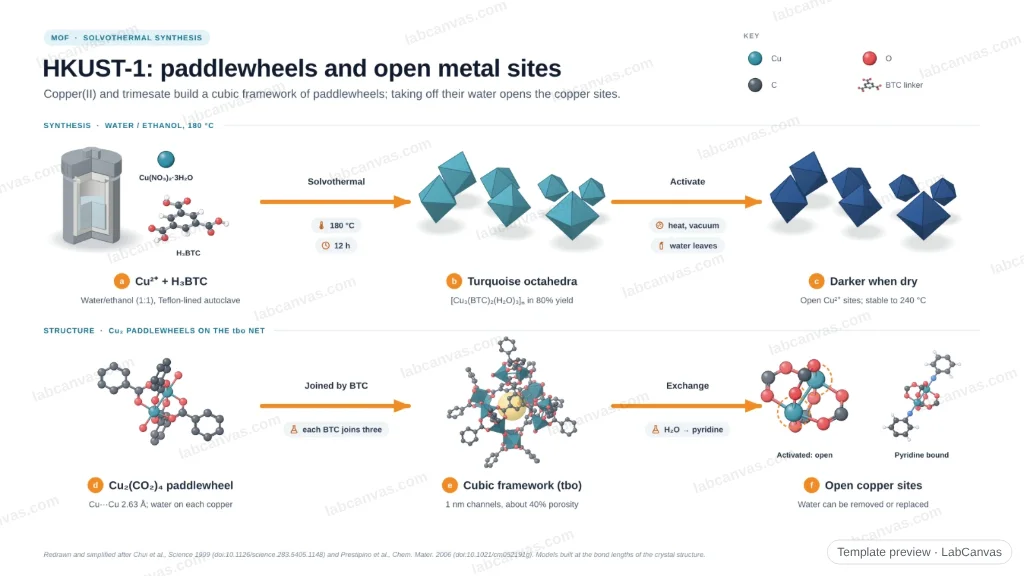
HKUST-1, also called Cu-BTC or MOF-199, is a copper metal–organic framework, Cu₃(BTC)₂: pairs of Cu²⁺ ions bridged by four carboxylates (paddlewheels) joined by trimesate (benzene-1,3,5-tricarboxylate, BTC) linkers into a cubic framework with 1 nm channels. First reported by Chui, Lo, Charmant, Orpen and Williams in Science in 1999 as [Cu₃(TMA)₂(H₂O)₃]ₙ, it is stable up to 240 °C, and removing the water bound to each copper leaves open metal sites that bind guest molecules.
Last updated
HKUST-1 at a glance
| Formula | Cu₃(BTC)₂, BTC = benzene-1,3,5-tricarboxylate (trimesate); as made, [Cu₃(BTC)₂(H₂O)₃]ₙ (Chui et al. 1999) |
|---|---|
| Other names | Cu-BTC, MOF-199, copper trimesate; TMA (trimesate) in the first paper |
| Name | From the Hong Kong University of Science and Technology, where it was first made (Chui et al. 1999) |
| Molar mass | 604.9 g mol⁻¹ for Cu₃(BTC)₂, 658.9 g mol⁻¹ with three waters (calculated from the formula) |
| Metal node (SBU) | Cu₂(CO₂)₄ paddlewheel, Cu···Cu 2.63 Å, one water molecule on each copper (Chui et al. 1999) |
| Organic linker | Trimesate (BTC³⁻), from trimesic acid H₃BTC; each linker joins three paddlewheels |
| Topology | tbo (Kong et al. 2013) |
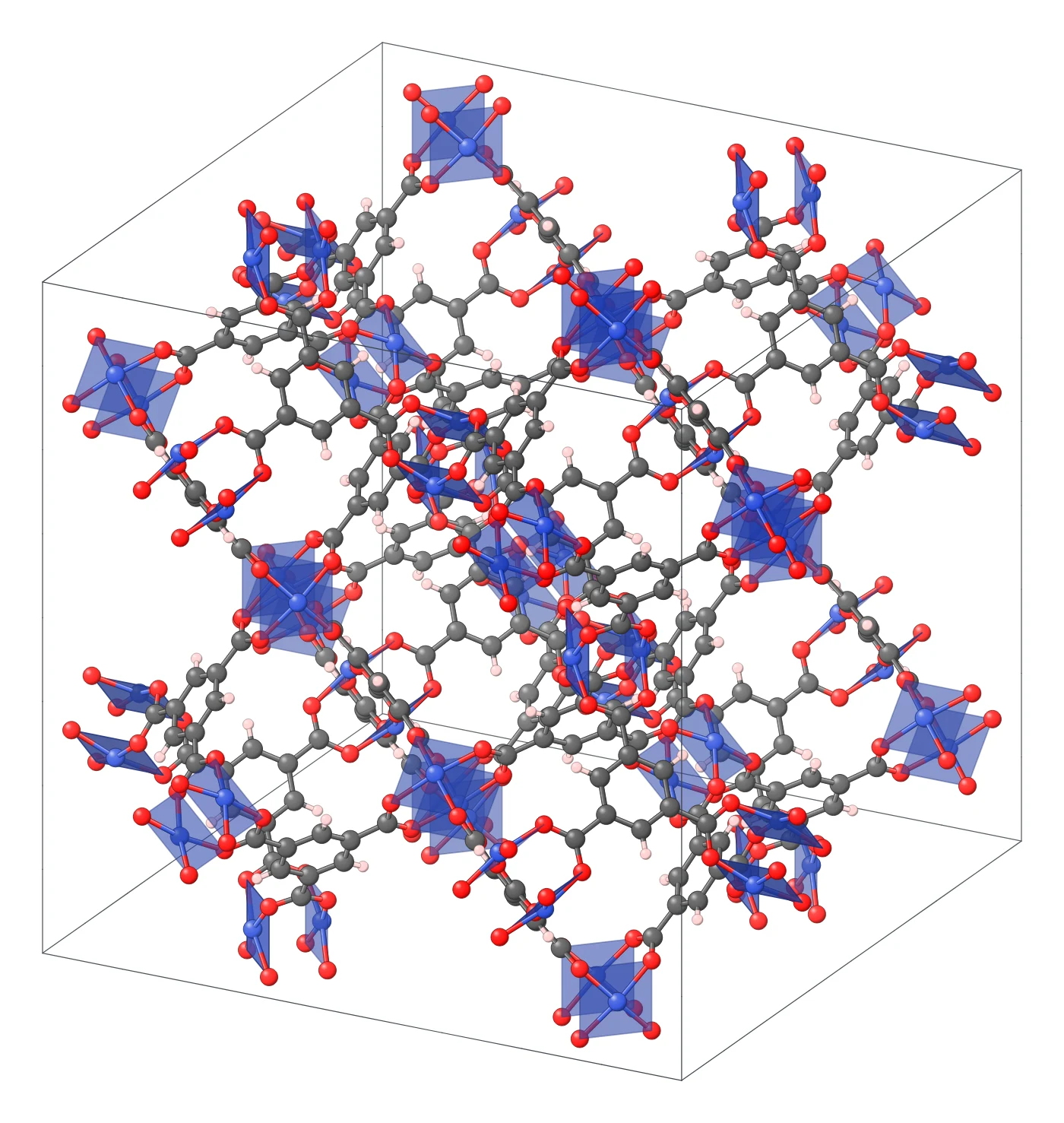
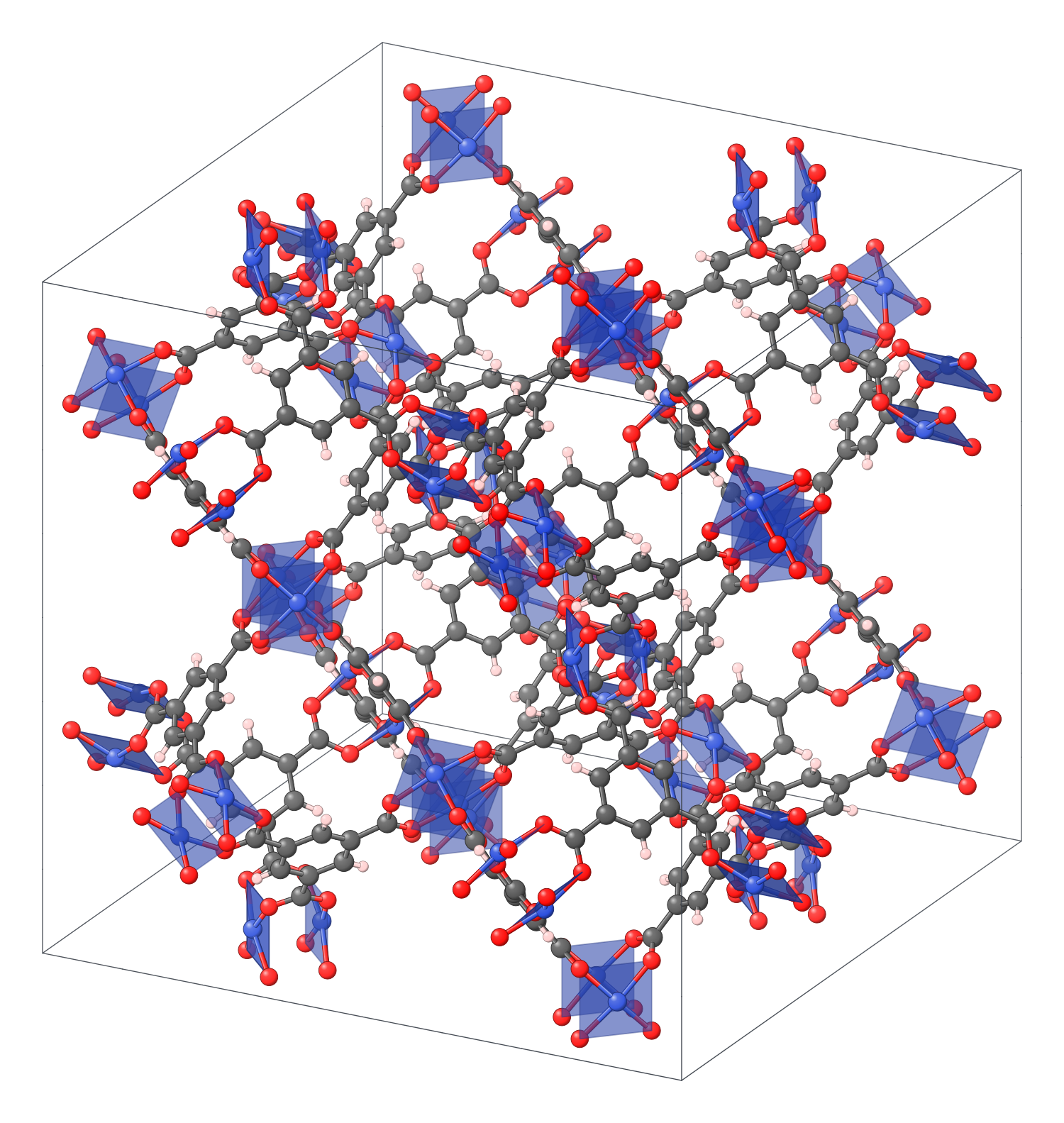
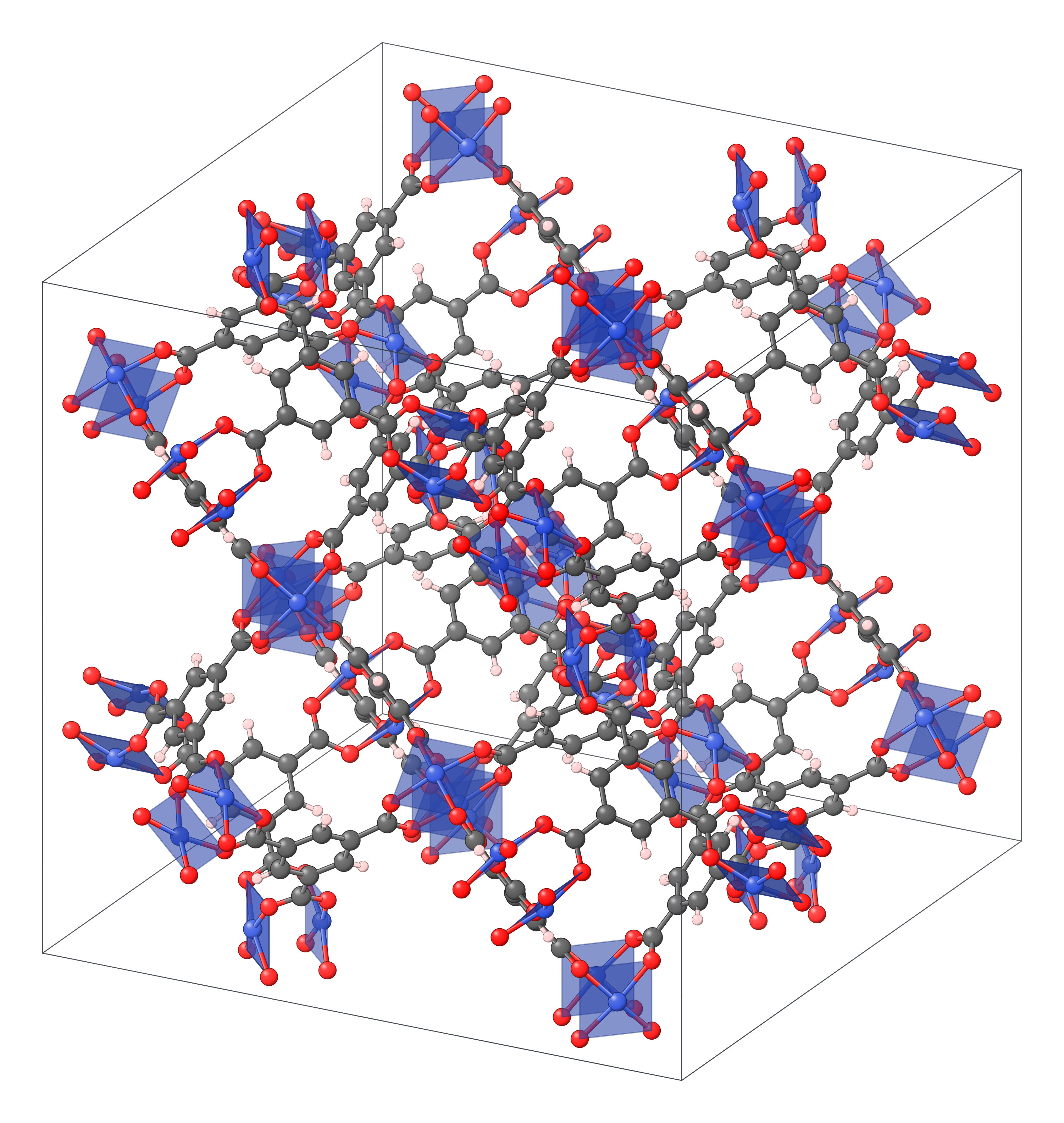
| Crystal system | Cubic, space group Fm-3m, a ≈ 26.34 Å (the crystal file on this page), 48 copper atoms per cell |
| Pores | 1 nm channels and about 40% accessible porosity (Chui et al. 1999); three kinds of pore about 12.6, 10.6 and 5.0 Å across in the dehydrated framework (Wong-Ng et al. 2015) |
| Density | About 0.88 g cm⁻³ without water (calculated from the cubic cell) |
| Thermal stability | Stable up to 240 °C by thermogravimetry and high-temperature single-crystal diffraction (Chui et al. 1999) |
| Open metal sites | Heating under vacuum removes the water on copper; the open Cu²⁺ sites then bind CO and H₂ at low temperature (Prestipino et al. 2006) |
| First reported | Chui, Lo, Charmant, Orpen and Williams, Science 283, 1148 (1999) |
HKUST-1 structure diagram
HKUST-1 crystal structure (high-resolution SVG)
HKUST-1 in 3D (interactive)
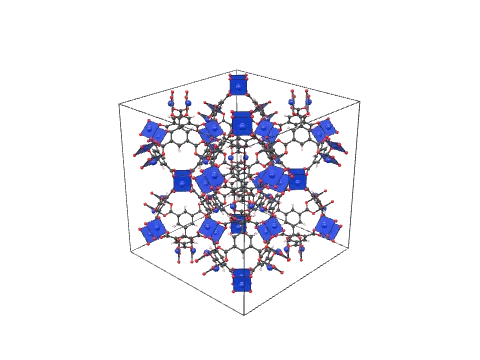
Loading the 3D model…
HKUST-1 structure explained
HKUST-1 is built from two parts. The node is a copper paddlewheel: two Cu²⁺ ions 2.63 Å apart, held together by four carboxylate groups that bridge them like the blades of a paddlewheel, Cu₂(CO₂)₄. Each copper also carries one water molecule, pointing out along the Cu···Cu axis (Chui et al. 1999).
The linker is trimesate (BTC³⁻), a benzene ring with three carboxylates at 120°. Each linker joins three paddlewheels, and each paddlewheel takes four linkers. Together they make the tbo net (Kong et al. 2013), a cubic framework of cages (Fm-3m, a ≈ 26.3 Å).
The result is a three-dimensional system of channels about 1 nm across, with about 40% of the solid accessible to guests (Chui et al. 1999). The dehydrated framework has three kinds of pore, about 12.6, 10.6 and 5.0 Å across (Wong-Ng et al. 2015).
How HKUST-1 is made
- Solvothermal synthesis. Copper(II) nitrate trihydrate and trimesic acid (H₃BTC) in water/ethanol are heated in a sealed, Teflon-lined vessel at 180 °C for 12 h. Turquoise octahedral crystals of [Cu₃(BTC)₂(H₂O)₃]ₙ form in 80% yield (Chui et al. 1999).
- Washing. The crystals are separated and washed to remove unreacted reagents.
- Activation. Heating under vacuum removes the water from the copper ions and empties the pores; the crystals turn darker and the framework survives (Prestipino et al. 2006). Water binds to these copper sites in the as-made crystals, so activated samples are kept dry when the open sites are needed.
- Other routes. HKUST-1 has also been made by sonochemistry, where the sonication conditions set the particle size (Armstrong et al. 2017), by continuous extrusion with little solvent (Crawford et al. 2015), and as thin films by seeded growth (Brower et al. 2017).
Why HKUST-1 matters
When it was reported in 1999, HKUST-1 offered something zeolites could not: a highly porous, thermally stable crystal whose channel linings could be changed chemically. The water molecules on the copper ions can be replaced by pyridines, functionalising the pores without destroying the framework (Chui et al. 1999).
It became the classic example of a MOF with open metal sites. Once the water is removed, each Cu²⁺ is left with a free coordination site facing the pore. Small molecules bind there: carbonyl and dihydrogen adducts of the copper ions were observed by infrared spectroscopy at low temperature (Prestipino et al. 2006). The copper paddlewheel it is built on is one of the most widely used building units in MOF chemistry.
Uses and research areas
- Gas adsorption. Its open copper sites bind small molecules such as CO and H₂ (Prestipino et al. 2006), which makes HKUST-1 a reference material in gas storage and separation studies.
- Thin films and electronics. HKUST-1 grows as thin films (Brower et al. 2017); filling the pores of such films with TCNQ makes them electrically conducting, with a conductivity that can be tuned (Talin et al. 2014).
- Scale-up. It was among the MOFs made continuously by extrusion at large scale with little or no solvent (Crawford et al. 2015).
- Limitation. Water binds to the copper sites, so the activated material has to be handled dry when the open sites are needed.
How to draw the HKUST-1 structure
For a paper, slide or poster, show the paddlewheel (two copper atoms and four carboxylates, with or without the axial water), one trimesate linker, and the cubic framework of cages. The figure above has all three, plus the synthesis and the open copper sites, and opens as an editable LabCanvas figure. The crystal structure SVG is drawn from the HKUST-1 crystal file by the LabCanvas figure editor, where you can switch between atoms and polyhedra and change the number of cells; the 3D model on this page opens in the LabCanvas 3D Studio, where you can turn it and export a high-resolution image.
HKUST-1 compared with other well-known MOFs
| MOF | Formula | Metal node | Linker | Net | Stable to | First report |
|---|---|---|---|---|---|---|
| HKUST-1 | Cu₃(BTC)₂ | Cu₂ paddlewheel | Trimesate (BTC) | tbo | 240 °C | Chui et al., Science 1999 |
| MOF-5 (IRMOF-1) | Zn₄O(BDC)₃ | Zn₄O cluster | Terephthalate | pcu | 300 °C | Li et al., Nature 1999 |
| ZIF-8 | Zn(mIm)₂ | Single Zn²⁺ (tetrahedral) | 2-Methylimidazolate | sod | 550 °C | Park et al., PNAS 2006 |
| UiO-66 | Zr₆O₄(OH)₄(BDC)₆ | Zr₆ cluster | Terephthalate | fcu | Above 500 °C | Cavka et al., JACS 2008 |
Related materials
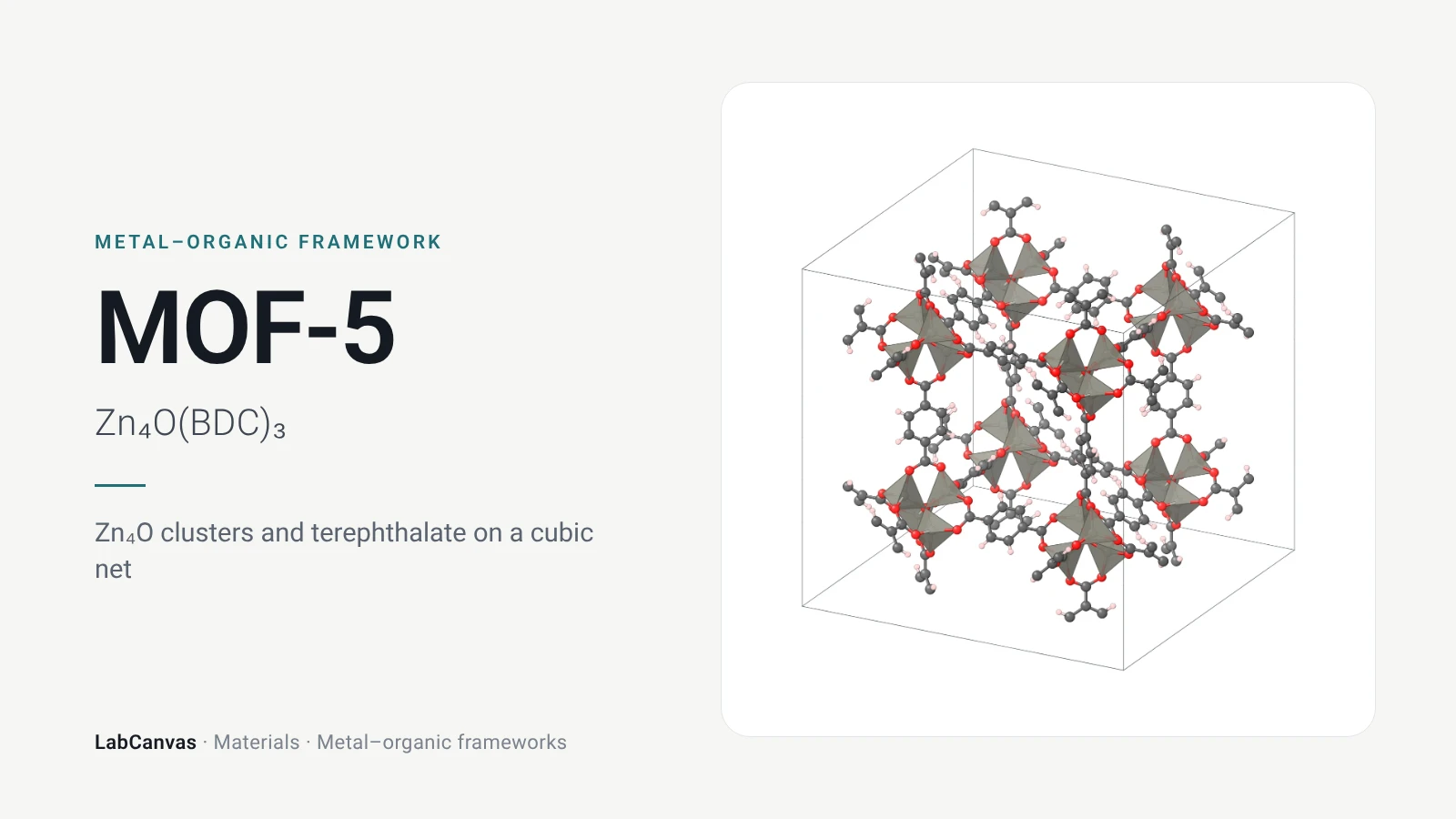
MOF-5
MOF-5, Zn₄O(BDC)₃: its cubic structure in 2D and interactive 3D, how it is made, surface area, stability and uses, with the original papers. Edit the figures free.
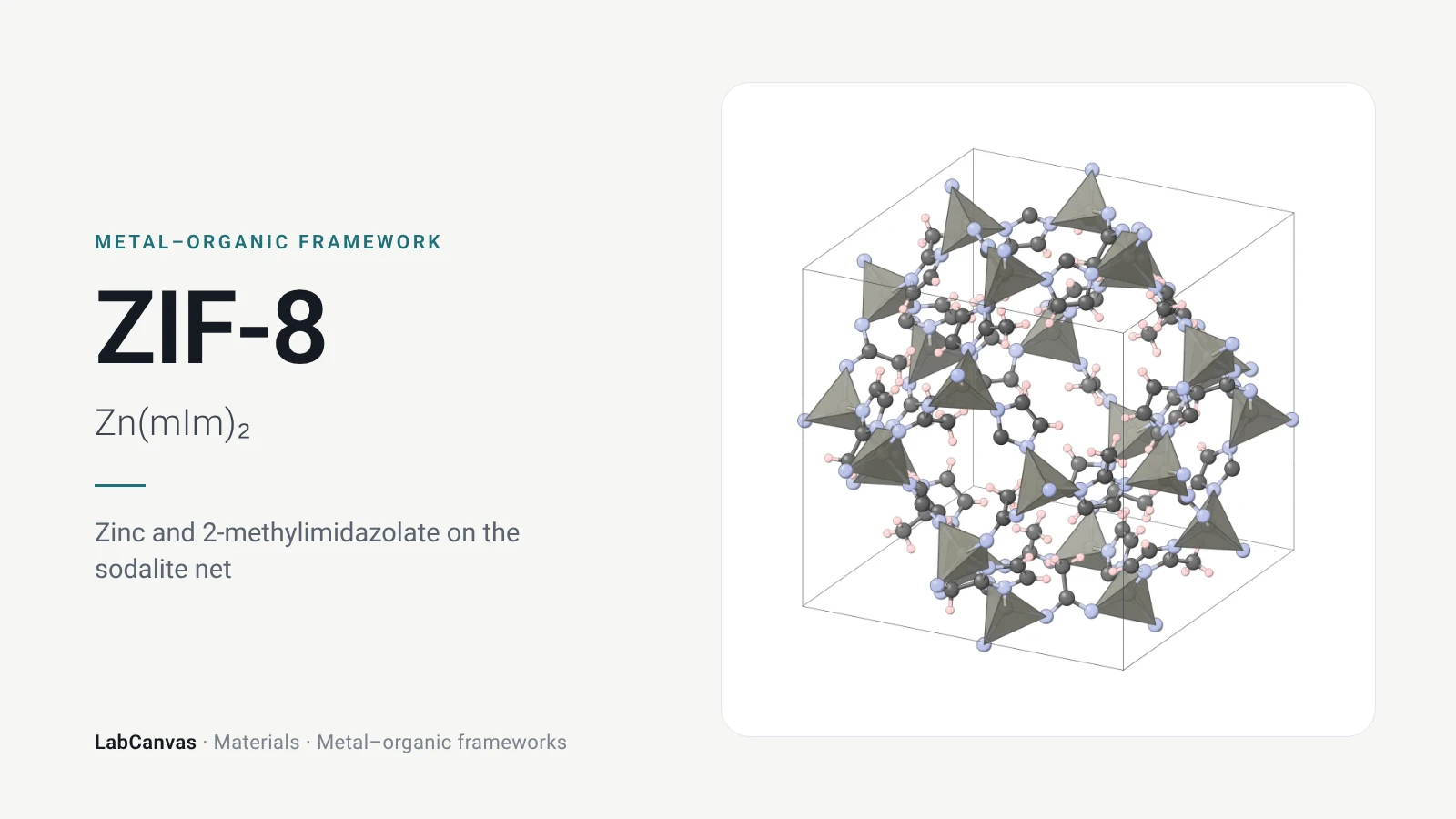
ZIF-8
ZIF-8, Zn(mIm)₂: its sodalite structure in 2D and 3D, how it is made, pore size, surface area and stability, with the original papers. Edit the figures free.
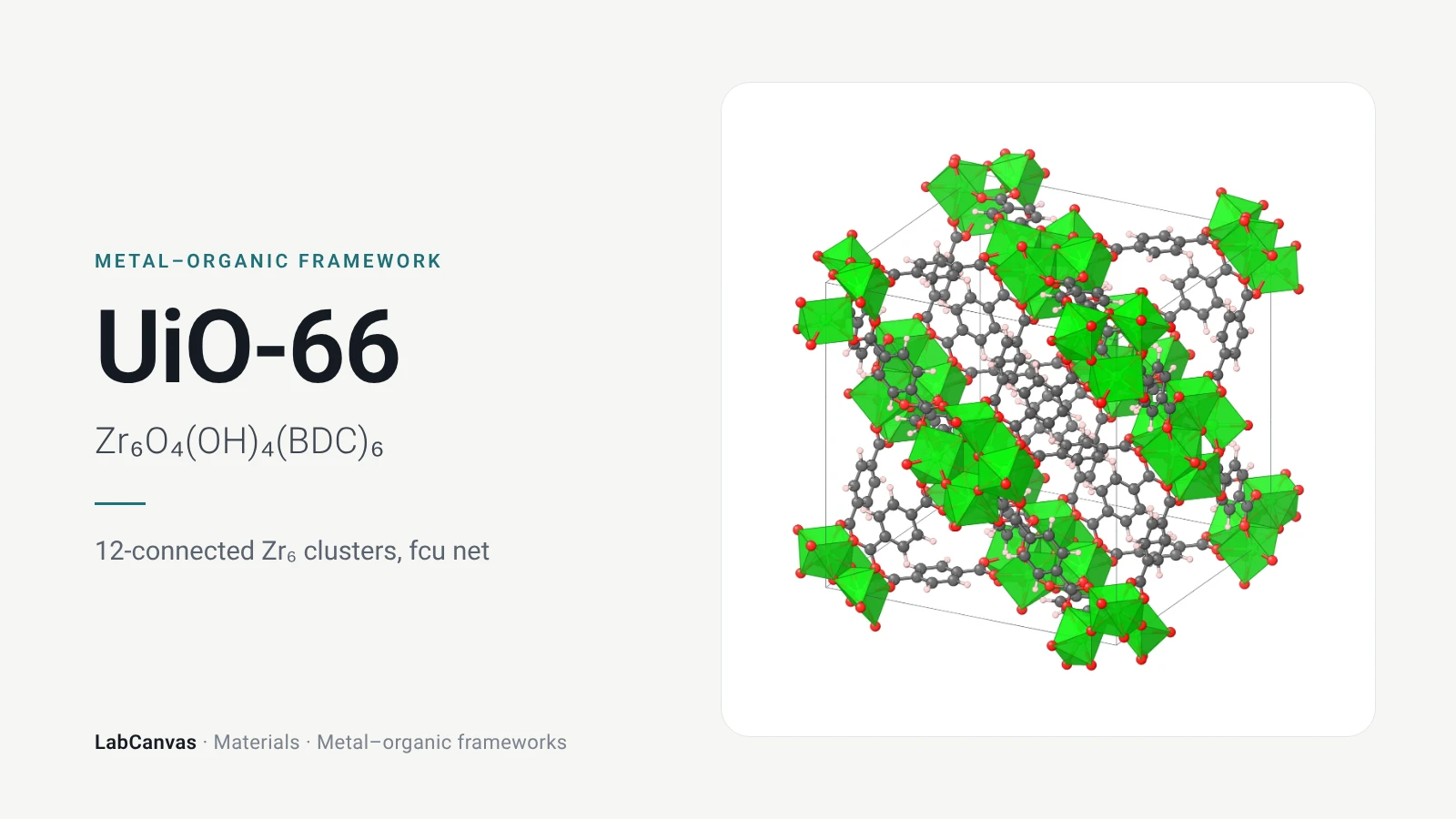
UiO-66
UiO-66, Zr₆O₄(OH)₄(BDC)₆: its fcu structure in 2D and 3D, how it is made, missing-linker defects, pore size, surface area and stability, with the papers.
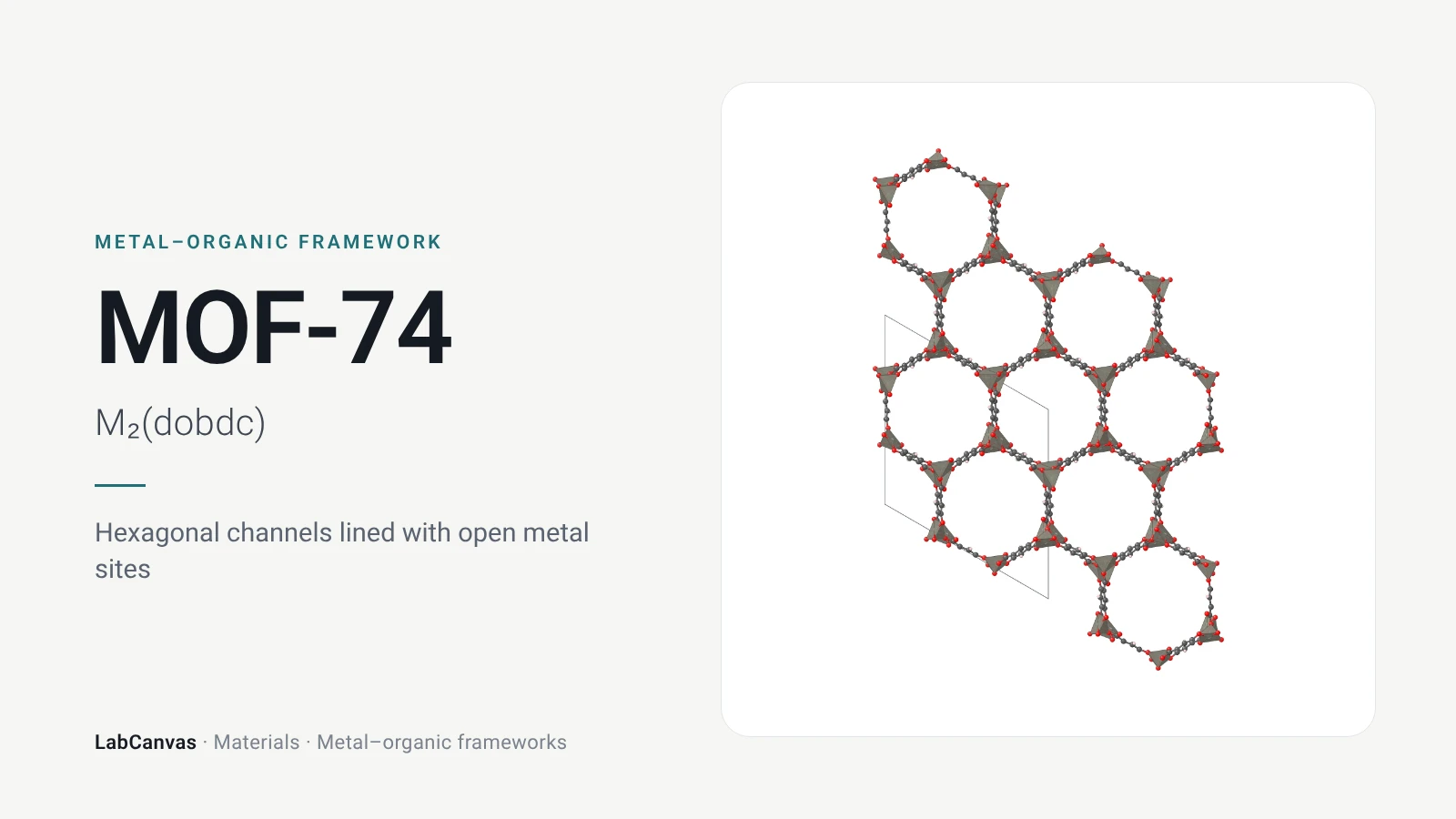
MOF-74
MOF-74 (CPO-27), M₂(dobdc): its honeycomb channels and open metal sites, Mg-MOF-74 for CO₂ capture, Zn-MOF-74, synthesis and pore size, with the papers.
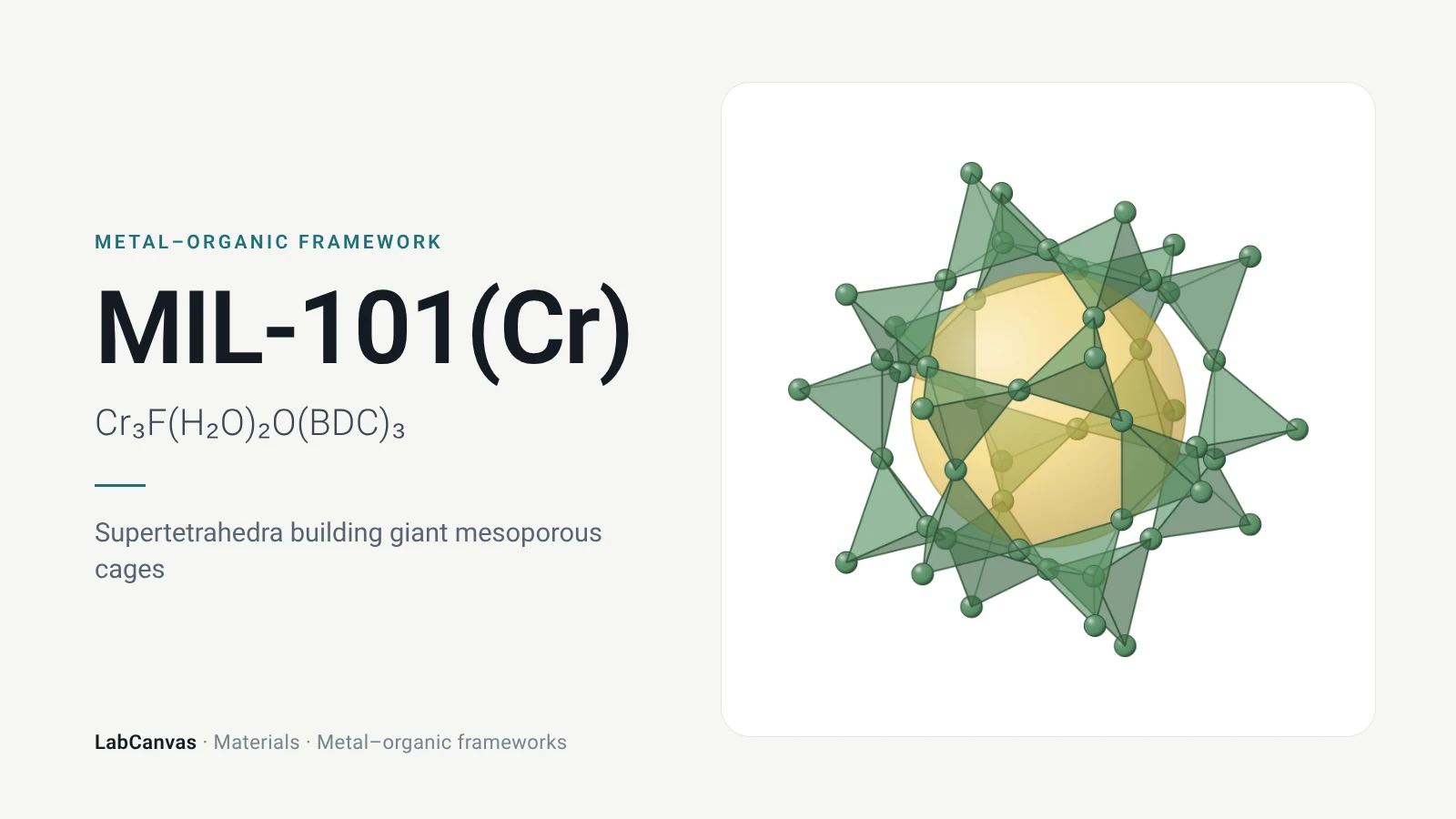
MIL-101(Cr)
MIL-101(Cr), a chromium terephthalate MOF: its giant 30–34 Å cages, MTN structure, synthesis, surface area, water stability and uses, with the original papers.
More on LabCanvas
- HKUST-1: copper paddlewheels and open metal sites: Editable figure template
- More MOF figure templates: Ready-made, cited figures to edit
- Crystal structure figure software compared: VESTA, Mercury, CrystalMaker, Avogadro and LabCanvas
- XRD Scherrer crystallite size calculator: Free tool
- Molar mass calculator: Free tool
- Journal figure size guide: Column widths and resolutions for 38 journals
- 3D models gallery: Turn MOFs, COFs and more in 3D
Frequently asked questions
What is HKUST-1?
HKUST-1 (Cu-BTC, MOF-199) is a metal–organic framework of copper paddlewheels joined by trimesate linkers into a porous cubic network. It was reported in 1999 by researchers at the Hong Kong University of Science and Technology and is known for its open copper sites.
What is the chemical formula of HKUST-1?
Cu₃(BTC)₂, where BTC is benzene-1,3,5-tricarboxylate (trimesate). As made, each copper carries a water molecule: [Cu₃(BTC)₂(H₂O)₃]ₙ. The molar mass of Cu₃(BTC)₂ is about 604.9 g/mol.
What is the structure of HKUST-1?
Pairs of Cu²⁺ ions bridged by four carboxylates (Cu₂(CO₂)₄ paddlewheels) are joined by triangular trimesate linkers into the cubic tbo net (Fm-3m, a ≈ 26.3 Å), with channels about 1 nm across.
What is the pore size of HKUST-1?
The first report described channels 1 nm across and about 40% accessible porosity (Chui et al., Science 1999). The dehydrated framework has three kinds of pore, about 12.6, 10.6 and 5.0 Å across (Wong-Ng et al., Powder Diffraction 2015).
What are the open metal sites in HKUST-1?
Each copper in the paddlewheel carries a water molecule. Heating under vacuum removes it and leaves a free coordination site on the Cu²⁺ facing the pore, where molecules such as CO and H₂ bind (Prestipino et al., Chem. Mater. 2006).
How is HKUST-1 synthesised?
Copper(II) nitrate and trimesic acid in water/ethanol are heated in a sealed vessel at 180 °C for 12 h, giving turquoise octahedral crystals in 80% yield (Chui et al., Science 1999). The crystals are then activated by heating under vacuum.
Is HKUST-1 thermally stable?
Yes, up to 240 °C, by thermogravimetry and high-temperature single-crystal X-ray diffraction (Chui et al., Science 1999). Because water binds to the copper sites, activated samples are stored dry.
Why is HKUST-1 blue?
Its colour comes from the Cu²⁺ ions. As-made crystals with water on the copper are turquoise; removing the water on activation changes the copper coordination and the crystals turn darker (Prestipino et al., Chem. Mater. 2006).
How can I draw HKUST-1 for a paper or presentation?
Open the HKUST-1 figure on this page in LabCanvas (free) to edit the paddlewheel, linker and cage, use the crystal structure SVG drawn from its crystal file, or open the 3D model in the LabCanvas 3D Studio and export a render.
References
- S. S.-Y. Chui, S. M.-F. Lo, J. P. H. Charmant, A. G. Orpen, I. D. Williams. A chemically functionalizable nanoporous material [Cu₃(TMA)₂(H₂O)₃]ₙ. Science 1999, 283, 1148–1150. doi:10.1126/science.283.5405.1148
- C. Prestipino et al.. Local structure of framework Cu(II) in HKUST-1 metallorganic framework: spectroscopic characterization upon activation and interaction with adsorbates. Chem. Mater. 2006, 18, 1337–1346. doi:10.1021/cm052191g
- W. Wong-Ng et al.. Reference diffraction patterns, microstructure, and pore-size distribution for the copper (II) benzene-1,3,5-tricarboxylate metal organic framework (Cu-BTC) compounds. Powder Diffr. 2015, 30, 2–13. doi:10.1017/S0885715614001195
- Kong et al.. Expanded organic building units for the construction of highly porous metal-organic frameworks. Chem. Eur. J. 2013, 19, 14886. doi:10.1002/chem.201302515
- A. A. Talin et al.. Tunable electrical conductivity in metal-organic framework thin-film devices. Science 2014, 343, 66. doi:10.1126/science.1246738
- Brower et al.. Tailoring the nanoscale morphology of HKUST-1 thin films via codeposition and seeded growth. Beilstein J. Nanotechnol. 2017, 8, 2307. doi:10.3762/bjnano.8.230
- Armstrong et al.. Particle size studies to reveal crystallization mechanisms of the metal organic framework HKUST-1 during sonochemical synthesis. Ultrason. Sonochem. 2017, 34, 365. doi:10.1016/j.ultsonch.2016.06.011
- D. Crawford et al.. Synthesis by extrusion: continuous, large-scale preparation of MOFs using little or no solvent. Chem. Sci. 2015, 6, 1645. doi:10.1039/c4sc03217a
Draw HKUST-1 for your paper or slides
LabCanvas is a browser workspace for scientific figures: framework clusters, linkers and nets, crystal structures in 2D and 3D, graphs and posters, all editable.
Edit the HKUST-1 figure