Graphical abstract template · Graphical abstracts · Graphical abstract
Bioconjugation on nanoparticles: EDC/NHS amides, maleimide–thiol and copper-free click
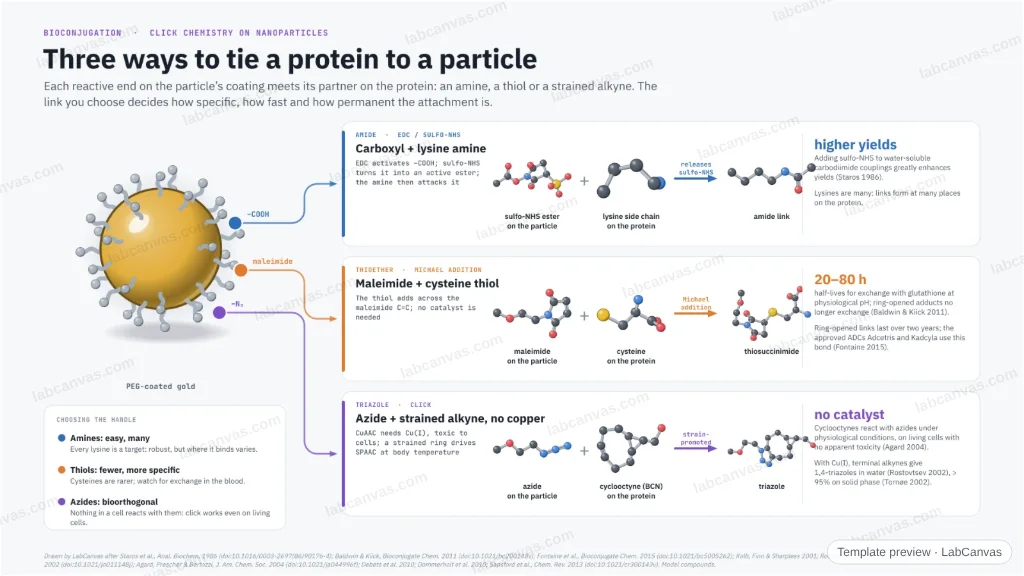
A coated nanoparticle with three docking ports, each wired to the reaction that ties a protein to it: carboxyls activated with EDC and sulfo-NHS couple to lysine amines as amides; maleimides add cysteine thiols as thiosuccinimides, which glutathione can undo with half-lives of 20–80 h unless the ring is opened; azides click with strained cyclooctynes without the copper that is toxic to cells. Real molecules from SMILES for every partner, and a guide to choosing the handle.
Updated 10 cited papers81 editable layers
At a glance
- Category
- Graphical abstracts
- Method
- Graphical abstract
- Starting materials
- A gold nanoparticle with a PEG coating ending in carboxyl, maleimide or azide groups; a protein with lysines, a cysteine or a strained alkyne
- Product
- Protein–nanoparticle conjugates linked by an amide, a thiosuccinimide or a triazole
- Key result
- Thiosuccinimide exchange half-lives 20–80 h with glutathione (Baldwin & Kiick 2011); ring-opened > 2 years (Fontaine et al. 2015); CuAAC > 95% conversion on solid phase (Tornøe et al. 2002)
- Figure
- 1920 × 1080 px (16:9), 81 editable layers, 10 generated objects
Step by step
- Carboxyl + amine → amideA water-soluble carbodiimide (EDC) activates the carboxyl; sulfo-NHS greatly enhances coupling yields (Staros et al. 1986); the lysine amine then forms an amide
- Maleimide + thiol → thiosuccinimideMichael addition of a cysteine thiol; glutathione can reverse or exchange it (half-lives 20–80 h) unless the ring is opened (Baldwin & Kiick 2011); ring-opened products last over two years (Fontaine et al. 2015)
- Azide + alkyne → triazoleCu(I) turns azides and terminal alkynes into 1,4-triazoles in water (Rostovtsev et al. 2002; Tornøe et al. 2002), but copper is toxic to cells; strained cyclooctynes react without a catalyst on living cells (Agard et al. 2004)
- Choose the handleAmines are common on proteins, thiols rarer, azides absent from biology: bioorthogonal (Agard et al. 2004; Sapsford et al. 2013)
Uses
- Graphical abstracts on nanoparticle bioconjugation and click chemistry
- Teaching amide coupling, Michael addition and azide–alkyne cycloadditions
- Talks on targeted nanoparticles and antibody conjugates
Papers this template follows
- Sapsford et al., “Functionalizing nanoparticles with biological molecules: developing chemistries that facilitate nanotechnology”, Chem. Rev. 2013. doi:10.1021/cr300143vreview
- Staros, Wright & Swingle, “Enhancement by N-hydroxysulfosuccinimide of water-soluble carbodiimide-mediated coupling reactions”, Anal. Biochem. 1986. doi:10.1016/0003-2697(86)90176-4primary
- Baldwin & Kiick, “Tunable degradation of maleimide–thiol adducts in reducing environments”, Bioconjugate Chem. 2011. doi:10.1021/bc200148vprimary
- Fontaine et al., “Long-term stabilization of maleimide–thiol conjugates”, Bioconjugate Chem. 2015. doi:10.1021/bc5005262primary
- Kolb, Finn & Sharpless, “Click chemistry: diverse chemical function from a few good reactions”, Angew. Chem. Int. Ed. 2001. doi:10.1002/1521-3773(20010601)40:11<2004::AID-ANIE2004>3.0.CO;2-5method origin
- Rostovtsev, Green, Fokin & Sharpless, “A stepwise Huisgen cycloaddition process: copper(I)-catalyzed regioselective “ligation” of azides and terminal alkynes”, Angew. Chem. Int. Ed. 2002. doi:10.1002/1521-3773(20020715)41:14<2596::AID-ANIE2596>3.0.CO;2-4primary
- Tornøe, Christensen & Meldal, “Peptidotriazoles on solid phase: [1,2,3]-triazoles by regiospecific copper(I)-catalyzed 1,3-dipolar cycloadditions of terminal alkynes to azides”, J. Org. Chem. 2002. doi:10.1021/jo011148jprimary
- Agard, Prescher & Bertozzi, “A strain-promoted [3 + 2] azide−alkyne cycloaddition for covalent modification of biomolecules in living systems”, J. Am. Chem. Soc. 2004. doi:10.1021/ja044996fprimary
- Debets et al., “Aza-dibenzocyclooctynes for fast and efficient enzyme PEGylation via copper-free (3+2) cycloaddition”, Chem. Commun. 2010. doi:10.1039/b917797cprimary
- Dommerholt et al., “Readily accessible bicyclononynes for bioorthogonal labeling and three-dimensional imaging of living cells”, Angew. Chem. Int. Ed. 2010. doi:10.1002/anie.201003761primary
Drawn by LabCanvas after Staros et al., Anal. Biochem. 1986 (doi:10.1016/0003-2697(86)90176-4); Baldwin & Kiick, Bioconjugate Chem. 2011 (doi:10.1021/bc200148v); Fontaine et al., Bioconjugate Chem. 2015 (doi:10.1021/bc5005262); Kolb, Finn & Sharpless 2001; Rostovtsev et al. 2002; Tornøe et al., J. Org. Chem. 2002 (doi:10.1021/jo011148j); Agard, Prescher & Bertozzi, J. Am. Chem. Soc. 2004 (doi:10.1021/ja044996f); Debets et al. 2010; Dommerholt et al. 2010; Sapsford et al., Chem. Rev. 2013 (doi:10.1021/cr300143v). Model compounds.
How templates are written and checked: editorial guidelines.
Questions
What does the “Bioconjugation on nanoparticles: EDC/NHS amides, maleimide–thiol and copper-free click” template show?
A coated nanoparticle with three docking ports, each wired to the reaction that ties a protein to it: carboxyls activated with EDC and sulfo-NHS couple to lysine amines as amides; maleimides add cysteine thiols as thiosuccinimides, which glutathione can undo with half-lives of 20–80 h unless the ring is opened; azides click with strained cyclooctynes without the copper that is toxic to cells. Real molecules from SMILES for every partner, and a guide to choosing the handle.
What are the steps shown in “Bioconjugation on nanoparticles: EDC/NHS amides, maleimide–thiol and copper-free click”?
1. Carboxyl + amine → amide: A water-soluble carbodiimide (EDC) activates the carboxyl; sulfo-NHS greatly enhances coupling yields (Staros et al. 1986); the lysine amine then forms an amide. 2. Maleimide + thiol → thiosuccinimide: Michael addition of a cysteine thiol; glutathione can reverse or exchange it (half-lives 20–80 h) unless the ring is opened (Baldwin & Kiick 2011); ring-opened products last over two years (Fontaine et al. 2015). 3. Azide + alkyne → triazole: Cu(I) turns azides and terminal alkynes into 1,4-triazoles in water (Rostovtsev et al. 2002; Tornøe et al. 2002), but copper is toxic to cells; strained cyclooctynes react without a catalyst on living cells (Agard et al. 2004). 4. Choose the handle: Amines are common on proteins, thiols rarer, azides absent from biology: bioorthogonal (Agard et al. 2004; Sapsford et al. 2013).
What are the starting materials and the product?
Starting materials: A gold nanoparticle with a PEG coating ending in carboxyl, maleimide or azide groups; a protein with lysines, a cysteine or a strained alkyne. Product: Protein–nanoparticle conjugates linked by an amide, a thiosuccinimide or a triazole.
Which papers is “Bioconjugation on nanoparticles: EDC/NHS amides, maleimide–thiol and copper-free click” based on?
Sapsford et al., “Functionalizing nanoparticles with biological molecules: developing chemistries that facilitate nanotechnology”, Chem. Rev. 2013 (doi:10.1021/cr300143v); Staros, Wright & Swingle, “Enhancement by N-hydroxysulfosuccinimide of water-soluble carbodiimide-mediated coupling reactions”, Anal. Biochem. 1986 (doi:10.1016/0003-2697(86)90176-4); Baldwin & Kiick, “Tunable degradation of maleimide–thiol adducts in reducing environments”, Bioconjugate Chem. 2011 (doi:10.1021/bc200148v); Fontaine et al., “Long-term stabilization of maleimide–thiol conjugates”, Bioconjugate Chem. 2015 (doi:10.1021/bc5005262); Kolb, Finn & Sharpless, “Click chemistry: diverse chemical function from a few good reactions”, Angew. Chem. Int. Ed. 2001 (doi:10.1002/1521-3773(20010601)40:11<2004::AID-ANIE2004>3.0.CO;2-5); Rostovtsev, Green, Fokin & Sharpless, “A stepwise Huisgen cycloaddition process: copper(I)-catalyzed regioselective “ligation” of azides and terminal alkynes”, Angew. Chem. Int. Ed. 2002 (doi:10.1002/1521-3773(20020715)41:14<2596::AID-ANIE2596>3.0.CO;2-4); Tornøe, Christensen & Meldal, “Peptidotriazoles on solid phase: [1,2,3]-triazoles by regiospecific copper(I)-catalyzed 1,3-dipolar cycloadditions of terminal alkynes to azides”, J. Org. Chem. 2002 (doi:10.1021/jo011148j); Agard, Prescher & Bertozzi, “A strain-promoted [3 + 2] azide−alkyne cycloaddition for covalent modification of biomolecules in living systems”, J. Am. Chem. Soc. 2004 (doi:10.1021/ja044996f); Debets et al., “Aza-dibenzocyclooctynes for fast and efficient enzyme PEGylation via copper-free (3+2) cycloaddition”, Chem. Commun. 2010 (doi:10.1039/b917797c); Dommerholt et al., “Readily accessible bicyclononynes for bioorthogonal labeling and three-dimensional imaging of living cells”, Angew. Chem. Int. Ed. 2010 (doi:10.1002/anie.201003761).
Can I edit the “Bioconjugation on nanoparticles: EDC/NHS amides, maleimide–thiol and copper-free click” template?
Yes. Open it in the LabCanvas editor: all 81 layers are editable, including 10 generated objects (structures, plots, equipment) with their own settings. Change the text, colours and layout, then export PNG, TIFF or PDF at the width and DPI the journal asks for.
Do I need an account to use this template?
Not to view it here. To open and edit it, sign in to LabCanvas or create a free account (the free plan keeps up to 3 designs). Downloading the figure is part of LabCanvas Pro (US$19 a month or US$199 a year).