Graphical abstract template · Graphical abstracts · Graphical abstract
Biomass to chemicals: catalytic valorisation of lignocellulose
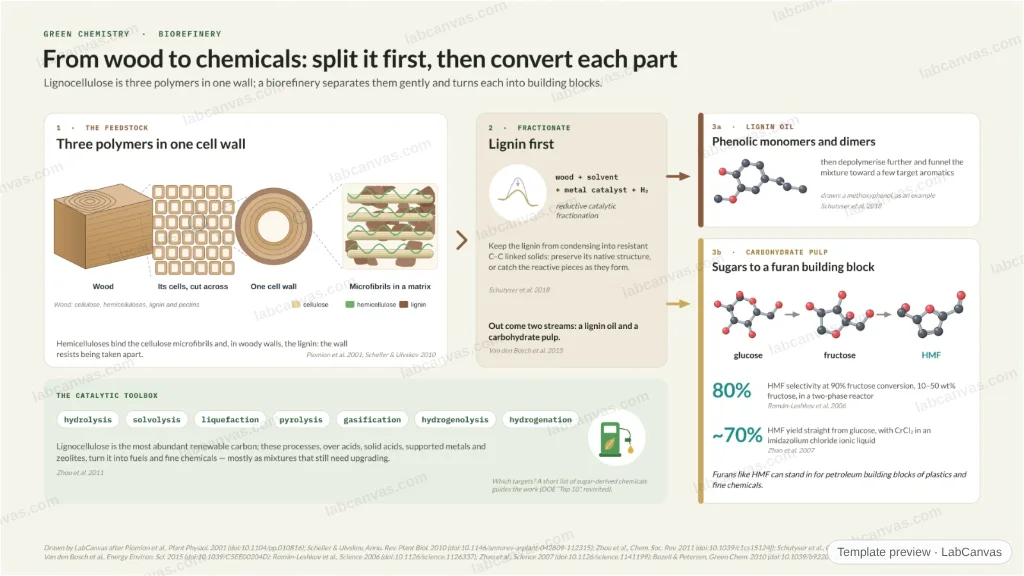
How a biorefinery turns wood into chemicals. Lignocellulose — cellulose microfibrils wrapped in hemicellulose and set in lignin — is first fractionated so the lignin is not condensed: reductive catalytic fractionation gives a lignin oil of phenolic monomers and dimers and a carbohydrate pulp. The sugars go on to furans: fructose to 5-hydroxymethylfurfural at 80% selectivity, glucose to HMF in yields near 70% with chromium chloride in an ionic liquid — building blocks for plastics and fine chemicals.
Updated 8 cited papers72 editable layers
At a glance
- Category
- Graphical abstracts
- Method
- Graphical abstract
- Starting materials
- Wood or other lignocellulosic biomass
- Product
- Phenolic monomers from lignin; sugars and furans (HMF) from the carbohydrates
- Key result
- HMF 80% selectivity at 90% fructose conversion, 10–50 wt% fructose (Román-Leshkov et al. 2006); HMF yield near 70% from glucose (Zhao et al. 2007)
- Figure
- 1920 × 1080 px (16:9), 72 editable layers, 7 generated objects
Step by step
- The feedstockWood is cellulose, hemicelluloses, lignin and pectins (Plomion et al. 2001); hemicelluloses bind cellulose and lignin (Scheller & Ulvskov 2010)
- Fractionate, lignin firstKeep lignin from condensing (Schutyser et al. 2018): reductive catalytic fractionation gives phenolic monomers and dimers and a carbohydrate pulp (Van den Bosch et al. 2015)
- Lignin to aromaticsDepolymerise, then upgrade and funnel the mixture toward a few target chemicals (Schutyser et al. 2018)
- Sugars to furansFructose to HMF at 80% selectivity, 90% conversion (Román-Leshkov et al. 2006); glucose to HMF near 70% with CrCl₂ in an ionic liquid (Zhao et al. 2007)
Uses
- Graphical abstracts on biorefineries and biomass conversion
- Teaching lignocellulose structure and valorisation
- Talks on lignin-first and furan platform chemicals
Papers this template follows
- Plomion, Leprovost & Stokes, “Wood formation in trees”, Plant Physiol. 2001. doi:10.1104/pp.010816review
- Scheller & Ulvskov, “Hemicelluloses”, Annu. Rev. Plant Biol. 2010. doi:10.1146/annurev-arplant-042809-112315review
- Zhou, Xia, Lin, Tong & Beltramini, “Catalytic conversion of lignocellulosic biomass to fine chemicals and fuels”, Chem. Soc. Rev. 2011. doi:10.1039/c1cs15124jreview
- Schutyser et al., “Chemicals from lignin: an interplay of lignocellulose fractionation, depolymerisation, and upgrading”, Chem. Soc. Rev. 2018. doi:10.1039/c7cs00566kreview
- Van den Bosch et al., “Reductive lignocellulose fractionation into soluble lignin-derived phenolic monomers and dimers and processable carbohydrate pulps”, Energy Environ. Sci. 2015. doi:10.1039/C5EE00204Dprimary
- Román-Leshkov, Chheda & Dumesic, “Phase modifiers promote efficient production of hydroxymethylfurfural from fructose”, Science 2006. doi:10.1126/science.1126337primary
- Zhao, Holladay, Brown & Zhang, “Metal chlorides in ionic liquid solvents convert sugars to 5-hydroxymethylfurfural”, Science 2007. doi:10.1126/science.1141199primary
- Bozell & Petersen, “Technology development for the production of biobased products from biorefinery carbohydrates — the US Department of Energy’s “Top 10” revisited”, Green Chem. 2010. doi:10.1039/b922014creview
Drawn by LabCanvas after Plomion et al., Plant Physiol. 2001 (doi:10.1104/pp.010816); Scheller & Ulvskov, Annu. Rev. Plant Biol. 2010 (doi:10.1146/annurev-arplant-042809-112315); Zhou et al., Chem. Soc. Rev. 2011 (doi:10.1039/c1cs15124j); Schutyser et al., Chem. Soc. Rev. 2018 (doi:10.1039/c7cs00566k); Van den Bosch et al., Energy Environ. Sci. 2015 (doi:10.1039/C5EE00204D); Román-Leshkov et al., Science 2006 (doi:10.1126/science.1126337); Zhao et al., Science 2007 (doi:10.1126/science.1141199); Bozell & Petersen, Green Chem. 2010 (doi:10.1039/b922014c). Cell wall schematic.
How templates are written and checked: editorial guidelines.
Questions
What does the “Biomass to chemicals: catalytic valorisation of lignocellulose” template show?
How a biorefinery turns wood into chemicals. Lignocellulose — cellulose microfibrils wrapped in hemicellulose and set in lignin — is first fractionated so the lignin is not condensed: reductive catalytic fractionation gives a lignin oil of phenolic monomers and dimers and a carbohydrate pulp. The sugars go on to furans: fructose to 5-hydroxymethylfurfural at 80% selectivity, glucose to HMF in yields near 70% with chromium chloride in an ionic liquid — building blocks for plastics and fine chemicals.
What are the steps shown in “Biomass to chemicals: catalytic valorisation of lignocellulose”?
1. The feedstock: Wood is cellulose, hemicelluloses, lignin and pectins (Plomion et al. 2001); hemicelluloses bind cellulose and lignin (Scheller & Ulvskov 2010). 2. Fractionate, lignin first: Keep lignin from condensing (Schutyser et al. 2018): reductive catalytic fractionation gives phenolic monomers and dimers and a carbohydrate pulp (Van den Bosch et al. 2015). 3. Lignin to aromatics: Depolymerise, then upgrade and funnel the mixture toward a few target chemicals (Schutyser et al. 2018). 4. Sugars to furans: Fructose to HMF at 80% selectivity, 90% conversion (Román-Leshkov et al. 2006); glucose to HMF near 70% with CrCl₂ in an ionic liquid (Zhao et al. 2007).
What are the starting materials and the product?
Starting materials: Wood or other lignocellulosic biomass. Product: Phenolic monomers from lignin; sugars and furans (HMF) from the carbohydrates.
Which papers is “Biomass to chemicals: catalytic valorisation of lignocellulose” based on?
Plomion, Leprovost & Stokes, “Wood formation in trees”, Plant Physiol. 2001 (doi:10.1104/pp.010816); Scheller & Ulvskov, “Hemicelluloses”, Annu. Rev. Plant Biol. 2010 (doi:10.1146/annurev-arplant-042809-112315); Zhou, Xia, Lin, Tong & Beltramini, “Catalytic conversion of lignocellulosic biomass to fine chemicals and fuels”, Chem. Soc. Rev. 2011 (doi:10.1039/c1cs15124j); Schutyser et al., “Chemicals from lignin: an interplay of lignocellulose fractionation, depolymerisation, and upgrading”, Chem. Soc. Rev. 2018 (doi:10.1039/c7cs00566k); Van den Bosch et al., “Reductive lignocellulose fractionation into soluble lignin-derived phenolic monomers and dimers and processable carbohydrate pulps”, Energy Environ. Sci. 2015 (doi:10.1039/C5EE00204D); Román-Leshkov, Chheda & Dumesic, “Phase modifiers promote efficient production of hydroxymethylfurfural from fructose”, Science 2006 (doi:10.1126/science.1126337); Zhao, Holladay, Brown & Zhang, “Metal chlorides in ionic liquid solvents convert sugars to 5-hydroxymethylfurfural”, Science 2007 (doi:10.1126/science.1141199); Bozell & Petersen, “Technology development for the production of biobased products from biorefinery carbohydrates — the US Department of Energy’s “Top 10” revisited”, Green Chem. 2010 (doi:10.1039/b922014c).
Can I edit the “Biomass to chemicals: catalytic valorisation of lignocellulose” template?
Yes. Open it in the LabCanvas editor: all 72 layers are editable, including 7 generated objects (structures, plots, equipment) with their own settings. Change the text, colours and layout, then export PNG, TIFF or PDF at the width and DPI the journal asks for.
Do I need an account to use this template?
Not to view it here. To open and edit it, sign in to LabCanvas or create a free account (the free plan keeps up to 3 designs). Downloading the figure is part of LabCanvas Pro (US$19 a month or US$199 a year).