Graphical abstract template · Graphical abstracts · Graphical abstract
Block-copolymer self-assembly: micelles in water, nanostructures in the melt
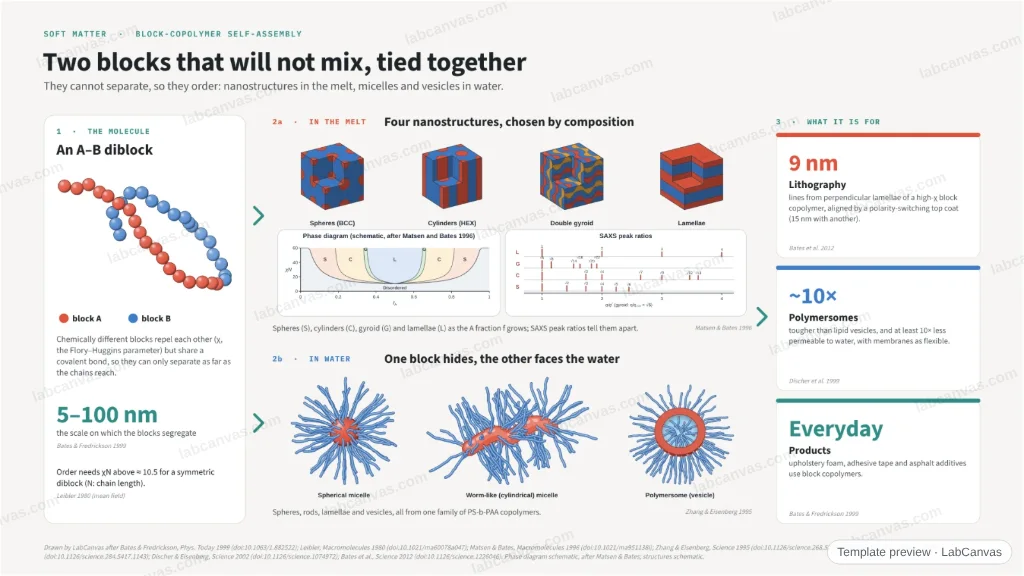
One A–B diblock copolymer, two kinds of order. In the melt the incompatible blocks segregate on the 5–100 nm scale into spheres, cylinders, the double gyroid or lamellae, depending on the volume fraction and χN (mean-field phase diagram after Matsen and Bates). In water the hydrophobic block hides, giving spherical micelles, worm-like micelles and polymersomes. The order is put to work: sub-10-nm lithography lines, polymersomes an order of magnitude tougher than lipid vesicles, and everyday foams, tapes and asphalt additives.
Updated 7 cited papers100 editable layers
At a glance
- Category
- Graphical abstracts
- Method
- Graphical abstract
- Starting materials
- An A–B diblock copolymer (two incompatible blocks joined end to end)
- Product
- Ordered nanostructures in the melt, or micelles and vesicles in a selective solvent
- Key result
- Segregation 5–100 nm (Bates & Fredrickson 1999); CPS for χN ≥ 17.67, gyroid not stable above χN ~ 60 (Matsen & Bates 1996); ~10× tougher, ≥ 10× less water-permeable vesicles (Discher et al. 1999); 15 and 9 nm lines (Bates et al. 2012)
- Figure
- 1920 × 1080 px (16:9), 100 editable layers, 3 generated objects
Step by step
- The moleculeTwo incompatible blocks tied together segregate on the molecular scale, 5–100 nm (Bates & Fredrickson 1999)
- In the meltSpheres, cylinders, gyroid or lamellae, set by the volume fraction f and χN; order sets in at χN ≈ 10.5 for a symmetric diblock (Leibler 1980; Matsen & Bates 1996)
- In waterThe hydrophobic block hides: spheres, rods, lamellae and vesicles from one copolymer family (Zhang & Eisenberg 1995)
- UsesSub-10-nm lithography (9 nm lines; Bates et al. 2012), tough, low-permeability polymersomes (Discher et al. 1999), foams, tapes and asphalt additives (Bates & Fredrickson 1999)
Uses
- Graphical abstracts on block copolymers and soft matter
- Teaching microphase separation and micellisation
- Talks on block copolymer lithography and polymersomes
Papers this template follows
- Bates & Fredrickson, “Block copolymers — designer soft materials”, Phys. Today 1999. doi:10.1063/1.882522review
- Leibler, “Theory of microphase separation in block copolymers”, Macromolecules 1980. doi:10.1021/ma60078a047primary
- Matsen & Bates, “Unifying weak- and strong-segregation block copolymer theories”, Macromolecules 1996. doi:10.1021/ma951138iprimary
- Zhang & Eisenberg, “Multiple morphologies of “crew-cut” aggregates of polystyrene-b-poly(acrylic acid) block copolymers”, Science 1995. doi:10.1126/science.268.5218.1728primary
- Discher et al., “Polymersomes: tough vesicles made from diblock copolymers”, Science 1999. doi:10.1126/science.284.5417.1143primary
- Discher & Eisenberg, “Polymer vesicles”, Science 2002. doi:10.1126/science.1074972review
- Bates et al., “Polarity-switching top coats enable orientation of sub-10-nm block copolymer domains”, Science 2012. doi:10.1126/science.1226046primary
Drawn by LabCanvas after Bates & Fredrickson, Phys. Today 1999 (doi:10.1063/1.882522); Leibler, Macromolecules 1980 (doi:10.1021/ma60078a047); Matsen & Bates, Macromolecules 1996 (doi:10.1021/ma951138i); Zhang & Eisenberg, Science 1995 (doi:10.1126/science.268.5218.1728); Discher et al., Science 1999 (doi:10.1126/science.284.5417.1143); Discher & Eisenberg, Science 2002 (doi:10.1126/science.1074972); Bates et al., Science 2012 (doi:10.1126/science.1226046). Phase diagram schematic, after Matsen & Bates; structures schematic.
How templates are written and checked: editorial guidelines.
Questions
What does the “Block-copolymer self-assembly: micelles in water, nanostructures in the melt” template show?
One A–B diblock copolymer, two kinds of order. In the melt the incompatible blocks segregate on the 5–100 nm scale into spheres, cylinders, the double gyroid or lamellae, depending on the volume fraction and χN (mean-field phase diagram after Matsen and Bates). In water the hydrophobic block hides, giving spherical micelles, worm-like micelles and polymersomes. The order is put to work: sub-10-nm lithography lines, polymersomes an order of magnitude tougher than lipid vesicles, and everyday foams, tapes and asphalt additives.
What are the steps shown in “Block-copolymer self-assembly: micelles in water, nanostructures in the melt”?
1. The molecule: Two incompatible blocks tied together segregate on the molecular scale, 5–100 nm (Bates & Fredrickson 1999). 2. In the melt: Spheres, cylinders, gyroid or lamellae, set by the volume fraction f and χN; order sets in at χN ≈ 10.5 for a symmetric diblock (Leibler 1980; Matsen & Bates 1996). 3. In water: The hydrophobic block hides: spheres, rods, lamellae and vesicles from one copolymer family (Zhang & Eisenberg 1995). 4. Uses: Sub-10-nm lithography (9 nm lines; Bates et al. 2012), tough, low-permeability polymersomes (Discher et al. 1999), foams, tapes and asphalt additives (Bates & Fredrickson 1999).
What are the starting materials and the product?
Starting materials: An A–B diblock copolymer (two incompatible blocks joined end to end). Product: Ordered nanostructures in the melt, or micelles and vesicles in a selective solvent.
Which papers is “Block-copolymer self-assembly: micelles in water, nanostructures in the melt” based on?
Bates & Fredrickson, “Block copolymers — designer soft materials”, Phys. Today 1999 (doi:10.1063/1.882522); Leibler, “Theory of microphase separation in block copolymers”, Macromolecules 1980 (doi:10.1021/ma60078a047); Matsen & Bates, “Unifying weak- and strong-segregation block copolymer theories”, Macromolecules 1996 (doi:10.1021/ma951138i); Zhang & Eisenberg, “Multiple morphologies of “crew-cut” aggregates of polystyrene-b-poly(acrylic acid) block copolymers”, Science 1995 (doi:10.1126/science.268.5218.1728); Discher et al., “Polymersomes: tough vesicles made from diblock copolymers”, Science 1999 (doi:10.1126/science.284.5417.1143); Discher & Eisenberg, “Polymer vesicles”, Science 2002 (doi:10.1126/science.1074972); Bates et al., “Polarity-switching top coats enable orientation of sub-10-nm block copolymer domains”, Science 2012 (doi:10.1126/science.1226046).
Can I edit the “Block-copolymer self-assembly: micelles in water, nanostructures in the melt” template?
Yes. Open it in the LabCanvas editor: all 100 layers are editable, including 3 generated objects (structures, plots, equipment) with their own settings. Change the text, colours and layout, then export PNG, TIFF or PDF at the width and DPI the journal asks for.
Do I need an account to use this template?
Not to view it here. To open and edit it, sign in to LabCanvas or create a free account (the free plan keeps up to 3 designs). Downloading the figure is part of LabCanvas Pro (US$19 a month or US$199 a year).





