Graphical abstract template · Graphical abstracts · Graphical abstract
Brust–Schiffrin synthesis: thiol-capped gold made across a water–toluene interface
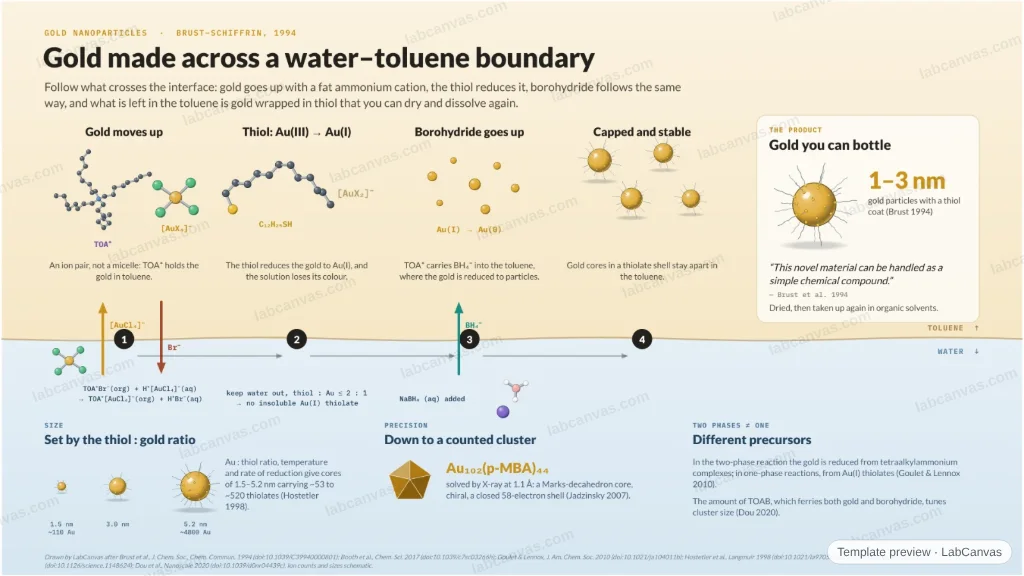
The two-phase Brust–Schiffrin synthesis told by what crosses the water–toluene boundary: tetraoctylammonium pulls tetrachloroaurate into toluene as an ion pair, an alkanethiol reduces Au(III) to Au(I), and borohydride, carried across by the same cation, makes 1–3 nm thiol-capped gold that can be dried and redissolved like a compound. Below the interface, the thiol-to-gold ratio that sets the size (1.5–5.2 nm cores), the atom-precise Au₁₀₂ cluster and why two phases differ from one.
Updated 6 cited papers88 editable layers
At a glance
- Category
- Graphical abstracts
- Method
- Graphical abstract
- Starting materials
- HAuCl₄ in water, tetraoctylammonium bromide (TOAB) and an alkanethiol in toluene, aqueous NaBH₄
- Product
- Alkanethiol-capped gold particles, 1–3 nm in the original report, in toluene
- Key result
- 1–3 nm (Brust et al. 1994); 1–6 nm by the thiol : Au ratio (Booth et al. 2017); 1.5–5.2 nm cores, ~110–4800 Au atoms, ~53–520 thiolates (Hostetler et al. 1998); Au₁₀₂(p-MBA)₄₄ (Jadzinsky et al. 2007)
- Figure
- 1920 × 1080 px (16:9), 88 editable layers, 14 generated objects
Step by step
- Phase transferTOA⁺ takes [AuCl₄]⁻ into toluene as an ion pair while Br⁻ goes into the water; Br⁻ then exchanges onto the gold (Booth et al. 2017)
- Thiol: Au(III) to Au(I)The alkanethiol reduces the gold to Au(I) and the colour fades; insoluble Au(I) thiolate forms if the water stays or above 2 thiol per gold (Booth et al. 2017)
- Borohydride acrossNaBH₄ added to the water; borohydride carried into the toluene by TOA⁺ reduces the gold to particles (Booth et al. 2017; Dou et al. 2020)
- A compound you can bottle1–3 nm thiol-coated gold that "can be handled as a simple chemical compound" (Brust et al. 1994)
- Size and precisionThe Au : thiol ratio, temperature and rate of reduction give 1.5–5.2 nm cores (Hostetler et al. 1998); Au₁₀₂(p-MBA)₄₄ solved at 1.1 Å (Jadzinsky et al. 2007)
Uses
- Graphical abstracts on thiol-protected gold nanoparticles and nanoclusters
- Teaching phase-transfer catalysis and two-phase reductions
- Talks on monolayer-protected clusters
Papers this template follows
- Brust, Walker, Bethell, Schiffrin & Whyman, “Synthesis of thiol-derivatised gold nanoparticles in a two-phase liquid–liquid system”, J. Chem. Soc., Chem. Commun. 1994. doi:10.1039/C39940000801method origin
- Booth et al., “The significance of bromide in the Brust–Schiffrin synthesis of thiol protected gold nanoparticles”, Chem. Sci. 2017. doi:10.1039/c7sc03266hprimary
- Goulet & Lennox, “New insights into Brust−Schiffrin metal nanoparticle synthesis”, J. Am. Chem. Soc. 2010. doi:10.1021/ja104011bprimary
- Hostetler et al., “Alkanethiolate gold cluster molecules with core diameters from 1.5 to 5.2 nm: core and monolayer properties as a function of core size”, Langmuir 1998. doi:10.1021/la970588wprimary
- Jadzinsky, Calero, Ackerson, Bushnell & Kornberg, “Structure of a thiol monolayer-protected gold nanoparticle at 1.1 Å resolution”, Science 2007. doi:10.1126/science.1148624primary
- Dou et al., “From understanding the roles of tetraoctylammonium bromide in the two-phase Brust–Schiffrin method to tuning the size of gold nanoclusters”, Nanoscale 2020. doi:10.1039/d0nr04439cprimary
Drawn by LabCanvas after Brust et al., J. Chem. Soc., Chem. Commun. 1994 (doi:10.1039/C39940000801); Booth et al., Chem. Sci. 2017 (doi:10.1039/c7sc03266h); Goulet & Lennox, J. Am. Chem. Soc. 2010 (doi:10.1021/ja104011b); Hostetler et al., Langmuir 1998 (doi:10.1021/la970588w); Jadzinsky et al., Science 2007 (doi:10.1126/science.1148624); Dou et al., Nanoscale 2020 (doi:10.1039/d0nr04439c). Ion counts and sizes schematic.
How templates are written and checked: editorial guidelines.
Questions
What does the “Brust–Schiffrin synthesis: thiol-capped gold made across a water–toluene interface” template show?
The two-phase Brust–Schiffrin synthesis told by what crosses the water–toluene boundary: tetraoctylammonium pulls tetrachloroaurate into toluene as an ion pair, an alkanethiol reduces Au(III) to Au(I), and borohydride, carried across by the same cation, makes 1–3 nm thiol-capped gold that can be dried and redissolved like a compound. Below the interface, the thiol-to-gold ratio that sets the size (1.5–5.2 nm cores), the atom-precise Au₁₀₂ cluster and why two phases differ from one.
What are the steps shown in “Brust–Schiffrin synthesis: thiol-capped gold made across a water–toluene interface”?
1. Phase transfer: TOA⁺ takes [AuCl₄]⁻ into toluene as an ion pair while Br⁻ goes into the water; Br⁻ then exchanges onto the gold (Booth et al. 2017). 2. Thiol: Au(III) to Au(I): The alkanethiol reduces the gold to Au(I) and the colour fades; insoluble Au(I) thiolate forms if the water stays or above 2 thiol per gold (Booth et al. 2017). 3. Borohydride across: NaBH₄ added to the water; borohydride carried into the toluene by TOA⁺ reduces the gold to particles (Booth et al. 2017; Dou et al. 2020). 4. A compound you can bottle: 1–3 nm thiol-coated gold that "can be handled as a simple chemical compound" (Brust et al. 1994). 5. Size and precision: The Au : thiol ratio, temperature and rate of reduction give 1.5–5.2 nm cores (Hostetler et al. 1998); Au₁₀₂(p-MBA)₄₄ solved at 1.1 Å (Jadzinsky et al. 2007).
What are the starting materials and the product?
Starting materials: HAuCl₄ in water, tetraoctylammonium bromide (TOAB) and an alkanethiol in toluene, aqueous NaBH₄. Product: Alkanethiol-capped gold particles, 1–3 nm in the original report, in toluene.
Which papers is “Brust–Schiffrin synthesis: thiol-capped gold made across a water–toluene interface” based on?
Brust, Walker, Bethell, Schiffrin & Whyman, “Synthesis of thiol-derivatised gold nanoparticles in a two-phase liquid–liquid system”, J. Chem. Soc., Chem. Commun. 1994 (doi:10.1039/C39940000801); Booth et al., “The significance of bromide in the Brust–Schiffrin synthesis of thiol protected gold nanoparticles”, Chem. Sci. 2017 (doi:10.1039/c7sc03266h); Goulet & Lennox, “New insights into Brust−Schiffrin metal nanoparticle synthesis”, J. Am. Chem. Soc. 2010 (doi:10.1021/ja104011b); Hostetler et al., “Alkanethiolate gold cluster molecules with core diameters from 1.5 to 5.2 nm: core and monolayer properties as a function of core size”, Langmuir 1998 (doi:10.1021/la970588w); Jadzinsky, Calero, Ackerson, Bushnell & Kornberg, “Structure of a thiol monolayer-protected gold nanoparticle at 1.1 Å resolution”, Science 2007 (doi:10.1126/science.1148624); Dou et al., “From understanding the roles of tetraoctylammonium bromide in the two-phase Brust–Schiffrin method to tuning the size of gold nanoclusters”, Nanoscale 2020 (doi:10.1039/d0nr04439c).
Can I edit the “Brust–Schiffrin synthesis: thiol-capped gold made across a water–toluene interface” template?
Yes. Open it in the LabCanvas editor: all 88 layers are editable, including 14 generated objects (structures, plots, equipment) with their own settings. Change the text, colours and layout, then export PNG, TIFF or PDF at the width and DPI the journal asks for.
Do I need an account to use this template?
Not to view it here. To open and edit it, sign in to LabCanvas or create a free account (the free plan keeps up to 3 designs). Downloading the figure is part of LabCanvas Pro (US$19 a month or US$199 a year).