Graphical abstract template · Graphical abstracts · Graphical abstract
CALF-20 for CO₂ capture: from the pore to the plant
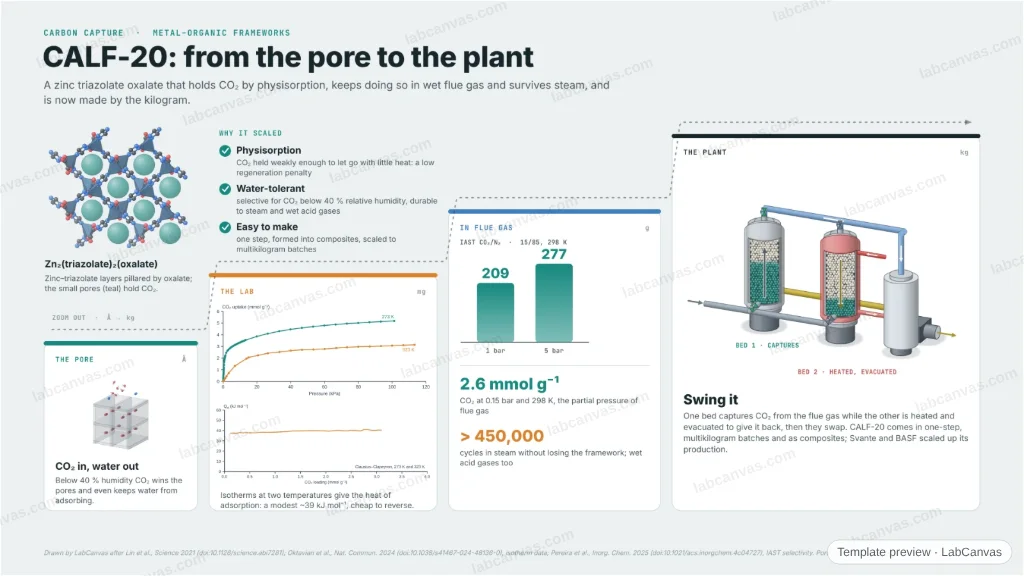
A rising staircase of frames follows a metal–organic framework from ångströms to tonnes: CO₂ held in the pores of CALF-20 while water stays out below 40 % humidity; measured CO₂ isotherms at 273 and 323 K and the isosteric heat computed from them; IAST CO₂/N₂ selectivity of about 200, 2.6 mmol g⁻¹ from flue-gas CO₂ and more than 450,000 steam cycles; and a two-bed vacuum temperature swing plant, for a framework now made by the multikilogram.
Updated 3 cited papers66 editable layers
At a glance
- Category
- Graphical abstracts
- Method
- Graphical abstract
- Starting materials
- CALF-20, Zn₂(1,2,4-triazolate)₂(oxalate), made in one step and scaled to multikilogram batches
- Product
- A durable physisorbent for capturing CO₂ from wet flue gas in swing-adsorption plants
- Key result
- > 450,000 steam cycles (Lin et al. 2021); IAST 209 (1 bar) and 277 (5 bar) (Pereira et al. 2025); 2.6 mmol g⁻¹ at 0.15 bar, 298 K; Qst 39.1 kJ mol⁻¹
- Figure
- 1920 × 1080 px (16:9), 66 editable layers, 3 generated objects
Step by step
- The poreCALF-20 physisorbs CO₂ and is selective over water: CO₂ is taken up in preference below 40 % relative humidity and suppresses water sorption (Lin et al. 2021)
- The labCO₂ isotherms at 273 and 323 K (Oktavian et al. 2024) give the isosteric heat by Clausius–Clapeyron; zero-loading Qst 39.1 kJ mol⁻¹ (Pereira et al. 2025); a low enthalpic regeneration penalty (Lin et al. 2021)
- Selectivity and durabilityIAST CO₂/N₂ selectivity 209 at 1 bar and 277 at 5 bar, 15/85 at 298 K (Pereira et al. 2025); 2.6 mmol g⁻¹ at 0.15 bar and 298 K (quoted by Oktavian et al. 2024); > 450,000 steam cycles and wet acid gases (Lin et al. 2021)
- The plantMultikilogram batches and composites (Lin et al. 2021); production scaled up by Svante with BASF (Oktavian et al. 2024); CO₂ captured and released in swing-adsorption beds
Uses
- Graphical abstracts on MOFs for carbon capture
- Talks on adsorbent screening: isotherms, Qst, IAST and cycling
- Teaching how a sorbent goes from the pore to a capture plant
Papers this template follows
- Lin et al., “A scalable metal-organic framework as a durable physisorbent for carbon dioxide capture”, Science 2021. doi:10.1126/science.abi7281primary
- Oktavian et al., “Gas adsorption and framework flexibility of CALF-20 explored via experiments and simulations”, Nat. Commun. 2024. doi:10.1038/s41467-024-48136-0primary
- Pereira et al., “Enhancing CO2 capture via fast microwave-assisted synthesis of the CALF-20 metal–organic framework”, Inorg. Chem. 2025. doi:10.1021/acs.inorgchem.4c04727primary
Drawn by LabCanvas after Lin et al., Science 2021 (doi:10.1126/science.abi7281); Oktavian et al., Nat. Commun. 2024 (doi:10.1038/s41467-024-48136-0), isotherm data; Pereira et al., Inorg. Chem. 2025 (doi:10.1021/acs.inorgchem.4c04727), IAST selectivity. Pore view and plant schematic.
How templates are written and checked: editorial guidelines.
Questions
What does the “CALF-20 for CO₂ capture: from the pore to the plant” template show?
A rising staircase of frames follows a metal–organic framework from ångströms to tonnes: CO₂ held in the pores of CALF-20 while water stays out below 40 % humidity; measured CO₂ isotherms at 273 and 323 K and the isosteric heat computed from them; IAST CO₂/N₂ selectivity of about 200, 2.6 mmol g⁻¹ from flue-gas CO₂ and more than 450,000 steam cycles; and a two-bed vacuum temperature swing plant, for a framework now made by the multikilogram.
What are the steps shown in “CALF-20 for CO₂ capture: from the pore to the plant”?
1. The pore: CALF-20 physisorbs CO₂ and is selective over water: CO₂ is taken up in preference below 40 % relative humidity and suppresses water sorption (Lin et al. 2021). 2. The lab: CO₂ isotherms at 273 and 323 K (Oktavian et al. 2024) give the isosteric heat by Clausius–Clapeyron; zero-loading Qst 39.1 kJ mol⁻¹ (Pereira et al. 2025); a low enthalpic regeneration penalty (Lin et al. 2021). 3. Selectivity and durability: IAST CO₂/N₂ selectivity 209 at 1 bar and 277 at 5 bar, 15/85 at 298 K (Pereira et al. 2025); 2.6 mmol g⁻¹ at 0.15 bar and 298 K (quoted by Oktavian et al. 2024); > 450,000 steam cycles and wet acid gases (Lin et al. 2021). 4. The plant: Multikilogram batches and composites (Lin et al. 2021); production scaled up by Svante with BASF (Oktavian et al. 2024); CO₂ captured and released in swing-adsorption beds.
What are the starting materials and the product?
Starting materials: CALF-20, Zn₂(1,2,4-triazolate)₂(oxalate), made in one step and scaled to multikilogram batches. Product: A durable physisorbent for capturing CO₂ from wet flue gas in swing-adsorption plants.
Which papers is “CALF-20 for CO₂ capture: from the pore to the plant” based on?
Lin et al., “A scalable metal-organic framework as a durable physisorbent for carbon dioxide capture”, Science 2021 (doi:10.1126/science.abi7281); Oktavian et al., “Gas adsorption and framework flexibility of CALF-20 explored via experiments and simulations”, Nat. Commun. 2024 (doi:10.1038/s41467-024-48136-0); Pereira et al., “Enhancing CO2 capture via fast microwave-assisted synthesis of the CALF-20 metal–organic framework”, Inorg. Chem. 2025 (doi:10.1021/acs.inorgchem.4c04727).
Can I edit the “CALF-20 for CO₂ capture: from the pore to the plant” template?
Yes. Open it in the LabCanvas editor: all 66 layers are editable, including 3 generated objects (structures, plots, equipment) with their own settings. Change the text, colours and layout, then export PNG, TIFF or PDF at the width and DPI the journal asks for.
Do I need an account to use this template?
Not to view it here. To open and edit it, sign in to LabCanvas or create a free account (the free plan keeps up to 3 designs). Downloading the figure is part of LabCanvas Pro (US$19 a month or US$199 a year).