Graphical abstract template · Graphical abstracts · Graphical abstract
Carbon nanotubes: chirality, growth and sorting, from the map to the chip
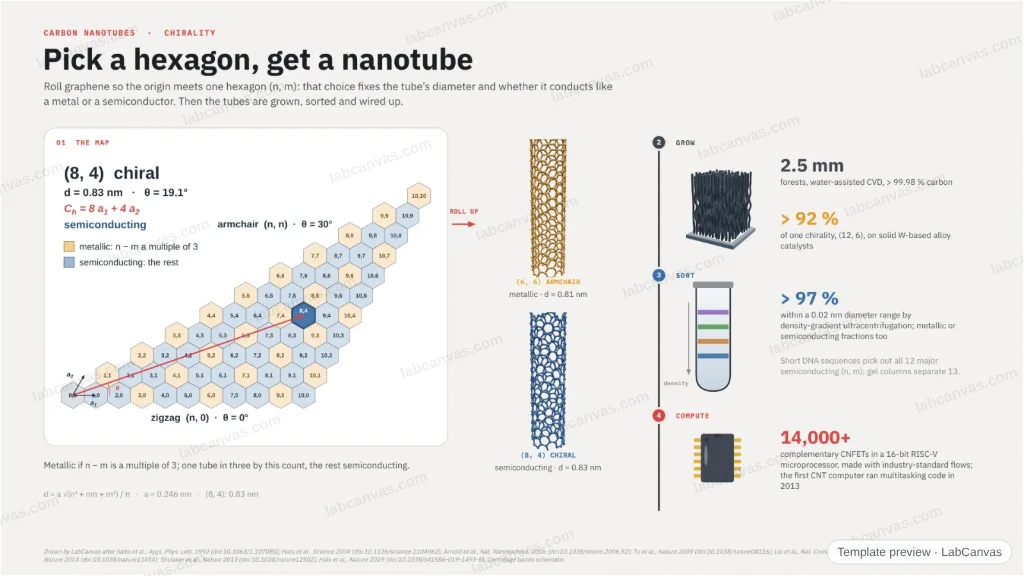
A graphical abstract read off the nanotube chirality map: each hexagon of graphene names the (n, m) tube made by rolling the sheet, metallic or semiconducting. Live 3D tubes show the roll-up; a rail of stations follows the tubes as they grow in vertically aligned forests and on chirality-selective catalysts, are sorted by density gradients, DNA and gel columns, and end up in the first nanotube computer and a 14,000-transistor RISC-V microprocessor.
Updated 9 cited papers47 editable layers
At a glance
- Category
- Graphical abstracts
- Method
- Graphical abstract
- Starting materials
- A graphene sheet, rolled up along a chiral vector Cₕ = n a₁ + m a₂
- Product
- Single-walled carbon nanotubes of chosen (n, m), grown, sorted and wired into logic
- Key result
- (12, 6) at > 92 % (Yang et al. 2014); > 97 % within 0.02 nm diameter (Arnold et al. 2006); 12 semiconducting species by DNA (Tu et al. 2009); > 14,000 CNFETs (Hills et al. 2019)
- Figure
- 1920 × 1080 px (16:9), 47 editable layers, 2 generated objects
Step by step
- RollThe wrapping (n, m) fixes diameter, chiral angle and whether a tube is metallic or semiconducting (Saito et al. 1992; Hamada et al. 1992; Yang et al. 2014)
- GrowWater-assisted CVD grows vertically aligned forests up to 2.5 mm tall at > 99.98 % carbon purity (Hata et al. 2004); solid W-based alloy catalysts grow (12, 6) tubes at > 92 % (Yang et al. 2014)
- SortDensity-gradient ultracentrifugation: > 97 % within a 0.02 nm diameter range, and metallic or semiconducting fractions (Arnold et al. 2006); DNA sequences purify all 12 major semiconducting species (Tu et al. 2009); gel columns separate 13 species (Liu et al. 2011)
- ComputeA computer built entirely from CNT transistors (Shulaker et al. 2013); a 16-bit RISC-V microprocessor of > 14,000 CNFETs (Hills et al. 2019)
Uses
- Graphical abstracts on carbon nanotube synthesis, sorting and electronics
- Teaching the chiral vector and the metallic/semiconducting rule
- Talks on beyond-silicon transistors
Papers this template follows
- Saito, Fujita, Dresselhaus & Dresselhaus, “Electronic structure of chiral graphene tubules”, Appl. Phys. Lett. 1992. doi:10.1063/1.107080method origin
- Hamada, Sawada & Oshiyama, “New one-dimensional conductors: graphitic microtubules”, Phys. Rev. Lett. 1992. doi:10.1103/PhysRevLett.68.1579primary
- Hata et al., “Water-assisted highly efficient synthesis of impurity-free single-walled carbon nanotubes”, Science 2004. doi:10.1126/science.1104962primary
- Yang et al., “Chirality-specific growth of single-walled carbon nanotubes on solid alloy catalysts”, Nature 2014. doi:10.1038/nature13434primary
- Arnold et al., “Sorting carbon nanotubes by electronic structure using density differentiation”, Nat. Nanotechnol. 2006. doi:10.1038/nnano.2006.52primary
- Tu et al., “DNA sequence motifs for structure-specific recognition and separation of carbon nanotubes”, Nature 2009. doi:10.1038/nature08116primary
- Liu et al., “Large-scale single-chirality separation of single-wall carbon nanotubes by simple gel chromatography”, Nat. Commun. 2011. doi:10.1038/ncomms1313primary
- Shulaker et al., “Carbon nanotube computer”, Nature 2013. doi:10.1038/nature12502primary
- Hills et al., “Modern microprocessor built from complementary carbon nanotube transistors”, Nature 2019. doi:10.1038/s41586-019-1493-8primary
Drawn by LabCanvas after Saito et al., Appl. Phys. Lett. 1992 (doi:10.1063/1.107080); Hata et al., Science 2004 (doi:10.1126/science.1104962); Arnold et al., Nat. Nanotechnol. 2006 (doi:10.1038/nnano.2006.52); Tu et al., Nature 2009 (doi:10.1038/nature08116); Liu et al., Nat. Commun. 2011 (doi:10.1038/ncomms1313); Yang et al., Nature 2014 (doi:10.1038/nature13434); Shulaker et al., Nature 2013 (doi:10.1038/nature12502); Hills et al., Nature 2019 (doi:10.1038/s41586-019-1493-8). Centrifuge bands schematic.
How templates are written and checked: editorial guidelines.
Questions
What does the “Carbon nanotubes: chirality, growth and sorting, from the map to the chip” template show?
A graphical abstract read off the nanotube chirality map: each hexagon of graphene names the (n, m) tube made by rolling the sheet, metallic or semiconducting. Live 3D tubes show the roll-up; a rail of stations follows the tubes as they grow in vertically aligned forests and on chirality-selective catalysts, are sorted by density gradients, DNA and gel columns, and end up in the first nanotube computer and a 14,000-transistor RISC-V microprocessor.
What are the steps shown in “Carbon nanotubes: chirality, growth and sorting, from the map to the chip”?
1. Roll: The wrapping (n, m) fixes diameter, chiral angle and whether a tube is metallic or semiconducting (Saito et al. 1992; Hamada et al. 1992; Yang et al. 2014). 2. Grow: Water-assisted CVD grows vertically aligned forests up to 2.5 mm tall at > 99.98 % carbon purity (Hata et al. 2004); solid W-based alloy catalysts grow (12, 6) tubes at > 92 % (Yang et al. 2014). 3. Sort: Density-gradient ultracentrifugation: > 97 % within a 0.02 nm diameter range, and metallic or semiconducting fractions (Arnold et al. 2006); DNA sequences purify all 12 major semiconducting species (Tu et al. 2009); gel columns separate 13 species (Liu et al. 2011). 4. Compute: A computer built entirely from CNT transistors (Shulaker et al. 2013); a 16-bit RISC-V microprocessor of > 14,000 CNFETs (Hills et al. 2019).
What are the starting materials and the product?
Starting materials: A graphene sheet, rolled up along a chiral vector Cₕ = n a₁ + m a₂. Product: Single-walled carbon nanotubes of chosen (n, m), grown, sorted and wired into logic.
Which papers is “Carbon nanotubes: chirality, growth and sorting, from the map to the chip” based on?
Saito, Fujita, Dresselhaus & Dresselhaus, “Electronic structure of chiral graphene tubules”, Appl. Phys. Lett. 1992 (doi:10.1063/1.107080); Hamada, Sawada & Oshiyama, “New one-dimensional conductors: graphitic microtubules”, Phys. Rev. Lett. 1992 (doi:10.1103/PhysRevLett.68.1579); Hata et al., “Water-assisted highly efficient synthesis of impurity-free single-walled carbon nanotubes”, Science 2004 (doi:10.1126/science.1104962); Yang et al., “Chirality-specific growth of single-walled carbon nanotubes on solid alloy catalysts”, Nature 2014 (doi:10.1038/nature13434); Arnold et al., “Sorting carbon nanotubes by electronic structure using density differentiation”, Nat. Nanotechnol. 2006 (doi:10.1038/nnano.2006.52); Tu et al., “DNA sequence motifs for structure-specific recognition and separation of carbon nanotubes”, Nature 2009 (doi:10.1038/nature08116); Liu et al., “Large-scale single-chirality separation of single-wall carbon nanotubes by simple gel chromatography”, Nat. Commun. 2011 (doi:10.1038/ncomms1313); Shulaker et al., “Carbon nanotube computer”, Nature 2013 (doi:10.1038/nature12502); Hills et al., “Modern microprocessor built from complementary carbon nanotube transistors”, Nature 2019 (doi:10.1038/s41586-019-1493-8).
Can I edit the “Carbon nanotubes: chirality, growth and sorting, from the map to the chip” template?
Yes. Open it in the LabCanvas editor: all 47 layers are editable, including 2 generated objects (structures, plots, equipment) with their own settings. Change the text, colours and layout, then export PNG, TIFF or PDF at the width and DPI the journal asks for.
Do I need an account to use this template?
Not to view it here. To open and edit it, sign in to LabCanvas or create a free account (the free plan keeps up to 3 designs). Downloading the figure is part of LabCanvas Pro (US$19 a month or US$199 a year).