Graphical abstract template · Graphical abstracts · Graphical abstract
CO₂ electroreduction: the catalyst picks the product, the cell sets the rate
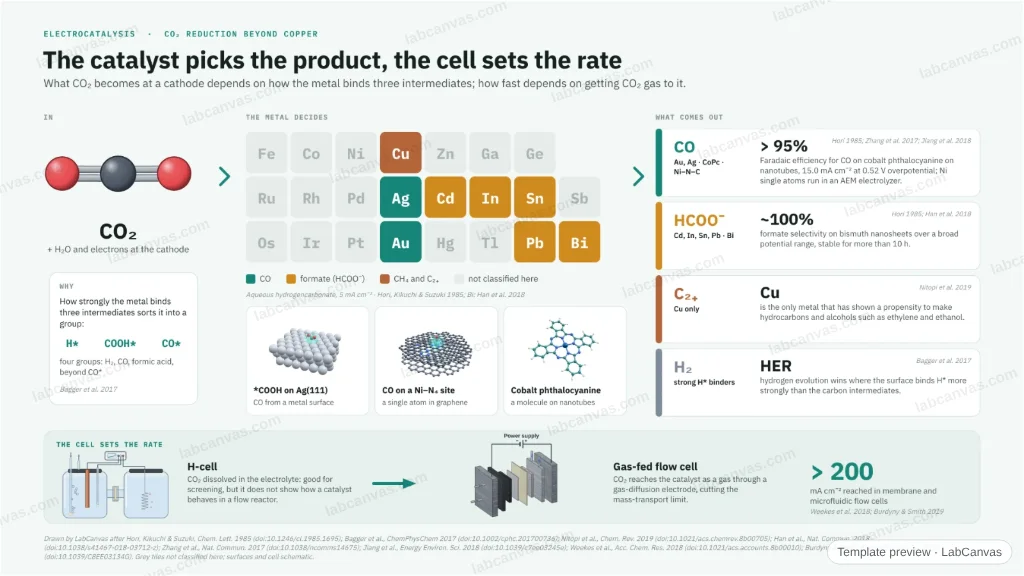
How the cathode decides what CO₂ becomes: gold and silver give CO, cadmium, indium, tin, lead and bismuth give formate, only copper goes on to hydrocarbons and alcohols, and where hydrogen binds too strongly H₂ wins — sorted by how strongly the metal binds H*, COOH* and CO*. Molecular and single-atom catalysts join the CO group (cobalt phthalocyanine on nanotubes above 95% Faradaic efficiency). Then the cell: feeding CO₂ as a gas in flow cells lifts current densities above 200 mA cm⁻².
Updated 8 cited papers126 editable layers
At a glance
- Category
- Graphical abstracts
- Method
- Graphical abstract
- Starting materials
- CO₂ and water, electrons from renewable power
- Product
- CO, formate, hydrocarbons and alcohols, or hydrogen — depending on the cathode
- Key result
- Product by metal at 5 mA cm⁻² (Hori et al. 1985); > 95% FE(CO), 15.0 mA cm⁻², TOF 4.1 s⁻¹ (Zhang et al. 2017); ~100% formate, > 10 h (Han et al. 2018); J > 200 mA cm⁻² in flow cells (Weekes et al. 2018)
- Figure
- 1920 × 1080 px (16:9), 126 editable layers, 3 generated objects
Step by step
- Sort by productAt 5 mA cm⁻², Ag and Au gave mainly CO, Cd, In, Sn and Pb mainly formate, and Cu made CH₄ (Hori et al. 1985)
- WhyThe adsorption energies of H*, COOH* and CO* sort metals into H₂, CO, formic-acid and beyond-CO* groups (Bagger et al. 2017)
- COCobalt phthalocyanine on nanotubes: > 95% Faradaic efficiency, 15.0 mA cm⁻² at 0.52 V overpotential (Zhang et al. 2017); Ni single atoms in an AEM electrolyzer (Jiang et al. 2018)
- FormateBismuth nanosheets: ~100% selectivity, stable > 10 h (Han et al. 2018)
- Beyond COOnly copper has shown a propensity for hydrocarbons and alcohols (Nitopi et al. 2019)
- The cellGas-fed flow cells avoid the mass-transport limits of H-cells and reach > 200 mA cm⁻² (Weekes et al. 2018); assess catalysts at such current densities (Burdyny & Smith 2019)
Uses
- Graphical abstracts on CO₂ electroreduction catalysts
- Talks comparing CO, formate and C₂₊ routes
- Teaching selectivity descriptors in electrocatalysis
Papers this template follows
- Hori, Kikuchi & Suzuki, “Production of CO and CH₄ in electrochemical reduction of CO₂ at metal electrodes in aqueous hydrogencarbonate solution”, Chem. Lett. 1985. doi:10.1246/cl.1985.1695primary
- Bagger, Ju, Varela, Strasser & Rossmeisl, “Electrochemical CO₂ reduction: a classification problem”, ChemPhysChem 2017. doi:10.1002/cphc.201700736primary
- Nitopi et al., “Progress and perspectives of electrochemical CO₂ reduction on copper in aqueous electrolyte”, Chem. Rev. 2019. doi:10.1021/acs.chemrev.8b00705review
- Han et al., “Ultrathin bismuth nanosheets from in situ topotactic transformation for selective electrocatalytic CO₂ reduction to formate”, Nat. Commun. 2018. doi:10.1038/s41467-018-03712-zprimary
- Zhang et al., “Highly selective and active CO₂ reduction electrocatalysts based on cobalt phthalocyanine/carbon nanotube hybrid structures”, Nat. Commun. 2017. doi:10.1038/ncomms14675primary
- Jiang et al., “Isolated Ni single atoms in graphene nanosheets for high-performance CO₂ reduction”, Energy Environ. Sci. 2018. doi:10.1039/c7ee03245eprimary
- Weekes, Salvatore, Reyes, Huang & Berlinguette, “Electrolytic CO₂ reduction in a flow cell”, Acc. Chem. Res. 2018. doi:10.1021/acs.accounts.8b00010review
- Burdyny & Smith, “CO₂ reduction on gas-diffusion electrodes and why catalytic performance must be assessed at commercially-relevant conditions”, Energy Environ. Sci. 2019. doi:10.1039/C8EE03134Greview
Drawn by LabCanvas after Hori, Kikuchi & Suzuki, Chem. Lett. 1985 (doi:10.1246/cl.1985.1695); Bagger et al., ChemPhysChem 2017 (doi:10.1002/cphc.201700736); Nitopi et al., Chem. Rev. 2019 (doi:10.1021/acs.chemrev.8b00705); Han et al., Nat. Commun. 2018 (doi:10.1038/s41467-018-03712-z); Zhang et al., Nat. Commun. 2017 (doi:10.1038/ncomms14675); Jiang et al., Energy Environ. Sci. 2018 (doi:10.1039/c7ee03245e); Weekes et al., Acc. Chem. Res. 2018 (doi:10.1021/acs.accounts.8b00010); Burdyny & Smith, Energy Environ. Sci. 2019 (doi:10.1039/C8EE03134G). Grey tiles not classified here; surfaces and cell schematic.
How templates are written and checked: editorial guidelines.
Questions
What does the “CO₂ electroreduction: the catalyst picks the product, the cell sets the rate” template show?
How the cathode decides what CO₂ becomes: gold and silver give CO, cadmium, indium, tin, lead and bismuth give formate, only copper goes on to hydrocarbons and alcohols, and where hydrogen binds too strongly H₂ wins — sorted by how strongly the metal binds H*, COOH* and CO*. Molecular and single-atom catalysts join the CO group (cobalt phthalocyanine on nanotubes above 95% Faradaic efficiency). Then the cell: feeding CO₂ as a gas in flow cells lifts current densities above 200 mA cm⁻².
What are the steps shown in “CO₂ electroreduction: the catalyst picks the product, the cell sets the rate”?
1. Sort by product: At 5 mA cm⁻², Ag and Au gave mainly CO, Cd, In, Sn and Pb mainly formate, and Cu made CH₄ (Hori et al. 1985). 2. Why: The adsorption energies of H*, COOH* and CO* sort metals into H₂, CO, formic-acid and beyond-CO* groups (Bagger et al. 2017). 3. CO: Cobalt phthalocyanine on nanotubes: > 95% Faradaic efficiency, 15.0 mA cm⁻² at 0.52 V overpotential (Zhang et al. 2017); Ni single atoms in an AEM electrolyzer (Jiang et al. 2018). 4. Formate: Bismuth nanosheets: ~100% selectivity, stable > 10 h (Han et al. 2018). 5. Beyond CO: Only copper has shown a propensity for hydrocarbons and alcohols (Nitopi et al. 2019). 6. The cell: Gas-fed flow cells avoid the mass-transport limits of H-cells and reach > 200 mA cm⁻² (Weekes et al. 2018); assess catalysts at such current densities (Burdyny & Smith 2019).
What are the starting materials and the product?
Starting materials: CO₂ and water, electrons from renewable power. Product: CO, formate, hydrocarbons and alcohols, or hydrogen — depending on the cathode.
Which papers is “CO₂ electroreduction: the catalyst picks the product, the cell sets the rate” based on?
Hori, Kikuchi & Suzuki, “Production of CO and CH₄ in electrochemical reduction of CO₂ at metal electrodes in aqueous hydrogencarbonate solution”, Chem. Lett. 1985 (doi:10.1246/cl.1985.1695); Bagger, Ju, Varela, Strasser & Rossmeisl, “Electrochemical CO₂ reduction: a classification problem”, ChemPhysChem 2017 (doi:10.1002/cphc.201700736); Nitopi et al., “Progress and perspectives of electrochemical CO₂ reduction on copper in aqueous electrolyte”, Chem. Rev. 2019 (doi:10.1021/acs.chemrev.8b00705); Han et al., “Ultrathin bismuth nanosheets from in situ topotactic transformation for selective electrocatalytic CO₂ reduction to formate”, Nat. Commun. 2018 (doi:10.1038/s41467-018-03712-z); Zhang et al., “Highly selective and active CO₂ reduction electrocatalysts based on cobalt phthalocyanine/carbon nanotube hybrid structures”, Nat. Commun. 2017 (doi:10.1038/ncomms14675); Jiang et al., “Isolated Ni single atoms in graphene nanosheets for high-performance CO₂ reduction”, Energy Environ. Sci. 2018 (doi:10.1039/c7ee03245e); Weekes, Salvatore, Reyes, Huang & Berlinguette, “Electrolytic CO₂ reduction in a flow cell”, Acc. Chem. Res. 2018 (doi:10.1021/acs.accounts.8b00010); Burdyny & Smith, “CO₂ reduction on gas-diffusion electrodes and why catalytic performance must be assessed at commercially-relevant conditions”, Energy Environ. Sci. 2019 (doi:10.1039/C8EE03134G).
Can I edit the “CO₂ electroreduction: the catalyst picks the product, the cell sets the rate” template?
Yes. Open it in the LabCanvas editor: all 126 layers are editable, including 3 generated objects (structures, plots, equipment) with their own settings. Change the text, colours and layout, then export PNG, TIFF or PDF at the width and DPI the journal asks for.
Do I need an account to use this template?
Not to view it here. To open and edit it, sign in to LabCanvas or create a free account (the free plan keeps up to 3 designs). Downloading the figure is part of LabCanvas Pro (US$19 a month or US$199 a year).