Graphical abstract template · Graphical abstracts · Graphical abstract
COF linkages: crystallise reversibly, then lock them in
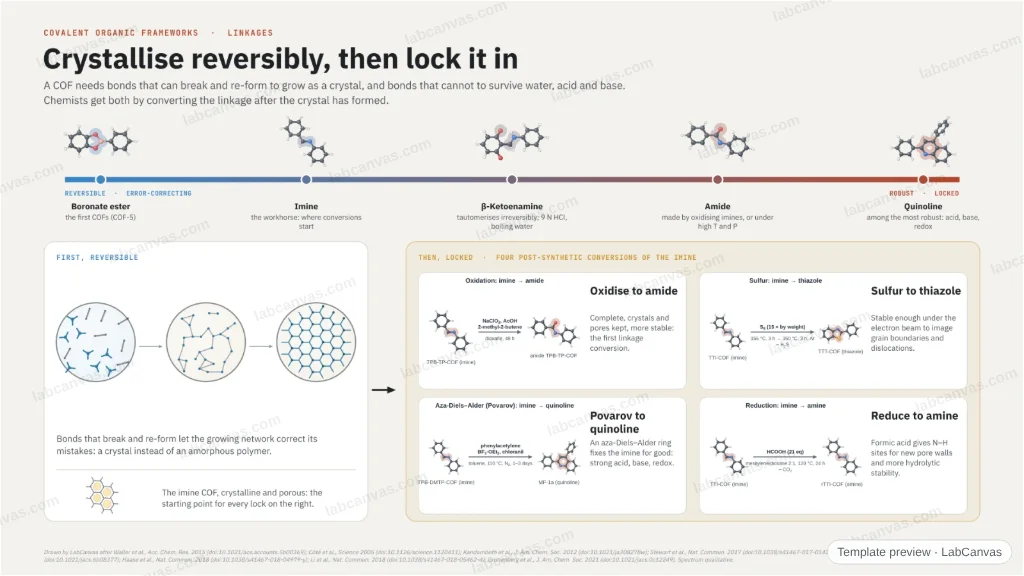
A spectrum of covalent-organic-framework linkages from reversible to robust (boronate ester, imine, β-ketoenamine, amide, quinoline), why COFs must first form through reversible bonds that heal their mistakes, and four ways to lock an imine COF afterwards with crystallinity kept: oxidation to amide, sulfur to thiazole, Povarov cycloaddition to quinoline and Leuckart–Wallach reduction to amine.
Updated 8 cited papers93 editable layers
At a glance
- Category
- Graphical abstracts
- Method
- Graphical abstract
- Starting materials
- Imine-linked 2D COFs (TPB-TP-COF, TTI-COF, TPB-DMTP-COF, PI-3-COF)
- Product
- Isostructural COFs with locked amide, thiazole, quinoline and amine linkages
- Key result
- Complete imine → amide oxidation (Waller et al. 2016); stable to 9 N HCl (Kandambeth et al. 2012); quinoline COFs stable to strong acid, base and redox (Li et al. 2018)
- Figure
- 1920 × 1080 px (16:9), 93 editable layers, 11 generated objects
Step by step
- Crystallise reversiblyCrystals come from balancing the reversibility of the linking reaction against its kinetics (Waller et al. 2015); reversible bonds allow the error checking that lets a network crystallise (Stewart et al. 2017)
- Lock as it formsTp-based enol-imines tautomerise irreversibly to β-ketoenamines that survive 9 N HCl and boiling water (Kandambeth et al. 2012)
- Oxidise to amideImine COFs oxidised completely to amides, crystallinity and porosity retained, with improved chemical stability: the first COF linkage conversion (Waller et al. 2016)
- Sulfur to thiazoleFull retention of crystallinity and porosity; chemical and electron-beam stability good enough to image grain boundaries and edge dislocations (Haase et al. 2018)
- Povarov to quinolineAza-Diels–Alder cycloaddition fixes the imine kinetically: among the most robust COFs, withstanding strong acid, base and redox conditions (Li et al. 2018)
- Reduce to amineLeuckart–Wallach reduction with formic acid gives crystalline amine COFs with increased hydrolytic stability and N–H sites for pore-wall modification (Grunenberg et al. 2021)
Uses
- Graphical abstracts on COF linkage chemistry and post-synthetic locking
- Talks on stability of crystalline porous polymers
- Teaching dynamic covalent chemistry and error correction
Papers this template follows
- Waller, Gándara & Yaghi, “Chemistry of covalent organic frameworks”, Acc. Chem. Res. 2015. doi:10.1021/acs.accounts.5b00369review
- Côté et al., “Porous, crystalline, covalent organic frameworks”, Science 2005. doi:10.1126/science.1120411method origin
- Kandambeth et al., “Construction of crystalline 2D covalent organic frameworks with remarkable chemical (acid/base) stability via a combined reversible and irreversible route”, J. Am. Chem. Soc. 2012. doi:10.1021/ja308278wprimary
- Stewart et al., “Stable and ordered amide frameworks synthesised under reversible conditions which facilitate error checking”, Nat. Commun. 2017. doi:10.1038/s41467-017-01423-5primary
- Waller et al., “Chemical conversion of linkages in covalent organic frameworks”, J. Am. Chem. Soc. 2016. doi:10.1021/jacs.6b08377primary
- Haase et al., “Topochemical conversion of an imine- into a thiazole-linked covalent organic framework enabling real structure analysis”, Nat. Commun. 2018. doi:10.1038/s41467-018-04979-yprimary
- Li et al., “Facile transformation of imine covalent organic frameworks into ultrastable crystalline porous aromatic frameworks”, Nat. Commun. 2018. doi:10.1038/s41467-018-05462-4primary
- Grunenberg et al., “Amine-linked covalent organic frameworks as a platform for postsynthetic structure interconversion and pore-wall modification”, J. Am. Chem. Soc. 2021. doi:10.1021/jacs.0c12249primary
Drawn by LabCanvas after Waller et al., Acc. Chem. Res. 2015 (doi:10.1021/acs.accounts.5b00369); Côté et al., Science 2005 (doi:10.1126/science.1120411); Kandambeth et al., J. Am. Chem. Soc. 2012 (doi:10.1021/ja308278w); Stewart et al., Nat. Commun. 2017 (doi:10.1038/s41467-017-01423-5); Waller et al., J. Am. Chem. Soc. 2016 (doi:10.1021/jacs.6b08377); Haase et al., Nat. Commun. 2018 (doi:10.1038/s41467-018-04979-y); Li et al., Nat. Commun. 2018 (doi:10.1038/s41467-018-05462-4); Grunenberg et al., J. Am. Chem. Soc. 2021 (doi:10.1021/jacs.0c12249). Spectrum qualitative.
How templates are written and checked: editorial guidelines.
Questions
What does the “COF linkages: crystallise reversibly, then lock them in” template show?
A spectrum of covalent-organic-framework linkages from reversible to robust (boronate ester, imine, β-ketoenamine, amide, quinoline), why COFs must first form through reversible bonds that heal their mistakes, and four ways to lock an imine COF afterwards with crystallinity kept: oxidation to amide, sulfur to thiazole, Povarov cycloaddition to quinoline and Leuckart–Wallach reduction to amine.
What are the steps shown in “COF linkages: crystallise reversibly, then lock them in”?
1. Crystallise reversibly: Crystals come from balancing the reversibility of the linking reaction against its kinetics (Waller et al. 2015); reversible bonds allow the error checking that lets a network crystallise (Stewart et al. 2017). 2. Lock as it forms: Tp-based enol-imines tautomerise irreversibly to β-ketoenamines that survive 9 N HCl and boiling water (Kandambeth et al. 2012). 3. Oxidise to amide: Imine COFs oxidised completely to amides, crystallinity and porosity retained, with improved chemical stability: the first COF linkage conversion (Waller et al. 2016). 4. Sulfur to thiazole: Full retention of crystallinity and porosity; chemical and electron-beam stability good enough to image grain boundaries and edge dislocations (Haase et al. 2018). 5. Povarov to quinoline: Aza-Diels–Alder cycloaddition fixes the imine kinetically: among the most robust COFs, withstanding strong acid, base and redox conditions (Li et al. 2018). 6. Reduce to amine: Leuckart–Wallach reduction with formic acid gives crystalline amine COFs with increased hydrolytic stability and N–H sites for pore-wall modification (Grunenberg et al. 2021).
What are the starting materials and the product?
Starting materials: Imine-linked 2D COFs (TPB-TP-COF, TTI-COF, TPB-DMTP-COF, PI-3-COF). Product: Isostructural COFs with locked amide, thiazole, quinoline and amine linkages.
Which papers is “COF linkages: crystallise reversibly, then lock them in” based on?
Waller, Gándara & Yaghi, “Chemistry of covalent organic frameworks”, Acc. Chem. Res. 2015 (doi:10.1021/acs.accounts.5b00369); Côté et al., “Porous, crystalline, covalent organic frameworks”, Science 2005 (doi:10.1126/science.1120411); Kandambeth et al., “Construction of crystalline 2D covalent organic frameworks with remarkable chemical (acid/base) stability via a combined reversible and irreversible route”, J. Am. Chem. Soc. 2012 (doi:10.1021/ja308278w); Stewart et al., “Stable and ordered amide frameworks synthesised under reversible conditions which facilitate error checking”, Nat. Commun. 2017 (doi:10.1038/s41467-017-01423-5); Waller et al., “Chemical conversion of linkages in covalent organic frameworks”, J. Am. Chem. Soc. 2016 (doi:10.1021/jacs.6b08377); Haase et al., “Topochemical conversion of an imine- into a thiazole-linked covalent organic framework enabling real structure analysis”, Nat. Commun. 2018 (doi:10.1038/s41467-018-04979-y); Li et al., “Facile transformation of imine covalent organic frameworks into ultrastable crystalline porous aromatic frameworks”, Nat. Commun. 2018 (doi:10.1038/s41467-018-05462-4); Grunenberg et al., “Amine-linked covalent organic frameworks as a platform for postsynthetic structure interconversion and pore-wall modification”, J. Am. Chem. Soc. 2021 (doi:10.1021/jacs.0c12249).
Can I edit the “COF linkages: crystallise reversibly, then lock them in” template?
Yes. Open it in the LabCanvas editor: all 93 layers are editable, including 11 generated objects (structures, plots, equipment) with their own settings. Change the text, colours and layout, then export PNG, TIFF or PDF at the width and DPI the journal asks for.
Do I need an account to use this template?
Not to view it here. To open and edit it, sign in to LabCanvas or create a free account (the free plan keeps up to 3 designs). Downloading the figure is part of LabCanvas Pro (US$19 a month or US$199 a year).