Graphical abstract template · Graphical abstracts · Graphical abstract
Controlled radical polymerisation: ATRP, RAFT and the architectures they build
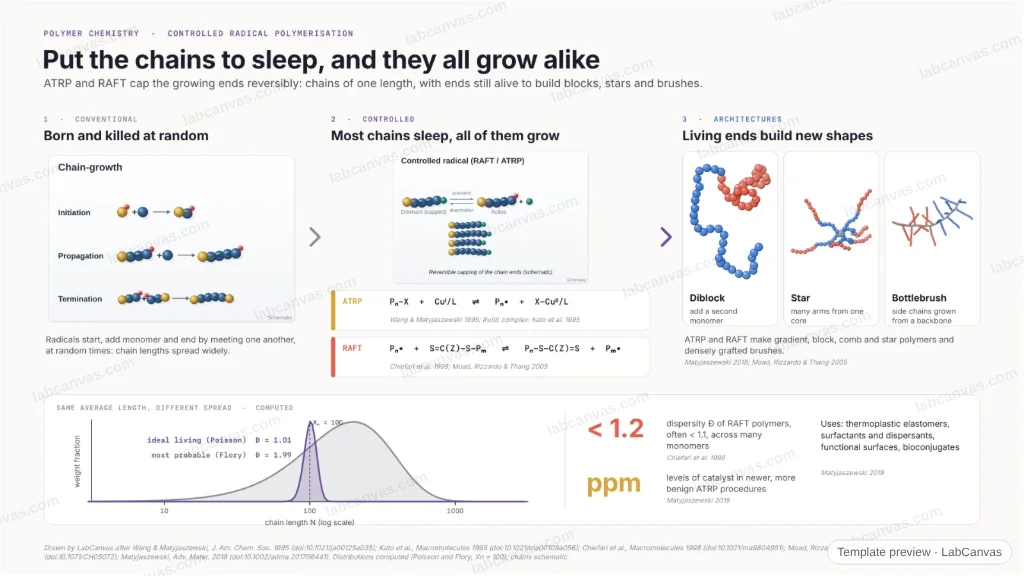
Why ATRP and RAFT give polymers of one length and new shapes. In a conventional radical polymerisation chains start and terminate at random; in ATRP a copper (or ruthenium) complex and in RAFT a thiocarbonylthio agent cap the growing ends reversibly, so most chains sleep and all grow together — dispersities usually below 1.2. The ends stay alive, so a second monomer makes a block, and many arms or side chains make stars and bottlebrushes. A computed Poisson versus Flory distribution at the same length shows the difference.
Updated 5 cited papers69 editable layers
At a glance
- Category
- Graphical abstracts
- Method
- Graphical abstract
- Starting materials
- A vinyl monomer, an initiator and a control agent (a Cu or Ru complex with an alkyl halide for ATRP; a thiocarbonylthio compound for RAFT)
- Product
- Chains of one length with living ends: blocks, stars, combs and brushes
- Key result
- Đ usually < 1.2 (Chiefari et al. 1998); ppm-level ATRP catalysts (Matyjaszewski 2018); Poisson Đ = 1.01 vs Flory Đ = 1.99 at Xn = 100 (computed)
- Figure
- 1920 × 1080 px (16:9), 69 editable layers, 5 generated objects
Step by step
- ConventionalRadicals start, grow and terminate at random, so chain lengths spread widely (a most-probable distribution has Đ ≈ 2, computed)
- ATRPA transition-metal complex moves a halogen atom on and off the chain end: Pₙ–X + Cuᴵ/L ⇌ Pₙ• + X–Cuᴵᴵ/L (Wang & Matyjaszewski 1995; Kato et al. 1995)
- RAFTA thiocarbonylthio agent swaps between chains by addition–fragmentation; dispersities usually < 1.2, sometimes < 1.1 (Chiefari et al. 1998)
- ArchitecturesLiving ends give gradient, block, comb and star polymers and densely grafted brushes (Matyjaszewski 2018; Moad, Rizzardo & Thang 2005)
Uses
- Graphical abstracts on polymer synthesis
- Teaching living and controlled radical polymerisation
- Talks on block copolymers, stars and brushes
Papers this template follows
- Wang & Matyjaszewski, “Controlled/“living” radical polymerization. Atom transfer radical polymerization in the presence of transition-metal complexes”, J. Am. Chem. Soc. 1995. doi:10.1021/ja00125a035primary
- Kato, Kamigaito, Sawamoto & Higashimura, “Polymerization of methyl methacrylate with the carbon tetrachloride/dichlorotris(triphenylphosphine)ruthenium(II)/methylaluminum bis(2,6-di-tert-butylphenoxide) initiating system: possibility of living radical polymerization”, Macromolecules 1995. doi:10.1021/ma00109a056primary
- Chiefari et al., “Living free-radical polymerization by reversible addition–fragmentation chain transfer: the RAFT process”, Macromolecules 1998. doi:10.1021/ma9804951primary
- Moad, Rizzardo & Thang, “Living radical polymerization by the RAFT process”, Aust. J. Chem. 2005. doi:10.1071/CH05072review
- Matyjaszewski, “Advanced materials by atom transfer radical polymerization”, Adv. Mater. 2018. doi:10.1002/adma.201706441review
Drawn by LabCanvas after Wang & Matyjaszewski, J. Am. Chem. Soc. 1995 (doi:10.1021/ja00125a035); Kato et al., Macromolecules 1995 (doi:10.1021/ma00109a056); Chiefari et al., Macromolecules 1998 (doi:10.1021/ma9804951); Moad, Rizzardo & Thang, Aust. J. Chem. 2005 (doi:10.1071/CH05072); Matyjaszewski, Adv. Mater. 2018 (doi:10.1002/adma.201706441). Distributions computed (Poisson and Flory, Xn = 100); chains schematic.
How templates are written and checked: editorial guidelines.
Questions
What does the “Controlled radical polymerisation: ATRP, RAFT and the architectures they build” template show?
Why ATRP and RAFT give polymers of one length and new shapes. In a conventional radical polymerisation chains start and terminate at random; in ATRP a copper (or ruthenium) complex and in RAFT a thiocarbonylthio agent cap the growing ends reversibly, so most chains sleep and all grow together — dispersities usually below 1.2. The ends stay alive, so a second monomer makes a block, and many arms or side chains make stars and bottlebrushes. A computed Poisson versus Flory distribution at the same length shows the difference.
What are the steps shown in “Controlled radical polymerisation: ATRP, RAFT and the architectures they build”?
1. Conventional: Radicals start, grow and terminate at random, so chain lengths spread widely (a most-probable distribution has Đ ≈ 2, computed). 2. ATRP: A transition-metal complex moves a halogen atom on and off the chain end: Pₙ–X + Cuᴵ/L ⇌ Pₙ• + X–Cuᴵᴵ/L (Wang & Matyjaszewski 1995; Kato et al. 1995). 3. RAFT: A thiocarbonylthio agent swaps between chains by addition–fragmentation; dispersities usually < 1.2, sometimes < 1.1 (Chiefari et al. 1998). 4. Architectures: Living ends give gradient, block, comb and star polymers and densely grafted brushes (Matyjaszewski 2018; Moad, Rizzardo & Thang 2005).
What are the starting materials and the product?
Starting materials: A vinyl monomer, an initiator and a control agent (a Cu or Ru complex with an alkyl halide for ATRP; a thiocarbonylthio compound for RAFT). Product: Chains of one length with living ends: blocks, stars, combs and brushes.
Which papers is “Controlled radical polymerisation: ATRP, RAFT and the architectures they build” based on?
Wang & Matyjaszewski, “Controlled/“living” radical polymerization. Atom transfer radical polymerization in the presence of transition-metal complexes”, J. Am. Chem. Soc. 1995 (doi:10.1021/ja00125a035); Kato, Kamigaito, Sawamoto & Higashimura, “Polymerization of methyl methacrylate with the carbon tetrachloride/dichlorotris(triphenylphosphine)ruthenium(II)/methylaluminum bis(2,6-di-tert-butylphenoxide) initiating system: possibility of living radical polymerization”, Macromolecules 1995 (doi:10.1021/ma00109a056); Chiefari et al., “Living free-radical polymerization by reversible addition–fragmentation chain transfer: the RAFT process”, Macromolecules 1998 (doi:10.1021/ma9804951); Moad, Rizzardo & Thang, “Living radical polymerization by the RAFT process”, Aust. J. Chem. 2005 (doi:10.1071/CH05072); Matyjaszewski, “Advanced materials by atom transfer radical polymerization”, Adv. Mater. 2018 (doi:10.1002/adma.201706441).
Can I edit the “Controlled radical polymerisation: ATRP, RAFT and the architectures they build” template?
Yes. Open it in the LabCanvas editor: all 69 layers are editable, including 5 generated objects (structures, plots, equipment) with their own settings. Change the text, colours and layout, then export PNG, TIFF or PDF at the width and DPI the journal asks for.
Do I need an account to use this template?
Not to view it here. To open and edit it, sign in to LabCanvas or create a free account (the free plan keeps up to 3 designs). Downloading the figure is part of LabCanvas Pro (US$19 a month or US$199 a year).